
For shift workers, achieving quality sleep during daylight hours is one of the most persistent challenges. Natural sunlight signals the brain to stay alert, making it difficult to fall and stay asleep when your schedule runs counter to the sun’s rhythm. Two popular solutions—blackout curtains and sleep masks—are frequently recommended, but each serves a different purpose and comes with distinct advantages and limitations. Choosing between them isn’t just about preference; it’s about understanding how each tool affects sleep hygiene, circadian alignment, and long-term well-being.
This article examines both blackout curtains and sleep masks in depth, comparing their effectiveness, comfort, cost, and impact on overall sleep quality. Whether you're a nurse, truck driver, factory employee, or work any non-traditional shift, this guide will help you make an informed decision—and even show how combining both tools may offer the best solution.
The Science of Light and Sleep Disruption
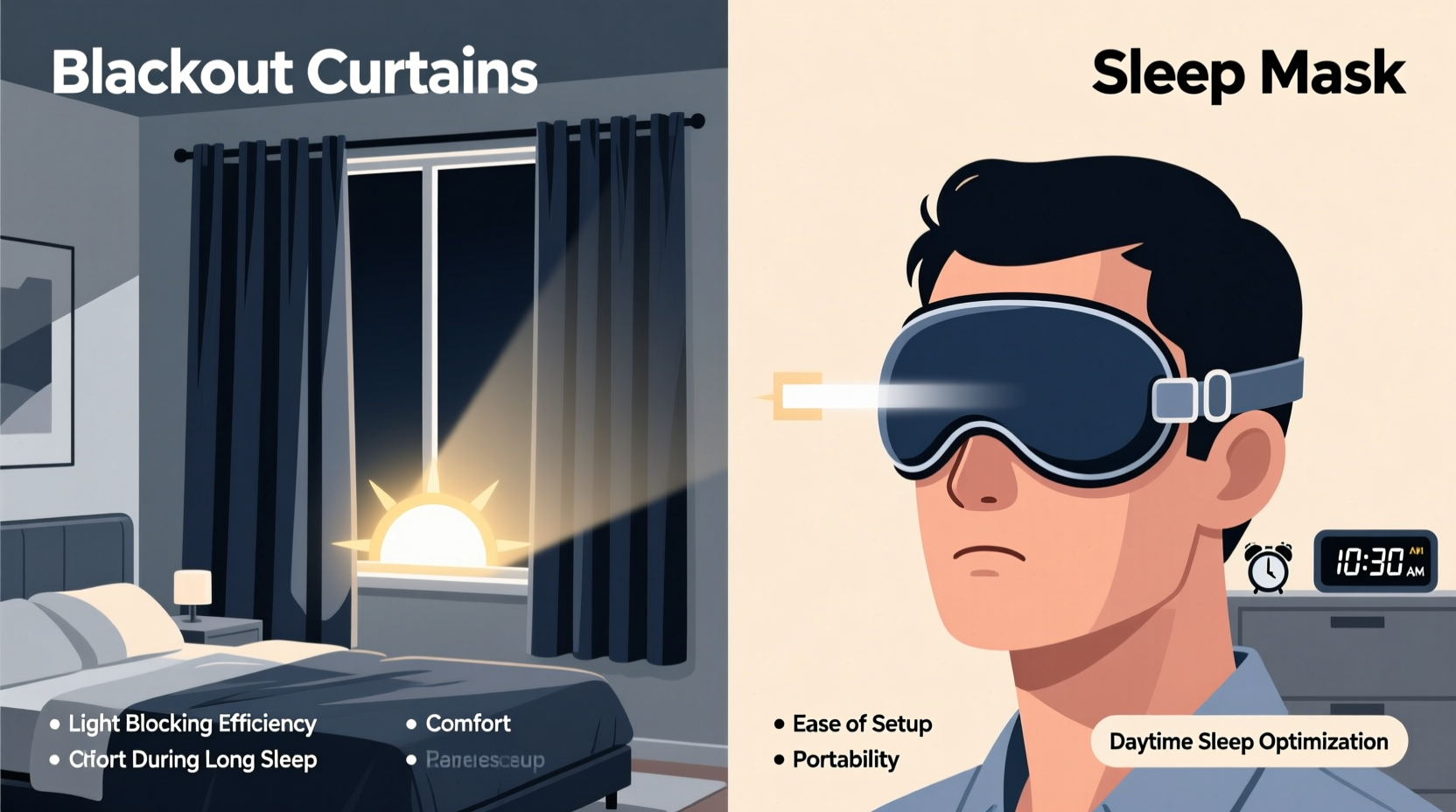
Light is the most powerful external cue influencing our circadian rhythm—the internal 24-hour clock that regulates sleep-wake cycles. When light enters the eyes, especially blue wavelengths from the sun or artificial sources, it suppresses melatonin production, the hormone responsible for signaling sleepiness. For day-sleeping shift workers, exposure to morning or midday sunlight can delay or prevent melatonin release, leading to fragmented, shallow, or insufficient sleep.
According to the National Institute of Occupational Safety and Health (NIOSH), shift workers are three times more likely to experience insomnia and report significantly lower sleep efficiency compared to daytime workers. One of the primary contributors? Ambient light exposure during sleep hours.
“Controlling light exposure is critical for shift workers. Even small amounts of light leaking into a bedroom can disrupt melatonin levels and reduce REM sleep.” — Dr. Lena Torres, Sleep Neurologist, Johns Hopkins Center for Sleep Disorders
Effective light management isn’t optional—it’s essential. That’s where blackout curtains and sleep masks come in. But they operate in fundamentally different ways.
Blackout Curtains: Room-Wide Darkness
Blackout curtains are thick, tightly woven window treatments designed to block 95–100% of incoming light. Unlike regular curtains or blinds, they often feature multiple layers, including foam backing or thermal lining, to enhance insulation and light-blocking performance.
When properly installed, blackout curtains transform a bedroom into a dark, cave-like environment ideal for daytime sleep. They work passively—once hung, they require no daily effort. This makes them particularly effective for people who share a room or prefer not to wear anything over their face while sleeping.
Advantages of Blackout Curtains
- Whole-room coverage: Everyone in the room benefits, making them ideal for couples or families.
- No physical contact: No need to wear anything on your face, which some find uncomfortable or restrictive.
- Thermal and noise insulation: Many blackout curtains also reduce heat transfer and dampen outside noise.
- Consistent use: Once installed, they’re always “on,” eliminating the risk of forgetting to use them.
Drawbacks of Blackout Curtains
- Installation required: May involve drilling, mounting hardware, and precise measuring.
- Cost: High-quality panels range from $30 to $100+ per pair.
- Portability: Not practical for travel, dorms, or temporary housing.
- Gaps: Poorly fitted curtains may still allow light through edges or top gaps.
Sleep Masks: Personalized Light Blocking
A sleep mask is a soft, adjustable fabric band worn over the eyes to block light. Modern versions often include contoured padding around the eyes to avoid eyelid pressure, breathable materials, and elastic straps for a secure fit.
Sleep masks are highly portable and inexpensive, typically costing between $5 and $25. They are favored by travelers, hotel guests, and those in shared or noisy environments where modifying the room isn’t possible.
For shift workers living in apartments with large windows, thin walls, or roommates, a sleep mask offers a low-barrier entry point to darkness without altering the space.
Advantages of Sleep Masks
- Affordable: Most high-quality masks cost less than $20.
- Portable: Easy to carry in a bag or suitcase for work breaks or overnight stays.
- Customizable fit: Adjustable straps accommodate different head sizes and sleeping positions.
- Versatile: Can be used anywhere—home, car, plane, break room couch.
Drawbacks of Sleep Masks
- Comfort issues: Some users report pressure on the eyes, ear discomfort, or overheating.
- Displacement: Can slip off during movement, especially for side sleepers.
- Psychological barrier: Wearing something over the face may feel confining or trigger mild anxiety in some individuals.
- Inconsistent use: Must remember to put it on every time—easy to forget after a long shift.
Direct Comparison: Blackout Curtains vs Sleep Mask
| Feature | Blackout Curtains | Sleep Mask |
|---|---|---|
| Light Blocking | Blocks 95–100% of light in entire room | Blocks light directly in front of eyes only |
| Cost | $30–$100+ per window | $5–$25 |
| Portability | Not portable | Fits in pocket or bag |
| Comfort | No physical contact; natural feel | May cause pressure or slipping |
| Effect on Others | Benefits all room occupants | Only helps the wearer |
| Maintenance | Occasional washing; check for wear | Washable; replace every 6–12 months |
| Best For | Home use, shared rooms, long-term stability | Travel, rentals, single-user needs |
Real-World Example: A Nurse’s Experience
Maya, a 34-year-old ICU nurse working rotating night shifts in Chicago, struggled with poor daytime sleep for years. Her apartment faced east, flooding her bedroom with sunlight by 6:30 a.m., just as she was settling in for rest.
She first tried a $12 sleep mask. While it helped initially, she found it slipped off when she turned onto her side and disliked the feeling of fabric pressing against her eyelids. After two weeks, she stopped using it consistently.
Then, she invested in custom-fit blackout curtains. She measured her windows precisely, chose triple-weave fabric with side tracks, and sealed the top with adhesive strips. The difference was immediate. “It felt like nighttime all day,” she said. “I fell asleep 20 minutes faster and woke up less groggy.”
Eventually, Maya combined both: she kept the blackout curtains as her primary defense and now uses a lightweight silk sleep mask as a backup during summer months when early twilight creeps in. “The curtain is my foundation,” she explained. “The mask is my insurance policy.”
Step-by-Step: Optimizing Your Sleep Environment as a Shift Worker
- Assess your current sleep space: Enter your bedroom during peak daylight. Is it bright? Are there light leaks around windows, doors, or devices?
- Choose your primary light-blocking method: If you own or control your space, install blackout curtains. If renting or needing portability, start with a high-quality sleep mask.
- Install or test your solution: Hang curtains so they overlap and reach the floor. Test the mask for comfort in different sleeping positions.
- Add complementary tools: Use a white noise machine, set a consistent pre-sleep routine, and consider wearing blue-light-blocking glasses before bed.
- Combine both if needed: Use blackout curtains for ambient control and a sleep mask for total eye coverage, especially if you’re sensitive to subtle light changes.
Expert Insight: Why Layering Works Best
“The most successful shift workers don’t rely on a single fix. They layer strategies—environmental, behavioral, and physiological. Using both blackout curtains and a sleep mask is like double protection: one guards the room, the other guards the individual.” — Dr. Rajiv Mehta, Circadian Researcher, University of California, San Diego
Layering minimizes failure points. A power outage might disable a fan or air conditioner, but passive solutions like curtains and masks remain effective. Similarly, if a partner turns on a lamp, a sleep mask ensures you’re not instantly awakened.
Frequently Asked Questions
Can I use regular curtains instead of blackout ones?
Standard curtains block only 20–50% of light, which is often enough to interfere with melatonin. True blackout curtains are specifically engineered with dense, opaque materials to prevent nearly all light transmission. For shift workers, regular curtains are usually insufficient.
Are silk sleep masks better than cotton?
Silk masks are smoother, reduce friction on skin and eyelashes, and tend to feel cooler. However, the material matters less than fit and design. Look for contoured eye space, adjustable straps, and breathable fabric regardless of material.
Do blackout curtains help with noise too?
Yes, many blackout curtains have sound-dampening properties due to their thickness and layered construction. While not a substitute for proper soundproofing, they can reduce outside noise by 30–50%, contributing to a quieter sleep environment.
Checklist: Choosing the Right Solution for You
- ☐ Do you own or rent your home? (Ownership favors curtains)
- ☐ Do you share the bedroom? (Shared space favors curtains)
- ☐ Do you travel frequently for work? (Frequent travel favors masks)
- ☐ Are you a side sleeper? (Side sleepers may prefer masks that stay in place)
- ☐ Is your bedroom exposed to direct sunlight? (High exposure demands strong curtains)
- ☐ Do you dislike things touching your face? (Face sensitivity favors curtains)
- ☐ Are you on a tight budget? (Masks offer immediate, low-cost relief)
Conclusion: Match the Tool to Your Lifestyle
There’s no universal answer to whether blackout curtains or sleep masks are better for shift workers. The right choice depends on your living situation, comfort preferences, budget, and consistency. Blackout curtains offer a permanent, whole-room solution ideal for stable home environments. Sleep masks provide flexibility and affordability, perfect for renters, travelers, or those testing sleep improvements.
The most effective approach, however, is often integration. Use blackout curtains as the foundation of your sleep sanctuary and keep a sleep mask as a backup for extra assurance. Pair either—or both—with good sleep hygiene: consistent schedules, limited screen time before bed, and a cool, quiet room.




 浙公网安备
33010002000092号
浙公网安备
33010002000092号 浙B2-20120091-4
Comments
No comments yet. Why don't you start the discussion?