
The term blitzkrieg, German for “lightning war,” became synonymous with rapid, overwhelming military offensives during the early years of World War II. Though not an official doctrine in the German military manual, blitzkrieg emerged as a highly effective operational model that combined speed, surprise, and coordinated force to dismantle enemy defenses before they could respond. This approach allowed Nazi Germany to conquer much of Europe in record time. Understanding what blitzkrieg was, how it functioned, and why it succeeded offers critical insights into the evolution of modern warfare.
What Was Blitzkrieg?
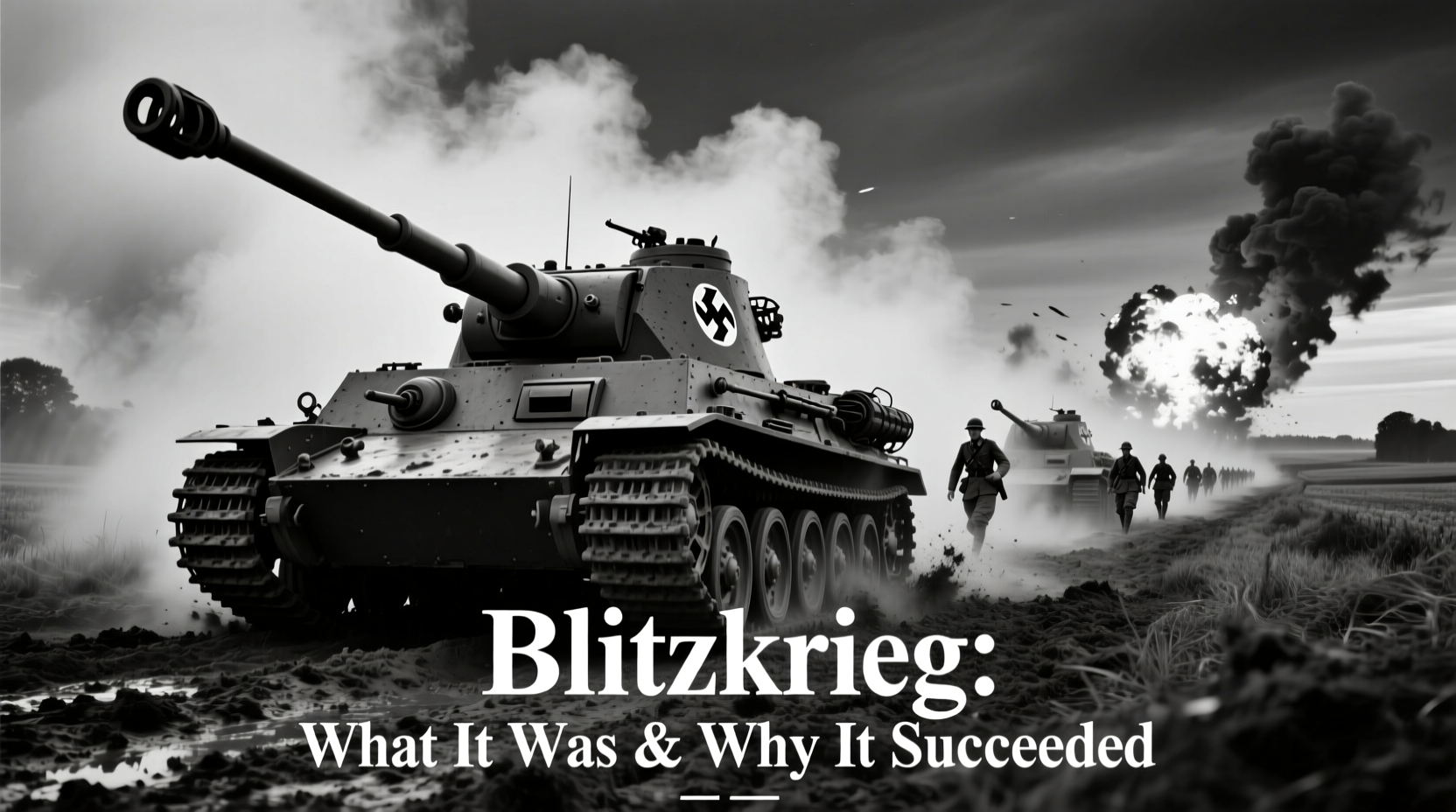
Blitzkrieg was not a formal military strategy but rather a label applied—both by journalists and historians—to describe the German method of warfare that emphasized rapid movement, concentrated force, and psychological disruption. The core idea was to break through enemy lines at weak points, then exploit those breaches with fast-moving armored units supported by air power and motorized infantry. Unlike the static trench warfare of World War I, blitzkrieg relied on momentum and continuous pressure to prevent the enemy from regrouping.
The concept drew from earlier military theories, including those of British strategist J.F.C. Fuller and German general Heinz Guderian, who championed the use of tanks not as infantry support but as independent striking forces. When implemented during the invasions of Poland (1939), France (1940), and the Soviet Union (1941), this approach delivered stunning victories against numerically superior or well-fortified opponents.
“Victory in modern war does not come from attrition, but from paralysis—the sudden collapse of the enemy’s will and ability to resist.” — Heinz Guderian, Achtung – Panzer! (1937)
Key Components of the Lightning War Strategy
Blitzkrieg succeeded due to its integration of multiple military elements into a unified, fast-paced system. These components worked in concert to create chaos and disorganization behind enemy lines:
- Armor Concentration: Tanks were massed into panzer divisions rather than dispersed among infantry units, allowing them to punch through enemy defenses at decisive points.
- Air Superiority: The Luftwaffe provided close air support, targeting command centers, supply depots, and troop concentrations to disrupt coordination.
- Mobility: Motorized infantry followed tanks to secure captured territory and protect flanks, maintaining the offensive’s momentum.
- Radio Communication: German units used real-time radio communication to adapt quickly to battlefield developments, giving them a command advantage over slower-reacting enemies.
- Psychological Shock: Speed and unpredictability created panic, often causing entire units to surrender or retreat without direct engagement.
Why Did Blitzkrieg Succeed in Early WWII Campaigns?
The effectiveness of blitzkrieg stemmed from a combination of German innovation and Allied unpreparedness. Several factors contributed to its early success:
Tactical Innovation vs. Outdated Doctrine
While Germany embraced mobile warfare, many European armies—including France and Britain—still operated under World War I assumptions. The French Maginot Line, for example, was a static defense system designed to repel frontal assaults, but it left the Ardennes Forest lightly guarded. German forces exploited this gap in May 1940, driving armored columns through what was considered impassable terrain and encircling Allied troops in Belgium.
Speed and Surprise
By bypassing strongpoints and pushing deep into enemy rear areas, German forces disrupted supply lines and severed communication. Commanders often found themselves cut off from their units, unable to issue orders. This confusion led to rapid collapses, even when overall troop numbers favored the Allies.
Integrated Command Structure
German officers were trained to exercise initiative within the broader intent of their superiors—a principle known as *Auftragstaktik* (mission-type tactics). This decentralized decision-making allowed frontline commanders to react swiftly without waiting for higher approval, a stark contrast to the rigid hierarchies in Allied chains of command.
Allied Underestimation
Many Western military leaders dismissed the possibility of large-scale mechanized operations. They assumed tanks were vulnerable without infantry support and that fuel logistics would limit deep advances. Germany proved otherwise by synchronizing resupply efforts and prioritizing breakthrough objectives over territorial control.
| Factor | German Advantage | Allied Weakness |
|---|---|---|
| Mobility | Massed panzer divisions with motorized support | Infantry-dependent, slow deployment |
| Air Support | Close coordination between Stuka dive bombers and ground units | Limited tactical air-ground integration |
| Command Flexibility | Mission-oriented leadership (*Auftragstaktik*) | Rigid top-down orders |
| Strategic Surprise | Exploited perceived weak zones (e.g., Ardennes) | Over-reliance on fixed fortifications |
Case Study: The Fall of France (1940)
The German invasion of France in May 1940 remains the most iconic example of blitzkrieg in action. Instead of attacking the heavily fortified Maginot Line directly, Germany launched a feint through Belgium, drawing Allied forces northward. Meanwhile, the main thrust—led by General Erwin Rommel’s 7th Panzer Division—raced through the Ardennes and crossed the Meuse River at Sedan.
In just 48 hours, German armor broke through French lines. Within days, they reached the English Channel, cutting off over 400,000 Allied troops in Belgium. The British Expeditionary Force was evacuated from Dunkirk, but France surrendered six weeks after the campaign began. What stunned military observers was not just the speed, but the fact that Germany achieved victory with fewer tanks and aircraft than the Allies.
This campaign demonstrated that technological parity was less important than operational agility, strategic deception, and synchronized execution. It also exposed the fatal flaw of relying on static defenses in an era of mechanized mobility.
Limitations and Decline of Blitzkrieg
Despite its early triumphs, blitzkrieg had inherent limitations. Its success depended on short campaigns, predictable terrain, and logistical sustainability—all of which faltered as the war expanded.
The invasion of the Soviet Union in 1941 marked the beginning of blitzkrieg’s decline. While initial advances were rapid, the vast distances, poor roads, and harsh winter conditions crippled German supply lines. Soviet resistance stiffened, and the Red Army adopted scorched-earth tactics, denying the Germans access to resources. By the time German forces reached Moscow, they were exhausted, undersupplied, and vulnerable to counterattacks.
Additionally, as Allied air power grew, German convoys and armored columns became increasingly exposed to aerial bombardment. Without air cover and facing coordinated resistance, the blitzkrieg model lost its edge.
Frequently Asked Questions
Was blitzkrieg an official German military doctrine?
No. The term \"blitzkrieg\" was rarely used in official German military documents. It was popularized by Western media. German operations were based on established doctrines of maneuver warfare (*Bewegungskrieg*), enhanced by new technologies and command practices.
Could blitzkrieg have succeeded against the Soviet Union if timed differently?
Possibly, but structural issues remained. Even with an earlier start, the Wehrmacht lacked the logistical capacity to sustain prolonged operations across Russia’s vast geography. The failure at Stalingrad and the attritional nature of the Eastern Front ultimately overwhelmed the blitzkrieg model.
Is blitzkrieg still relevant in modern warfare?
Elements of blitzkrieg—speed, shock, and coordination—remain central to modern military doctrine. Contemporary operations, such as the U.S.-led invasion of Iraq in 2003, echoed blitzkrieg principles using precision airstrikes and rapid armored advances. However, today’s emphasis on cyber warfare, drones, and electronic warfare has evolved the concept beyond its 1940s form.
Actionable Checklist: Principles of Rapid Military Success
While blitzkrieg was a product of its time, its underlying principles offer lessons in strategic efficiency. Here’s a checklist applicable to both military and organizational planning:
- Concentrate resources at the point of greatest impact.
- Ensure seamless communication between units or departments.
- Empower frontline decision-makers with clear objectives and autonomy.
- Use speed to disrupt competitors’ response cycles.
- Combine multiple capabilities (e.g., digital, physical, informational) for synergistic effect.
- Anticipate logistical limits before committing to rapid expansion.
Conclusion: The Legacy of the Lightning War
Blitzkrieg redefined warfare by proving that speed and coordination could overcome size and fortification. Its successes in 1939–1941 shocked the world and forced a fundamental rethink of military strategy. Though it eventually failed due to overreach and logistical strain, its influence persists in modern doctrines emphasizing agility, surprise, and integrated operations.
Understanding blitzkrieg is not just about studying history—it’s about recognizing how innovation, timing, and execution can shift the balance of power. Whether in conflict, business, or crisis response, the lessons of the lightning war remind us that momentum, when properly harnessed, can be unstoppable.




 浙公网安备
33010002000092号
浙公网安备
33010002000092号 浙B2-20120091-4
Comments
No comments yet. Why don't you start the discussion?