
Negative thought patterns don’t appear out of nowhere. They’re often the result of repeated mental habits—automatic responses shaped by stress, past experiences, or ingrained beliefs. The good news? These patterns aren’t permanent. With intentional practice, you can interrupt them, reframe your thinking, and build a more resilient, balanced mindset. This isn’t about forced positivity; it’s about cultivating awareness, choice, and self-compassion in how you respond to your inner world.
Understanding Negative Thought Cycles
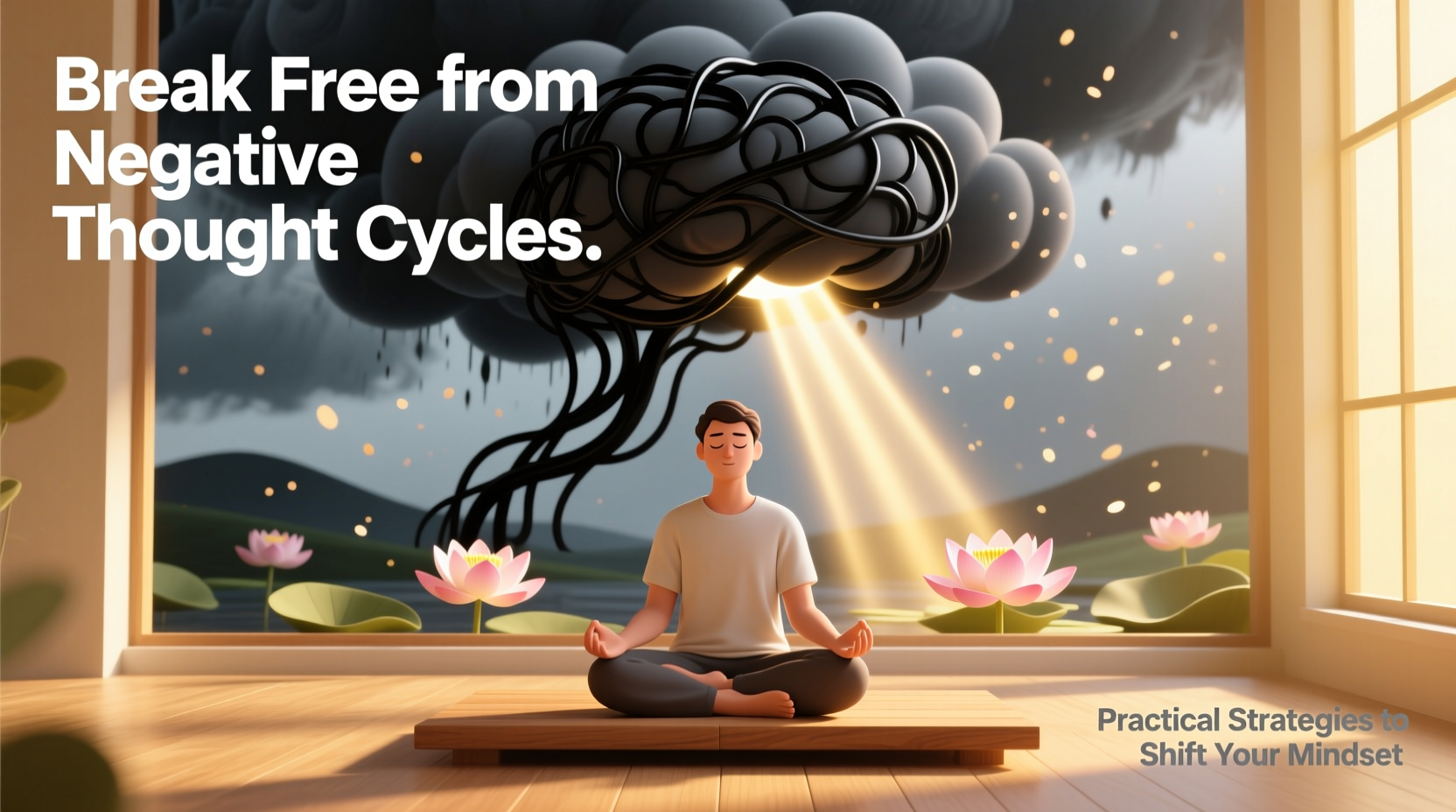
Negative thought cycles are repetitive loops of distressing thinking that reinforce themselves. One anxious thought leads to another, spiraling into rumination, catastrophizing, or self-criticism. For example: “I made a mistake at work” becomes “I’m incompetent,” which then escalates to “I’ll get fired and never find another job.” These cycles activate the brain’s threat response, making it harder to think clearly or act constructively.
Common types of cognitive distortions fuel these loops:
- Catastrophizing: Assuming the worst will happen.
- Mind reading: Believing you know what others are thinking—usually negatively.
- Overgeneralization: Taking one event as evidence of a universal pattern (“I failed once, so I always fail”).
- Black-and-white thinking: Seeing things as all good or all bad, with no middle ground.
The first step to breaking free is recognition. You can’t change what you don’t see.
A Step-by-Step Guide to Interrupting Negative Thinking
Breaking a cycle requires deliberate action. Here’s a five-step process grounded in cognitive behavioral therapy (CBT) principles:
- Pause and notice: When a negative thought arises, stop. Take one deep breath. Acknowledge the thought without reacting: “I’m having the thought that I’m not good enough.”
- Label the distortion: Ask: What type of distorted thinking is this? Is it catastrophizing? Overgeneralization? Naming it weakens its power.
- Challenge the evidence: Ask: What facts support this thought? What contradicts it? Would I say this to a friend?
- Reframe with balance: Replace the extreme thought with a more realistic one. Instead of “I ruined everything,” try “I made a mistake, but I can learn from it.”
- Shift attention: Engage in an activity that demands focus—cooking, walking, listening to music—to disengage from rumination.
This sequence takes less than two minutes when practiced regularly. Over time, it rewires automatic responses.
Practical Tools to Sustain a Healthier Mindset
Consistency matters. Use these tools daily to strengthen mental resilience:
Morning intention setting
Start your day by stating a simple intention: “Today, I will respond with patience,” or “I will notice my thoughts without believing all of them.” This sets a psychological anchor.
Thought substitution
Create a list of personalized affirmations based on real strengths. Not generic phrases like “I am perfect,” but grounded truths: “I’ve handled tough situations before,” or “I am capable of learning.” Use them when negativity strikes.
Behavioral activation
Mood follows action. When stuck in a loop, do something small but purposeful: make your bed, text a friend, organize a drawer. Action breaks inertia and proves you have agency.
| Negative Thought | Cognitive Distortion | Balanced Reframe |
|---|---|---|
| “No one likes me.” | Mind reading / overgeneralization | “I don’t feel connected right now, but I have meaningful relationships.” |
| “I’ll never get better at this.” | Fortune telling / black-and-white thinking | “This is challenging, but progress comes with practice.” |
| “If I fail, it means I’m worthless.” | Self-worth tied to performance | “My value isn’t defined by outcomes. Effort counts too.” |
Real Example: How Sarah Broke the Cycle
Sarah, a project manager, found herself dreading team meetings. After one presentation, her boss asked clarifying questions. Her immediate thought: “He thinks I’m unprepared. I’m going to be replaced.” That night, she ruminated for hours, replaying the moment and imagining worst-case scenarios.
Using the five-step method, she paused and wrote: “I’m having the thought that I’m about to lose my job because of one meeting.” She labeled it as catastrophizing. Then, she challenged it: “Has he ever said I’m underperforming? No. Did he ask questions to help clarify, or to criticize? Probably the former.” She reframed: “Feedback is part of growth. One interaction doesn’t define my competence.”
The next morning, she scheduled a follow-up with her boss to discuss feedback. He praised her initiative. More importantly, Sarah began noticing how often her mind jumped to worst-case conclusions—and how rarely they came true.
“Thoughts are not facts. The ability to separate yourself from your thinking is the foundation of cognitive flexibility.” — Dr. Lisa Harper, Clinical Psychologist and CBT Specialist
Checklist: Daily Practices to Shift Your Mindset
Use this checklist each day to build momentum:
- ✅ Spend 5 minutes in mindful breathing upon waking.
- ✅ Write down one negative thought and reframe it.
- ✅ Do one thing that aligns with your values—even if motivation is low.
- ✅ Practice gratitude: Name three specific things you appreciate today.
- ✅ Before bed, reflect: “What did I handle well today?”
Frequently Asked Questions
Isn’t positive thinking just ignoring reality?
Not when done correctly. Healthy mindset shifts aren’t about denying pain or pretending everything is fine. They’re about avoiding exaggeration and hopelessness. Realistic optimism acknowledges difficulty while recognizing resources, options, and past resilience.
How long does it take to break a negative thought cycle?
There’s no fixed timeline. Research suggests that consistent practice of cognitive techniques can lead to noticeable changes in 4–8 weeks. But even small interruptions reduce the intensity and frequency of negative loops over time. Progress is cumulative.
What if my thoughts feel completely true?
That’s common. Emotionally charged thoughts feel factual, even when distorted. Try the “friend test”: Would you let a loved one believe this about themselves? If not, why accept it for yourself? Also, consider: Has this belief served you? Or has it limited your actions and peace?
Conclusion: Reclaim Your Mental Freedom
You are not your thoughts. You are the awareness behind them—the observer who can choose which ones to engage with and which to let pass like clouds. Breaking free from negative cycles isn’t about achieving constant happiness. It’s about building mental agility: the ability to notice, pause, question, and redirect. These skills grow stronger with practice, not perfection.




 浙公网安备
33010002000092号
浙公网安备
33010002000092号 浙B2-20120091-4
Comments
No comments yet. Why don't you start the discussion?