
There’s a quiet crisis unfolding in homes, offices, and remote workspaces: people are struggling to distinguish between being burnt out and simply being lazy. On the surface, both states look similar—low energy, lack of productivity, disinterest in tasks. But beneath the surface, they stem from entirely different causes and demand opposite responses. Misdiagnosing one for the other can lead to frustration, guilt, or worse—pushing through when your body and mind are screaming for rest.
Understanding the difference isn’t just about semantics. It’s about self-awareness, sustainable performance, and long-term well-being. When you’re truly burnt out, motivation won’t save you. And when you're merely avoiding effort, rest might only deepen the inertia. This article breaks down the psychological, emotional, and physical markers of burnout versus laziness, equips you with tools to assess your state, and guides you toward the right solution—whether that’s recovery or re-engagement.
What Burnout Really Is (And What It Isn’t)
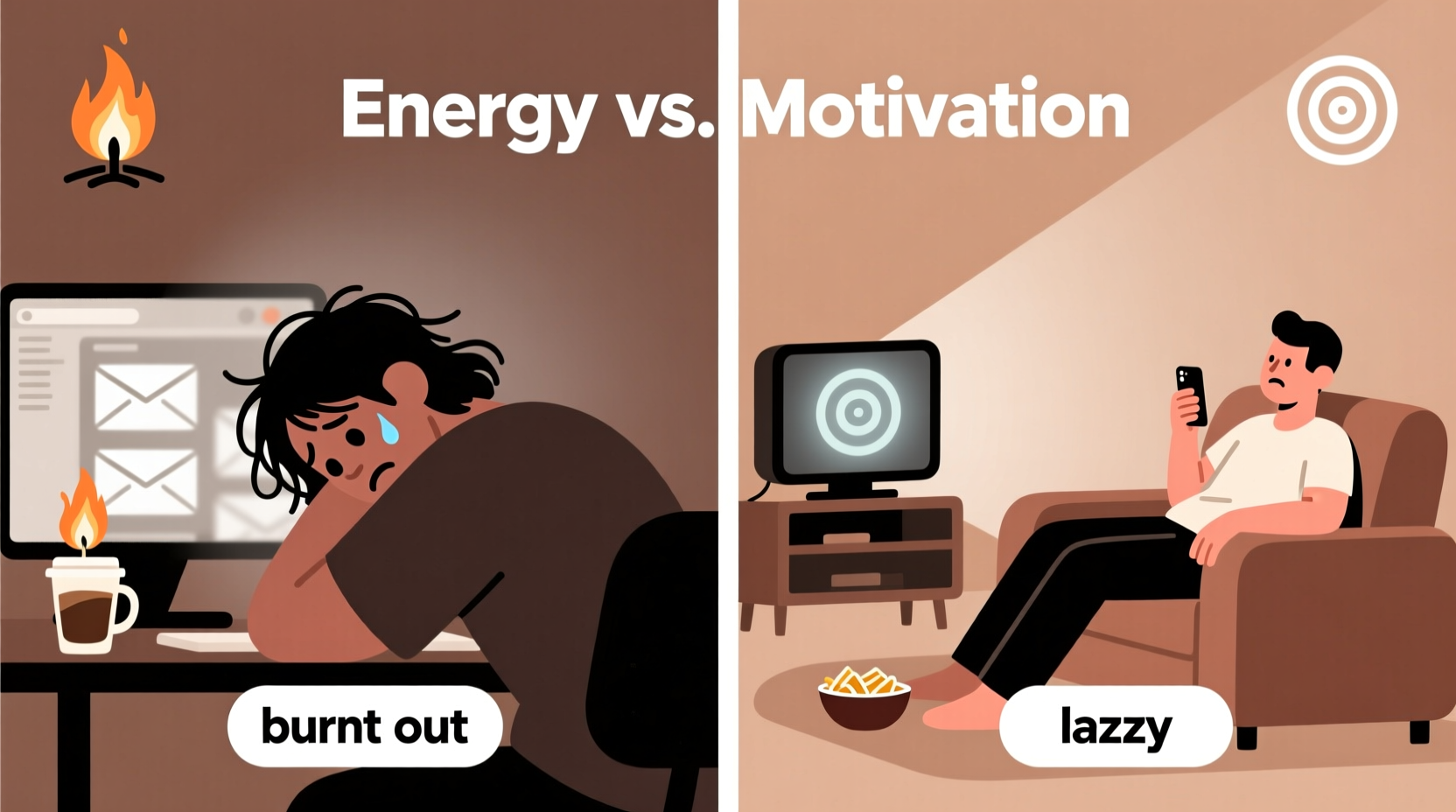
Burnout is not just tiredness. It’s a clinical condition recognized by the World Health Organization as an occupational phenomenon resulting from chronic workplace stress that hasn’t been successfully managed. It manifests in three key dimensions:
- Emotional exhaustion: A deep sense of being drained, overwhelmed, and unable to face another task.
- Cynicism or detachment: Feeling disconnected from your work, colleagues, or even personal goals.
- Reduced professional efficacy: A noticeable decline in performance, confidence, and competence.
Burnout doesn’t happen overnight. It builds over weeks or months of sustained pressure, overcommitment, lack of control, or misalignment with values. It affects not only your output but your identity. You start questioning your worth, purpose, and ability to contribute meaningfully.
Unlike laziness, burnout often comes with guilt. You *want* to perform. You miss the satisfaction of getting things done. But every attempt to restart feels like pushing a boulder uphill. The mental fog, irritability, and physical symptoms—insomnia, headaches, stomach issues—are real and measurable.
Laziness: A Misunderstood Concept
Laziness gets a bad reputation, but it’s often misunderstood. In psychology, what we label as “laziness” is frequently a symptom of something deeper: fear of failure, unclear goals, lack of interest, or poor motivation systems. True laziness—the conscious choice to avoid effort without consequence—is rare.
When someone is lazy, they typically experience:
- Low effort despite having energy.
- No emotional toll from inactivity.
- Ability to engage in enjoyable activities (e.g., scrolling social media, gaming).
- Lack of urgency or concern about unfinished tasks.
The key distinction? Laziness doesn’t impair function across life domains. You might procrastinate on a report but still have the energy to cook, exercise, or socialize. Burnout, on the other hand, creates a blanket fatigue—it seeps into relationships, hobbies, and basic self-care.
“Burnout is not a sign of weakness. It’s a signal that your system is overloaded. Laziness is a behavior; burnout is a physiological response.” — Dr. Naomi Chen, Clinical Psychologist
How to Tell the Difference: A Practical Framework
Distinguishing between burnout and laziness requires honest self-assessment. Use this decision framework to evaluate your current state.
| Factor | Burnout | Laziness |
|---|---|---|
| Energy Level | Chronically low, even after sleep | Available, but not directed toward tasks |
| Motivation | Desire to act, but mentally blocked | Lack of desire to act |
| Guilt | High—feels like failing oneself | Low or absent |
| Physical Symptoms | Fatigue, headaches, digestive issues | None directly tied to inactivity |
| Scope of Impact | Affects work, relationships, self-care | Limited to specific responsibilities |
| Response to Rest | Improves gradually with true downtime | May worsen due to increased inertia |
If most of your answers align with the “Burnout” column, your body is asking for recovery. If they lean toward “Laziness,” the issue may be motivational structure, not depletion.
Mini Case Study: Sarah’s Turning Point
Sarah, a 32-year-old project manager, found herself staring at her laptop for hours without typing a word. Deadlines loomed, but she couldn’t focus. She skipped workouts, canceled dinners with friends, and felt constant dread. Her first thought was, “I’m just being lazy.”
She tried motivational videos, strict schedules, and even self-imposed penalties. Nothing worked. After two months, she visited a therapist who asked simple questions: “When did you last take a full day off?” “Are you sleeping?” “Do you feel valued at work?”
The truth emerged: Sarah had worked 60+ hour weeks for nine months, taken no vacation, and was managing a team under constant restructuring. She wasn’t lazy—she was emotionally exhausted, detached, and doubting her abilities. A diagnosis of moderate burnout followed.
Her recovery began with a two-week digital detox, therapy sessions, and renegotiating her workload. Within six weeks, her clarity and energy returned. “I wasn’t broken,” she said later. “I was just spent. I needed rest, not a pep talk.”
Step-by-Step Guide: Assess and Respond
Follow this five-step process to determine whether you need rest or motivation—and act accordingly.
- Pause and Reflect (1–3 Days)
Stop trying to push forward. Journal honestly: How do you feel physically and emotionally? What tasks feel impossible? What would happen if you didn’t do them? - Track Your Energy and Mood (3–7 Days)
Use a notebook or app to log your energy levels hourly. Note patterns: Are you consistently drained by noon? Do you feel relief or anxiety when avoiding work? - Test a Small Task
Pick a low-stakes, meaningful task (e.g., replying to an email, organizing a drawer). Set a timer for 15 minutes. If you complete it and feel relieved, laziness may be the barrier. If you struggle to start or feel worse afterward, burnout is likely. - Evaluate Your Environment
Ask: Is my workload sustainable? Do I have control over my time? Am I recognized and supported? Chronic stressors point to burnout. - Choose Your Intervention
- If signs point to burnout: Prioritize rest. Take time off, reduce commitments, seek support, and consider professional help.
- If signs point to laziness: Rebuild momentum. Break tasks into micro-steps, use accountability partners, or reframe goals to reignite purpose.
Action Checklist: What to Do Next
Based on your self-assessment, use this checklist to move forward effectively.
If You’re Burnt Out:
- ✅ Schedule at least 3 consecutive days completely off work.
- ✅ Cancel non-essential commitments.
- ✅ Talk to a therapist or counselor.
- ✅ Practice daily grounding techniques (e.g., meditation, walks in nature).
- ✅ Re-evaluate your long-term role or workload with a supervisor.
If You’re Struggling with Motivation (Not Burnout):
- ✅ Define one small, achievable goal for the week.
- ✅ Use the \"two-minute rule\": If it takes less than two minutes, do it now.
- ✅ Pair tasks with rewards (e.g., coffee after completing a report).
- ✅ Share your goal with a friend for accountability.
- ✅ Audit your environment—remove distractions, improve lighting, organize workspace.
FAQ: Common Questions Answered
Can you be both burnt out and lazy at the same time?
Not exactly. Laziness implies a choice to avoid effort, while burnout removes the capacity to exert effort. However, someone recovering from burnout might appear “lazy” because their energy is still rebuilding. Similarly, chronic avoidance can lead to stress and eventual burnout. The conditions can coexist in sequence, but not simultaneously in their pure forms.
How long does it take to recover from burnout?
Recovery varies. Mild burnout may resolve in 2–4 weeks with proper rest. Moderate cases often require 1–3 months of reduced load and active recovery. Severe burnout—especially with depression or anxiety—can take 6 months or more. Healing isn’t linear; setbacks are normal.
Is taking time off a sign of weakness?
No. Taking time off to recover is a sign of strength and self-awareness. High performers understand that sustainability matters more than short-term output. Just as athletes rest between training cycles, mental work requires recovery to maintain peak performance.
Conclusion: Listen Before You Act
The line between burnout and laziness is thin but critical. One demands compassion and rest; the other calls for structure and action. Pushing harder when you’re burnt out leads to breakdown. Resting endlessly when you’re merely stuck deepens stagnation.
The wisest thing you can do is pause and listen—to your body, your emotions, your patterns. Ask not “Why am I not doing anything?” but “What is this state trying to tell me?” That shift in questioning changes everything.




 浙公网安备
33010002000092号
浙公网安备
33010002000092号 浙B2-20120091-4
Comments
No comments yet. Why don't you start the discussion?