
When it comes to decorating homes with traditional incandescent or LED Christmas lights, the choice between C7 and C9 bulbs often hinges on aesthetics, brightness, and compatibility with existing fixtures. But for homeowners who plan to reuse their lights year after year, one critical factor outweighs the rest: durability. Both C7 and C9 bulbs are widely used in residential and commercial holiday displays, but their physical design, base construction, and resistance to environmental stress differ significantly. Understanding these differences helps ensure your investment lasts through multiple seasons without frequent replacements.
Durability isn’t just about how long a bulb works—it’s about how well the entire system withstands weather, handling, installation strain, and storage wear. This article breaks down the structural strengths of C7 and C9 light bases, compares real-world performance, and provides actionable guidance for choosing the most resilient option for annual holiday setups.
Understanding C7 and C9 Light Bases: What’s the Difference?
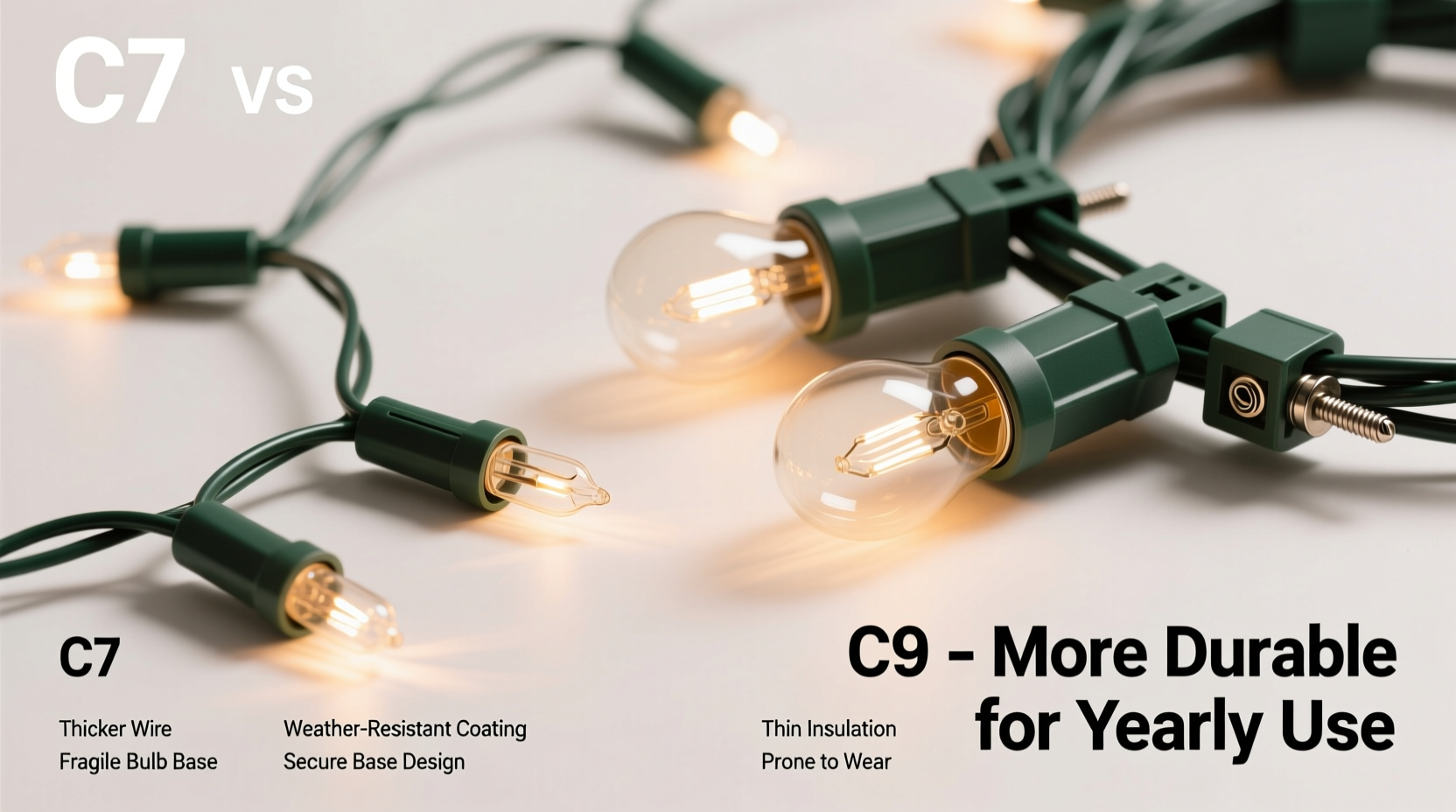
The terms “C7” and “C9” refer to the size and shape of the bulb, as well as the dimensions of the screw base that connects it to a socket. These are standardized sizes developed decades ago for decorative lighting and remain common in string lights today.
- C7 bulbs have a 7/8-inch diameter and use an E12 (candelabra) base—smaller and narrower than standard household bulbs.
- C9 bulbs are larger, measuring 1¼ inches in diameter, and use an E17 (intermediate) base, which is wider and longer than the C7’s base.
While both are considered “screw-in” types, the mechanical stability of each base plays a key role in long-term durability. The E17 base on C9 bulbs has more threads and a broader contact surface, which improves grip and electrical connection. In contrast, the E12 base on C7 bulbs, though reliable in protected environments, is more prone to loosening under vibration or thermal expansion.
This difference becomes especially important when lights are mounted on eaves, trees, or fences where wind, temperature shifts, and physical contact can cause movement over time. A looser base increases the risk of flickering, arcing, or complete disconnection—issues that accelerate wear and reduce lifespan.
Comparing Durability Factors: Structure, Materials, and Real-World Stress
Durability isn’t just about size—it’s a combination of materials, construction quality, and resilience to environmental exposure. Let’s examine the key factors that determine how well C7 and C9 bases hold up over repeated seasonal use.
Base Strength and Thread Design
The E17 base used in C9 bulbs features more threaded turns and a wider diameter than the E12 base of C7 bulbs. This allows for a tighter, more secure fit in the socket. Over time, as plastic sockets expand and contract with temperature changes, the additional thread engagement of the C9 helps maintain a stable connection.
In contrast, the smaller E12 base relies on fewer threads and less surface area. While adequate for indoor or low-stress applications, it’s more likely to loosen in outdoor settings exposed to wind and freeze-thaw cycles.
Resistance to Vibration and Physical Shock
During installation and removal, lights are often tugged, bent, or dropped. C9 bulbs, due to their larger base and sturdier overall build, handle physical shocks better. Their weight also stabilizes them in sockets, reducing wobble.
C7 bulbs, being lighter and more delicate, are more susceptible to damage during handling. A misaligned twist during installation can strip the E12 base, rendering the bulb unusable. Once damaged, replacement bulbs must match exact specifications—a growing challenge as C7 availability declines in some markets.
Weather and UV Resistance
Both C7 and C9 bulbs are commonly made with polycarbonate or PVC-coated shells, but the thicker housing of C9 bulbs offers better protection against moisture ingress and UV degradation. Many premium C9 strings use gasketed sockets designed to seal out water, reducing corrosion at the base-contact point.
C7 strings, particularly older or budget models, often lack this level of sealing. Moisture seeping into the socket corrodes the E12 base and socket contacts, leading to intermittent connections and premature failure.
Comparison Table: C7 vs C9 Base Durability
| Feature | C7 (E12 Base) | C9 (E17 Base) |
|---|---|---|
| Base Size | Smaller (E12 – candelabra) | Larger (E17 – intermediate) |
| Thread Engagement | Fewer threads, less grip | More threads, stronger hold |
| Vibration Resistance | Moderate – prone to loosening | High – resists wobble and disconnection |
| Moisture Protection | Limited – many open sockets | Better – often gasketed or sealed |
| Replacement Availability | Declining – less common | Widely available – industry standard |
| Typical Lifespan (with care) | 3–5 years | 5–7+ years |
Real-World Performance: A Mini Case Study
Consider the experience of Mark T., a homeowner in Ohio who maintains a large holiday display along his roofline and driveway trees. For five years, he used C7 lights due to their smaller profile and lower initial cost. Each spring, he carefully coiled the strands and stored them in labeled bins. Yet by the third season, nearly 40% of his bulbs failed to illuminate—not because the filaments burned out, but because the bases had corroded or stripped during installation.
After switching to commercial-grade C9 strings with sealed sockets and die-cast bases, Mark noticed immediate improvements. Despite harsh winters with heavy snow and ice, the C9 bulbs remained firmly seated and showed minimal signs of wear after three full cycles. He attributes the increase in longevity not just to the bulbs themselves, but to the robustness of the E17 base and better socket design.
“I used to spend hours troubleshooting dark sections caused by loose C7 bulbs,” Mark said. “With C9s, I plug them in once and they stay on all season. It’s less stress and fewer replacements.”
“The E17 base is inherently more durable than E12 for outdoor use. More thread contact means less chance of micro-arcing, which degrades both the bulb and socket over time.” — Daniel Reyes, Electrical Systems Technician with 18 years in holiday lighting installations
Action Plan: How to Maximize Longevity Regardless of Bulb Type
Even the most durable lights degrade without proper care. Whether you choose C7 or C9, follow this step-by-step guide to extend the life of your holiday lighting system.
- Inspect Before Installation: Check each bulb and socket for cracks, corrosion, or bent contacts. Replace damaged components early.
- Handle with Care: Never yank strings from storage or pull them during removal. Coil loosely and avoid kinking wires.
- Screw Bulbs Fully In: Use firm, even pressure to seat bulbs completely. Under-tightened bulbs vibrate loose; over-tightening strips threads.
- Use Dielectric Grease: Apply a small amount to the base threads before installation to prevent moisture buildup and corrosion.
- Store Properly: Keep strings on reels or cardboard spools. Avoid stuffing into boxes where wires bend sharply.
- Label and Organize: Group lights by location and length. This reduces trial-and-error setup and unnecessary handling.
- Test Annually: Plug in each strand before installing to catch failures early and replace bulbs while supplies are available.
Checklist: Choosing the Most Durable Option for Yearly Use
Before purchasing or reusing lights, ask yourself the following:
- ✅ Will the lights be exposed to wind, rain, or snow?
- ✅ Are the sockets sealed or gasketed against moisture?
- ✅ Is the base type (E12 or E17) readily available for replacements?
- ✅ Do the bulbs feel sturdy, or do they seem flimsy when handled?
- ✅ Have previous C7 sets failed prematurely due to base issues?
- ✅ Is long-term cost more important than upfront price?
If most answers lean toward outdoor exposure, availability concerns, and long-term savings, C9 bulbs with E17 bases are the superior choice for durability.
Frequently Asked Questions
Can I mix C7 and C9 bulbs on the same light string?
No. C7 and C9 bulbs use different base types (E12 vs E17) and are not interchangeable. Attempting to force one into the wrong socket can damage both the bulb and the string. Always match bulb size and base type exactly.
Are LED versions of C7 and C9 more durable than incandescent?
Yes. LED bulbs generate less heat, reducing stress on plastic sockets and wiring. They also consume less power and last significantly longer—often 25,000 to 50,000 hours. However, the base durability still depends on the underlying design (E12 vs E17). An LED C7 still has a weaker mechanical connection than an LED C9.
Why do some people still prefer C7 if C9 is more durable?
C7 bulbs are smaller and offer a more subtle, vintage look preferred for classic or nostalgic displays. They’re also easier to hide behind gutters or in dense foliage. Some users prioritize aesthetics over ruggedness, especially for covered porches or low-exposure areas.
Final Recommendation: Choose C9 for Maximum Durability
For homeowners committed to reusing their Christmas lights year after year, the evidence points clearly to C9 bulbs with E17 bases as the more durable option. The combination of a larger, more secure base, better resistance to environmental stress, and wider availability of replacements makes C9 the smarter long-term investment.
While C7 bulbs have their place in delicate or retro-themed displays, they simply don’t match the mechanical resilience required for repeated outdoor use. If your priority is reliability, reduced maintenance, and fewer replacements over time, upgrading to C9 is a practical decision that pays off after just two or three seasons.
Durability isn’t just about surviving one winter—it’s about enduring many. With proper selection and care, your holiday lights can become a dependable tradition rather than an annual repair project.




 浙公网安备
33010002000092号
浙公网安备
33010002000092号 浙B2-20120091-4
Comments
No comments yet. Why don't you start the discussion?