
Understanding the caloric content of everyday foods is essential for balanced nutrition, weight management, and informed dietary choices. Among staple vegetables worldwide, the humble potato stands out not only for its versatility but also for frequent misconceptions about its energy density. A common question arises: How many calories are actually in a single plain potato? The answer depends on several factors—variety, size, preparation method, and whether the skin is included. Far from being inherently high in calories, a plain potato in its natural state is a nutrient-dense, low-fat food that can support a wide range of diets when prepared mindfully.
This article provides a comprehensive breakdown of the calorie content in a single plain potato, grounded in USDA nutritional data and culinary science. It examines different potato types, sizes, and forms—from raw to boiled, baked, and steamed—while dispelling myths about this often-misunderstood vegetable. Whether you're meal planning, tracking macros, or simply curious about your favorite side dish, this guide delivers precise, practical insights for home cooks, health-conscious eaters, and culinary professionals alike.
Definition & Overview
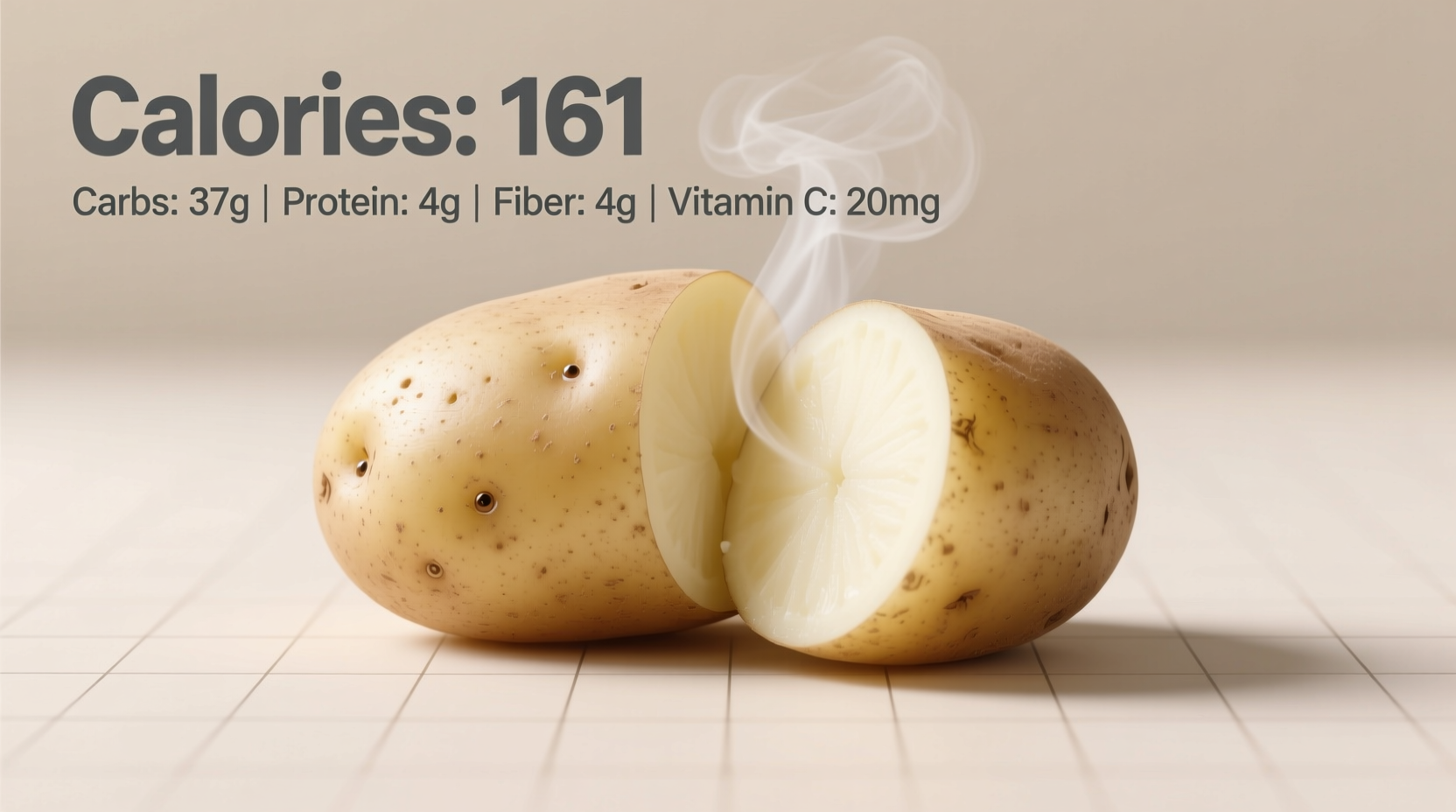
The potato (Solanum tuberosum) is a starchy tuberous crop native to the Andes region of South America, first domesticated over 7,000 years ago. Today, it ranks as one of the most widely consumed food crops globally, second only to rice, wheat, and maize in human consumption. Botanically classified as a vegetable, the potato functions culinarily as both a side dish and a carbohydrate source, similar to grains or legumes.
A \"plain potato\" refers to a whole, unseasoned potato prepared without added fats, oils, dairy, or sauces—typically boiled, baked, or steamed. This distinguishes it from preparations like french fries, mashed potatoes with butter, or scalloped potatoes, which significantly increase caloric load due to processing and added ingredients.
Potatoes consist primarily of water (about 79%) and carbohydrates (around 17–18%), mostly in the form of starch. They contain minimal fat and moderate protein, along with essential nutrients such as vitamin C, potassium, vitamin B6, and dietary fiber—especially when the skin is retained. Despite historical stigma linking them to weight gain, plain potatoes have a low energy density and high satiety index, meaning they promote fullness relative to their calorie content.
Key Characteristics
- Flavor Profile: Mild, earthy, slightly sweet, with subtle nutty undertones depending on variety.
- Aroma: Neutral when raw; develops a warm, roasted scent when cooked.
- Color/Form: Ranges from white, yellow, and red to purple-fleshed; shapes vary from oval to oblong.
- Heat Level: Non-pungent; does not contribute spiciness.
- Culinary Function: Acts as a base ingredient, thickener, binder, or standalone side; excellent for absorbing flavors.
- Shelf Life: 1–3 weeks at room temperature (cool, dark place); longer when refrigerated, though cold storage may alter starch composition.
- Glycemic Index (GI): Medium to high (varies by type and cooking method), but cooled potatoes develop resistant starch, lowering effective GI.
Expert Tip: Cooling cooked potatoes overnight increases resistant starch content by up to 50%, improving gut health and reducing insulin response—ideal for potato salads served chilled.
Calorie Content by Size and Type
The number of calories in a single plain potato is directly proportional to its weight and variety. Below is a detailed reference based on USDA FoodData Central values for unseasoned, skin-on potatoes prepared by boiling or baking without added fat.
Common Varieties and Average Caloric Values
| Potato Type | Average Weight (g) | Calories (Total) | Calories per 100g |
|---|---|---|---|
| Russet (Baking Potato) | 173 g (medium) | 138 kcal | 80 kcal |
| Yukon Gold (Medium) | 156 g | 125 kcal | 80 kcal |
| Red Bliss (Medium) | 140 g | 112 kcal | 80 kcal |
| Fingerling (Small, ~75g) | 75 g | 60 kcal | 80 kcal |
| Purple/Peruvian (Medium) | 130 g | 104 kcal | 80 kcal |
Note that while caloric density per 100 grams remains relatively consistent across varieties (~80 kcal), total calories scale linearly with mass. Larger russets can exceed 200 kcal each, while small new potatoes may contain as little as 40–50 kcal.
Size-Based Calorie Estimates (Russet Potato Example)
| Size Category | Weight (g) | Diameter / Length | Total Calories |
|---|---|---|---|
| Small | 138 g | 2–3 inches diameter | 110 kcal |
| Medium | 173 g | 3–4 inches long | 138 kcal |
| Large | 250 g | 4–5 inches long | 200 kcal |
| Extra Large | 369 g | 5+ inches long | 295 kcal |
These figures assume the potato is baked or boiled with skin intact and no additions. Removing the skin reduces fiber and some micronutrients but has negligible impact on total calories (~5–10 kcal less).
Impact of Cooking Method on Caloric Value
While the potato itself contains no fat, the preparation method dramatically affects final caloric content. Here's how various techniques influence energy delivery:
- Boiled (Plain): Minimal change in calories; slight leaching of water-soluble nutrients. A medium potato: 138 kcal.
- Baked (Skin On): Concentrates flavor slightly due to moisture loss; same caloric value as raw per gram. Medium: 138 kcal.
- Steamed: Preserves more nutrients than boiling; calorie count unchanged. Medium: ~138 kcal.
- Cooled After Cooking: No reduction in total calories, but increased resistant starch improves metabolic response.
- Fried (e.g., French Fries): Absorbs oil; calorie content doubles or triples. A medium potato fried: 300–400 kcal.
- Mashed (with Butter/Milk): Addition of dairy increases fat and calories significantly. Plain mashed: ~138 kcal; with 1 tbsp butter + milk: ~220 kcal.
\"The potato isn't the problem—it's what we do to it. A plain baked potato has fewer calories than a bagel, yet we treat it like a dietary villain.\" — Dr. Darya Rose, neuroscientist and author of Foodist
Variants & Forms
Potatoes appear in multiple forms beyond the whole tuber, each with distinct culinary uses and nutritional profiles:
1. Whole Fresh Potatoes
The most common form for home cooking. Best stored in a cool, dry, dark environment. Ideal for roasting, mashing, boiling, and grilling.
2. Pre-Cut/Frozen
Includes frozen diced, sliced, or shoestring-cut potatoes. Often blanched and treated with anti-darkening agents. May contain added oil (check labels). Calorie content can be 10–20% higher than fresh due to coating oils.
3. Dehydrated (Instant Mashed Potatoes)
Reconstituted with water or milk. While convenient, instant versions lose some texture and nutrients. A typical 1/3-cup dry serving contains ~80–100 kcal, but rehydration with whole milk and butter raises this substantially.
4. Powdered Potato Flakes
Used in baking as a moisture retainer or in processed foods. High in concentrated starch; ~350 kcal per 100g.
5. Canned Potatoes
Less common; typically pre-cooked and preserved in brine. Higher sodium content; texture softer. Calorie count similar to boiled, but watch for added preservatives.
Pro Tip: When using frozen potato products, opt for varieties labeled “no added oil” or “oven crisps” to maintain lower fat and calorie levels.
Comparison with Similar Carbohydrate Sources
How does a plain potato compare to other common starchy foods? The table below illustrates caloric and nutritional differences per 100g cooked basis.
| Food Item | Calories | Carbohydrates (g) | Fiber (g) | Protein (g) | Notable Nutrients |
|---|---|---|---|---|---|
| Plain Potato (boiled, skin) | 87 kcal | 20 g | 2.2 g | 2.0 g | Potassium, Vitamin C, B6 |
| Brown Rice (cooked) | 111 kcal | 23 g | 1.8 g | 2.6 g | Magnesium, Selenium, Fiber |
| Quinoa (cooked) | 120 kcal | 21 g | 2.8 g | 4.4 g | Complete protein, Iron, Magnesium |
| Whole Wheat Pasta | 124 kcal | 25 g | 3.2 g | 5.1 g | Folate, Iron, Complex carbs |
| Sweet Potato (boiled) | 86 kcal | 20 g | 3.0 g | 1.6 g | Vitamin A (beta-carotene), C, K |
As shown, plain potatoes are calorically comparable to or lower than other complex carbohydrates. Their unique advantage lies in high potassium (more than a banana) and vitamin C retention when lightly cooked. Unlike grains, they are naturally gluten-free, making them suitable for celiac and gluten-sensitive individuals.
Practical Usage & Culinary Applications
A plain potato serves as a blank canvas in the kitchen. Its neutral taste and soft texture make it ideal for building nutritious meals without excess calories.
Home Cooking Techniques
- Baking: Pierce skin, bake at 400°F (200°C) for 45–60 minutes. Top with Greek yogurt, steamed broccoli, black beans, or chili for balanced meals under 300 kcal.
- Boiling: Use for soups, stews, or salads. Cool before chopping to preserve structure and boost resistant starch.
- Roasting (Oil-Free): Toss in spices like paprika, garlic powder, and rosemary. Roast on parchment paper at 425°F (220°C) until golden—no oil needed for crispness if cut uniformly.
- Microwaving: Fastest method. Prick and microwave 5–8 minutes. Retains moisture and nutrients efficiently.
Professional Kitchen Insights
In restaurant settings, chefs leverage plain potatoes for consistency and cost-efficiency. Many upscale kitchens steam or sous-vide potatoes to retain exact texture before finishing with high-heat searing. For buffets or institutional feeding, large batches are boiled and held in insulated containers with minimal nutrient loss.
Pairing Suggestions
- High-Protein Pairings: Grilled chicken, salmon, lentils, eggs, tofu.
- Fiber-Rich Additions: Black beans, corn, sautéed greens, avocado (in moderation).
- Flavor Enhancers (Low-Cal): Lemon juice, vinegar, herbs (dill, chives), hot sauce, mustard.
Actionable Ratio Guide: For a balanced plate, use a 4:3:3 ratio—4 parts plain potato, 3 parts non-starchy vegetables, 3 parts lean protein. Total meal stays under 450 kcal with optimal satiety.
Storage, Shelf Life & Substitutions
Storage Tips
- Store in a cool, dark, well-ventilated area (ideal: 45–50°F / 7–10°C).
- Avoid plastic bags; use mesh or paper to prevent moisture buildup.
- Do not refrigerate unless necessary; cold temperatures convert starch to sugar, causing discoloration and sweetness upon cooking.
- Never store near onions—they emit gases that accelerate sprouting.
Shelf Life
- At room temperature: 1–3 weeks (depending on humidity).
- In pantry: Up to 2 months in ideal conditions.
- After cutting: Refrigerate in water up to 24 hours to prevent oxidation.
Substitutions
If avoiding nightshades or seeking alternatives:
- For mashing: Cauliflower (25 kcal per cup), turnips (36 kcal), parsnips (100 kcal).
- For roasting: Carrots, beets, rutabaga—offer similar texture with different nutrient profiles.
- For frying/crisping: Jicama, taro root, or plantains (higher sugar content).
Practical Tips & FAQs
Q: Are potatoes fattening?
A: No—potatoes themselves are not fattening. They are low in fat and calories. Weight gain occurs when they are prepared with large amounts of butter, cheese, sour cream, or deep-fried. In isolation, plain potatoes rank high on the satiety index, helping control appetite.
Q: Is the skin edible and nutritious?
A: Yes. The skin contains nearly half the fiber and significant potassium, iron, and antioxidants. Always wash thoroughly before cooking with skin on.
Q: Can diabetics eat plain potatoes?
A: Yes, in controlled portions and mindful preparation. Cooling after cooking lowers glycemic impact. Pair with protein and acid (like vinegar) to slow glucose absorption.
Q: How accurate are “one potato” calorie counts on nutrition labels?
A: Labels often generalize. Always verify weight. A “medium” potato assumed at 148g may underestimate larger specimens. Weighing ensures accuracy in macro tracking.
Q: Do organic potatoes have fewer calories?
A: No. Organic refers to farming practices, not caloric content. Nutritionally, they are nearly identical unless differing in size or moisture.
Q: What’s the lowest-calorie way to prepare a potato?
A: Steaming or boiling without salt. These methods add no fat and minimize nutrient loss compared to frying or roasting with oil.
Summary & Key Takeaways
The caloric content of a single plain potato is modest—typically between 100 and 150 kcal for a medium specimen—and heavily influenced by size, not variety. Prepared without added fat, it remains one of the most satiating, affordable, and nutrient-rich carbohydrate sources available.
Key points to remember:
- A medium plain potato contains approximately 138 calories, comparable to other whole grains.
- Calories increase significantly only when cooked with oil, butter, or dairy.
- The skin is edible and nutritionally valuable—retain it whenever possible.
- Cooling cooked potatoes enhances resistant starch, benefiting gut health and blood sugar control.
- Potatoes are naturally gluten-free, rich in potassium and vitamin C, and highly versatile.
- Proper storage extends shelf life and maintains quality without refrigeration.
Final Thought: Reclaim the potato as a healthful staple. Instead of eliminating it, focus on preparation. A plain baked potato topped with salsa, black beans, and cilantro makes a complete, satisfying meal under 300 calories—proof that simplicity supports wellness.




 浙公网安备
33010002000092号
浙公网安备
33010002000092号 浙B2-20120091-4
Comments
No comments yet. Why don't you start the discussion?