
When it comes to accessorizing a tailored blazer, the right lapel accent can transform an outfit from polished to profoundly elegant. Two of the most popular choices—camellia brooches and enamel pins—occupy opposite ends of the aesthetic spectrum. One speaks of heritage, refinement, and quiet luxury; the other broadcasts personality, rebellion, or niche interests with bold color and graphic flair. But when the goal is sophistication, which truly earns its place on a fine wool or cashmere lapel?
The answer isn’t just about personal taste—it’s about context, craftsmanship, and the subtle language of sartorial etiquette. A camellia brooch carries over a century of symbolic weight, while enamel pins thrive in contemporary subcultures. To understand which option reads as “classier,” we must examine not only design but also history, materials, and the social signals each sends.
The Legacy of the Camellia Brooch
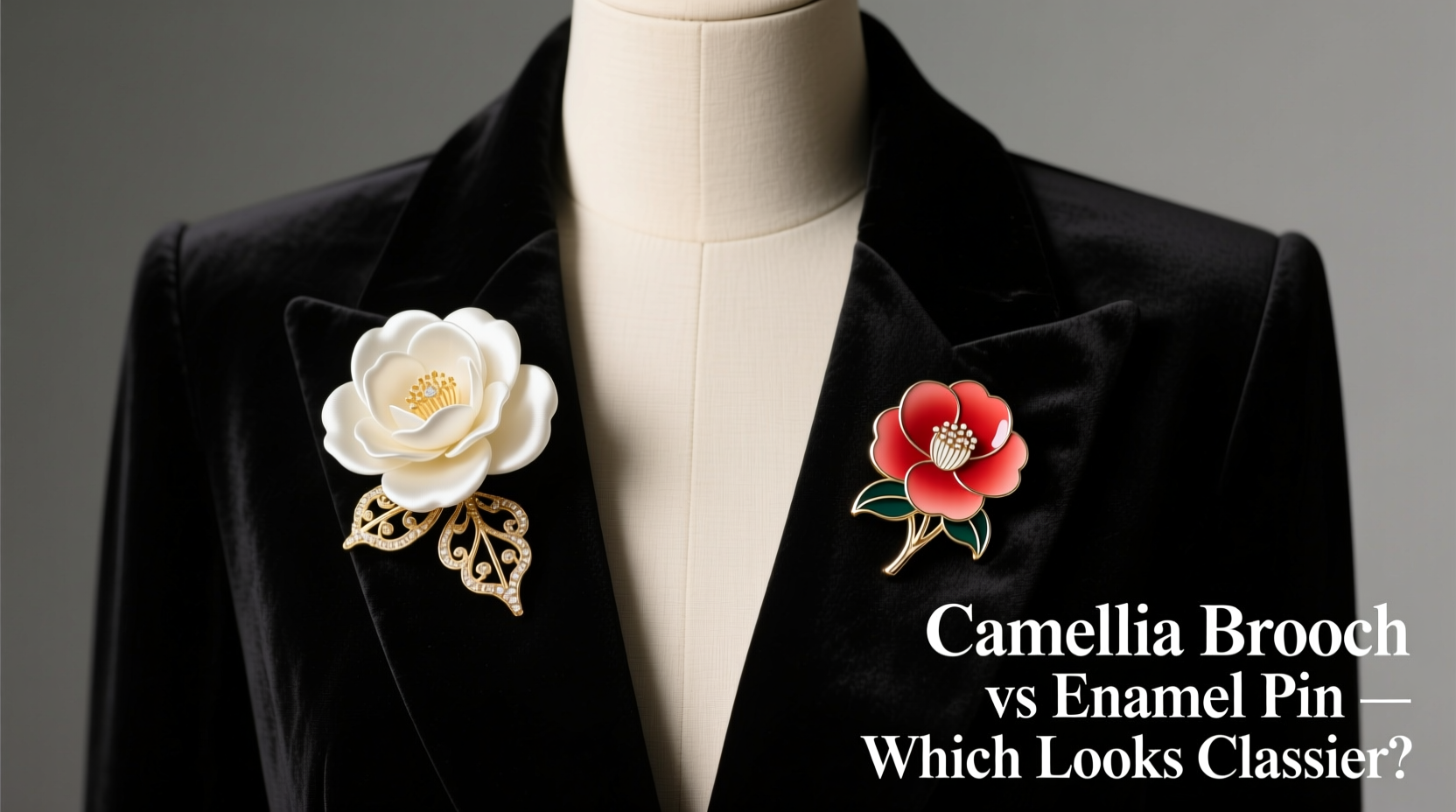
The camellia flower has long been associated with grace, perfection, and understated beauty. Its association with high fashion began in earnest with Gabrielle “Coco” Chanel, who adopted the bloom after seeing actress Pola Negri wear one in the 1920s. Enamored by its symmetry and lack of scent—Chanel believed fragrance distracted from perfume—she began incorporating camellias into her designs. Soon, white silk camellias became a signature accessory, often worn pinned to lapels, hats, or nestled in buttonholes.
Today, a camellia brooch—especially one crafted from silk, resin, or precious metals—is more than decoration. It's a nod to timeless elegance. Most are monochrome (white, black, or ivory), subtly detailed, and designed to complement rather than dominate. Their three-dimensional form adds texture without flashiness, making them ideal for formalwear, business attire, or evening ensembles.
“Luxury is in details that don’t shout. A camellia brooch says you know the rules—and choose to honor them quietly.” — Lucien Moreau, Fashion Historian & Curator at the Paris Institute of Style
The Rise of the Enamel Pin
Enamel pins emerged from functional origins—as membership badges, military insignia, or political campaign tokens—but have evolved into a vibrant form of self-expression. Modern enamel pins are typically made using hard or soft enamel techniques, featuring vivid colors, metallic borders, and intricate illustrations ranging from animals and pop culture icons to witty slogans.
They’re lightweight, affordable, and highly customizable, which explains their popularity in streetwear, creative industries, and youth-driven fashion. While some designer enamel pins are meticulously crafted and plated in gold or rhodium, many retain a playful, almost whimsical character. This makes them excellent for casual blazers, denim jackets, or outfits aiming for irony, nostalgia, or individuality.
However, their visual loudness can clash with the restrained tone of traditional tailoring. A cartoon mascot or neon-colored slogan on a navy suit jacket may read as incongruous in formal or conservative settings.
Comparative Analysis: Key Differences
To determine which accessory projects more class, consider five core dimensions: material quality, design language, versatility, occasion appropriateness, and cultural perception.
| Feature | Camellia Brooch | Enamel Pin |
|---|---|---|
| Material | Silk, satin, resin, metal, pearls | Metal base with colored enamel fill |
| Design Tone | Elegant, minimalist, organic | Vibrant, illustrative, graphic |
| Versatility | High—with suits, coats, dresses | Moderate—best with casual or themed wear |
| Formal Suitability | Excellent—appropriate for weddings, interviews, galas | Limited—rarely appropriate in strict formal settings |
| Cultural Perception | Timeless, refined, classic | Trendy, youthful, expressive |
Real-World Example: The Boardroom vs. The Gallery Opening
Consider two professionals preparing for different events. Clara, a corporate lawyer, wears a charcoal gray double-breasted blazer to a client meeting. She selects a matte-white camellia brooch with a delicate silver stem. The accessory echoes the precision of her outfit, adding femininity without distraction. Clients perceive her as composed, detail-oriented, and tasteful.
Daniel, a graphic designer, attends a gallery opening in a midnight blue unstructured blazer. He fastens a limited-edition enamel pin shaped like a retro camera with rainbow enamel detailing. The pin reflects his creative identity and sparks conversation. While stylish, it would seem out of place in Clara’s boardroom.
This contrast illustrates that “class” is not inherent in the object itself, but in how well it aligns with context. For environments where discretion and tradition matter, the camellia brooch holds superior elegance.
How to Choose Based on Occasion
Selecting the right lapel accent depends less on trend and more on purpose. Follow this decision guide to match your accessory to the moment.
- Formal Events (Weddings, Funerals, Diplomatic Functions): Opt for a camellia brooch in white, black, or blush. Avoid anything colorful or thematic.
- Business Professional Settings: A small metallic or fabric camellia complements a power suit. Enamel pins should be avoided unless minimal and brand-related (e.g., a discreet company logo).
- Creative Industries (Art, Media, Design): Enamel pins gain legitimacy here. Choose high-quality, tastefully designed pieces that reflect your brand or values.
- Casual or Social Gatherings: Both options work. A camellia offers vintage charm; a curated enamel pin adds personality.
- Memorial or Sentimental Moments: A camellia brooch often carries deeper emotional resonance due to its historical associations with remembrance and purity.
Checklist: Is Your Lapel Pin Classy Enough?
- ✅ Does it match the formality of the outfit?
- ✅ Is it made from high-quality materials (e.g., silk, sterling silver, vitreous enamel)?
- ✅ Is the design understated rather than cartoonish or overly trendy?
- ✅ Does it complement, not compete with, your clothing?
- ✅ Would it be appropriate in a conservative professional setting?
Frequently Asked Questions
Can I wear an enamel pin on a suit and still look professional?
Yes, but with caution. Choose a small, monochrome, or elegantly designed enamel pin—such as a simple geometric shape, compass, or abstract line art. Avoid pop culture references, humor, or bright colors in serious environments.
Are camellia brooches only for women?
No. While historically popular among women, men have worn floral lapel accents for centuries—especially in European fashion. A black or deep burgundy camellia brooch on a tuxedo or overcoat can be strikingly sophisticated for male or gender-neutral styling.
How do I care for a silk camellia brooch?
Store it upright in a dust bag away from moisture and direct sunlight. Gently dab stains with a dry cloth; never wash or steam. If bent, carefully reshape by hand at room temperature.
Final Verdict: Which Looks Classier?
In the contest between camellia brooch and enamel pin, the camellia emerges as the definitive choice for class. Its legacy in haute couture, restrained aesthetics, and seamless integration with formal tailoring give it an enduring advantage. It doesn’t announce itself—it lingers in memory.
That said, class isn’t the absence of personality. It’s the presence of intention. An enamel pin can be classy if chosen with restraint, quality, and awareness of context. But as a rule, when elegance, tradition, and quiet confidence are the goals, nothing surpasses the serene authority of a well-placed camellia.




 浙公网安备
33010002000092号
浙公网安备
33010002000092号 浙B2-20120091-4
Comments
No comments yet. Why don't you start the discussion?