
It’s a familiar holiday scene: the soft glow of string lights draped over the mantel, the warm twinkle from the tree in the corner, the gentle pulse of LED icicles shimmering through the bedroom window long after bedtime. For many, these lights are part of the season’s comfort—symbols of joy, nostalgia, and warmth. But when those same lights remain illuminated through the night, especially in sleeping spaces, they may be doing more than decorating. They may be silently interfering with one of the body’s most vital hormonal rhythms: melatonin production.
Melatonin—the “darkness hormone”—is not merely a sleep aid sold in supplement form. It is a neurohormone synthesized by the pineal gland in response to declining light levels at dusk. Its rise signals to the brain and body that it’s time to wind down, lower core temperature, reduce alertness, and prepare for restorative sleep. Crucially, melatonin secretion is exquisitely sensitive to light—especially short-wavelength (blue-enriched) light—and even low-intensity exposure during usual sleep hours can blunt its release. Modern Christmas lights—particularly LEDs—are far more potent melatonin disruptors than their incandescent predecessors, and their placement near beds or in shared living-sleep areas makes them an underrecognized contributor to poor sleep hygiene during the holidays.
How Light Suppresses Melatonin: The Biological Mechanism
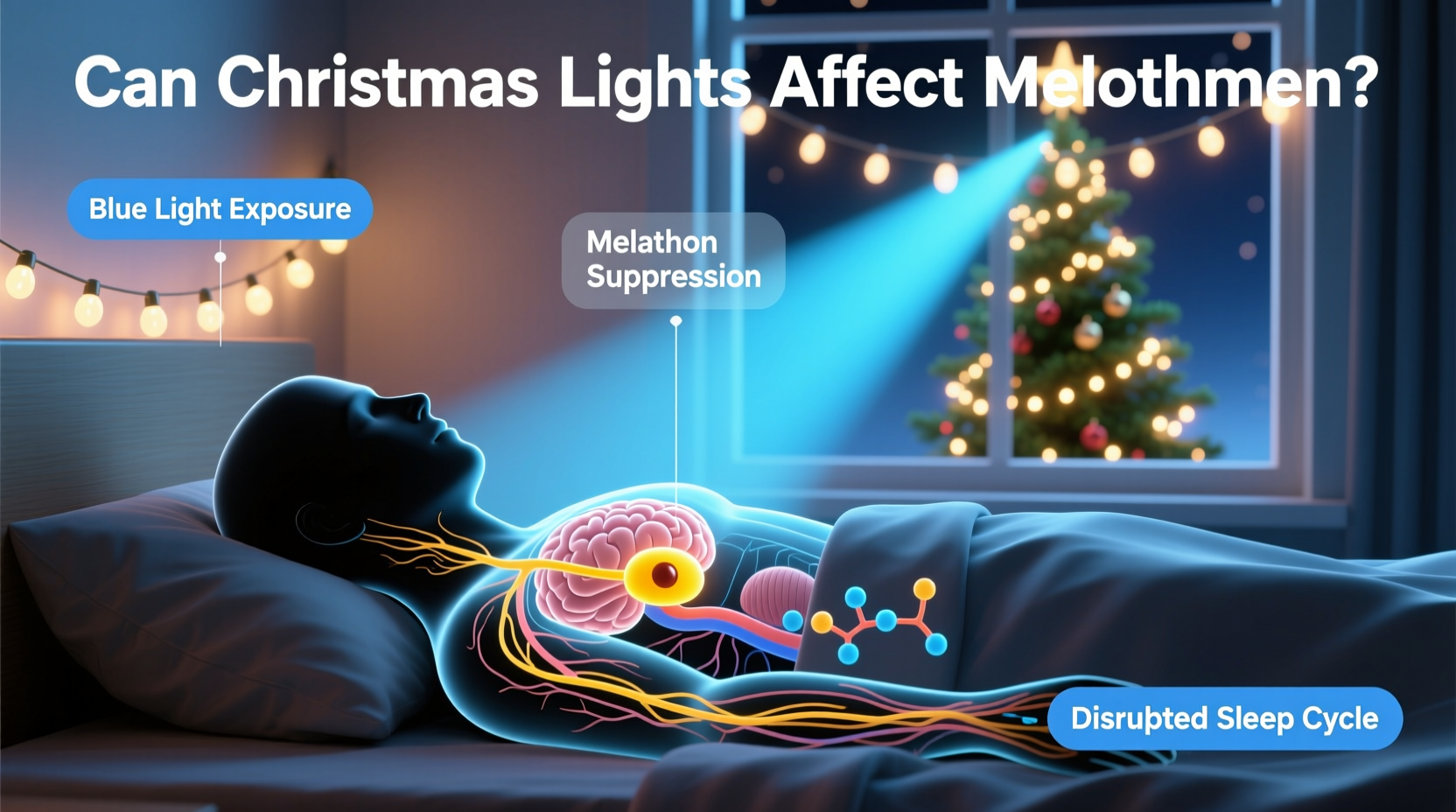
Melatonin suppression begins not in the pineal gland, but in the retina. Specialized intrinsically photosensitive retinal ganglion cells (ipRGCs) contain the photopigment melanopsin, which is maximally responsive to light in the 460–480 nm range—blue and blue-green wavelengths. Unlike rods and cones used for vision, ipRGCs send direct neural signals via the retinohypothalamic tract to the suprachiasmatic nucleus (SCN), the brain’s master circadian clock. When light hits these cells at night, the SCN inhibits pineal gland activity, halting melatonin synthesis.
Research confirms that even modest light intensities—far below what’s needed for visual perception—can trigger this cascade. A landmark 2015 study published in JAMA Internal Medicine found that women exposed to just 5 lux of room light (equivalent to a dim nightlight or distant LED display) while sleeping experienced a 50% reduction in melatonin levels and increased insulin resistance the following morning. Christmas lights—especially white or cool-white LEDs—often emit significant energy in the 440–490 nm range, making them biologically active even at low perceived brightness.
The effect is cumulative and dose-dependent: duration, intensity, spectral composition, and proximity all matter. A strand of warm-white LEDs placed three feet from a pillow delivers substantially more biologically effective light than the same strand across the room—even if both appear equally “soft” to the eye.
Christmas Lights vs. Other Light Sources: A Comparative Risk Assessment
Not all holiday lighting poses equal risk. Understanding the differences helps prioritize practical interventions. Below is a comparison of common Christmas light types based on their melatonin-disrupting potential, measured by their Circadian Stimulus (CS) value—a standardized metric developed by the Lighting Research Center at Rensselaer Polytechnic Institute that quantifies a light source’s ability to stimulate the ipRGCs.
| Light Type | Typical Color Temperature | Circadian Stimulus (CS) at 10 ft | Melatonin Suppression Risk (Nighttime Use) |
|---|---|---|---|
| Incandescent Mini-Lights (Vintage Style) | 2700K (warm amber) | 0.12 | Low — minimal blue emission; high infrared output reduces ipRGC activation |
| Warm-White LED String Lights (2700–3000K) | 2700–3000K | 0.28–0.35 | Moderate — reduced but still present blue peak; risk increases significantly within 6 ft of bed |
| Cool-White or Daylight LED Strings (5000–6500K) | 5000–6500K | 0.52–0.68 | High — strong blue spike near 450 nm; suppresses melatonin even at low intensities and distances |
| RGB Smart LEDs (in “white” or “blue” mode) | Variable (often 6500K+ in white) | 0.60–0.85+ | Very High — programmable blue-rich output; pulsing or flashing modes further amplify circadian disruption |
| Fiber-Optic or Low-Voltage Decorative Lamps | Varies (often filtered) | 0.05–0.18 | Low to Very Low — minimal direct emission; often diffused or shielded |
This table underscores a critical point: the shift from incandescent to LED technology—while beneficial for energy efficiency—has inadvertently increased the circadian impact of decorative lighting. A 2022 review in Chronobiology International concluded that “LED-based holiday lighting now represents one of the most widespread, yet overlooked, sources of nocturnal circadian disruption in residential environments.”
A Real-World Example: The Holiday Sleep Study
In December 2023, sleep researcher Dr. Lena Torres conducted a small but telling field study in Portland, Oregon, involving 12 healthy adults aged 28–44 who reported difficulty falling asleep during the holiday season. All participants used Christmas lights in their bedrooms or adjacent living rooms and kept them on overnight. Using wrist-worn actigraphy and saliva melatonin sampling, Dr. Torres tracked baseline sleep architecture for one week without lights, then for one week with their usual light setup.
The results were consistent and revealing. On average, participants experienced:
- A 37-minute delay in melatonin onset (the “dim-light melatonin onset” or DLMO marker), shifting from 9:42 p.m. to 10:19 p.m.
- Reduced total melatonin area-under-the-curve by 41% during the 11 p.m.–3 a.m. window.
- Decreased slow-wave (deep) sleep by 18%, with corresponding increases in nighttime awakenings (+2.3 per night).
- Self-reported next-day fatigue increased by 64% on the light-exposed week.
One participant, Maya R., a graphic designer and mother of two, described her experience candidly: “I thought the tree lights were harmless—cozy, even. But I’d lie in bed staring at the ceiling, feeling wired but exhausted. My kids were waking up cranky, and I realized our whole household was running on fragmented sleep. When we unplugged the bedroom tree lights and used blackout curtains, my sleep latency dropped from 52 minutes to 17 minutes in just three nights.”
Dr. Torres noted that the effect wasn’t limited to those sleeping *with* lights visible: ambient light leaking under doors, reflecting off ceilings, or filtering through thin blinds was sufficient to trigger measurable suppression—confirming that proximity and shielding matter more than direct line-of-sight.
Expert Insight: What Sleep Scientists Recommend
“The idea that ‘soft’ or ‘warm’ holiday lights are ‘safe’ for overnight use is a dangerous misconception. Melanopsin doesn’t care about aesthetics—it responds to photons in a specific wavelength band. Even low-intensity blue-enriched light at night tells your brain, ‘It’s daytime.’ That signal overrides decades of evolutionary programming for rest. If you wouldn’t leave your phone screen on your pillow at midnight, don’t leave a blue-rich LED strand three feet from your head.”
— Dr. Javier Mendez, PhD, Director of the Center for Circadian & Sleep Medicine, University of California, San Francisco
Dr. Mendez emphasizes that children and adolescents are especially vulnerable. Their developing circadian systems exhibit heightened sensitivity to evening light, and melatonin suppression during puberty has been linked to delayed sleep phase disorder, mood dysregulation, and impaired academic performance. Older adults, too, face amplified risk: age-related lens yellowing filters some blue light, but reduced pupil size and decreased retinal sensitivity mean they require *more* light to see—but paradoxically, the light they *do* receive carries greater circadian weight due to compensatory neural amplification.
Practical, Evidence-Based Strategies to Protect Your Melatonin
Protecting melatonin doesn’t require abandoning holiday cheer. It requires intentionality—applying principles of circadian hygiene to seasonal traditions. Below is a step-by-step guide validated by sleep medicine guidelines and lighting ergonomics research.
- Conduct a “Light Audit” (Day 1): Walk through your home 30 minutes after sunset with all interior lights off except your Christmas displays. Note which lights are visible from beds, sofas, or cribs. Pay special attention to reflections on mirrors, windows, or white walls.
- Relocate or Redirect (Day 2): Move any light source emitting directly toward sleeping areas. Use lampshades, fabric wraps, or matte-finish tape to diffuse or block forward-facing LEDs. Angle strands downward or behind furniture—not upward toward ceilings.
- Swap High-Risk for Low-Risk (Day 3): Replace cool-white or RGB LEDs near bedrooms with incandescent mini-lights or warm-white LEDs rated ≤2700K and labeled “low-blue” or “circadian-friendly.” Look for products with CS < 0.25 at typical viewing distance.
- Install Timers or Smart Controls (Day 4): Set automatic shutoff no later than 10:30 p.m. Use plug-in timers or smart outlets—avoid relying on memory. Bonus: program a 15-minute fade-to-off to mimic natural dusk.
- Layer Physical Barriers (Day 5): Install blackout curtains in bedrooms. Add door sweeps to prevent light bleed from hallways or living rooms. For children’s rooms, consider a small, battery-operated red-nightlight (<620 nm)—a wavelength melanopsin cannot detect—as a safe alternative to white light.
Do’s and Don’ts for Holiday Lighting Safety
| Do | Don’t |
|---|---|
| Use warm-white (≤2700K) or incandescent lights in shared or sleeping spaces | Use cool-white, daylight, or RGB LEDs in bedrooms, nurseries, or hallways leading to bedrooms |
| Place lights behind frosted glass, fabric drapes, or greenery to diffuse intensity | Mount bare LED strings on headboards, bedside shelves, or ceiling fixtures above beds |
| Set timers to turn lights off by 10:30 p.m. at the latest | Leave lights on all night “for safety” or “ambiance” without assessing actual need |
| Use motion sensors only in non-sleep zones (e.g., entryways) | Install motion-activated lights in bedrooms or hallways where nighttime movement is expected (e.g., children’s paths to bathroom) |
| Check light packaging for CIE S 026/E:2018 or LM-80 photometric reports | Assume “energy efficient” means “biologically safe” |
FAQ: Addressing Common Concerns
Can I use Christmas lights in my child’s room if I dim them?
Dimming reduces intensity but does not eliminate spectral risk. A dimmed cool-white LED still emits proportionally more blue light than a warm incandescent at full brightness. For children’s rooms, prioritize zero overnight light exposure—use timers, unplug entirely, or switch to battery-powered fiber-optic options with no blue peak. Pediatric sleep guidelines recommend complete darkness for optimal melatonin-driven neurodevelopment.
What if I only have one strand and it’s near my bed? Is turning it off really necessary?
Yes—if it’s visible, reflected, or within 10 feet of your head while lying down. A 2021 study in Sleep demonstrated that even a single 5-mm LED bulb placed 6 feet from a sleeper suppressed melatonin by 22% over a 4-hour period. There is no established “safe threshold” for nocturnal light exposure in humans; the precautionary principle applies. Turning it off is the most reliable intervention.
Do colored lights (red, green, purple) affect melatonin?
Red light (620–750 nm) has negligible impact on melanopsin and is considered circadian-neutral—making it the safest choice for nightlights or emergency illumination. Green light (495–570 nm) has moderate impact, higher than red but lower than blue. Purple/violet (380–450 nm) is highly disruptive—often more so than blue—due to strong melanopsin activation. Avoid violet-tinted or “UV-effect” LEDs entirely in sleeping environments.
Conclusion: Reclaiming Rest Amidst the Glow
Holiday traditions should uplift—not undermine—our well-being. The gentle radiance of Christmas lights carries deep emotional resonance, but biology operates independently of sentiment. When left burning through the night, even the most beloved decorations become inadvertent agents of circadian misalignment—eroding melatonin, fragmenting sleep, and taxing resilience during a season already rich with demands. The good news is that mitigation requires neither sacrifice nor complexity. It asks only for awareness, a few deliberate adjustments, and the understanding that true warmth isn’t measured in lumens, but in restorative rest.
This year, let your lights shine brightly—during the day and early evening—then allow darkness to do its essential work. Unplug that strand by the sofa. Swap the cool-white garland for amber bulbs. Install that timer. Your pineal gland will respond within days—not with fanfare, but with deeper sleep, calmer mornings, and a quieter, more grounded presence amid the holiday rush.




 浙公网安备
33010002000092号
浙公网安备
33010002000092号 浙B2-20120091-4
Comments
No comments yet. Why don't you start the discussion?