
The Myers-Briggs Type Indicator (MBTI) has become one of the most widely used tools for understanding personality. From corporate team-building sessions to online quizzes shared across social media, millions of people have identified themselves as an INFP, ESTJ, or any of the 16 personality types. But a common question lingers: once you’ve taken the test and received your four-letter result, is that who you are—forever?
While the MBTI suggests that your core preferences are innate and relatively stable, lived experience and psychological research indicate that personality can—and often does—evolve over time. The truth lies somewhere between consistency and change, shaped by biology, environment, personal growth, and life transitions.
The Foundations of MBTI: A Brief Overview
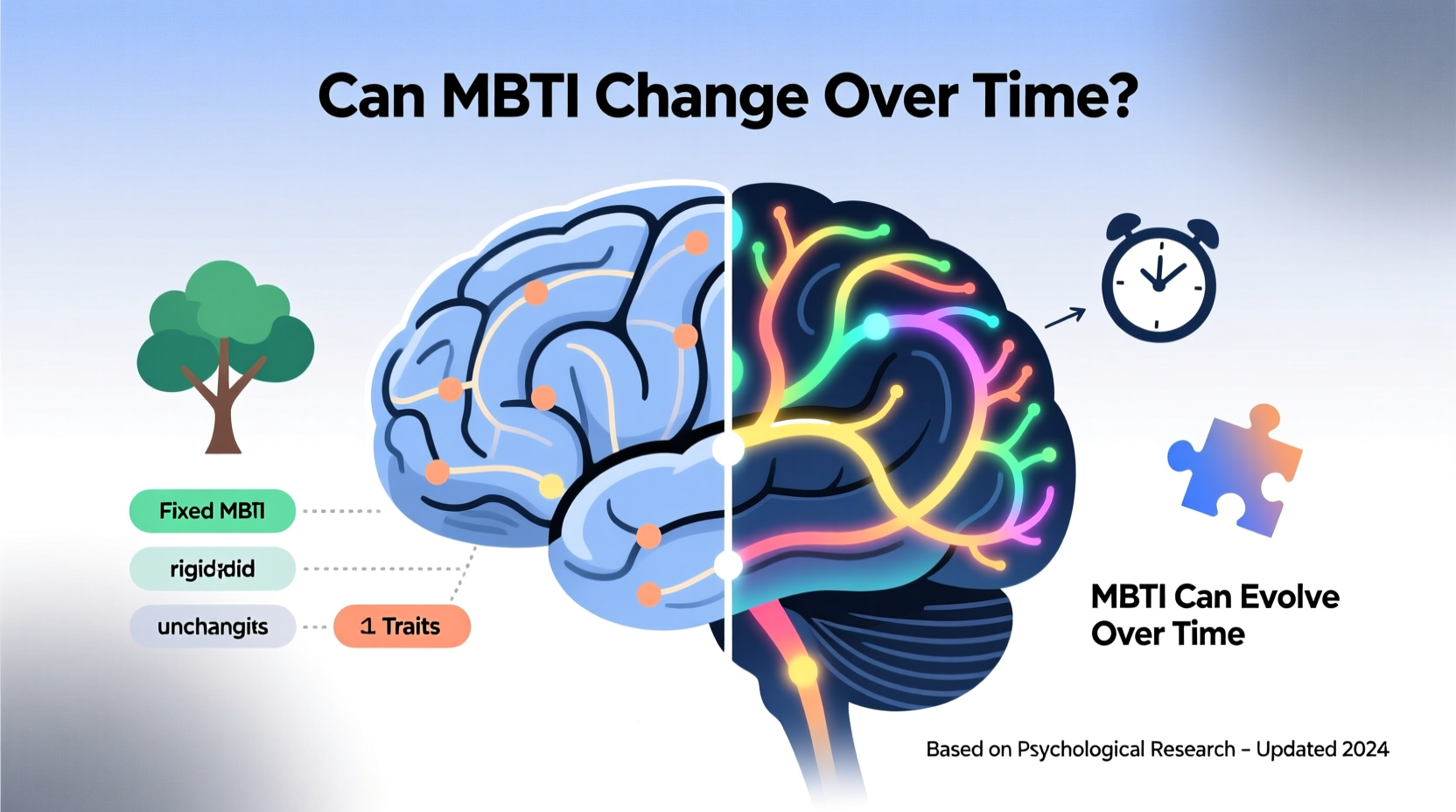
Developed by Katharine Cook Briggs and her daughter Isabel Briggs Myers during the mid-20th century, the MBTI is based on Carl Jung’s theory of psychological types. It categorizes individuals along four dichotomies:
- Extraversion (E) vs. Introversion (I): Where you draw energy—from external interaction or internal reflection.
- Sensing (S) vs. Intuition (N): How you gather information—through concrete details or abstract patterns.
- Thinking (T) vs. Feeling (F): How you make decisions—based on logic or values.
- Judging (J) vs. Perceiving (P): How you approach the outside world—structured planning or spontaneous flexibility.
The resulting 16 types are meant to reflect natural preferences, not abilities or skills. According to official MBTI literature, these preferences are “innate” and remain consistent throughout life. However, this claim has sparked debate among psychologists and researchers.
“Personality is both stable and malleable. We see continuity, but also meaningful change—especially during key developmental stages.” — Dr. Christopher Soto, Personality Psychologist, Colby College
Scientific Perspectives on Personality Stability
Modern psychology, particularly the Five-Factor Model (also known as the Big Five), offers a more nuanced view than the MBTI’s binary framework. Traits such as openness, conscientiousness, extraversion, agreeableness, and neuroticism are measured on spectrums and are known to shift gradually over time.
Longitudinal studies support this. Research published in the journal Psychological Science followed participants over decades and found that average levels of conscientiousness and agreeableness increase from adolescence into middle age, while neuroticism tends to decline. These changes aren’t random—they correlate with life experiences like education, career development, relationships, and parenting.
Unlike the MBTI, which assigns fixed categories, the Big Five acknowledges that personality traits exist on continua and are subject to gradual evolution. This raises a critical point: if broader, empirically validated models recognize personality change, why should the MBTI be considered immutable?
Why MBTI Results Might Seem to Change Over Time
Many people report receiving different MBTI results when retaking the test months or years apart. While some attribute this to inconsistent testing conditions, deeper psychological and situational factors often play a role.
1. Contextual Behavior vs. Innate Preference
You might score as an “Introvert” at 25, working in a quiet research role, but later test as an “Extravert” after becoming a sales manager. This doesn’t necessarily mean your core preference changed—it may reflect adaptation to job demands. The MBTI measures self-perceived preferences, which can be influenced by recent behavior rather than underlying tendencies.
2. Personal Growth and Self-Awareness
As people mature, they often develop underused aspects of their personality. An INTP (Introverted, Intuitive, Thinking, Perceiving) might strengthen their feeling function through therapy or deep relationships, leading them to answer questions differently—even if their dominant cognitive functions remain unchanged.
3. Life Transitions
Major life events—marriage, parenthood, trauma, career shifts—can reshape how we interact with the world. A naturally perceiving (flexible) person may adopt judging (organized) behaviors to manage family responsibilities, temporarily altering their test outcome.
4. Mood and Circumstance During Testing
Taking the MBTI after a stressful week or during a period of depression can skew results. Someone typically high in extraversion might feel drained and select introverted options simply because they’re emotionally fatigued.
| Factor | Impact on MBTI Results | Example |
|---|---|---|
| Age and Maturity | Increased emotional regulation and responsibility may shift J/P or T/F scores | A 20-year-old ENFP becomes a 40-year-old ENFJ due to leadership roles |
| Career Demands | Work environment may encourage use of non-dominant functions | An ISTP learns to prioritize teamwork (Fe) in a collaborative office |
| Mental Health | Depression or anxiety can affect E/I and J/P responses | An usually outgoing ESFJ scores as ISFJ during a depressive episode |
| Test Reliability | MBTI retest reliability ranges from 50–75% within five weeks | Half of test-takers receive a different type upon retesting |
When Does Change Reflect Growth vs. Inconsistency?
It’s important to distinguish between genuine personality development and fluctuating test results due to unreliable measurement. The MBTI itself has been criticized for low test-retest reliability and lack of scientific rigor compared to models like the Big Five.
However, even critics acknowledge that people grow. A teenager scoring as an ESTP (adventurous, action-oriented) may evolve into an ENTJ (strategic, goal-driven) by their 30s—not because their MBTI “changed,” but because their priorities, skills, and self-concept developed.
This aligns with the concept of “functional type” versus “core type.” Some MBTI practitioners suggest that while your dominant cognitive function (e.g., Introverted Thinking in an INTP) remains stable, your auxiliary or tertiary functions can strengthen over time, altering outward behavior and test responses.
“We don’t outgrow our type—we grow into it. Maturity allows us to access all eight cognitive functions more fluidly, not just our preferred ones.” — Dario Nardi, Neuroscientist and MBTI Researcher
Mini Case Study: From ISTJ to INFJ?
Sarah took the MBTI at 22 and was typed as ISTJ—detail-oriented, practical, and reserved. She worked in accounting and valued structure. Ten years later, after volunteering with refugees and completing a master’s in counseling, she retook the test and scored as INFJ.
Was her personality fundamentally different? Not entirely. Her dominant function shifted from Introverted Sensing (ISTJ) to Introverted Intuition (INFJ), reflecting her growing focus on meaning, patterns, and human potential. Life experiences had expanded her worldview, allowing her intuitive side to emerge more strongly. Her core need for order remained, but now served a deeper purpose.
In reality, Sarah hadn’t changed types—she had integrated new dimensions of herself that were always present but previously underdeveloped.
Practical Guide: Assessing Your Own Personality Shifts
If you’re wondering whether your MBTI has changed—or whether it ever really was accurate—consider this step-by-step process to gain clarity:
- Retake the Test Thoughtfully: Use a reputable version (e.g., the official MBTI Step I or Step II). Take it when rested and reflective, not during a crisis.
- Compare Cognitive Functions: Look beyond the four letters. Did your dominant function (e.g., Extraverted Feeling in ENFJ) truly shift, or did a supporting function become more prominent?
- Reflect on Life Changes: Have you experienced major transitions? New roles often require using different parts of your personality.
- Seek Feedback: Ask trusted friends or colleagues how they’d describe your communication style, decision-making, and energy patterns.
- Track Patterns Over Time: Keep a journal for a few weeks noting when you feel energized, stressed, or in flow. Do your observations align with your original type?
Frequently Asked Questions
Can your true MBTI type change permanently?
According to the official MBTI framework, your innate preferences do not change. However, your behavior, self-perception, and test results can shift due to growth, stress, or context. Most experts agree that while expression evolves, core preferences tend to persist.
Why do I get different results each time I take the MBTI?
The MBTI has moderate test-retest reliability. Factors like mood, recent experiences, and how you interpret questions can influence outcomes. Short online versions are especially prone to inconsistency. For greater accuracy, consider professional administration with interpretation.
Is the MBTI scientifically valid?
The MBTI is popular but controversial in academic psychology. While it offers useful insights for self-reflection and team dynamics, it lacks the empirical support and predictive power of models like the Big Five. It’s best used as a tool for exploration, not diagnosis or hiring decisions.
Action Checklist: Understanding Your Personality Journey
- ✅ Retake the MBTI after significant life milestones
- ✅ Study cognitive functions, not just four-letter codes
- ✅ Journal about moments when you felt “in your element”
- ✅ Discuss your type with someone who knows you well
- ✅ Use personality insights to guide growth, not limit yourself
Conclusion: Embracing Both Stability and Change
The question of whether MBTI types are fixed or changeable doesn’t have a simple yes-or-no answer. Personality is both enduring and dynamic. While you may consistently prefer solitude over crowds or logic over emotion, your relationship with those preferences can deepen, shift, or expand over time.
Rather than seeking a definitive label, use the MBTI as a starting point for self-inquiry. Recognize that growth isn’t about changing who you are—it’s about becoming more fully who you’ve always been. The value of personality assessments lies not in boxing you in, but in helping you understand your patterns, strengths, and potentials.




 浙公网安备
33010002000092号
浙公网安备
33010002000092号 浙B2-20120091-4
Comments
No comments yet. Why don't you start the discussion?