
As holiday traditions evolve alongside technology, many homeowners and event planners are rethinking the way they decorate for Christmas. One of the most intriguing innovations in seasonal décor is projector mapping—using digital light projections to transform ordinary objects into dynamic visual experiences. A common question arises: Can you use projector mapping on a Christmas tree instead of traditional string lights? The short answer is yes—but with important caveats. This article explores the feasibility, benefits, challenges, and best practices of replacing physical lights with projected ones, offering a comprehensive look at whether this futuristic approach fits your festive vision.
How Projector Mapping Works on Christmas Trees
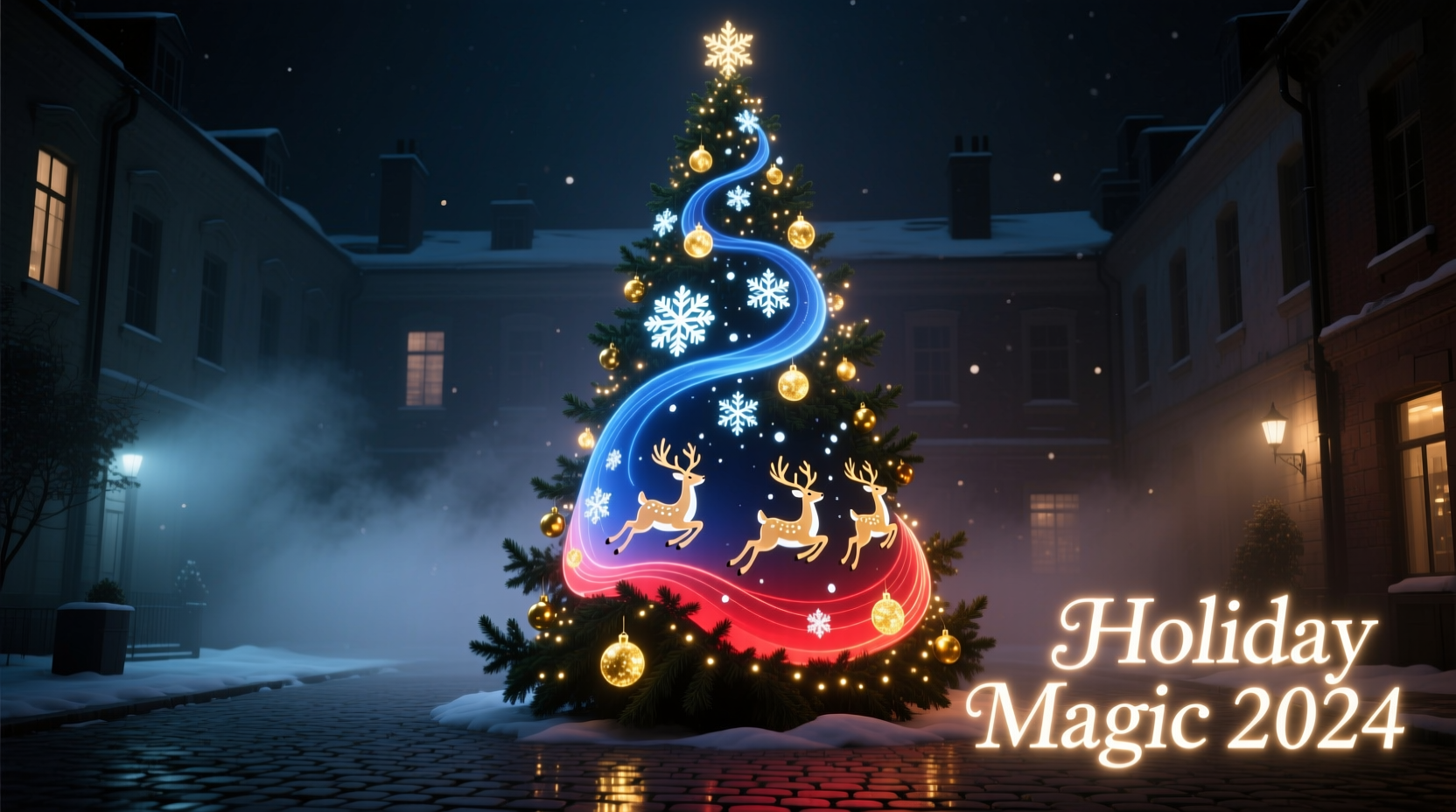
Projector mapping, also known as spatial augmented reality, involves projecting images or animations onto three-dimensional surfaces in a way that aligns perfectly with their shape. When applied to a Christmas tree, specialized software maps the tree’s contours so that lights, patterns, snowflakes, or even animated scenes appear to wrap around its branches.
Unlike flat-screen projections, projector mapping accounts for depth and irregular geometry. For a conical object like a Christmas tree, this means calibrating the projector’s angle, distance, and lens settings to avoid distortion. High-lumen projectors (3,000 lumens or more) are typically required to ensure visibility, especially in environments with ambient light.
The process begins with a 3D scan or manual calibration of the tree’s structure. Designers then create custom animations—such as twinkling “lights,” falling snow, or color-changing gradients—that sync with music or timers. Once aligned, the projection gives the illusion of physical decoration without a single bulb or wire.
Advantages of Using Projector Mapping Over Physical Lights
Replacing traditional Christmas lights with projector mapping offers several compelling benefits, particularly for those seeking innovation, convenience, or creative expression.
- No tangled wires: One of the biggest frustrations during holiday decorating is untangling strings of lights. Projection eliminates cords entirely, reducing setup time and electrical hazards.
- Dynamic visuals: While physical lights offer limited variation (steady, blinking, fading), projector mapping allows for animated sequences, color transitions, and themed displays that change throughout the evening.
- Customization: Users can switch themes instantly—from classic white lights to a winter forest scene to a disco party—without changing any hardware.
- Allergy and safety considerations: Families with allergies to PVC or dust-heavy decorations may prefer a contactless lighting solution. Additionally, there’s no fire risk from overheating bulbs.
- Eco-friendliness: Though projectors consume electricity, eliminating mass-produced plastic lights reduces long-term waste, especially when decorations are discarded annually.
“Projection mapping turns static objects into living canvases. A Christmas tree becomes not just a decoration, but an experience.” — Daniel Reeves, Immersive Media Designer
Challenges and Limitations to Consider
Despite its appeal, projector mapping isn’t a one-size-fits-all replacement for physical lights. Several practical limitations affect its effectiveness in real-world settings.
Ambient light interference is the most significant hurdle. Projections require darkness to achieve high contrast. In a brightly lit room or near windows with streetlights, the effect can appear washed out. Even moderate indoor lighting diminishes the impact.
Surface texture matters. Real Christmas trees, with their dense, uneven foliage, scatter light unpredictably. Artificial trees with smoother, more uniform branch layouts tend to yield better results. However, overly reflective ornaments or metallic tinsel can cause glare and hotspots.
Equipment cost and complexity present another barrier. Consumer-grade projectors may lack the brightness or resolution needed for crisp mapping. Professional setups often include multiple projectors, media servers, and calibration software—costing hundreds or thousands of dollars.
Additionally, viewing angles are limited. The illusion works best from a frontal perspective. From the sides or rear, distortions become apparent, breaking immersion. This makes it less ideal for trees placed in round rooms or viewed from all directions.
Step-by-Step Guide to Setting Up Projector Mapping on a Christmas Tree
For those ready to experiment, here’s a practical timeline to implement projector mapping successfully:
- Choose the right tree location: Place the tree against a dark wall, away from windows and bright lamps. Ensure at least 6–10 feet of clearance between the tree and the projector placement point.
- Select a high-lumen projector: Opt for a model with at least 3,500 lumens and native 1080p resolution. Short-throw projectors are ideal if space is limited.
- Calibrate the surface: Use free or paid mapping software (like HeavyM, MadMapper, or Resolume) to outline the tree’s silhouette. Some apps support automatic edge detection via camera input.
- Create or download animations: Design simple light patterns resembling traditional bulbs, or explore seasonal templates available online. Sync animations to holiday music if desired.
- Test and adjust: Run a preview in low-light conditions. Fine-tune focus, keystone correction, and brightness. Add masking layers to prevent spill onto surrounding walls.
- Secure equipment: Mount the projector on a stable surface or tripod. Protect cables and power sources from accidental tripping or moisture.
- Operate and enjoy: Automate playback via timer or remote control. Consider looping a 10–15 minute show every hour during gatherings.
Real-World Example: A Family’s Holiday Experiment
The Thompson family in Portland, Oregon, decided to go cord-free for their 2023 Christmas. With two young children and a history of tangled light frustration, they invested in a mid-range projector and downloaded holiday-themed mapping content.
They used an artificial pre-lit tree (with lights turned off) as their canvas. After calibrating the projector using free software, they programmed a nightly 8 PM light show featuring animated stars, gentle snowfall, and pulsing colored “bulbs” synced to classic carols.
Neighbors began gathering outside their window each evening, turning the display into a community event. However, they noted challenges: the effect was barely visible during dusk, and side views lacked precision. By Christmas Day, they reintroduced subtle physical lights to complement the projection, creating a hybrid system that balanced innovation with tradition.
Their takeaway? Projector mapping worked beautifully as a centerpiece spectacle—but not as a complete standalone replacement.
Comparison: Projected vs. Physical Lights
| Feature | Projected Lights | Physical Lights |
|---|---|---|
| Brightness in daylight | Poor – requires darkness | Moderate – visible indoors |
| Setup time | High – requires calibration | Medium – stringing lights |
| Customization | High – dynamic themes | Low – fixed color/style |
| Durability | Depends on equipment lifespan | Years with proper storage |
| Safety | No heat/fire risk | Fire hazard if faulty |
| Cost (initial) | $300–$1,500+ | $20–$100 |
| Environmental impact | Lower waste, higher energy use | Plastic waste, recyclable metals |
Expert Recommendations and Best Practices
While projector mapping can technically replace physical lights, industry experts generally advise a blended approach for optimal results.
“Pure projection lacks the tactile warmth of real lights,” says interior designer Miriam Lopez. “People associate Christmas with the soft glow and subtle sparkle of actual bulbs. Projection feels impressive, but sometimes too perfect—too digital.”
She recommends using projectors for special effects—animated snow, starry skies, or interactive elements—while retaining a base layer of warm-white LED lights on the tree. This hybrid method preserves tradition while embracing innovation.
For commercial installations—such as in malls or city squares—projection mapping shines due to controlled environments and professional equipment. But for home use, simplicity and emotional resonance often favor physical lights.
Frequently Asked Questions
Can I use a regular home projector for Christmas tree mapping?
Yes, but only in dark rooms. Most consumer projectors lack the brightness for clear projection on large trees. Look for models labeled “high-brightness” or “outdoor use” for better results.
Do I need special software to map the tree?
Yes. Basic video playback won’t conform to the tree’s shape. You’ll need mapping software to warp and mask the image correctly. Free tools like HeavyM or MapMap offer beginner-friendly options.
Is projector mapping energy-efficient compared to LED lights?
Typically, no. A standard projector uses 200–300 watts per hour, while a full set of LED Christmas lights consumes 10–40 watts. If left running all night, projection can significantly increase electricity usage.
Checklist: Getting Started with Tree Projection Mapping
- ☐ Choose a dark, clutter-free location for the tree
- ☐ Acquire a projector with at least 3,500 lumens
- ☐ Install mapping software on a laptop or media player
- ☐ Calibrate the projector-to-tree distance and angle
- ☐ Design or download holiday-themed animations
- ☐ Test the projection at night and adjust brightness
- ☐ Consider combining with minimal physical lights for depth
- ☐ Schedule automated playback for consistent display
Conclusion: Tradition Meets Innovation
Projector mapping can indeed replace physical lights on a Christmas tree—but whether it should depends on your goals, environment, and expectations. As a standalone solution, it struggles in well-lit spaces and lacks the intimate charm of real bulbs. Yet as a creative enhancement, it unlocks possibilities no string of lights ever could: dancing auroras, morphing colors, and storytelling through light.
For most households, the future lies not in choosing one over the other, but in blending both. Use physical lights to anchor the tree in tradition, then elevate it with projected magic. That balance honors the past while embracing what’s next.




 浙公网安备
33010002000092号
浙公网安备
33010002000092号 浙B2-20120091-4
Comments
No comments yet. Why don't you start the discussion?