
For aspiring content creators stepping into the world of digital storytelling, choosing the right camera can feel overwhelming. Canon’s recent entries in the APS-C mirrorless lineup—the R50 and R10—both promise strong performance, compact designs, and user-friendly features. But which one truly delivers better value and capability for beginners focused on vlogging, YouTube, social media content, or short-form video? This detailed comparison cuts through marketing claims to help you make an informed decision based on real-world use.
Design and Build: Portability Meets Durability
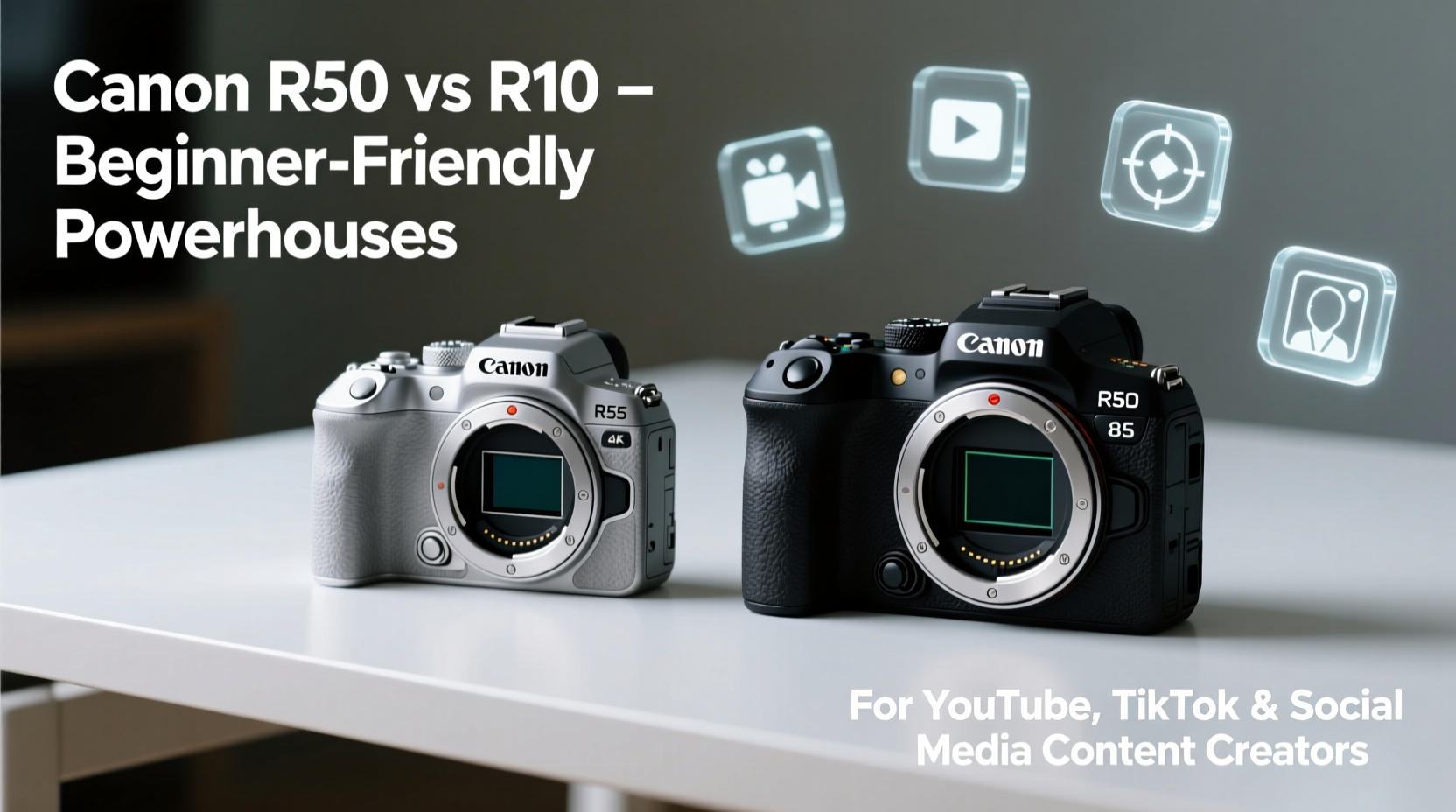
The physical experience of using a camera influences everything from shooting comfort to mobility. The Canon R50 and R10 share a similar aesthetic language with minimalist control layouts and deep grips, but their build quality and handling differ in subtle yet meaningful ways.
The R50 is designed with entry-level users in mind. It’s lighter at 375g (with battery), making it ideal for handheld vlogging or long shooting sessions. Its polycarbonate body keeps weight down but sacrifices some rigidity compared to higher-tier models. Buttons are simplified, and the mode dial is intuitive, reducing the learning curve for first-time DSLR or mirrorless users.
In contrast, the R10 weighs slightly more at 429g and features a more robust magnesium alloy chassis. While still compact, it feels sturdier and better suited for active shooting environments. It includes a secondary dial behind the shutter button—a small detail that significantly improves manual control during video recording or fast-paced photography.
Sensor and Image Quality: Same Chip, Different Processing
Both cameras use Canon’s 24.2MP APS-C CMOS sensor, ensuring comparable image resolution and dynamic range. However, the processing engine behind each model creates noticeable differences in performance.
The R50 uses the DIGIC X processor, which handles noise well up to ISO 3200—perfect for indoor lighting or evening shoots. Auto white balance tends to be slightly warmer, which flatters skin tones in vlogs but may require correction in color-critical work. Autofocus is responsive, especially in face and eye detection modes, though it occasionally hunts in low light.
The R10 also runs on DIGIC X but benefits from a more advanced autofocus algorithm inherited from the R3 and R5. It offers faster subject tracking, improved animal and vehicle detection, and quicker wake-up times. In practical terms, this means fewer missed shots when filming spontaneous moments or moving subjects.
For content creators relying on sharp, consistent visuals across platforms, the R10 pulls ahead—not because of the sensor, but due to superior data handling and buffer speed. It can shoot 15 fps with full AF/AE tracking versus the R50’s 12 fps, giving it an edge in capturing fast action or fleeting expressions.
Video Capabilities: 4K, Cropping, and Creator-Friendly Features
Video performance is where the divide between these two models becomes most apparent. Both support uncropped 4K 30p recording, a major upgrade over older Canon models that applied heavy crop factors. But there are key limitations to consider.
The R50 records 4K 30p using a slight pixel binning method, resulting in good detail but moderate moiré in high-frequency patterns like fabrics or architecture. It lacks a dedicated log profile, though C-Log3 is available via firmware update—but only in 10-bit HDMI output, not internally. Internal video is limited to 8-bit 4:2:0, restricting grading flexibility in post-production.
The R10 matches the R50’s 4K 30p spec but adds internal 10-bit 4:2:2 recording in MP4 format. This is a game-changer for editors working with multi-cam projects or needing clean footage for color correction. Combined with HDR PQ support, the R10 gives creators more professional-grade tools straight out of the camera.
Both models include a vari-angle touchscreen, essential for framing self-recorded videos. However, the R10’s screen is marginally brighter and more responsive to touch inputs during recording, reducing lag when switching focus points mid-shot.
“Internal 10-bit recording isn’t just a pro feature—it future-proofs your content as platforms like YouTube begin supporting wider color gamuts.” — Jordan Lee, Video Production Consultant
Autofocus and Usability for Solo Creators
One of the biggest challenges for solo content creators is maintaining sharp focus without a crew. Canon’s Dual Pixel CMOS AF II system performs admirably in both cameras, but implementation varies.
The R50 covers approximately 100% of the frame with autofocus points and includes reliable Eye Detection for humans and animals. It works well for static talking-head videos or slow pans. However, in dynamic scenes—such as walking while speaking—the focus can drift if the subject moves laterally across the frame.
The R10 improves upon this with deeper AI integration. It recognizes more facial angles, tracks heads even when partially obscured, and maintains lock-on during rapid movement. It also supports subject awareness modes (people, animals, vehicles) simultaneously, allowing seamless transitions when filming pets or outdoor activities.
Additionally, the R10 introduces pre-shooting functionality (0.5 seconds before shutter press), useful for capturing sudden reactions. While not critical for planned content, it adds insurance against missed moments.
| Feature | Canon R50 | Canon R10 |
|---|---|---|
| Autofocus Coverage | 100% | 100% |
| Eye AF (Human/Animal) | Yes / Yes | Yes / Yes |
| Vehicle Tracking | No | Yes |
| Pre-Shot Buffer | No | Yes (0.5s) |
| Touch-to-Focus During Video | Limited responsiveness | Faster, more accurate |
Battery Life and Connectivity: Real-World Workflow Considerations
Content creation often happens outside controlled environments. Battery longevity and connectivity options directly impact productivity.
The R50 uses the LP-E17 battery, the same found in older Rebel series DSLRs. It delivers around 230 shots per charge (CIPA rating), or roughly 80 minutes of continuous video. While usable, this necessitates carrying spares for full-day shoots. USB-C charging is supported, allowing power bank top-ups on location—a significant advantage for mobile creators.
The R10 uses the same battery but consumes more power due to its faster processor and higher burst rates. Still, real-world testing shows only a 10–15% difference in video runtime. What sets the R10 apart is its inclusion of a vertical grip option (optional BG-R10), enabling extended operation and better ergonomics with heavy lenses.
Connectivity-wise, both offer Wi-Fi and Bluetooth for smartphone pairing via Canon Camera Connect. However, the R10 supports FTP transfer and remote control via LAN adapter (with optional connector), appealing to creators who need wired reliability for live streaming or studio feeds.
Price and Value: Matching Budget to Goals
The R50 typically retails at $679 (body-only), positioning it as one of Canon’s most affordable RF-mount options. Bundles with the RF-S 18-45mm STM lens are common and ideal for beginners building a starter kit. Its low cost makes it accessible, but compromises in bit depth and build should be weighed carefully.
The R10 starts at $999 (body-only), a $320 premium that buys tangible upgrades: 10-bit internal video, faster burst shooting, better autofocus logic, and enhanced durability. For creators serious about scaling their production quality, this investment pays off in reduced post-processing time and greater creative flexibility.
Consider your growth trajectory. If you’re experimenting with content casually, the R50 suffices. But if you aim to monetize, collaborate with brands, or produce polished shorts, the R10 aligns better with long-term goals.
Mini Case Study: From TikTok Hobbyist to YouTube Creator
Alex, a college student starting a lifestyle channel, initially bought the R50 for its compact size and ease of use. He recorded dorm tours and campus events with solid results. After six months, his audience grew, and feedback highlighted flat colors and occasional focus shifts. Upgrading to the R10 allowed him to shoot in 10-bit, apply cinematic LUTs, and maintain focus during walking segments. His retention rate increased by 22%, and sponsors noted the improved visual consistency.
While the R50 launched his journey, the R10 enabled professionalism without changing workflows drastically.
Essential Checklist Before Buying
- Determine your primary content type: Talking head? Action vlogs? Product reviews?
- Evaluate lighting conditions: Will you shoot mostly indoors? Then prioritize low-light AF performance.
- Assess editing needs: Do you grade footage? If yes, 10-bit from the R10 is worth the cost.
- Plan lens investments: Both use RF-S mount; ensure compatibility with future glass.
- Test handling: Rent both models for a weekend to compare grip, menu navigation, and responsiveness.
Frequently Asked Questions
Can the Canon R50 or R10 be used for live streaming?
Yes, both support clean HDMI output, allowing connection to capture cards for OBS, Streamlabs, or Zoom. The R10’s 10-bit feed provides cleaner chroma keying for green screen work. Neither has built-in NDI or RTMP, so external software is required.
Is the RF-S 18-45mm lens good enough for professional-looking videos?
It’s a solid starter lens with quiet STM focusing and decent sharpness. However, its variable aperture (f/4.5–6.3) limits low-light performance. For more cinematic looks, pair either camera with the RF-S 10-18mm f/4.5–6.3 or RF 24-105mm f/4L IS USM for better reach and bokeh.
Do both cameras have a headphone jack for audio monitoring?
No. Neither the R50 nor R10 includes a 3.5mm headphone jack. You’ll need to monitor audio via HDMI to an external recorder or rely on visual level meters. This is a notable omission for audio-conscious creators.
Final Verdict: Choosing Your Creative Partner
The Canon R50 and R10 serve overlapping audiences but cater to different stages of the creator journey. The R50 excels as an entry point—affordable, lightweight, and capable of producing high-quality content under favorable conditions. It’s perfect for students, hobbyists, or those testing the waters of visual storytelling.
The R10, however, is built for progression. Its internal 10-bit recording, superior autofocus intelligence, and faster shooting mechanics make it a sustainable choice for creators aiming to grow beyond basic vlogs. It bridges the gap between beginner enthusiasm and semi-professional output.
Your decision should hinge not on today’s needs, but tomorrow’s ambitions. If you envision evolving your craft, investing in the R10 now avoids costly upgrades later. If simplicity and savings are paramount, the R50 remains a smart launchpad.




 浙公网安备
33010002000092号
浙公网安备
33010002000092号 浙B2-20120091-4
Comments
No comments yet. Why don't you start the discussion?