
For years, the standard split ring or leather loop has dominated how people carry their keys. But in recent years, carabiner keychains—borrowed from climbing gear—have surged in popularity. Marketed as rugged, quick-access tools for everyday carry, they’ve become staples on backpacks, belts, and EDC (everyday carry) kits. But beyond aesthetics and trendiness, do carabiners truly offer functional advantages over traditional keychains? Or are they just another niche accessory with exaggerated benefits?
The answer depends on lifestyle, usage patterns, and what you value in convenience. To make an informed decision, it’s essential to examine both designs across multiple practical dimensions: accessibility, durability, weight, security, and adaptability.
Durability: Built to Climb, Not Just Hold Keys
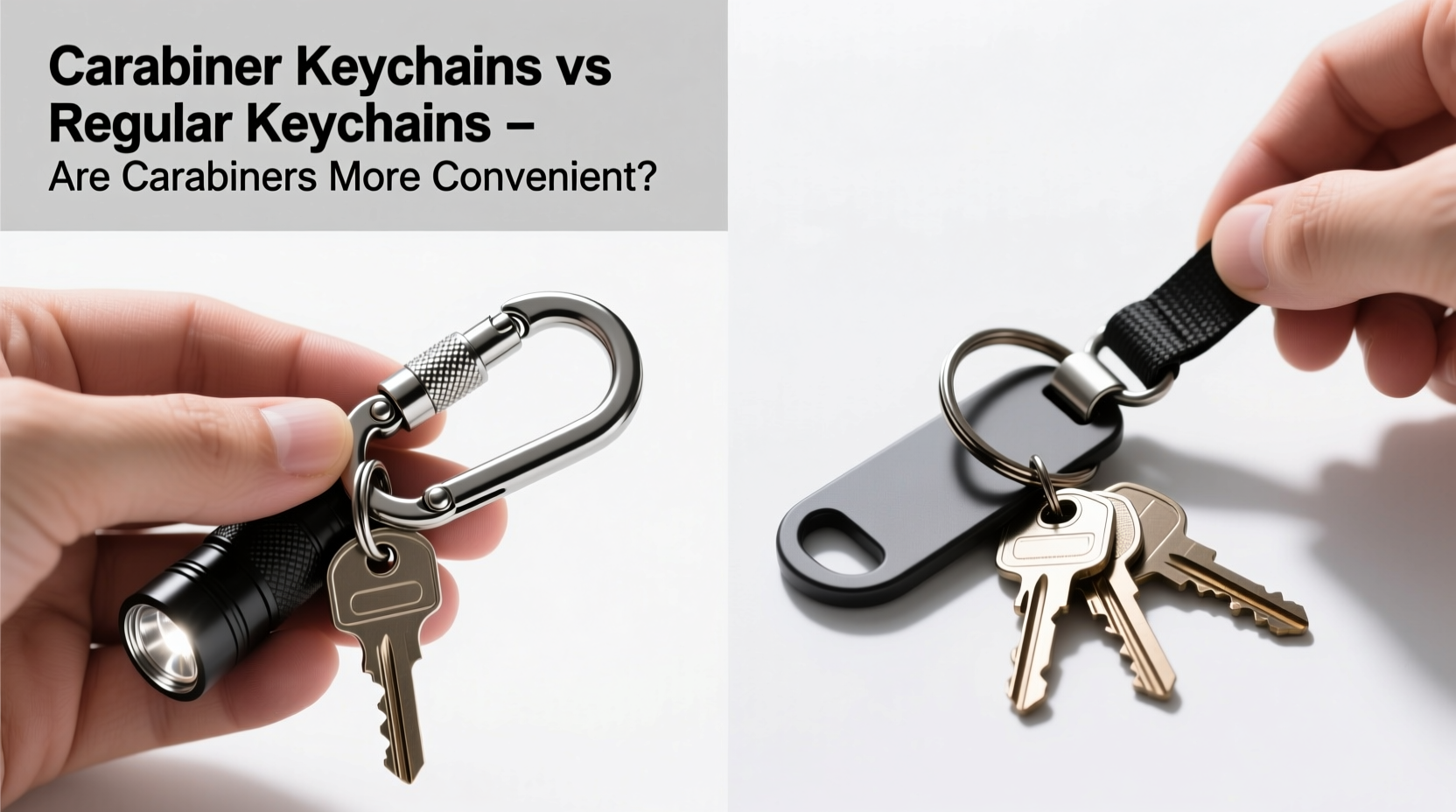
Carabiners were originally engineered for life-or-death situations in rock climbing and rescue operations. As such, they’re constructed from aerospace-grade aluminum or stainless steel and tested to withstand thousands of pounds of force. Even miniaturized versions designed for key storage maintain this structural integrity.
In contrast, most regular keychains use thin metal split rings, plastic connectors, or fabric loops that degrade over time. Split rings can bend, snap, or unravel when overloaded. Leather or nylon loops may fray or stretch. While adequate for light use, these materials lack the long-term resilience of a forged carabiner.
Accessibility and One-Handed Use
One of the strongest arguments for carabiner keychains is ease of access. Their spring-loaded gate allows users to attach and detach keys—or clip the entire unit onto bags, belts, or pockets—with one hand. This is especially useful when entering secured buildings, unlocking bikes, or managing gear during outdoor activities.
Traditional keychains often require two hands: one to hold the ring and another to thread keys through. Over time, this small friction adds up. Carabiners eliminate that step entirely. Once your keys are loaded onto a carabiner, swapping them between carriers becomes effortless.
Additionally, many modern carabiners feature magnetic gates or twist-lock mechanisms that prevent accidental opening while maintaining fast deployment. This blend of safety and speed is difficult to replicate with conventional designs.
Security Comparison: Do Carabiners Stay Closed?
A common concern about carabiner keychains is whether they’ll accidentally open and drop your keys. Early models did have issues with gate flutter—especially when jostled in pockets—but today’s locking variants address this effectively.
Screw-lock and auto-lock carabiners require deliberate action to open, making them significantly more secure than basic split rings, which can pop open if snagged on fabric or furniture. In fact, split rings are responsible for countless lost keys due to partial uncoiling.
“Modern locking carabiners offer superior retention compared to traditional rings. The risk isn’t the design—it’s using non-locking models in high-motion environments.” — Daniel Reyes, Outdoor Gear Engineer at Alpine Innovations
Weight and Bulk: Practical Trade-offs
While carabiners excel in strength and function, they come with trade-offs. Most are heavier than standard key rings. A typical aluminum carabiner weighs 15–30 grams; add steel models, and you’re looking at 50+ grams before keys are even attached.
For someone carrying only house and car keys, this added mass might feel unnecessary. However, for those with multi-tool setups, flashlights, USB drives, or bike locks, the extra weight is negligible compared to the organizational benefit.
Bulk is another consideration. Carabiners protrude more than flat rings, which can make pocket carry less comfortable. Some users solve this by clipping them to belt loops or backpack zippers instead—turning a potential downside into a strategic advantage.
Comparison Table: Carabiner vs Regular Keychains
| Feature | Carabiner Keychain | Regular Keychain |
|---|---|---|
| Durability | High – made from aerospace metals | Low to moderate – prone to bending/fraying |
| One-Handed Use | Yes – easy clip/unclip | No – usually requires two hands |
| Security | High (with locking gate) | Moderate – split rings can loosen |
| Weight | Heavier (15–60g) | Light (under 10g) |
| Adaptability | Excellent – clips to bags, belts, MOLLE | Limited – mostly ring-based attachment |
| Pocket Comfort | Fair – bulkier profile | Good – low-profile design |
Real-World Example: Urban Commuter vs Outdoor Enthusiast
Consider two individuals: Maya, a city commuter who walks to work and uses public transit, and Jordan, a trail runner and weekend camper.
Maya carries three keys: home, office, and mailbox. She keeps them in her jacket pocket. A slim leather key fob or micro-split ring works perfectly for her—lightweight, quiet, and discreet. Switching to a carabiner would add noticeable bulk without meaningful benefit.
Jordan, however, attaches his keys to a carabiner clipped to his hydration pack. During runs, he frequently needs to access a lock for his bike or gate. With frozen fingers in winter, the one-handed operation of his magnetic-lock carabiner makes all the difference. He also trusts it won’t fail mid-hike. For him, the slight weight gain is justified by reliability and speed.
This contrast shows that convenience isn’t universal—it’s contextual.
Step-by-Step: How to Choose the Right Keychain for Your Lifestyle
- Assess your daily routine: Do you walk, cycle, drive, or commute via transit? High-movement lifestyles favor carabiners.
- Count your keys and tools: More than four items? A carabiner helps organize and distribute weight.
- Evaluate carry method: Pocket carry favors compact rings; bag, belt, or pack clips favor carabiners.
- Test for security needs: If losing keys would be disruptive (e.g., no spare), opt for a locking carabiner.
- Try both: Spend a week with each type. Note frustration points like fumbling, noise, or discomfort.
Common Myths About Carabiner Keychains
- Myth: All carabiners are the same.
Reality: There are major differences between climbing-rated, EDC-grade, and novelty carabiners. Only use those rated for load-bearing applications. - Myth: They’re too loud.
Reality: Modern versions include rubber silencers or smooth-action gates to minimize noise. - Myth: They damage keys.
Reality: When properly sized, carabiners don’t cause wear. Oversized gates that let keys rattle loose are the real culprit.
Checklist: Is a Carabiner Right for You?
- ☐ I carry more than three keys or tools
- ☐ I frequently switch where I carry my keys (pocket → bag → belt)
- ☐ I need one-handed access in cold or wet conditions
- ☐ I prioritize durability over minimalism
- ☐ I already use or own gear with attachment loops (backpacks, tactical vests, etc.)
If three or more apply, a carabiner keychain is likely a smart upgrade.
Frequently Asked Questions
Can I use any carabiner for keys?
No. Avoid cheap, unmarked carabiners from generic retailers—they may not meet safety standards. Opt for reputable EDC brands like Nite Ize, Black Diamond, or GRIZZLY that specify strength ratings and locking mechanisms.
Do carabiners scratch phones or other items in my pocket?
Possibly. Metal-on-metal contact can cause micro-scratches. To prevent this, choose models with powder-coated finishes or store them in a dedicated pouch when carried alongside sensitive devices.
Are there lightweight carabiner options?
Yes. Many manufacturers offer titanium or ultra-light aluminum models weighing under 15 grams. These balance strength and portability for minimalist users.
Final Verdict: Convenience Redefined, Not Guaranteed
Carabiner keychains aren’t inherently “better” than regular keychains—they redefine convenience for specific needs. If your life involves movement, multitasking, or outdoor activity, the ability to clip, unclip, and secure your keys quickly offers tangible benefits. The added durability and peace of mind are bonuses.
But if you value silence, slim profiles, and simplicity, a well-made split ring or minimalist key holder remains a perfectly valid choice. The goal isn’t to follow trends, but to match your tool to your lifestyle.




 浙公网安备
33010002000092号
浙公网安备
33010002000092号 浙B2-20120091-4
Comments
No comments yet. Why don't you start the discussion?