
Understanding the carbohydrate content of common ingredients is essential for anyone managing blood sugar, following a low-carb or ketogenic diet, or simply aiming for balanced nutrition. Onions—ubiquitous in global cuisines—are often assumed to be low in carbohydrates due to their vegetable classification. However, their natural sugars contribute more carbs than many realize, especially when used in volume. A single onion’s carbohydrate count varies significantly by size, variety, and preparation method. This article provides a precise, science-backed analysis of onion carbs, empowering home cooks and health-conscious eaters to use onions strategically without compromising dietary goals.
Definition & Overview
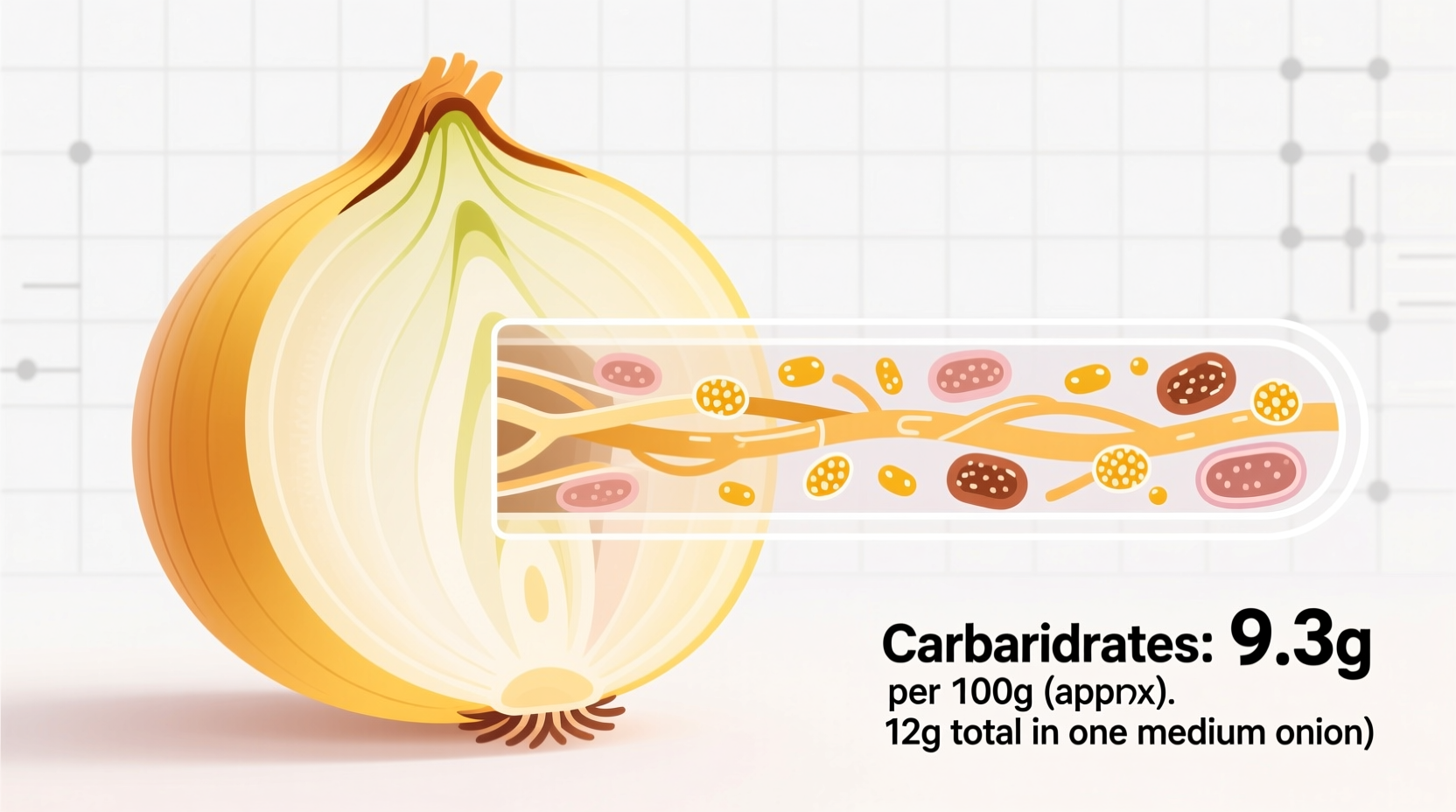
Onions (Allium cepa) are biennial plants cultivated as annuals, belonging to the Amaryllidaceae family, which includes garlic, leeks, and shallots. They grow underground as bulbous structures composed of layered fleshy scales, protecting a central bud. Onions have been cultivated for over 5,000 years, with origins traced to Central Asia. Today, they are a culinary cornerstone across cultures—from French mirepoix and Indian tadka to Mexican salsas and Middle Eastern salads.
Botanically classified as vegetables, onions are nutritionally complex. While rich in fiber, vitamin C, B vitamins (especially B6 and folate), and antioxidants like quercetin, they also contain naturally occurring sugars that contribute to digestible carbohydrates. Their flavor profile ranges from sharp and pungent when raw to sweet and savory when cooked, making them both a functional base ingredient and a standalone component in dishes.
Key Characteristics
Onions vary widely in appearance, taste, and composition. The following table outlines key characteristics of major onion types relevant to carbohydrate content and culinary use:
| Type | Color/Appearance | Flavor Profile | Average Carbs per 100g | Primary Culinary Use |
|---|---|---|---|---|
| Yellow Onion | Brown papery skin, white flesh | Pungent raw, sweet when caramelized | 9–10 g | Sautéing, roasting, soups, stews |
| White Onion | Thin white skin, crisp white flesh | Sharp, slightly hotter than yellow | 8–9 g | Mexican cuisine, salsas, pickling |
| Red Onion | Purple-red skin and flesh | Mild, slightly sweet, tangy | 8.5–9.5 g | Raw applications, grilling, salads |
| Shallot | Copper skin, grayish-purple flesh | Delicate, garlicky-sweet | 16–17 g | Vinaigrettes, sauces, fine dining |
| Green Onion (Scallion) | Long green tops, small white bulb | Mild, fresh, grassy | 7–8 g | Garnishes, stir-fries, Asian dishes |
The variation in carbohydrate density reflects differences in water content, sugar concentration, and cell structure. For example, shallots are smaller and denser, with less water and higher sugar content, resulting in nearly double the carbs per gram compared to scallions.
Carbohydrate Breakdown by Onion Size
To determine the total carbohydrate count in a single onion, size must be considered. Onions are typically categorized as small (≤2\"), medium (2–3\"), and large (≥3\") in diameter. The USDA National Nutrient Database provides standardized values based on edible portion weight.
Below is a detailed carbohydrate calculation for a raw yellow onion—the most commonly used variety:
- Small onion (2\", ~100g): 9.3 g total carbohydrates
- Medium onion (2.5\", ~150g): 14.0 g total carbohydrates
- Large onion (3.5\", ~200g): 18.6 g total carbohydrates
Of these totals, approximately 1.5–2.0 grams per 100g come from dietary fiber, meaning net digestible carbs (total carbs minus fiber) range from:
- Small: ~7.8 g net carbs
- Medium: ~11.8 g net carbs
- Large: ~15.6 g net carbs
For individuals limiting daily net carb intake to 20–50 grams (as in ketogenic diets), a single large onion can represent up to 78% of their allowance. This underscores the importance of portion control and substitution strategies in low-carb cooking.
Pro Tip: When tracking carbs, weigh your onion before cooking. Water loss during sautéing or roasting concentrates sugars and increases carb density per bite—even if total carbs remain unchanged.
Practical Usage in Cooking
Onions serve multiple functions in the kitchen: flavor foundation, texture enhancer, color contributor, and aroma builder. How they are used directly affects their carbohydrate impact on a dish.
Raw Applications
In salads, salsas, ceviche, or sandwiches, raw onions contribute their full carbohydrate load without alteration. Red and white onions are preferred here due to their brighter flavor and crisp texture. Because raw onions retain all moisture and sugars, even a quarter-cup (about 40g) adds roughly 3.5g of total carbs (2.8g net).
To reduce carb intake while preserving bite and flavor:
- Use red onion sparingly—its vibrant color means less is needed for visual impact.
- Soak sliced onions in ice water for 10 minutes to mellow pungency, allowing greater perceived flavor with smaller quantities.
- Substitute part of the onion with jicama or cucumber for crunch with fewer carbs.
Cooked Applications
Cooking transforms onions chemically. As heat breaks down polysaccharides, natural sugars (fructose, glucose, sucrose) caramelize, enhancing sweetness. While total carbohydrate mass remains stable (minus minor evaporation), the perception of sugar increases dramatically.
For example, 1 cup of sliced raw yellow onion (~160g) contains about 15g total carbs (12.5g net). After 30 minutes of slow caramelization, it reduces to ¼ cup, concentrating flavors—and carbs—into a much smaller volume. Each tablespoon of caramelized onion then contains ~1.5g net carbs, making it potent in flavor but dense in sugars.
In professional kitchens, chefs balance this by:
- Using a combination of onions and celery in mirepoix to dilute carb density.
- Adding a splash of vinegar at the end of caramelization to cut sweetness and restore balance.
- Finishing dishes with raw scallion garnish to deliver onion flavor with minimal carb load.
Low-Carb Substitutions and Modifications
For those strictly managing carbohydrate intake, complete elimination of onions isn’t necessary—strategic adaptation is.
Smart Swaps:
• Replace half the onion in soups/stews with diced celery or fennel.
• Use asafetida (hing) powder (¼ tsp) in oil to mimic onion-garlic depth in Indian dishes—near-zero carbs.
• Opt for green onions—lower in sugar and often used in smaller amounts.
Variants & Types: Carb Content Compared
Different onion types offer distinct advantages depending on dietary needs and culinary goals. Understanding their carbohydrate profiles helps optimize usage.
Shallots vs. Regular Onions
Shallots have gained popularity in gourmet cooking for their refined taste. However, per gram, they contain nearly twice the carbohydrates of yellow onions (16.8g vs. 9.3g per 100g). A single average shallot (~35g) delivers ~6g total carbs (5g net)—equivalent to a small yellow onion despite its size.
Best used where intense flavor is needed in small doses: vinaigrettes, pan sauces, or glazes. Not ideal for bulk sautéing if minimizing carbs.
Green Onions (Scallions)
With only 7.3g of total carbs per 100g, green onions are the lowest-carb allium option. The white bulbous end has slightly more sugar than the green stalk, but overall, they provide onion essence with minimal metabolic impact. One full scallion (~10g) contains just 0.7g total carbs.
Ideal for garnishing tacos, ramen, omelets, or stir-fries where you want onion presence without significant carb contribution.
Storage and Sweet Onions
Varieties like Vidalia, Walla Walla, and Maui are marketed as “sweet” due to lower sulfur compounds and higher water and sugar content. Despite being juicier, their total carbohydrate count is similar to yellow onions—around 8–9g per 100g—but perceived sweetness is greater because fructose levels are elevated.
These are excellent for grilling or eating raw but should be measured carefully in low-carb plans. A whole medium Vidalia (~150g) still contributes ~13.5g total carbs.
Comparison with Similar Ingredients
Onions are frequently confused with other alliums or mistaken for low-carb vegetables. The table below clarifies key differences:
| Ingredient | Carbs per 100g | Flavor Role | Best Low-Carb Alternative? |
|---|---|---|---|
| Yellow Onion | 9.3 g | Base aromatic, savory depth | No — moderate carb load |
| Garlic | 33.1 g | Pungent, spicy accent | No — very high in carbs |
| Leek (bulb only) | 14.2 g | Mild onion-garlic note | No — higher than onion |
| Fennel Bulb | 7.0 g | Anise-like, crisp texture | Yes — lower carb, similar crunch |
| Celery | 3.0 g | Earthy, watery base | Yes — excellent mirepoix diluter |
| Jicama | 8.8 g | Neutral, crunchy | Yes — for raw applications |
This comparison reveals that while onions are not the highest-carb allium, garlic and leeks surpass them significantly. Meanwhile, non-allium vegetables like celery and fennel offer structural and textural parallels with reduced carbohydrate impact.
Impact of Cooking Methods on Carbohydrate Availability
Although cooking does not destroy carbohydrates, it alters their bioavailability and sensory expression.
- Sautéing: Begins breaking down cell walls, releasing sugars. Minimal water loss means carb concentration stays close to raw levels.
- Caramelizing: Extended heat converts polysaccharides into simple sugars via Maillard reaction and pyrolysis. No carbs are lost, but sweetness intensifies, potentially increasing insulin response.
- Roasting: Evaporates moisture, shrinking volume and concentrating all nutrients—including carbs. A roasted onion has the same total carbs as raw but delivers them in a smaller space.
- Pickling: Adds vinegar and sometimes sugar, which may increase total carbs depending on brine formulation. Homemade versions using water, vinegar, and salt add negligible carbs.
For diabetics or insulin-sensitive individuals, monitoring how cooking affects glycemic response is crucial—even if total carbs appear unchanged.
Practical Tips & FAQs
Q: Are onions safe on a keto diet?
A: In moderation. A small amount (e.g., ¼ cup chopped, ~40g) adds ~3.7g total carbs (3g net), fitting within most keto frameworks. Avoid large servings or caramelized versions unless accounted for in macros.
Q: Can I eat onions raw to reduce carb impact?
A: Raw onions don’t have fewer carbs, but they’re often used in smaller quantities due to pungency, indirectly reducing intake. Soaking can make larger portions palatable without added sugars.
Q: Do green onions count as low-carb?
A: Yes. At 7.3g per 100g and typically used in garnish amounts, green onions are one of the most keto-friendly alliums.
Q: How should I store onions to preserve freshness and nutrition?
A: Keep whole, unpeeled onions in a cool, dry, dark place with good airflow. Avoid refrigeration unless peeled or cut (then store in a sealed container for up to 10 days). Exposure to light or moisture accelerates sprouting and spoilage.
Q: What’s the best way to measure onion portions for carb counting?
A: Use a kitchen scale. Volume measurements (cups) vary widely based on chop size and density. Weighing ensures accuracy—especially important for medical diets like keto or diabetic meal planning.
Q: Does sprouting affect onion carbs?
A: Sprouted onions begin converting stored starches into energy for growth, potentially altering carbohydrate composition slightly. However, data is limited. From a safety and taste standpoint, sprouted onions become bitter and fibrous—best avoided.
Expert Insight: \"In clinical nutrition, we teach patients to treat onions like fruit—not because they’re sugary, but because their natural fructose content requires mindful portioning. Think of an onion not as a free vegetable, but as a flavorful seasoning.\" — Dr. Lena Torres, Registered Dietitian & Diabetes Educator
Summary & Key Takeaways
The carbohydrate count in a single onion depends on its type, size, and preparation. A medium yellow onion (150g) contains approximately 14g of total carbohydrates, with 11.8g of net digestible carbs—significant for low-carb dieters. Shallots are higher in carbs per gram, while green onions and certain substitutes like celery or fennel offer lower-impact alternatives.
Key points to remember:
- Onions are nutrient-dense but not carb-free; portion control is essential for keto, diabetic, or low-sugar diets.
- Raw and cooked onions have similar total carb counts, but cooking concentrates flavor and perceived sweetness.
- Green onions, asafetida, and vegetable blends can reduce carb load while maintaining savory depth.
- Always weigh onions for accurate carb tracking—volume measures are unreliable.
- Pair onions with high-fiber or high-fat ingredients to slow glucose absorption and stabilize blood sugar.
Onions remain indispensable in cooking, but treating them with the same precision as any other ingredient—especially one with measurable carbohydrates—ensures both culinary success and nutritional integrity. Whether building a stew, crafting a salad, or managing a medical diet, knowing the exact carb cost of a single onion empowers smarter, more informed choices in the kitchen.
Take Action: Next time you cook, weigh your onion and log the carbs. You might be surprised how quickly they add up—and how easily small adjustments can align flavor with health goals.




 浙公网安备
33010002000092号
浙公网安备
33010002000092号 浙B2-20120091-4
Comments
No comments yet. Why don't you start the discussion?