
For indoor cats, environmental stimulation is essential to prevent boredom, reduce stress, and support overall health. Without access to the outdoors, cats miss out on natural behaviors like hunting, exploring, and chewing on plants. That’s where cat-safe greens come in—specifically, cat grass and catnip. While both are marketed as enriching additions to a cat’s environment, they serve very different purposes. Understanding their distinctions helps owners make informed decisions about what best supports their feline companions.
Cat grass typically refers to young cereal grasses such as wheatgrass, oat grass, barley, or rye. Catnip, on the other hand, is a member of the mint family known for its psychoactive effects on cats due to the compound nepetalactone. Though both can be grown at home and offered to cats, their impact on behavior, digestion, and mental stimulation varies significantly. Choosing between them—or deciding to offer both—depends on your cat’s temperament, dietary needs, and reaction patterns.
What Is Cat Grass and Why Do Cats Eat It?
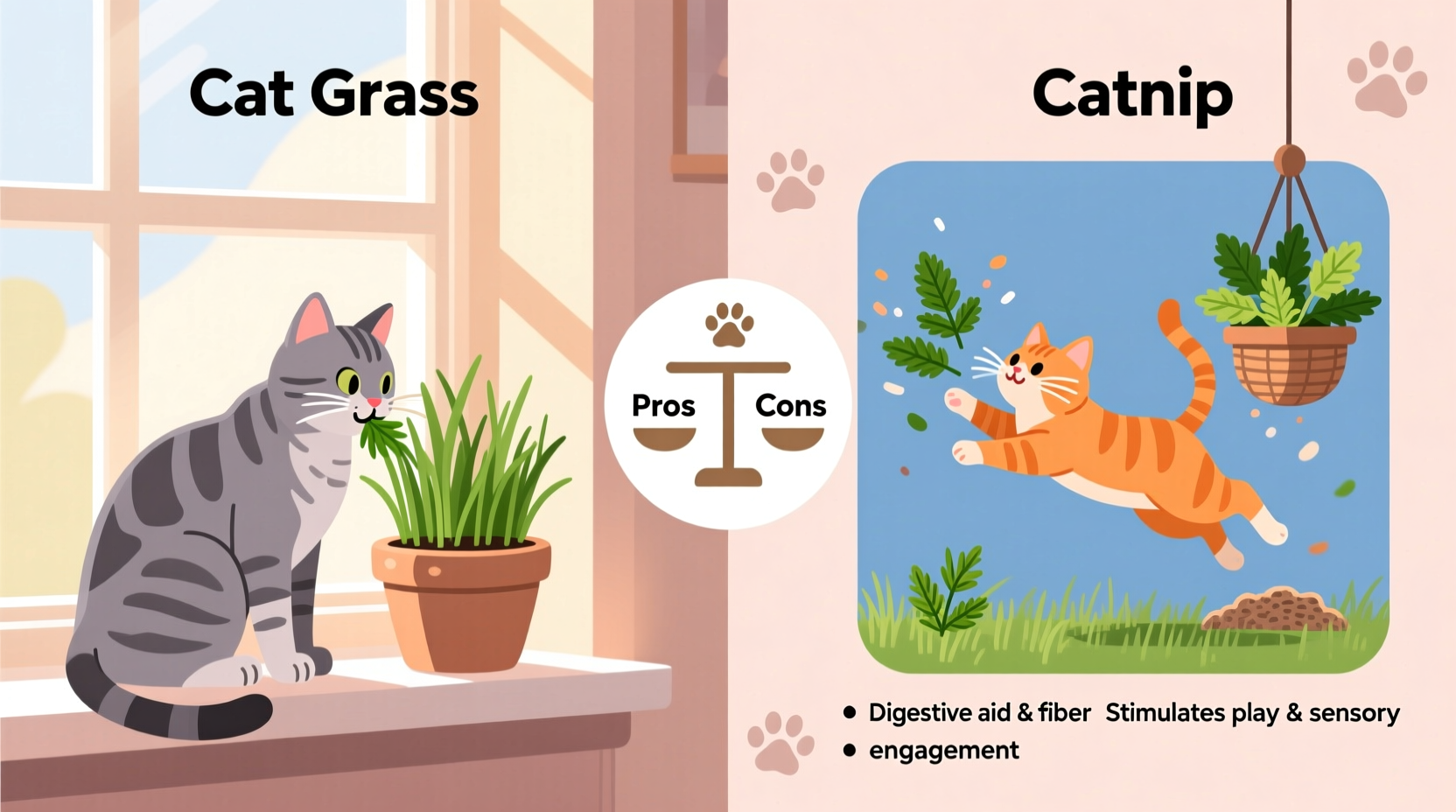
Cat grass is not a single plant but a general term for non-toxic, young grasses grown from seeds like wheat, oats, barley, or rye. These grasses are rich in chlorophyll, fiber, and certain nutrients that may aid digestion. Many cats instinctively chew on grass in the wild, and indoor cats retain this behavior. While the exact reason isn’t fully understood, several theories explain why cats seek out grass:
- Digestive aid: Grass may help cats regurgitate indigestible materials like fur or feathers, acting as a natural emetic when needed.
- Fiber supplementation: The fibrous texture supports intestinal motility and may reduce hairball formation.
- Nutritional boost: Grass contains folic acid (vitamin B9), which plays a role in oxygen transport via hemoglobin production.
- Behavioral satisfaction: Chewing satisfies natural foraging instincts and provides oral stimulation.
Unlike catnip, cat grass does not produce a euphoric or hallucinogenic effect. Instead, it functions more like a functional food—offering subtle physiological benefits while satisfying innate behaviors. Most cats consume small amounts daily without adverse effects, though excessive ingestion may lead to vomiting, especially if eaten rapidly.
How Catnip Works and Which Cats Respond to It
Catnip (Nepeta cataria) is a perennial herb in the Lamiaceae family, native to Europe and parts of Asia but now widespread in North America. Its active ingredient, nepetalactone, binds to receptors in a cat’s nasal tissue that stimulate sensory neurons leading to the brain’s limbic system—the region associated with emotion and behavior.
The response to catnip is hereditary and affects only about 50–70% of cats. Kittens under six months and senior cats are less likely to react. When responsive cats encounter catnip, they may exhibit one or more of the following behaviors:
- Rubbing, rolling, or chin-rubbing the plant
- Vocalizing or meowing excitedly
- Hyperactivity or playful bursts
- Zoning out or appearing “trance-like”
- Aggression or avoidance (rare)
These effects last approximately 5 to 15 minutes, after which the cat becomes temporarily immune to further stimulation for about 30 minutes. After that window, sensitivity resets.
“Catnip doesn’t work on all cats, and that’s perfectly normal. It’s a genetic trait, much like tasting cilantro as soapy. For those who do respond, it can be a powerful tool for play and stress relief.” — Dr. Lena Torres, Feline Behavior Specialist
Interestingly, some big cats—including lions and jaguars—also respond to catnip, suggesting an evolutionary basis for the reaction. However, domestic cats vary widely in their sensitivity, and repeated exposure doesn’t increase responsiveness.
Comparative Benefits: Cat Grass vs Catnip
To determine which option offers greater value for indoor feline enrichment, it's helpful to compare their roles across key categories. The table below outlines the primary differences:
| Feature | Cat Grass | Catnip |
|---|---|---|
| Primary Purpose | Digestive support, nutritional supplement, behavioral outlet | Behavioral stimulation, mood enhancement, play encouragement |
| Effect on Cats | Calming or neutral; may induce mild vomiting if overeaten | Euphoric, stimulating, or sedative depending on cat |
| Response Rate | Nearly all cats will nibble or show interest | Only 50–70% of cats respond genetically |
| Safety Profile | Very safe; non-toxic and digestible in moderation | Safe, but overstimulation possible in sensitive cats |
| Lifespan of Use | Lasts 1–3 weeks before needing replacement | Can be reused dried; effects diminish with exposure frequency |
| Growing Difficulty | Easy; grows quickly indoors with sunlight | Moderate; prefers outdoor conditions but can grow indoors |
| Best For | Daily routine, digestive health, hairball management | Play sessions, reducing anxiety, encouraging activity |
This comparison shows that neither option is universally “better.” Instead, each serves distinct functions. Cat grass supports physical health and routine enrichment, while catnip enhances emotional well-being through temporary behavioral shifts.
When to Use Each—And How to Combine Them
The ideal approach for most indoor households is not choosing one over the other, but integrating both into a holistic enrichment strategy. Here’s how:
- Use cat grass as a daily staple: Place a small pot near your cat’s favorite resting spot or feeding area. Replace every two to three weeks or when it starts to yellow.
- Offer catnip selectively: Use during playtime with toys stuffed with dried catnip, or sprinkle a pinch on scratching posts to encourage use.
- Rotate offerings: To prevent habituation, alternate between catnip and silver vine (a related stimulant) every few weeks.
- Observe reactions: Some cats become overly excited by catnip and may benefit more from the calming presence of grass.
- Combine in multi-sensory setups: Create an indoor “garden” corner with cat grass growing beside a catnip toy or planter.
Mini Case Study: Enrichment Transformation in a Sedentary Senior Cat
Milo, a 10-year-old indoor tabby, had become increasingly inactive over six months. His owner, Sarah, noticed he spent most days sleeping and showed little interest in toys. Concerned about weight gain and low mood, she consulted a veterinary behaviorist who recommended introducing both cat grass and controlled catnip sessions.
Sarah started with a wheatgrass kit placed near the windowsill. Within days, Milo began nibbling daily, often after meals. Over two weeks, his bowel movements became more regular, and he seemed more alert. Then, she introduced catnip in a stuffed mouse toy twice weekly. Though initially hesitant, Milo eventually rolled and batted at the toy with renewed energy.
After one month, Sarah reported increased activity levels, reduced hairballs, and improved engagement. The combination provided both physical comfort (via grass) and mental stimulation (via catnip), proving that dual enrichment strategies can revitalize even older, less active cats.
Step-by-Step Guide to Growing and Using Cat Grass and Catnip
Both plants can be grown at home with minimal effort. Follow this timeline to establish a sustainable supply:
- Week 1: Prepare Supplies
- Cat grass: Seeds (wheat, oat, or barley), shallow container with drainage, organic soil
- Catnip: Nepeta cataria seeds, larger pot (12” deep), well-draining soil
- Week 2: Plant and Germinate
- Sow cat grass seeds densely on soil surface; mist daily. Expect sprouts in 3–7 days.
- Plant catnip seeds ¼ inch deep; keep in warm, sunny spot. Germination takes 5–14 days.
- Week 3–4: Growth and First Use
- Cat grass reaches 4–6 inches tall—safe to introduce. Trim occasionally to promote regrowth.
- Catnip seedlings should be thinned to 12” apart. Not yet ready for feline use.
- Month 2: Ongoing Care
- Harvest cat grass by cutting tops; it will regrow 1–2 times before replanting.
- Catnip can be lightly pinched back to encourage bushiness. Begin offering dried leaves after 8 weeks.
- Ongoing: Rotation and Refresh
- Start new batches of cat grass every 2–3 weeks for continuous supply.
- Dry excess catnip by hanging stems upside down in a dark, dry room. Store in airtight containers.
Frequently Asked Questions
Can cats eat too much cat grass?
While cat grass is non-toxic, excessive consumption may cause vomiting or diarrhea. Most cats self-regulate, but if your cat eats large amounts rapidly, limit access or offer smaller portions. Persistent vomiting warrants a vet visit to rule out underlying issues.
Is catnip safe for kittens?
Catnip is safe but generally ineffective in kittens under 3–6 months old. Sensitivity develops with maturity. Avoid forcing exposure; wait until your kitten shows curiosity or reacts naturally.
Are there alternatives to catnip for non-responsive cats?
Yes. Silver vine (Actinidia polygama) and valerian root elicit responses in up to 80% of cats, including many who don’t react to catnip. Tatarian honeysuckle is another option, particularly for older or mellow cats.
Final Recommendations and Action Plan
When evaluating cat grass versus catnip for indoor feline enrichment, the answer isn’t either/or—it’s both/and. Cat grass delivers consistent, health-oriented benefits suitable for daily use, while catnip offers episodic joy and stimulation ideal for play and bonding. Together, they form a balanced enrichment foundation that addresses both physical and psychological needs.
Every cat is unique. Some thrive on the calm ritual of grazing; others light up at the scent of catnip. Observing your cat’s preferences allows you to tailor their environment effectively. Start with a simple pot of cat grass and a small amount of dried catnip. Track behavior, digestion, and engagement over time. Adjust based on what brings your cat comfort, movement, and happiness.




 浙公网安备
33010002000092号
浙公网安备
33010002000092号 浙B2-20120091-4
Comments
No comments yet. Why don't you start the discussion?