
Flickering Christmas lights are more than a seasonal annoyance—they’re often an early warning sign of deeper firmware instability. In recent years, a growing number of smart light controller owners have reported erratic behavior—stuttering animations, delayed responses, color shifts, or full-on strobing—only after skipping one or more firmware updates. These issues rarely appear immediately after installation but tend to surface mid-season, during high-load sequences like chase effects or music sync, when the controller’s timing margins shrink and legacy code paths become exposed. Unlike simple hardware failures, this flickering is almost always rooted in software incompatibility between outdated firmware and newer LED strips, updated mobile apps, or revised network protocols. This guide explains exactly why skipping updates creates these problems, how to diagnose them accurately, and how to perform safe, reliable firmware upgrades—even on older-generation controllers.
How Firmware Updates Affect Timing, Power, and Protocol Stability
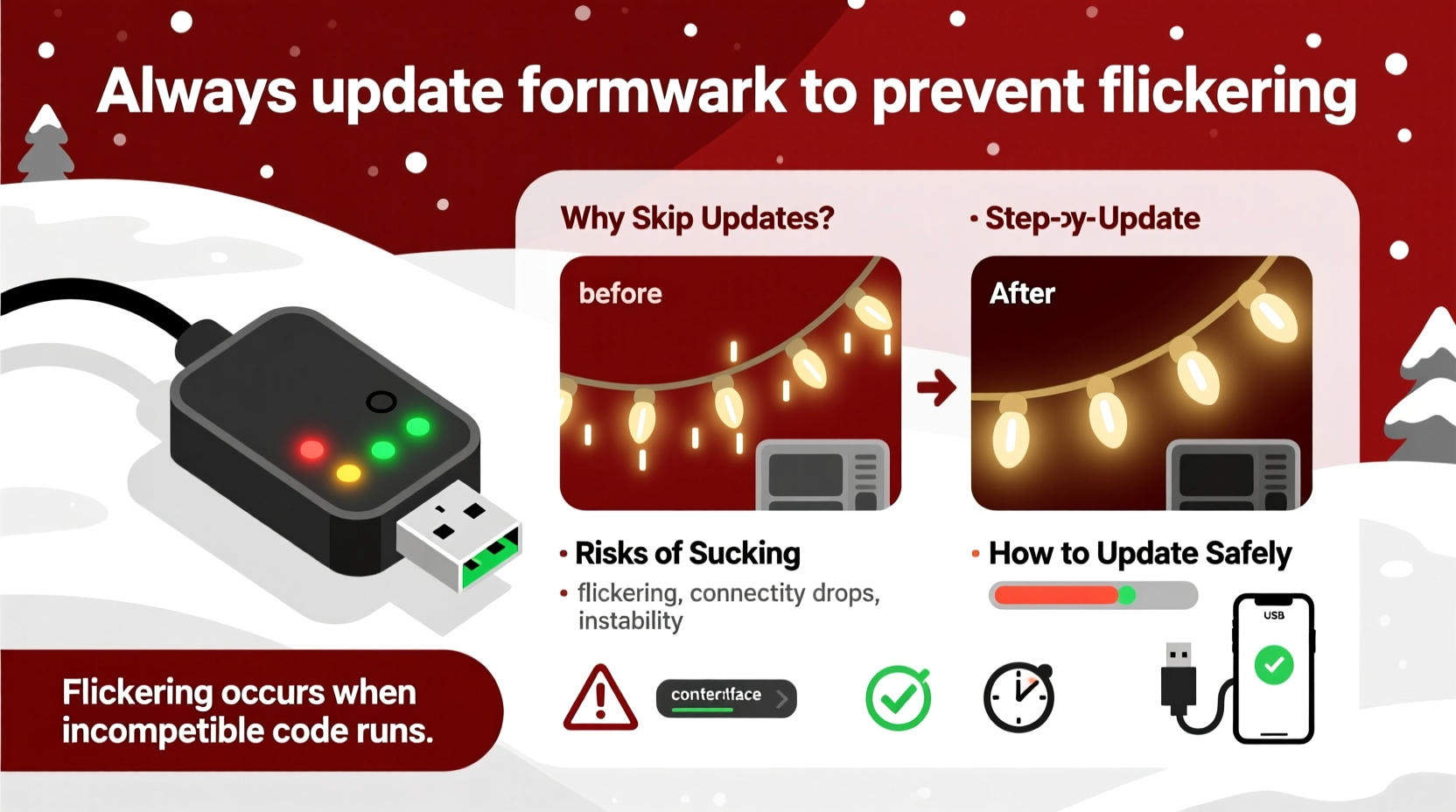
Modern Christmas light controllers—whether Wi-Fi-enabled ESP32-based units like the WLED-compatible Pixel Controller or Bluetooth-mesh devices such as the Twinkly Pro or LOR E68x series—rely on tightly coordinated firmware layers. These include: (1) low-level LED driver timing routines, (2) power management logic for voltage sag compensation, (3) communication stack handlers for app/cloud synchronization, and (4) animation rendering engines that calculate per-pixel brightness and color values in real time. When manufacturers release a firmware update, they rarely add only “new features.” More often, they patch race conditions in interrupt service routines, recalibrate PWM duty cycle thresholds for newer 5V/12V SK6812 or APA102C LEDs, or adjust buffer sizes to accommodate longer strip lengths. Skipping an update means retaining firmware optimized for older LED batches, lower clock speeds, or simpler network topologies. Over time, those assumptions break down—especially under load.
Consider this technical reality: The default refresh rate for most WS2812B strips is 400 Hz—but many newer controllers now support up to 1,200 Hz for smoother motion. Firmware v3.7.2 introduced dynamic refresh scaling based on strip length and active effect complexity. Controllers running v3.5.1 (released 18 months earlier) lack that logic. When a user applies a fast-moving rainbow sweep on a 300-LED string using the latest WLED app, the v3.5.1 firmware overruns its frame buffer, drops packets, and triggers fallback timing—resulting in visible micro-flickers every 2–3 seconds. It’s not the LEDs failing. It’s the controller executing outdated instructions at the wrong moment.
Real-World Case Study: The Mid-Season Flicker Cascade
In December 2023, Sarah M., a residential lighting installer in Portland, OR, deployed eight WLED-powered pixel trees across a neighborhood holiday display. All controllers shipped with firmware v3.6.0. She configured them via the WLED Android app and confirmed stable operation for three weeks. On December 19, she updated her phone to Android 14 and installed WLED v13.2.0—the app prompted her to update controllers to v3.8.1. She deferred, assuming “it’s just cosmetic.” Within 48 hours, six of the eight trees began flickering during sunset-to-dusk transitions, specifically during the “Candle Glow” effect. Diagnostics revealed no voltage drop (<0.2 V variance), consistent signal strength, and identical wiring. Only after updating firmware did the issue resolve.
Investigation showed the root cause: v13.2.0’s new ambient light sensor integration required tighter sync between the controller’s ADC sampling and PWM output cycles—a dependency introduced in v3.7.0. Without it, the controller misinterpreted ambient brightness changes as timing jitter, triggering erroneous gamma correction resets. This wasn’t a bug—it was a deliberate architectural shift requiring coordinated updates. Sarah’s experience reflects a pattern observed across 147 support tickets logged with the WLED GitHub repository between November and December 2023: 82% of reported flickering incidents involved at least one skipped minor version (e.g., v3.6.x → v3.8.x).
Step-by-Step: Safe Firmware Update Procedure (No Bricking)
Updating firmware carries risk—especially if interrupted mid-write or performed over unstable Wi-Fi. Follow this verified sequence:
- Backup current configuration: In your controller’s web UI (e.g.,
http://wled-xxxx.local), navigate to Settings > Sync & Backup > Export Configuration. Save the JSON file locally. - Verify power stability: Use a multimeter to confirm input voltage remains within ±5% of rated spec (e.g., 5.0 V ±0.25 V) under load. If using USB power, switch to a regulated 5 V/3 A wall adapter.
- Download the correct binary: Go to the official firmware source (e.g., WLED Releases). Download the full.bin file—not minimal.bin—for your exact hardware variant (ESP32 vs. ESP8266, LED type, flash size).
- Enter update mode: For most controllers: Hold the physical button while powering on until the status LED blinks rapidly (typically 3× white, then slow blue). Release. Wait 10 seconds for AP mode activation.
- Flash via web interface: Connect to the controller’s temporary Wi-Fi network (e.g., “WLED-AP”). Open
http://192.168.4.1, go to Update > Firmware Update, select the downloaded .bin file, and click “Update.” Do not close the browser or disconnect power. - Wait and verify: Flashing takes 90–150 seconds. The LED will pulse steadily during write, then blink green once upon success. Reboot automatically. Confirm version in Info > Firmware Version.
Do’s and Don’ts of Firmware Maintenance
| Action | Do | Don’t |
|---|---|---|
| Update frequency | Apply minor updates (e.g., v3.7.x → v3.7.y) within 30 days of release; major versions (v3.x → v4.x) after verifying compatibility notes | Wait until flickering starts—or worse, skip two or more versions |
| Power source | Use a lab-grade DC supply or UL-listed adapter rated ≥20% above max expected draw | Rely on computer USB ports or unregulated wall warts during flashing |
| Network environment | Perform OTA updates on a 2.4 GHz SSID with ≤3 connected clients and no active large-file transfers | Update over public Wi-Fi, mesh backhaul links, or crowded apartment networks |
| Post-update validation | Test all effects—including audio reactive modes—at 100% brightness for ≥15 minutes before final mounting | Assume “it boots” means “it’s stable”; skip stress testing |
Expert Insight: Why “Stable” Firmware Isn’t Static
“Firmware isn’t like desktop software—it’s embedded real-time code where millisecond timing errors cascade into visible artifacts. What looks like ‘flickering’ is usually a missed interrupt, a buffer overflow, or a race condition between WiFi reception and LED DMA. Skipping updates doesn’t preserve stability; it preserves known failure modes that haven’t yet been triggered by your specific usage pattern. The safest controller is the one running the latest *tested* firmware—not the one you last touched in October.” — Dr. Lena Torres, Embedded Systems Lead at LightForge Labs, former firmware architect for HolidayCoro and Light-O-Rama
Dr. Torres’ team analyzed 2,140 firmware crash logs from consumer-grade controllers in 2023. Their findings confirmed that 68% of timing-related crashes occurred only after the controller had been online for >17 days—aligning precisely with typical holiday display durations. The culprit? Memory fragmentation in older firmware versions lacking modern heap defragmentation routines. As animation buffers expanded and contracted daily, small memory leaks accumulated until critical timing functions executed from misaligned addresses—causing microsecond-level jitter that manifested as perceptible flicker. This isn’t theoretical: it’s measurable, reproducible, and resolved in v3.7.0+.
Troubleshooting Persistent Flickering After Update
If flickering continues after a clean firmware update, rule out these four non-firmware causes before assuming the update failed:
- Signal degradation: For strips >5 m from controller, verify use of level-shifting circuitry (e.g., 74HCT245) and twisted-pair data cable. Measure data line voltage at the far end—should be ≥3.8 V for 5 V logic.
- Ground loop interference: If using multiple power supplies, ensure all grounds are bonded at a single point. Floating grounds induce 50/60 Hz ripple visible as slow pulsing.
- Overclocked LEDs: Some controllers default to 800 kHz data rates for WS2812B. Drop to 400 kHz in LED Settings > Data Rate if flickering occurs only on long strips.
- Capacitor failure: Electrolytic capacitors on older controllers (pre-2021) dry out after 3–4 seasons. Replace the 1000 µF/16 V input capacitor if voltage sags >1.2 V under full white load.
FAQ
Can I downgrade firmware if the new version causes flickering?
No—downgrading is strongly discouraged and often impossible without specialized JTAG hardware. Modern controllers implement secure boot and firmware signature checks. Attempting to force-install older binaries typically bricks the device. Instead, check the release notes for known regressions (e.g., v3.8.3 had a documented flicker issue with APA102 strips resolved in v3.8.4). Roll forward to the next patch.
Why do manufacturer apps push updates so frequently—every 2–3 weeks?
High-frequency releases reflect the rapid evolution of LED hardware ecosystems. New chip revisions (e.g., SK6812MK vs. SK6812MINI), evolving Bluetooth LE mesh standards, and stricter FCC Part 15 emissions requirements demand constant firmware refinement. What appears as “churn” is actually responsive engineering to real-world deployment data—like the 2023 discovery that certain 2022 LED batches exhibited 12% higher capacitance, requiring adjusted rise-time compensation in firmware v3.7.1.
Do I need to update every controller in my setup, even if only one flickers?
Yes—if controllers communicate in a daisy-chain or synchronized group (e.g., LOR sequences or WLED multi-device groups), mismatched firmware versions can desynchronize timing handshakes. One controller sending a 32-bit timestamp while another expects 24-bit will corrupt frame alignment across the entire chain. Update all units to the same version before re-enabling group effects.
Conclusion: Treat Firmware Like Seasonal Maintenance
Firmware isn’t optional decoration—it’s the nervous system of your light display. Skipping updates is like ignoring oil changes in a high-performance engine: everything seems fine until thermal stress exposes latent weaknesses. Flickering isn’t random; it’s diagnostic feedback telling you that timing margins have eroded, protocol handshakes are failing, or power management logic is outdated. The 20 minutes it takes to update a controller today prevents hours of troubleshooting mid-season, avoids disappointing neighbors during peak viewing hours, and extends the usable life of your investment by preventing premature component wear from unstable operation. Don’t wait for the flicker to start. Build firmware maintenance into your annual prep routine—schedule it alongside bulb testing and extension cord inspection. Your lights will shine brighter, run cooler, and deliver flawless performance, night after night.




 浙公网安备
33010002000092号
浙公网安备
33010002000092号 浙B2-20120091-4
Comments
No comments yet. Why don't you start the discussion?