
As the holiday season approaches, one of the most impactful ways to create festive curb appeal is through exterior lighting. Whether you're aiming for a subtle glow or a dazzling display, choosing the right lighting method can make all the difference—not just in appearance, but in installation time, maintenance, and overall effectiveness. Among the growing debate in seasonal decor, two options stand out: Christmas light projectors and traditional string lights. For homeowners seeking fast, full wall coverage with minimal hassle, understanding the strengths and limitations of each is essential.
While traditional string lights have long been the go-to for holiday displays, projectors are gaining popularity due to their speed of setup and expansive visual reach. But does a projector truly replace the charm and precision of real lights? This article dives deep into both options, comparing performance, cost, aesthetics, and practicality—so you can decide which solution best fits your holiday goals.
Understanding the Basics: How Each Option Works
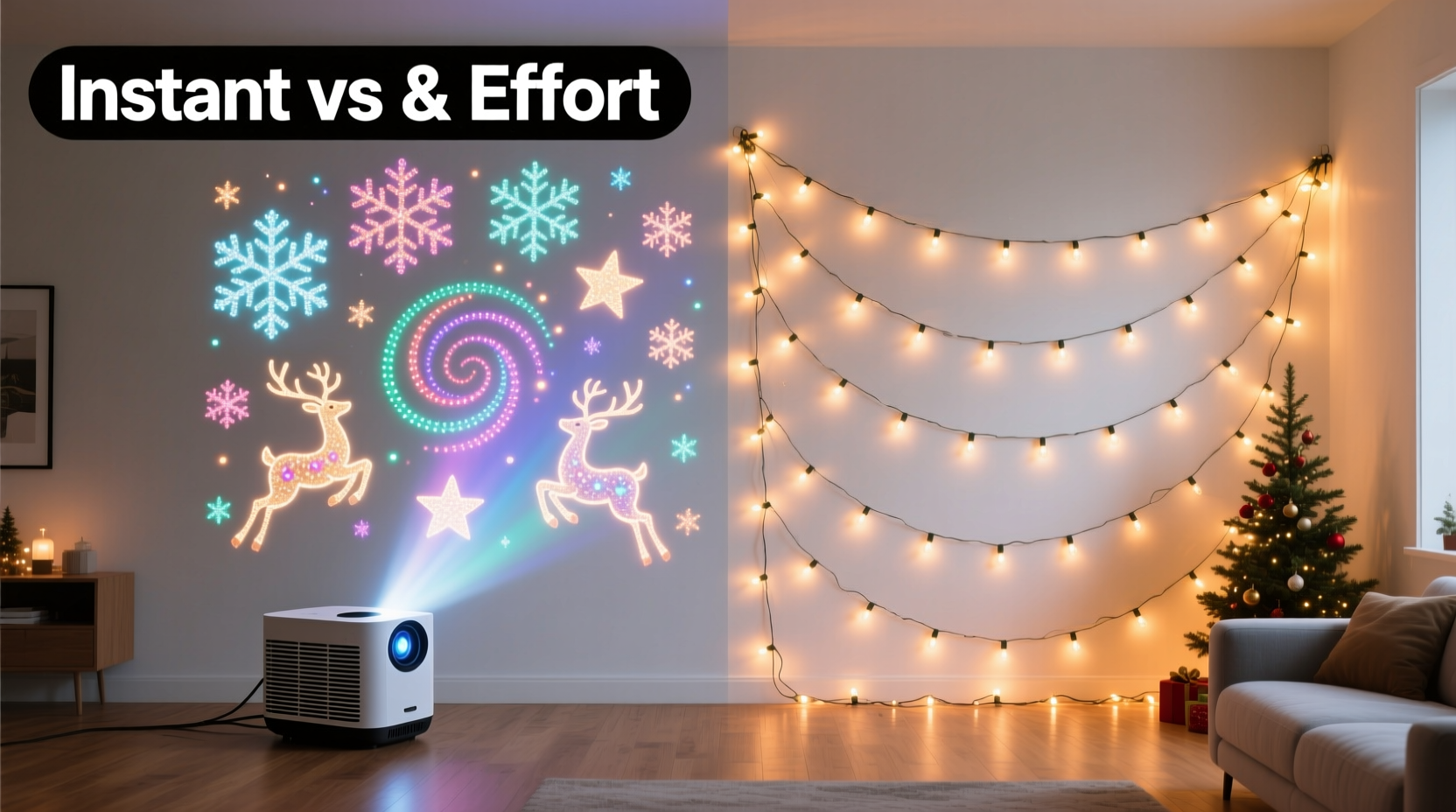
Before making a decision, it's important to understand how each lighting system functions and what kind of effect it produces.
Traditional string lights consist of individual bulbs connected by insulated wire, typically powered via an electrical outlet. They are manually arranged across surfaces such as eaves, fences, windows, or trees. Available in incandescent and LED varieties, these lights offer physical illumination and come in various colors, bulb sizes, and effects (like twinkling or steady glow). Installation requires planning, extension cords, clips or hooks, and often a ladder.
In contrast, Christmas light projectors are compact devices that use high-lumen LEDs and rotating lenses to cast patterns of light onto walls, driveways, or siding. These units plug into an outdoor outlet and project thousands of simulated light points in predefined designs—such as snowflakes, stars, or classic bulb shapes—covering large areas instantly. Some models include multiple interchangeable discs or digital animations for variety.
The core distinction lies in physical presence versus optical illusion. String lights emit real light from actual sources placed throughout the space. Projectors create the *appearance* of widespread lighting using focused beams, requiring only one or two placement points for broad coverage.
Speed and Ease of Setup: The Real Time-Saver?
When it comes to achieving quick full wall coverage, speed of installation is often the deciding factor—especially for busy households or those managing large homes.
String lights require meticulous placement. Even with pre-lit garlands or net lights, covering an entire façade may take several hours. You’ll need to measure spacing, secure each section with clips, test connections, and manage cord routing. For multi-story homes, this process becomes even more labor-intensive and potentially hazardous without proper safety gear.
Projectors, on the other hand, offer near-instant deployment. Most models set up in under five minutes: place the unit, plug it in, adjust the focus and angle, and turn it on. No climbing, no weaving wires, no tangled strands. One projector can cover up to 700 square feet depending on distance and surface texture—equivalent to dozens of string light strands.
This dramatic reduction in setup time makes projectors ideal for renters, elderly homeowners, or anyone short on time. However, ease doesn’t always equal quality. While projectors deliver fast results, they lack the three-dimensional depth and warmth of real lights. Shadows, ambient interference, and surface imperfections can affect clarity, especially on uneven or dark-colored walls.
“Projectors are a game-changer for people who want holiday spirit without the weekend-long installation,” says Mark Reynolds, landscape lighting designer and founder of Holiday Illuminations LLC. “But they’re not a complete replacement—they’re a supplement for specific applications.”
Visual Impact and Aesthetic Quality
Aesthetics matter when it comes to holiday lighting. The goal isn't just visibility—it’s creating atmosphere, joy, and a sense of celebration.
Traditional string lights provide a tangible, immersive experience. Their physical glow casts soft halos, reflects off glass, and interacts naturally with the environment. When properly installed, they outline architectural features, add dimensionality, and produce a warm ambiance that feels authentic and inviting.
Projectors generate flat, two-dimensional patterns. While impressive from a distance, close inspection reveals pixelated edges, inconsistent brightness, and limited color blending. On textured surfaces like stucco or brick, the image can appear distorted or fragmented. Additionally, most projectors offer only a few preset patterns, limiting creative flexibility compared to customizable string layouts.
Another consideration is ambient competition. In neighborhoods with many lit homes, projector light can blend into surrounding glare, reducing its standout effect. String lights, being localized and directional, maintain higher contrast and perceived brightness.
That said, modern projectors have improved significantly. High-lumen models (5,000+ lumens) with adjustable focus and RGB color wheels now offer vibrant, dynamic displays. Some even sync with music or include motion effects, adding entertainment value beyond static decoration.
Comparison Table: Visual Performance Factors
| Feature | String Lights | Projectors |
|---|---|---|
| Depth & Dimension | High – creates 3D effect | Low – flat projection |
| Brightness Control | Adjustable per strand | Fixed per unit |
| Surface Flexibility | Works on any surface | Best on light, smooth walls |
| Pattern Customization | Full control over layout | Limited to disc/digital presets |
| Nighttime Ambiance | Warm, cozy, realistic | Bright, flashy, theatrical |
Cost, Durability, and Long-Term Value
Initial price isn't the only financial factor—durability, energy use, and reusability play major roles in long-term value.
Entry-level string light sets start around $10–$20, but fully decorating a house may require 10–20 strands or more, pushing total costs to $150–$400 for quality LED versions. Higher-end programmable smart lights (e.g., Philips Hue or Twinkly) can exceed $500. However, well-maintained strings can last 5–10 years, especially if stored properly and used outdoors only seasonally.
Christmas projectors range from $30 for basic models to $100+ for premium units with remote controls, multiple patterns, and weather resistance. Since only one or two units are typically needed per house, the upfront investment is often lower than equivalent string coverage. Most projectors are built with durable ABS plastic and sealed lenses, rated for outdoor use (IP44 or higher), and can last 3–7 seasons with care.
Energy efficiency favors projectors slightly. A typical 5,000-lumen LED projector consumes about 20–30 watts. Meanwhile, covering the same area with mini LED strings might require 100–150 watts depending on density. Over a 30-day season running 6 hours nightly, that translates to meaningful savings—especially in regions with high electricity rates.
Real-World Example: A Suburban Home Makeover
Consider the case of the Thompson family in Denver, Colorado. With a two-story colonial home and limited weekend availability, they previously spent two full days installing over 1,200 feet of string lights—only to face wind damage and partial outages mid-season.
Last year, they switched strategy. They kept a single strand outlining the front porch railing for authenticity but added two high-lumen projectors aimed at the upper and lower façades. Setup took less than 20 minutes. Using snowflake and multicolor dot patterns, they achieved near-complete wall coverage with vivid, eye-catching results.
Neighbors noticed immediately. “It looked like they’d done twice the work,” said one. The family reported no technical issues, enjoyed consistent performance throughout December, and stored the projectors in a small box—no coiling, no fragile bulbs.
Still, they acknowledged trade-offs. Indoors, the projected light didn’t create the same cozy glow as real strings. And during heavy fog, the beams diffused and lost sharpness. But for exterior impact and convenience, they deemed the switch a success—and plan to expand with additional projectors next year.
Step-by-Step Guide: Choosing and Installing the Right Option
Follow this timeline-based approach to select and deploy your lighting solution before the holidays begin.
- Week 1: Assess Your Space
Walk around your home at night. Identify key walls, entry points, and viewing angles. Measure wall dimensions and note surface type (smooth, brick, etc.). Determine whether full coverage or accent lighting is your priority. - Week 2: Set a Budget and Goal
Decide how much time and money you’re willing to invest. If speed and simplicity are top priorities, lean toward projectors. If realism and ambiance matter most, plan for string lights. - Week 3: Purchase Equipment
Buy weather-rated products with outdoor certifications. For projectors, choose at least 4,000 lumens with adjustable focus. For strings, opt for commercial-grade LED with spare bulbs/connectors included. - Week 4: Test and Install
Set up your system on a dry evening. For projectors, experiment with distance and angle. For strings, lay them out first, then secure gradually. Use a voltage tester to confirm all connections. - Ongoing: Monitor and Maintain
Check weekly for damage, moisture, or dislodged units. Clean projector lenses gently with a microfiber cloth. Replace faulty string sections promptly to prevent cascading failures.
Expert Checklist: What to Evaluate Before Buying
- ✅ Wall size and distance from power source
- ✅ Surface color and texture (dark or rough walls reduce projector clarity)
- ✅ Local weather conditions (wind, snow load, rain exposure)
- ✅ Desired runtime and timer compatibility
- ✅ Storage space and portability needs
- ✅ Compatibility with existing décor (e.g., rooflines, trees, shrubs)
- ✅ Safety concerns (ladder use, tripping hazards, electrical load)
Frequently Asked Questions
Can I use both projectors and string lights together?
Absolutely. Many homeowners combine both for layered effects. Use projectors for broad wall coverage and string lights for architectural outlines, porches, or trees. This hybrid approach balances speed and authenticity.
Do projectors work on dark-colored houses?
They can, but effectiveness drops significantly. Dark siding absorbs light, reducing brightness and clarity. If you have a black or deep brown exterior, consider lighter accent strips or stick with physical lights for better visibility.
Are Christmas light projectors safe to leave outside all season?
Most modern models are designed for outdoor use with weather-resistant casings. However, avoid direct water exposure (e.g., under leaky eaves) and ensure the power cord is elevated or protected. Using a GFCI outlet adds extra safety.
Final Recommendation: Match the Tool to the Goal
There is no universal winner between Christmas light projectors and traditional string lights—only the right choice for your specific situation.
If your primary goal is **quick, full wall coverage** with minimal effort, **projectors are the superior option**. They deliver instant transformation, require little maintenance, and offer excellent value for time-constrained decorators. They shine in suburban neighborhoods, rental properties, and temporary displays.
However, if you prioritize **authentic ambiance, tactile beauty, and long-term reuse**, traditional string lights remain unmatched. Their versatility, durability, and emotional resonance continue to define classic holiday charm.
For many, the smart move is integration: use projectors to amplify scale and speed, while preserving string lights for focal points where detail and warmth matter most.




 浙公网安备
33010002000092号
浙公网安备
33010002000092号 浙B2-20120091-4
Comments
No comments yet. Why don't you start the discussion?