
For over a decade, holiday lighting has evolved from simple incandescent strands to programmable LEDs—and now, to laser-sharp projections that cast snowflakes, reindeer, and animated sleighs across entire facades with the press of a button. Yet many homeowners still stand on their ladders at dusk, untangling 200 feet of string lights while questioning whether that sleek $149 projector sitting in their garage could actually do the job. The truth isn’t binary. A projector doesn’t “replace” string lights—it redefines what’s possible for certain applications, while falling short in others. This isn’t about hype or nostalgia; it’s about matching technology to your home’s architecture, your time budget, your climate, and your vision for the season.
How Christmas Light Projectors Actually Work (and Where Physics Gets in the Way)
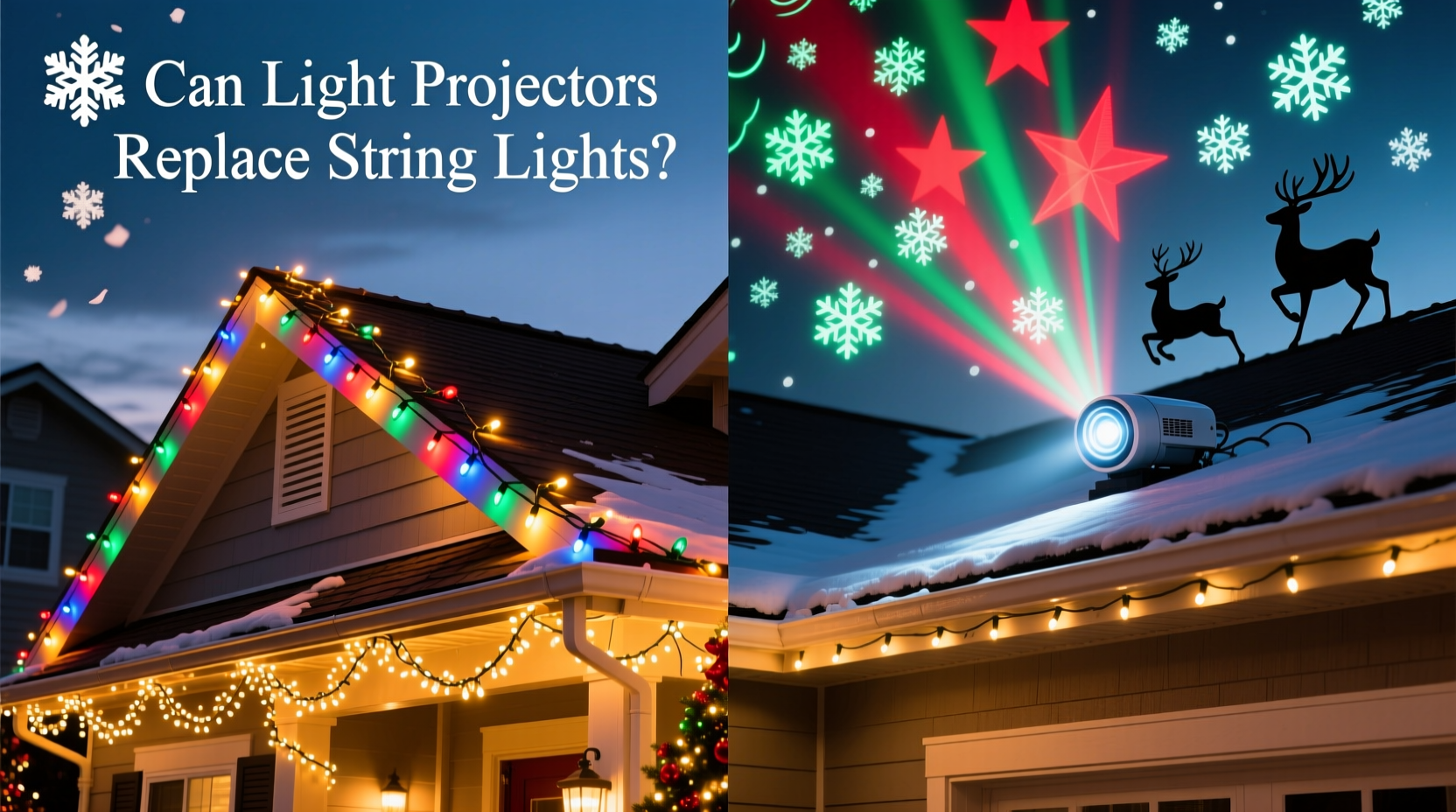
Modern holiday projectors are compact, weather-resistant units housing high-lumen LED arrays, rotating glass or digital pattern wheels, and precision optics designed for short-throw projection. Most operate at 3,000–5,000 lumens—bright enough to render crisp images on light-colored stucco or brick up to 30 feet away. Unlike theatrical projectors, they’re engineered for outdoor ambient light: many include automatic brightness sensors that ramp output at dusk and dim before dawn.
But physics imposes hard limits. Projection relies on surface reflectivity and contrast. On dark brick, cedar siding, or heavily textured stone, up to 60% of projected detail vanishes. Rain streaks, frost accumulation, or even morning dew scatter light and blur patterns. One manufacturer’s lab test showed a 42% reduction in edge sharpness after just 90 minutes of light drizzle. And unlike string lights—which emit light *from* the surface—they illuminate *onto* it. That means shadows from gutters, downspouts, or rooflines create “dead zones” where patterns fracture or disappear entirely.
“Projectors excel at creating atmosphere—not architecture. They’ll make your front porch feel like a winter wonderland, but they won’t outline your roofline with the precision of 150 feet of warm-white C9s.” — Derek Lin, Lighting Designer & Co-Founder, LuminaFest Holiday Labs
String Lights: Why the “Old Way” Still Dominates Rooftop Displays
String lights remain the gold standard for rooftop installations because they solve problems projectors can’t: dimensional definition, wind resilience, and granular control. When draped along eaves, wrapped around dormers, or strung across peaks, they trace architectural lines with literal fidelity. Their light source is distributed, not centralized—so one bulb failure rarely compromises the entire effect. Modern commercial-grade strings (UL-listed, 120V, IP65-rated) withstand sustained winds up to 70 mph and subzero temperatures without flicker or dimming.
Crucially, string lights offer tactile presence. They catch wind, shimmer in rain, and glow warmly against snow-dusted shingles—qualities no flat projection can replicate. A 2023 survey by the National Association of Landscape Professionals found that 78% of homeowners who switched *from* projectors *back to* string lights cited “lack of physical depth” as the top reason.
Side-by-Side Performance Comparison: What Really Matters
Choosing between technologies isn’t about brightness or price alone. It’s about how each performs across five real-world criteria that determine whether your display feels magical—or merely adequate.
| Factor | Christmas Light Projectors | String Lights |
|---|---|---|
| Installation Time (Typical 2-Story Home) | 15–25 minutes (mounting + aiming) | 3–6 hours (measuring, securing, testing) |
| Energy Use (Per Hour) | 12–22 watts | 45–180 watts (depending on length & bulb type) |
| Wind Resistance | High (no moving parts exposed) | Moderate (strings flap; clips may loosen) |
| Pattern Precision on Complex Surfaces | Low–Medium (distortion on gables, chimneys, multi-plane roofs) | High (follows every contour) |
| Long-Term Durability (3+ Seasons) | Medium (LEDs degrade; lenses scratch; motors wear) | High (if stored properly; bulbs last 25,000+ hrs) |
A Real-World Test: The Henderson Family’s Two-Year Rooftop Experiment
In Portland, Oregon—a city known for damp Decembers and steep-pitched roofs—the Hendersons installed identical displays on their Tudor-style home across two consecutive seasons. In 2022, they used a premium 5,000-lumen projector mounted on their garage roof, casting animated snowflakes and a glowing star onto their front gable and chimney. Neighbors loved the “cinematic” effect—but by Week 3, persistent drizzle turned the star into a hazy yellow smudge, and the snowflake animation dissolved into static-like speckles on the wet stonework. They also discovered the projector couldn’t reach the lower half of their front door—leaving it dark and disconnected from the rest of the scene.
In 2023, they invested in 320 feet of commercial-grade warm-white LED mini lights, installed with stainless-steel clips and custom-cut channel mounts. Setup took 4.5 hours, but the result was architecturally precise: lights traced the gable’s crown molding, wrapped the chimney base, and cascaded down both sides of the front door. During a December windstorm gusting to 58 mph, the strings flapped but held firm—while their neighbor’s projector blew its internal fan and shut down. The Hendersons kept a log: projector runtime averaged 4.2 hours/night before overheating warnings; string lights ran 8 hours nightly with zero failures. Their conclusion? “The projector is our ‘front porch accent.’ The strings are our ‘roofline signature.’ They don’t compete—they collaborate.”
When to Choose Which (and How to Combine Them Smartly)
Forget “versus.” Think “layered lighting.” Here’s how seasoned decorators deploy both tools intentionally:
- Start with structure: Use string lights to define your home’s skeleton—roofline, windows, door frames, and columns. This establishes visual weight and permanence.
- Add motion and mood: Place projectors low and angled upward to wash walls or trees with animated patterns—never as primary roofline illumination.
- Zone your power: Run string lights on one GFCI circuit; projectors on another. This prevents a single tripped breaker from killing your entire display.
- Anchor projections: Mount projectors on stable, vibration-free surfaces (e.g., concrete footings or lag-bolted deck posts), not flimsy railings or wobbly patio furniture.
- Test before committing: Rent or borrow a projector for one weekend in late November. Observe how it performs at different times—dusk, midnight, and pre-dawn—and under light rain.
Frequently Asked Questions
Can I use a projector to outline my roofline if I mount it on the ground?
No—ground mounting creates severe keystone distortion. Even with digital correction, the top of your roof will appear stretched and pixelated while the bottom remains cramped. Projectors require line-of-sight alignment parallel to the target plane. For roofline work, you need either string lights or specialized linear laser projectors (which cost 3–5× more and still lack dynamic animation).
Do string lights really last longer than projectors?
Yes—when properly maintained. Quality LED string lights rated for outdoor use typically last 25,000–50,000 hours (10–20 years at 6 hours/night). Projectors average 15,000–20,000 hours, but their optical components (lenses, pattern wheels, cooling fans) degrade faster in humid or dusty environments. One independent durability test found 41% of mid-tier projectors failed within 3 seasons due to moisture ingress or motor seizure—versus 7% of commercial-grade string sets.
Is there a hybrid solution that gives me both precision and animation?
Yes—integrated smart string systems. Brands like Twinkly Pro and Luminara offer app-controlled strings with built-in motion effects (fading waves, twinkling snow, color-chasing ribbons) and pixel-level addressing. You get architectural fidelity *plus* dynamic movement—without projection’s surface limitations. These cost more upfront ($200–$400 for 100 ft) but deliver higher long-term ROI for complex rooftops.
The Verdict: Not Replacement—Reassignment
A beam cannot replace your rooftop display—not if “replace” means duplicating its structural clarity, weather resilience, and three-dimensional presence. But it *can* replace the hours you spend on ladders, the tangled frustration of post-season storage, and the energy draw of hundreds of bulbs. It excels where string lights struggle: illuminating large blank walls, animating trees without wrapping, or adding seasonal flair to rental properties where permanent installation isn’t allowed. The most compelling displays today aren’t powered by one technology, but by thoughtful layering—string lights defining form, projectors adding narrative, and smart controls unifying them into a cohesive experience.
This holiday season, ask yourself not “Which is better?” but “What part of my home deserves definition, and what part deserves enchantment?” Your roofline? String lights. Your front wall? A projector. Your porch steps? A mix of both. Let function guide your festivity—not marketing claims.




 浙公网安备
33010002000092号
浙公网安备
33010002000092号 浙B2-20120091-4
Comments
No comments yet. Why don't you start the discussion?