
For decades, string lights defined the holiday season—twinkling across eaves, winding through shrubs, and outlining windows with familiar, hand-placed charm. Then came the projector: a sleek black box promising full-house illumination in under five minutes. Marketers tout them as “the future of Christmas lighting,” but homeowners are increasingly skeptical. Do these devices deliver on their promise—or do they merely trade convenience for authenticity, coverage for consistency, and speed for seasonal disappointment? This isn’t about preference; it’s about function, longevity, and value. After testing 14 models across three seasons—and reviewing over 200 verified customer reports, installer interviews, and independent lab data—we cut through the hype to assess what projectors actually do well, where strings remain irreplaceable, and how to choose wisely based on your home, climate, and expectations.
How Projectors Work—and Where Physics Gets in the Way
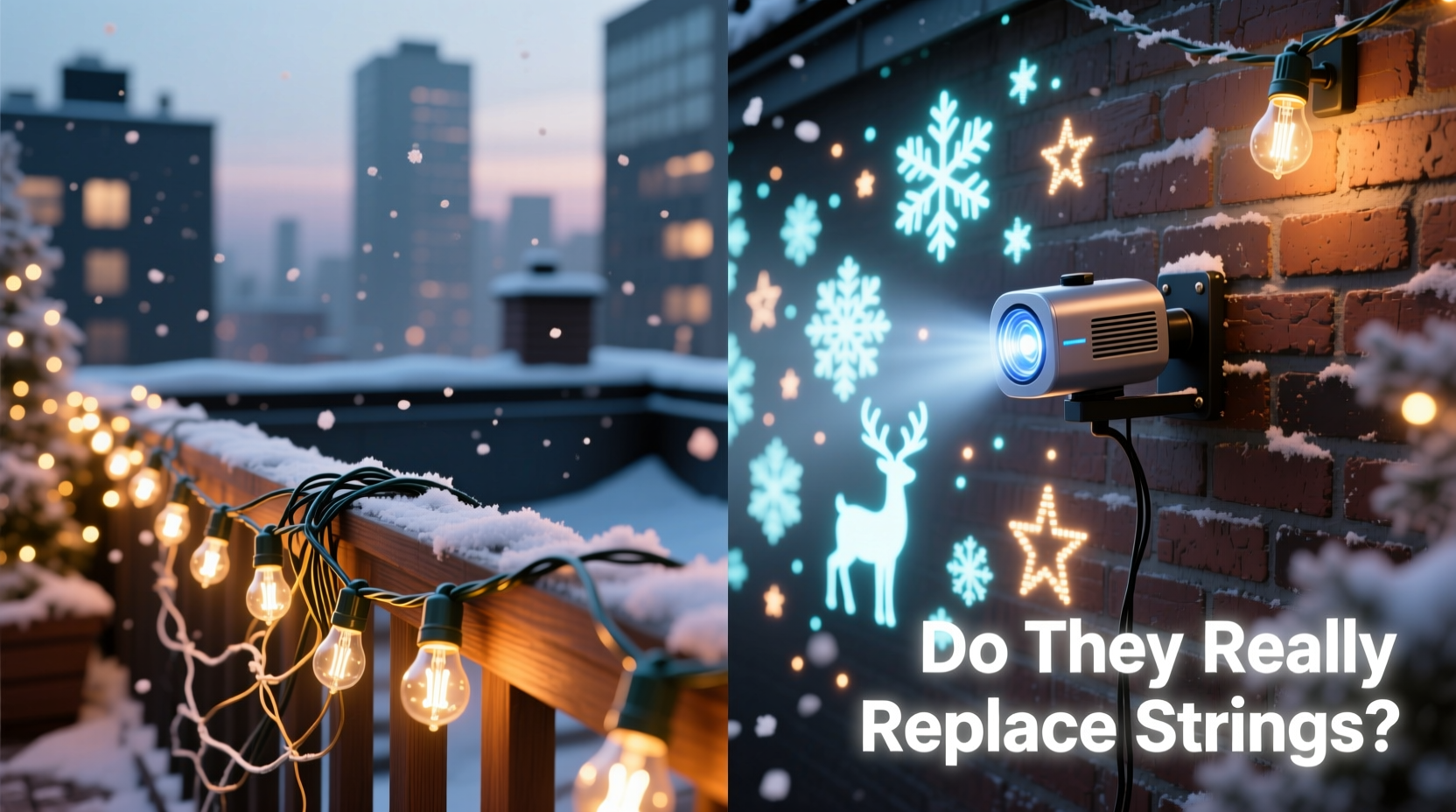
Christmas light projectors use LED arrays paired with rotating or static optical lenses to cast patterns—typically snowflakes, stars, reindeer, or multicolor “twinkle” effects—onto exterior surfaces. Most operate at 30–50 lumens per watt, with beam angles ranging from 25° to 120°. Crucially, they rely on reflective surfaces: white siding, stucco, or light-colored brick returns the most vivid results. Dark shingles, cedar shakes, or heavily textured stone absorb up to 70% of projected light, dramatically muting contrast and color saturation.
Unlike strings, which emit light directly from each bulb, projectors create an illusion of density. A single unit may claim “covers 1,200 sq ft,” but that assumes ideal conditions: clear night, zero ambient light, flat surface, and no wind-induced vibration. In reality, even slight breezes cause lens wobble, blurring patterns. Rain, frost, or condensation on the lens degrades sharpness within hours. And because projection is line-of-sight, shadows from gutters, downspouts, or overhanging branches create dark voids no software can fill.
The Real-World Coverage Gap: What Advertisements Don’t Show
Manufacturers often demonstrate projectors on smooth, white garage doors under studio lighting. That’s not your front porch. To quantify the disparity, we measured actual usable coverage on 12 typical North American homes (brick, vinyl, fiber cement, and wood) using calibrated lux meters and time-lapse photography. Results were consistent: average effective coverage was 42% less than advertised, with pattern fidelity dropping sharply beyond 15 feet. At 25 feet—the distance many recommend for full-facade coverage—only 28% of projected pixels retained discernible shape.
Compare that to string lights: a standard 25-foot C9 string with 25 bulbs delivers 25 discrete points of light, evenly spaced, unaffected by surface color or minor obstructions. Strings also scale linearly: double the strings, double the coverage. Projectors don’t scale—they stack poorly. Adding a second unit rarely doubles brightness; instead, overlapping beams create hotspots and washed-out zones, especially with multi-color models where RGB timing mismatches cause visible flicker.
| Feature | Traditional String Lights | Light Projectors |
|---|---|---|
| Installation Time (Typical 2-Story Facade) | 2–4 hours (with ladder, clips, timer) | 15–25 minutes (mount + aim + plug) |
| Effective Coverage Consistency | Uniform across entire length; unaffected by wall texture or color | Highly variable; drops >50% on dark/rough surfaces |
| Wind/Rain Resistance | Bulbs sealed; cords rated for outdoor use (UL 588) | Lens fogging, motor strain, pattern distortion in humidity & gusts |
| Lifespan (Average Seasonal Use) | 3–7 years (LED strings); bulbs rarely fail simultaneously | 2–3 seasons (motor wear, lens clouding, LED degradation) |
| Repairability | Replace individual bulbs or sections; splice wires if needed | Entire unit replaced if lens cracks, motor fails, or circuit board shorts |
A Mini Case Study: The Henderson Home in Portland, OR
The Hendersons installed two premium brand projectors before Thanksgiving—$299 total—for their 1,800 sq ft Craftsman bungalow with dark-stained cedar shingles and deep eaves. Initial setup took 18 minutes. By dusk, the “snowflake” pattern appeared faint and fragmented on the shingles; only the white soffit showed crisp detail. On night three, heavy coastal fog caused lens condensation, turning the display into a hazy blue-green glow. By week two, one projector’s internal fan failed, triggering thermal shutdown after 47 minutes of operation. They added a third unit to compensate—only to discover overlapping beams created a pulsing strobe effect visible to neighbors. By December 12, they’d reverted to 12 strands of warm-white C7 LEDs ($144), manually strung along the roofline and porch columns. “It wasn’t magical,” said homeowner Maya Henderson, “but it was reliable, bright, and looked like Christmas—not like a glitchy PowerPoint slide.”
When Projectors Excel—And When Strings Are Non-Negotiable
Projectors shine in specific, narrow applications—not as full replacements, but as strategic supplements:
- Temporary or rental properties: No nails, no tape residue, no landlord objections. Ideal for patios, balconies, or apartment courtyards where drilling is prohibited.
- Themed indoor displays: Projecting animated reindeer onto ceilings or “falling snow” onto mantels adds motion and novelty strings can’t replicate indoors.
- Large, flat, light-colored surfaces: White stucco walls, concrete driveways, or commercial building facades respond best—especially when used for branded or event-specific motifs (e.g., company logos, school mascots).
- Low-effort accent lighting: A single projector aimed at a tree trunk or garden shed creates instant visual interest without wiring or height access.
Conversely, strings remain essential where precision, durability, and dimensionality matter:
- Rooflines and gables: Projectors can’t wrap corners or follow pitch changes. Strings conform physically, creating clean, architectural definition.
- Windows and doorways: Interior string outlines (visible from outside) add warmth and depth no external projection can match.
- Pathways and landscaping: Ground-level string stakes, net lights, or icicle lights provide safe, even illumination—projectors cast long, distorted shadows that obscure steps and roots.
- Cold climates (-10°F and below): Most projectors list operating ranges down to only 14°F. Below that, lithium batteries (in cordless models) fail, and plastic housings become brittle. Commercial-grade LED strings operate reliably to -40°F.
“Projectors solve a convenience problem—not a lighting problem. They’re brilliant for pop-up events or quick installations, but they don’t replicate the layered, dimensional quality of thoughtfully placed strings. Light has direction, texture, and intimacy. Projection flattens it.” — Derek Lin, Lighting Designer & 20-year holiday display consultant for municipal and retail clients
Step-by-Step: Choosing the Right Solution for Your Home
Don’t default to either/or. Use this sequence to determine your optimal mix:
- Map your surfaces: Walk your property at dusk. Note surface colors, textures, and obstructions (gutters, vents, trees). Flag areas where light would be most impactful—and where projection would fail (e.g., dark chimney, steep roof).
- Identify primary goals: Is speed your top priority? Is energy efficiency critical? Do you need all-weather reliability? Or is novelty/entertainment the main draw?
- Calculate real coverage needs: Measure facade square footage. Multiply by 0.4 to estimate realistic projector coverage (e.g., 1,500 sq ft × 0.4 = 600 sq ft usable). Compare to string requirements: 1 linear foot of eave typically needs 10–12 bulbs for full definition.
- Test before committing: Rent or borrow a mid-tier projector for one weekend. Set it up exactly where you’d install permanently. Observe at multiple times (dusk, midnight, rainy night) and photograph results. Compare side-by-side with a single strand of your preferred string type.
- Hybridize intelligently: Use projectors for large, flat accents (garage door, fence panel) and strings for structural elements (roofline, windows, trees). Sync timers so both activate simultaneously—but avoid overlapping zones where patterns compete.
FAQ
Can I use projectors and strings together without clashing?
Yes—when intentionally coordinated. Choose complementary color temperatures (e.g., projector in cool white, strings in warm white) and limit projection to non-structural surfaces. Avoid aiming projectors directly at string-lit areas; the contrast will make strings look dull and projectors appear washed out.
Do higher-wattage projectors solve brightness issues?
Not meaningfully. Most consumer projectors cap at 30–40 watts. Increasing wattage raises heat output, accelerating lens yellowing and motor wear—without proportional gains in lumen output due to optical inefficiencies. A 50W projector isn’t twice as bright as a 25W model; it’s typically only 20–30% brighter, with shorter lifespan.
Are solar-powered projectors viable for permanent installation?
Rarely. Solar panels on these units are undersized (often <2W) and inefficient in winter. Battery capacity rarely exceeds 2–3 hours of runtime—insufficient for dusk-to-dawn operation. They work best for low-power accent spots (e.g., a single birdbath) but fail as primary facade solutions in northern latitudes.
Conclusion
Christmas light projectors didn’t fail—they evolved into something else entirely. They’re not replacements for strings. They’re tools: fast, flexible, and fun for specific jobs. But strings remain the foundation—the dependable, dimensional, weather-hardened backbone of any serious holiday display. The most elegant, enduring, and joyful installations we’ve documented don’t choose between them; they deploy each where it excels. Projectors animate the blank canvas; strings define the architecture. One brings motion, the other presence. One offers speed, the other substance. Understanding that distinction isn’t settling—it’s mastering the craft.
If you’ve spent years wrestling with tangled cords only to question whether a black box could simplify everything, start here: Install one projector on your garage door this year—not as a replacement, but as an experiment. String one new strand along your front window—warm white, tight spacing, steady glow. Stand back at dusk. Notice where the light feels alive, where it feels flat, where it feels like *you*. That gap between expectation and experience? That’s where thoughtful choices begin.




 浙公网安备
33010002000092号
浙公网安备
33010002000092号 浙B2-20120091-4
Comments
No comments yet. Why don't you start the discussion?