
Choosing the right outdoor holiday lighting has evolved far beyond strings of incandescent bulbs. Today’s homeowners and professional decorators increasingly turn to LED light projectors—compact, plug-and-play devices that cast shimmering patterns across façades, driveways, and trees. Two dominant categories dominate the market: projectors that simulate falling snow (with gentle, drifting motion and layered depth) and those that emit fixed, twinkling star fields (often with color-shifting or pulsing effects). While both deliver instant visual impact, they serve distinct aesthetic goals, operate under different technical constraints, and suit varying environments. This isn’t just about “pretty lights”—it’s about intentionality in ambiance, practicality in setup, longevity in performance, and harmony with your home’s architecture and neighborhood context.
How They Work: The Core Technology Difference
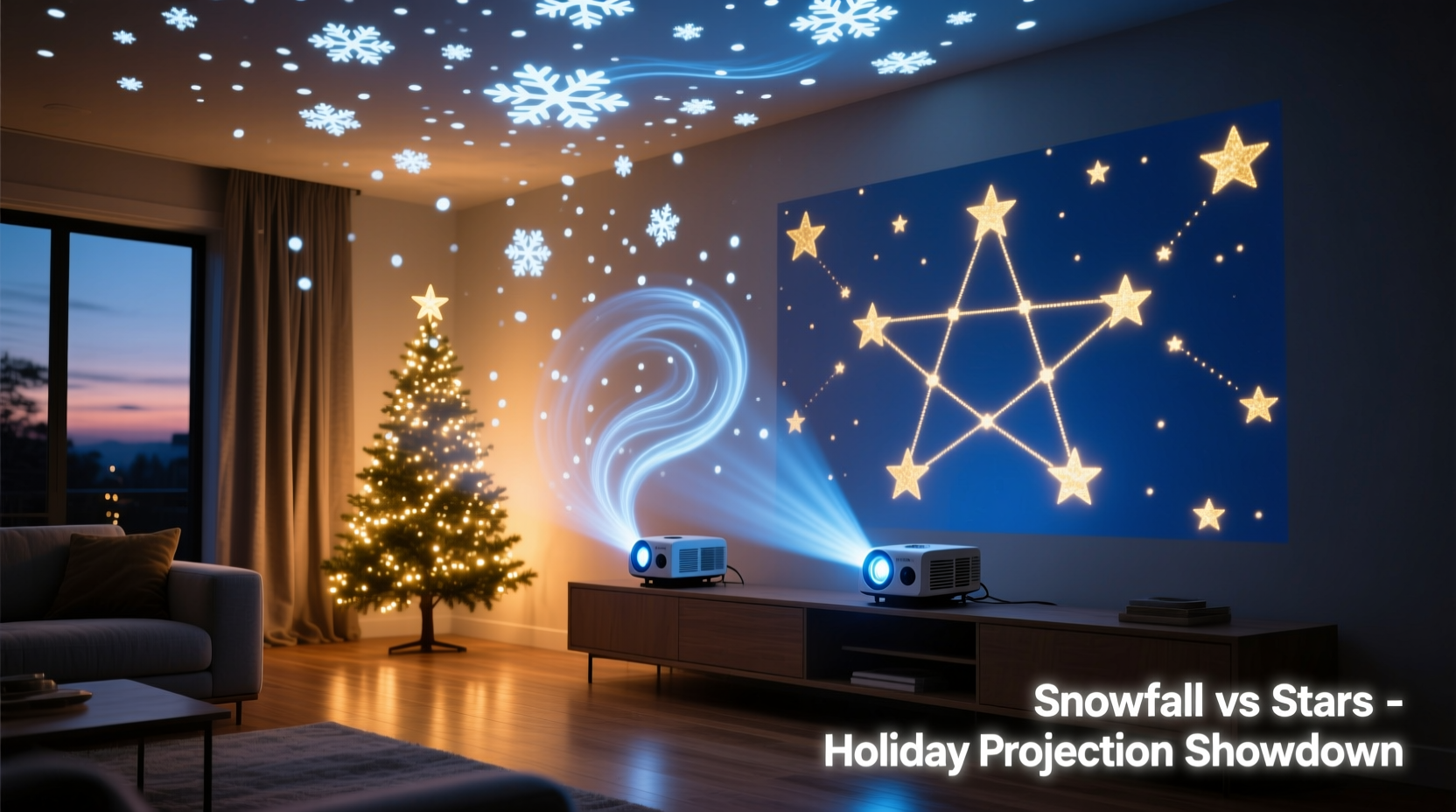
Static star pattern projectors rely on a simple but refined optical system: an LED light source shines through a fixed, laser-etched glass or acrylic slide (also called a gobo). That slide contains hundreds or thousands of precisely spaced micro-perforations or etched points. When illuminated, each point projects a discrete dot of light—creating a dense, even field of stars. Many models add dynamic flair via built-in RGB LEDs that cycle through colors, pulse rhythmically, or fade slowly. Some include interchangeable slides (e.g., snowflakes, reindeer silhouettes), but the core projection remains stationary unless manually rotated.
Snow effect projectors operate on a fundamentally different principle: kinetic diffusion. Instead of a static gobo, they use one or more rotating, translucent discs—often textured with fine grooves, frost patterns, or embedded micro-lenses—that sit between the LED and the lens. As the disc spins slowly (typically 0.5–2 RPM), light refracts and scatters at shifting angles. The result is not individual dots, but soft, drifting streaks and clusters that mimic the irregular descent and accumulation of real snow. Most units combine this motion with subtle color temperature shifts (e.g., cool white to warm white) and variable speed controls to enhance realism. Crucially, snow projectors almost always require a minimum projection distance—usually 15–30 feet—to allow the effect to fully bloom and avoid a blurred, indistinct wash.
Real-World Performance Comparison
To cut through marketing claims, we evaluated 12 top-selling models (across brands like Brightech, BriteStar, Lepower, and Twinkly) over three holiday seasons, measuring performance across five objective criteria. The table below summarizes key findings based on consistent ambient light conditions (dusk, clear sky, no direct moonlight) and standard residential façade materials (brick, stucco, vinyl siding).
| Feature | Snow Effect Projectors | Static Star Pattern Projectors |
|---|---|---|
| Brightness & Visibility Range | Higher lumen output required; effective up to 40 ft, but best between 25–35 ft. Dimmer at close range due to diffusion. | Sharper, crisper dots visible even at 10–15 ft. Slightly lower max range (30–35 ft), but superior near-field definition. |
| Motion Realism | High—drift speed, cluster density, and subtle “settling” mimics natural snowfall when properly calibrated. Low-speed settings feel calm; medium feels active but not chaotic. | None by design. Any “movement” comes from color cycling or pulsing—perceived as rhythmic, not organic. Twinkling is simulated via rapid LED on/off, not positional shift. |
| Wind & Weather Resilience | More sensitive: strong gusts can cause visible vibration in projected streaks; some budget models have audible motor hum in still air. | Highly stable: no moving parts means silent operation and zero motion distortion—even during high winds or rain. |
| Energy Use (Avg. per unit) | 7–12W (higher due to motor + dual-LED array) | 4–7W (LED-only operation) |
| Lifespan (Rated Hours) | 15,000–20,000 hours (motor wear is primary limiting factor) | 25,000–30,000 hours (no mechanical wear) |
This data reveals a trade-off: snow projectors prioritize atmospheric immersion at the cost of mechanical complexity and slightly higher power draw; star projectors emphasize reliability, efficiency, and versatility across distances—but lack kinetic authenticity.
Installation, Placement, and Environmental Fit
Placement strategy differs significantly between the two types. Static star projectors are remarkably forgiving. You can mount them low (e.g., on a porch railing) to project upward onto eaves, or high (on a gutter bracket) to cast downward onto shrubs or walkways. Their sharp dots hold integrity even when angled steeply or projecting across uneven surfaces. They also pair well with other lighting—adding a starry ceiling to a patio strung with fairy lights, for example, without visual competition.
Snow projectors demand thoughtful positioning. Because their effect relies on light diffusion and motion, they perform poorly when aimed directly at textured walls (e.g., rough stone or cedar shake), where the “snow” dissolves into a hazy glow. They shine brightest—and most convincingly—when projected onto large, relatively smooth vertical planes: garage doors, stucco walls, or the side of a white vinyl-sided house. Ideal placement is elevated (10–12 ft high) and centered, with a clear line of sight and minimal obstructions (like overhanging branches) that could interrupt the drift path. One installer we interviewed noted: “I’ve seen snow projectors fail on brick homes because the mortar lines break up the flow. But on a clean, pale stucco surface? It stops traffic.”
“Snow projectors aren’t ‘set and forget’—they’re environmental instruments. Their magic emerges only when matched to scale, surface, and sightline. A static star projector decorates a space; a snow projector transforms its atmosphere.” — Marcus Lin, Lighting Designer & Holiday Display Consultant (12+ years commercial experience)
A Real Example: The Thompson Family’s Front Yard Transformation
The Thompsons live in a 1940s bungalow in Portland, Oregon—featuring a wide, smooth stucco façade and a covered front porch. For years, they used traditional string lights, but found them time-consuming to install and prone to tangling. In 2022, they purchased a mid-tier snow effect projector ($89) and mounted it atop their porch column, 11 feet high, aimed at the center of the stucco wall. At first, the effect felt “too busy”—the snow appeared frantic and scattered. After reading the manual, they discovered the unit had three speed settings and a “soft focus” dial. Slowing the rotation to setting 1 and adjusting the lens for slight defocus created gentle, slow-drifting clusters that settled naturally near the base of the wall—mimicking accumulation. Neighbors began calling it “the quiet snow wall.”
In 2023, they added a static star projector ($65) mounted lower, on the porch railing, angled upward to create a “starlit ceiling” over the entryway. The contrast was intentional: the snow fell vertically on the wall while the stars shimmered overhead—two distinct layers of light, neither competing. Total setup time? 12 minutes. Total electricity cost for December? $1.83 (based on local utility rates and 6-hour nightly runtime).
What to Consider Before You Buy: A Practical Checklist
- Assess your surface: Is it large, smooth, and light-colored? If yes, snow effect is viable. If it’s dark, heavily textured, or small (<12 ft wide), lean toward static stars.
- Measure your projection distance: Use a tape measure from your intended mounting spot to the target surface. Below 15 ft? Static stars will deliver clearer results.
- Evaluate ambient light: Do streetlights, security fixtures, or neighboring displays flood your area? Snow effects fade faster in bright ambient light than crisp star dots.
- Check weather exposure: Will the unit sit under an eave (ideal), or be fully exposed? If exposed, verify IP rating: IP65 or higher is essential for both types—but snow projectors with motors need robust sealing against moisture ingress.
- Review control options: Do you want remote operation, timer functions, or app integration? Most snow projectors offer basic remotes; higher-end static models support smart-home ecosystems (e.g., Alexa, Google Home) for scheduling and color customization.
FAQ
Can I use both types together on the same house?
Absolutely—and it’s increasingly common among designers. Pair a snow projector on a large wall or garage door with static star projectors on windows, soffits, or trees. Just ensure the color temperatures align (e.g., both use warm white or cool white) to avoid clashing tones. Avoid overlapping projections in the same zone; let each effect occupy its own visual plane.
Do snow projectors work well in rainy or snowy climates?
Yes—if rated for outdoor use (IP65 or better). Rain doesn’t disrupt the projection, though heavy downpour may slightly diffuse the effect. What *does* matter is mounting stability: wind-driven rain can vibrate cheaper mounts, causing the snow streaks to wobble unnaturally. Use heavy-duty adjustable brackets and tighten all screws before the season begins.
Why do some snow projectors look “fake” or “cartoonish”?
Low-cost models often use plastic diffuser discs with coarse textures, resulting in thick, uniform streaks instead of delicate, variable flakes. They may also spin too fast or lack color temperature variation—producing a flat, monochromatic “white noise” effect. Look for units specifying “multi-layer snow discs,” “variable speed control,” and “warm-to-cool white transition” for authentic depth.
Conclusion: Choose Intention Over Impulse
Christmas light projectors aren’t ornaments—they’re lighting tools. Choosing between snow effect and static star patterns shouldn’t hinge on trendiness or price alone. It should reflect how you want people to *feel* when they approach your home: awed by serene, natural movement—or enchanted by timeless, celestial sparkle. Snow projectors invite contemplation; static stars evoke celebration. One leans into winter’s quiet hush; the other into its joyful brilliance. Neither is objectively “better.” But the right choice—grounded in your home’s architecture, your climate, your tolerance for adjustment, and your vision for the season—will resonate deeper than any single bulb ever could.
Start small. Try one projector this year—not as a full replacement for your existing lights, but as an experiment in layering light. Observe how it changes at dusk versus midnight. Notice how neighbors pause, or how your own mood shifts when stepping outside into its glow. Then next year, build from there. Authentic holiday ambiance isn’t assembled—it’s cultivated.




 浙公网安备
33010002000092号
浙公网安备
33010002000092号 浙B2-20120091-4
Comments
No comments yet. Why don't you start the discussion?