
The holiday season has always been a time for spectacle—twinkling lights, festive music, and homes transformed into winter wonderlands. For decades, physical Christmas lights have defined this tradition, draping rooftops, trees, and porches in warm glows and vibrant colors. But as technology advances, a new contender has emerged: Christmas projection mapping. This dynamic display method uses high-lumen projectors to cast animated light shows directly onto buildings and surfaces. As more households and municipalities consider upgrading their holiday decor, a critical question arises: Is projection mapping the future, or will traditional lights remain king?
The answer isn’t simple. Both options offer unique advantages and trade-offs across cost, installation, environmental impact, and visual appeal. Understanding these differences helps homeowners, event planners, and city officials make informed decisions about how best to celebrate the season in the years ahead.
How Physical Christmas Lights Work—and Why They Endure
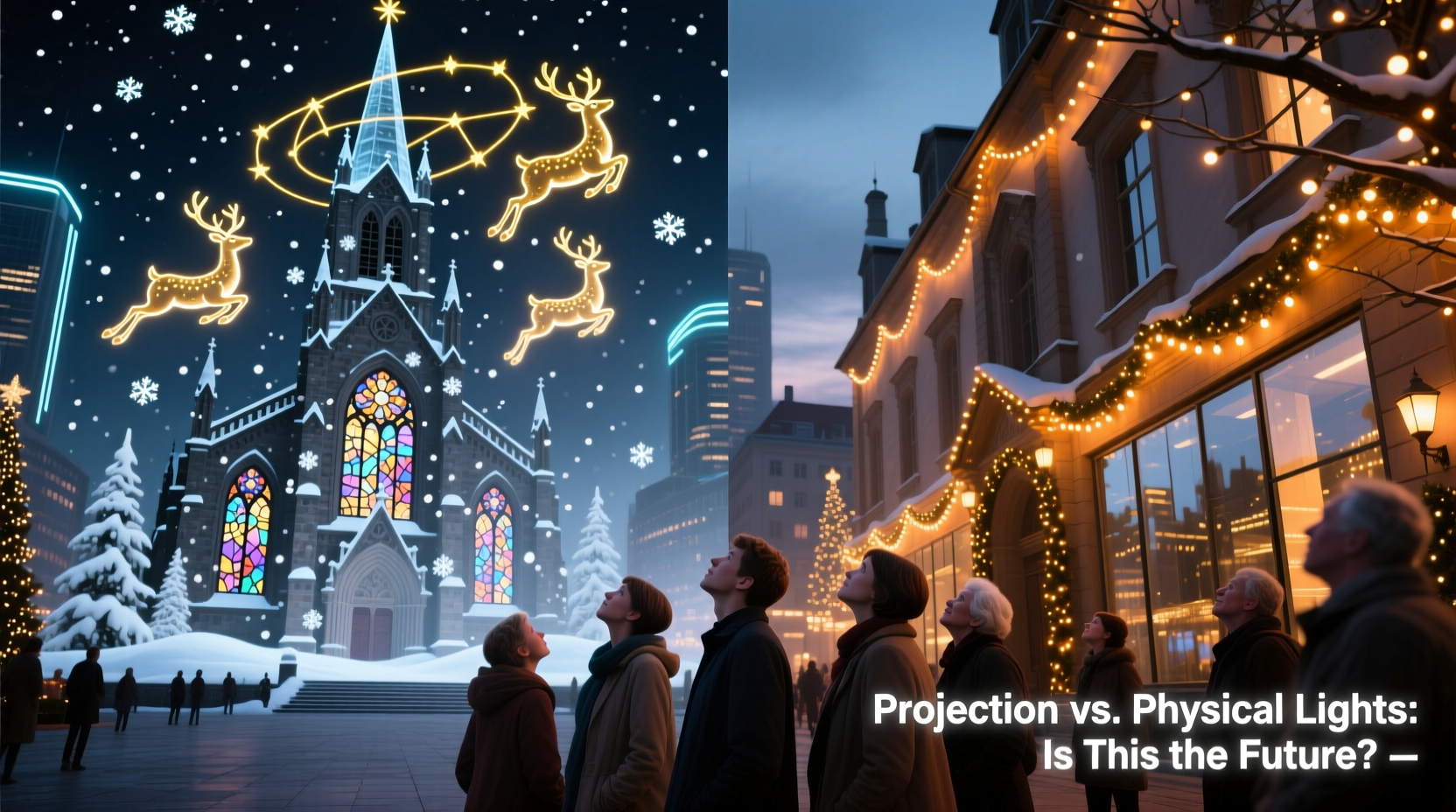
Physical Christmas lights are strings of small electric bulbs, typically LED today, connected by insulated wires. They’re manually installed on roofs, gutters, trees, fences, and other structures. The process is labor-intensive but familiar, with millions of people spending hours each year untangling cords, testing strands, and securing clips.
Despite the effort, physical lights persist because they deliver tangible charm. Their three-dimensional presence creates depth and texture that can’t be replicated by flat projections. When snow falls through illuminated branches, or wind causes lights to sway gently, the effect feels organic and immersive. Many people associate these details with childhood memories and family traditions.
Modern LED versions have improved efficiency dramatically. Today’s strings use up to 90% less energy than incandescent bulbs from the 1990s and last 25,000 to 50,000 hours. They also come in smart varieties, allowing remote control via apps, synchronization with music, and customizable color patterns.
The Rise of Christmas Projection Mapping
Projection mapping takes holiday lighting into the digital age. Instead of attaching lights, users place one or more projectors around a house or building to cast animated scenes—dancing snowmen, falling snow, Santa’s sleigh ride—onto walls and façades. These animations often sync with music played over outdoor speakers or FM transmitters.
The core technology relies on software that maps video content to architectural features. A projector aimed at a two-story home might display a reindeer leaping from roof to chimney, with shadows and perspective adjusted so the movement appears realistic. Advanced systems use multiple projectors with edge blending to cover large or irregular surfaces seamlessly.
For many, the appeal lies in versatility. With a single evening’s software update, the entire theme of a display can shift—from classic carols to a “Grinch” storyline to a Hanukkah celebration. There’s no need to store bulky boxes or risk ladder accidents during setup.
“Projection mapping turns static architecture into living canvases. It’s not just decoration—it’s storytelling.” — Dr. Lena Torres, Digital Media Artist and Public Installation Designer
Comparing the Two: A Practical Breakdown
To understand which option may dominate the future, it helps to compare them across key categories. The table below summarizes major differences between physical lights and projection mapping.
| Factor | Physical Lights | Projection Mapping |
|---|---|---|
| Installation Time | High (hours to days) | Low (30–90 minutes) |
| Upfront Cost | $100–$1,000+ (scales with size) | $600–$3,000+ (projector + accessories) |
| Energy Use (avg. per season) | 150–500 kWh | 300–800 kWh (depends on brightness) |
| Weather Resistance | High (if rated for outdoors) | Low (rain/fog disrupts image) |
| Visual Depth | High (3D sparkle, shadow play) | Flat (2D surface projection) |
| Customization | Limited (fixed colors/patterns) | High (animations, themes, music sync) |
| Storage & Longevity | Bulky; 3–5 years average lifespan | Compact; projector lasts 5–10 years |
While upfront costs for projection systems are higher, their long-term flexibility can justify the investment for frequent users. However, physical lights still win in durability and aesthetic warmth, especially in snowy or rainy climates where projections struggle.
A Real-World Example: Small Town vs. Tech-Savvy Suburb
In Breckenridge, Colorado, the annual “Light Up the Night” festival has used hand-strung LED icicle lights along Main Street for over 30 years. Residents value the tradition, and local businesses report increased foot traffic during the display period. Maintenance is shared among volunteers, and the community hosts a lighting ceremony with carolers and hot cocoa.
Contrast that with Irvine, California, where a neighborhood association recently adopted synchronized projection mapping for its holiday event. Using four 5,000-lumen projectors, they transformed a central community center into a rotating canvas of seasonal stories—each night featuring a different theme. Attendance tripled compared to previous years, and social media shares exploded.
The difference highlights a cultural shift. Traditional towns prioritize continuity and tactile experiences. Suburban and tech-forward areas lean into novelty and shareability. Neither approach is inherently better—but the trend data suggests growing interest in digital solutions.
Environmental and Practical Considerations
Sustainability is becoming a deciding factor in holiday decor choices. Physical lights, while energy-efficient, contribute to e-waste when discarded. Broken strands often aren’t recyclable due to mixed materials. Additionally, manufacturing and shipping thousands of plastic-coated wires carry a carbon footprint.
Projection mapping reduces material waste. Once purchased, a projector serves multiple seasons with only electricity and digital content updates. However, high-lumen models consume significant power, and improper aiming can cause light pollution—disrupting neighbors and nocturnal wildlife.
Another concern is accessibility. Not all homes have flat, light-colored walls ideal for projection. Historic homes with textured stucco or dark siding may not reflect images clearly. In contrast, physical lights adapt easily to varied surfaces.
Step-by-Step: Planning Your Holiday Display
Whether you choose lights, projections, or a hybrid approach, follow this timeline to ensure success:
- Early October: Assess your space. Note wall conditions, outlet access, and sightlines from the street.
- Mid-October: Decide on theme and budget. Research projectors (for mapping) or light types (for physical).
- November 1–15: Purchase equipment. Test all components indoors before deployment.
- November 16–30: Install system. For projections, calibrate alignment and brightness at night. For lights, secure strands and test circuits.
- December 1: Launch display. Monitor performance daily, especially after storms.
- January 2: Dismantle carefully. Label cords and store in climate-controlled space.
This structured approach minimizes stress and maximizes impact, regardless of technology chosen.
Hybrid Displays: The Best of Both Worlds?
An emerging trend blends physical lights with projection mapping. For example, a homeowner might keep traditional lights on trees and railings while using projections for animated scenes on the garage door. This hybrid model preserves the nostalgic glow while adding modern flair.
Some professional installers now offer “augmented lighting” packages—using projections to enhance, not replace, physical elements. Imagine glowing windows that appear to open as Santa waves inside, or a nativity scene where stars twinkle above in projected animation while real lights outline the figures.
These combinations require careful planning to avoid visual clutter, but when executed well, they create layered, memorable experiences that stand out in crowded neighborhoods.
Frequently Asked Questions
Can I run a projection show without disturbing my neighbors?
Yes, but consider placement and brightness. Aim projectors downward or onto specific zones, use lower lumens if visibility allows, and limit volume on external speakers. Some cities regulate outdoor sound levels after 10 PM—check local ordinances.
Are projection mappings visible in snowy conditions?
Poorly. Snowfall scatters light and reduces image clarity. Accumulated snow on walls blocks projections entirely. In snowy regions, physical lights remain more reliable.
Do I need technical skills to set up a projection system?
Basic models come with preloaded content and auto-calibration. However, custom animations or multi-projector setups require familiarity with software like MadMapper or HeavyM. Beginners should start with plug-and-play kits before advancing.
Checklist: Choosing Between Lights and Projections
- ☐ Measure your display surface (height, width, color, texture)
- ☐ Set a clear budget (include power needs and potential upgrades)
- ☐ Evaluate local weather patterns (snow, rain, wind exposure)
- ☐ Survey neighbor proximity and potential light/sound impact
- ☐ Decide on theme and desired level of interactivity
- ☐ Test both options temporarily if possible (rent a projector or borrow lights)
- ☐ Plan storage and maintenance for off-seasons
The Future Isn’t Either/Or—It’s Strategic Choice
Projection mapping isn’t replacing physical Christmas lights—at least not universally. Instead, it’s expanding the toolkit available for holiday expression. The future of Christmas lighting lies in intentionality: choosing the right tool for the context, audience, and goals.
Cities hosting large public events may favor projections for their scalability and crowd engagement. Families focused on tradition and tactile involvement will likely stick with stringing lights together. Meanwhile, creative individuals and communities may blend both to craft immersive experiences that honor the past while embracing innovation.
As projector costs decline and smart lighting becomes more sophisticated, the line between physical and digital will continue to blur. What remains constant is the human desire to celebrate, connect, and spread joy during the darkest time of the year. Whether through a single bulb on a tree or a laser-precise animation across a cathedral, that spirit endures.
“The most powerful holiday displays aren’t about technology—they’re about emotion. The tools we use matter less than the feelings they inspire.” — Marcus Reed, Festival Director, National Holiday Lights Association
Conclusion
Christmas projection mapping and physical lights each bring unique strengths to the season. One offers nostalgia, depth, and resilience. The other delivers innovation, flexibility, and spectacle. The future won’t belong exclusively to either—but to those who thoughtfully combine purpose with possibility.




 浙公网安备
33010002000092号
浙公网安备
33010002000092号 浙B2-20120091-4
Comments
No comments yet. Why don't you start the discussion?