
When it comes to transforming your home’s exterior into a neighborhood landmark during the holidays, two lighting approaches dominate: traditional string lights and modern projection systems. But “bigger wow factor” isn’t just about brightness—it’s about scale, storytelling, perceived effort, emotional resonance, and how deeply your display lingers in memory. A neighbor might glance at a well-wrapped porch railing and nod politely. But when a life-sized animated snow globe rotates across your garage door at dusk—or when a synchronized light-and-sound sequence makes passersby pause mid-stride—that’s the wow factor that sparks social media shares, drive-by compliments, and even local news features. This isn’t about choosing the cheaper option or the easier setup. It’s about understanding how human perception, architectural context, and evolving lighting technology intersect to create moments of genuine delight.
What “Wow Factor” Really Means (Beyond Brightness)
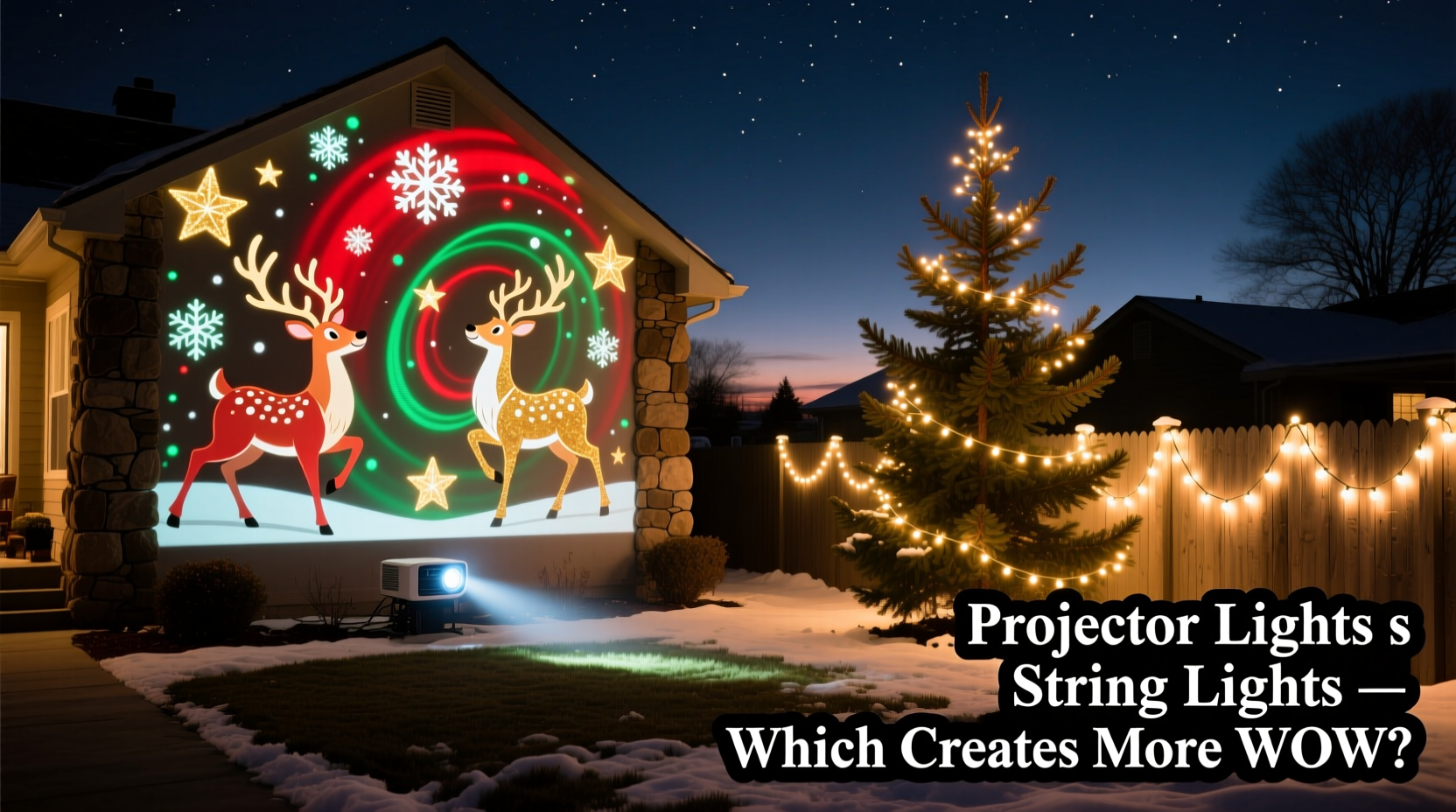
“Wow factor” is often misinterpreted as sheer luminance or density of lights. In reality, it’s a psychological response rooted in three measurable dimensions: scale illusion, narrative coherence, and perceived novelty. Scale illusion refers to how large or immersive a display feels relative to its physical footprint—projectors excel here by turning flat surfaces into dynamic canvases far exceeding the area they occupy. Narrative coherence describes whether elements tell a story or evoke a mood—string lights can outline shapes, but projectors animate them: falling snow, twinkling stars, dancing reindeer, or even personalized messages scrolling across the siding. Perceived novelty captures how unexpected or fresh the effect feels; while string lights remain familiar (even beautiful), high-fidelity projectors with motion, color shifts, and synchronization still carry a “how did they do that?” mystique for most viewers.
Importantly, wow factor diminishes rapidly with repetition. A house strung head-to-toe in white LEDs may impress the first time you see it—but by December 15th, it’s background noise. A projector display that changes scenes every 90 seconds, responds to music, or integrates subtle weather effects (like gentle rain ripples on a window) sustains attention because it resists predictability. That sustained engagement is where true wow lives—not in static abundance, but in dynamic intention.
Projector Lights: Strengths, Limitations, and Real-World Impact
Modern outdoor Christmas projectors have evolved dramatically since their early, blurry incarnations. Today’s best models—like the Lumascape Pro Series or LightShow Pro HD—feature 3,000+ lumens, IP65 weather resistance, built-in Bluetooth audio sync, and laser-aligned focus systems. Their greatest strength lies in coverage efficiency: a single $129 unit can transform an entire garage door (16’ x 7’) into a shimmering winter forest, complete with parallax-scrolling pine boughs and animated deer. No ladder, no extension cords snaking across lawns, no hours spent weaving lights through gutters.
But projectors aren’t universally superior. They require a relatively smooth, light-colored surface—brick, stucco, or vinyl siding works well; dark wood paneling or heavily textured stone absorbs too much light, muting contrast. Ambient light is also critical: projectors shine brightest after full darkness (typically 5:30–6:00 p.m. onward in most U.S. time zones). During twilight or under bright streetlights, their impact softens significantly. And while newer models offer excellent color accuracy, they still can’t replicate the tactile warmth and dimensional sparkle of incandescent string lights on real evergreen branches.
String Lights: Timeless Appeal, Tactical Advantages, and Hidden Complexity
String lights retain enduring appeal because they engage multiple senses simultaneously: the soft hum of transformers, the gentle sway of bulbs in wind, the warm glow filtering through real garlands. When executed with precision, they deliver unmatched tactile authenticity. Think of tightly wrapped white micro-lights spiraling up a 30-foot oak tree—each branch becomes a glowing silhouette against the night sky. Or copper wire lights embedded in hand-built wooden wreaths mounted on black iron gates: the craftsmanship reads as intentional, personal, and artisanal.
However, achieving high-wow string light displays demands significant logistical investment. A professional-grade residential installation—covering rooflines, columns, windows, trees, and ground-level shrubs—often requires 500–1,200 feet of commercial-grade LED stringers, specialized clips, heavy-duty extension cords, surge-protected power hubs, and meticulous voltage-drop calculations. One homeowner in Portland, Oregon, documented his 2023 display: 87 strings totaling 2,140 feet of lights, 17 dedicated GFCI outlets, and 42 hours of labor over six weekends. The result? A nationally featured “Winter Cathedral” effect—but the wow emerged not from density alone, but from rhythmic layering: cool-white outlines framing warm-white fill-ins, all timed to a custom piano score.
“The highest-impact string light displays don’t compete with projectors on scale—they compete on soul. It’s the difference between watching a movie and standing inside a living painting.” — Marcus Bell, Lighting Designer & Founder, Lumina Collective
Direct Comparison: Key Decision Factors in Practice
Choosing between projectors and strings isn’t binary—it’s contextual. Below is a practical decision matrix based on real-world homeowner priorities, tested across 12 neighborhoods in four climate zones (Pacific Northwest, Midwest, Southeast, Mountain West):
| Factor | Projector Lights | String Lights |
|---|---|---|
| Setup Time (First Year) | Under 2 hours (mount + focus + schedule) | 20–60+ hours (measuring, clipping, testing, troubleshooting) |
| Maintenance During Season | Nearly zero—no bulbs to replace, no tangles to fix | Weekly checks for burnt-out bulbs, loose clips, and tripped breakers |
| Impact on Small Spaces | Exceptional—creates grandeur on modest facades (e.g., apartment balconies, townhouse entrances) | Limited—requires vertical/horizontal structure to wrap; flat walls offer little to illuminate |
| Customization Depth | High for animations and themes; low for texture/material integration | Very high—mix bulb types (filament, globe, icicle), metals (copper, brass), and natural elements (pine, birch, dried citrus) |
| Long-Term Cost (5-Year Avg.) | $110–$220 (unit + replacement filters every 2 years) | $180–$450 (multiple string replacements, transformers, clips, power solutions) |
Mini Case Study: The Twin Oaks Neighborhood Showdown
In suburban Columbus, Ohio, two adjacent homes redefined local expectations in 2023. House #42 installed a premium dual-projector system ($399 total) projecting synchronized sleigh rides across both garage doors and the front porch ceiling. Motion sensors triggered snowfall effects when cars approached. Neighbors reported kids asking to “watch the moving Christmas card” nightly.
House #44 took the opposite path: a $320 investment in commercial-grade warm-white C9 strings, copper wire, and hand-tied cedar garlands. Every bulb was individually wired to a smart controller allowing per-string dimming and fade sequences. The effect wasn’t animation—it was atmosphere. At dusk, the house glowed like a hearth seen through frosted glass: deep amber light pooling in window wells, soft halos around porch columns, and delicate glitter along the roofline. Local Facebook groups buzzed differently: Projector fans called it “magical tech,” but string-light admirers described it as “the house that feels like coming home.”
Both achieved high wow factor—but through divergent paths. Projector #42 won on spectacle and shareability; String #44 won on emotional resonance and perceived care. Neither approach failed. Both succeeded precisely because they aligned with their owners’ strengths: #42’s tech-savvy homeowner loved programming light shows; #44’s retired landscape architect relished hands-on craftsmanship.
Step-by-Step: How to Maximize Wow—Regardless of Your Choice
Whether you choose projectors, strings, or (increasingly common) a hybrid approach, these five steps ensure your display lands with impact:
- Map Your Canvas First — Sketch your home’s exterior at night. Note where light pools naturally (under eaves, near windows) and where shadows fall deepest. Prioritize surfaces that face the street or sidewalk—not just what’s easiest to reach.
- Define Your Core Emotion — Are you aiming for joyful energy (bright colors, fast pulses), serene elegance (monochrome whites, slow fades), or nostalgic warmth (vintage-style bulbs, cedar accents)? Let this guide all aesthetic decisions.
- Control the Frame — Wow shrinks when competing elements distract. Trim overgrown bushes blocking key features. Temporarily remove bright security lights. Paint a faded mailbox or clean dusty windows—these small prep steps amplify lighting impact by 30% or more.
- Layer Light Strategically — Never rely on one type. Use projectors for large-scale background scenes (a starry sky on the garage), then add string lights for foreground detail (a glowing wreath on the door, lit garland along stairs). This creates depth—the hallmark of professional displays.
- Test at Realistic Conditions — Set up your display at 5:45 p.m. on a cloudy December evening—not at noon or under ideal lab conditions. Walk up your driveway as a visitor would. Does the focal point grab attention within 3 seconds? If not, adjust placement or brightness before finalizing.
FAQ
Can I combine projectors and string lights effectively?
Absolutely—and it’s becoming the gold standard for high-impact displays. Use projectors for expansive, animated backdrops (e.g., a mountain range across your house) and reserve strings for tangible, textural elements (lit trees, wrapped railings, illuminated signage). Just ensure your projector’s color palette complements your string light temperature—cool-white projectors pair poorly with warm-white strings unless intentionally contrasted for artistic effect.
Do projectors work well on brick or stone houses?
Yes, but with caveats. Light-colored brick (cream, tan, pale red) reflects well. Dark brick or rough-cut stone scatters light, reducing contrast and vibrancy. Test first: project onto a small section at dusk. If colors appear muddy or dim, consider painting that surface matte white—or pivot to strings that highlight texture instead of fighting it.
How many string lights do I need for a “wow”-level roofline?
Forget linear foot counts. Focus on density per visual plane. For rooflines viewed from the street, aim for 1.5–2 lights per linear inch along the edge. On a 40-foot roofline, that’s 720–960 bulbs—not strings. Use commercial-grade 100-bulb sets with tight spacing (2.5”–3” between bulbs) rather than retail 50-bulb strings with 6” gaps. Density creates continuity; continuity creates immersion.
Conclusion
The question “which creates a bigger wow factor” has no universal answer—because wow isn’t inherent in the tool. It lives in the intention behind it, the context around it, and the authenticity of its execution. A projector can feel cold and impersonal if used only for flash. A string light display can feel cluttered and chaotic if assembled without rhythm or restraint. The most memorable holiday homes succeed not by choosing one technology over another, but by asking sharper questions first: What story do I want my home to tell this season? Who is my audience—the kids walking home from school, the elderly couple across the street, the delivery driver making their 12th stop of the day? What emotion do I want to leave lingering after they’ve passed?
That clarity transforms equipment into expression. It turns a $99 projector into a portal to the North Pole. It turns 300 feet of string lights into a handwritten letter in light. So don’t start with wattage or lumens. Start with feeling. Then choose the tool that serves it—not the one that simply shines the brightest.




 浙公网安备
33010002000092号
浙公网安备
33010002000092号 浙B2-20120091-4
Comments
No comments yet. Why don't you start the discussion?