
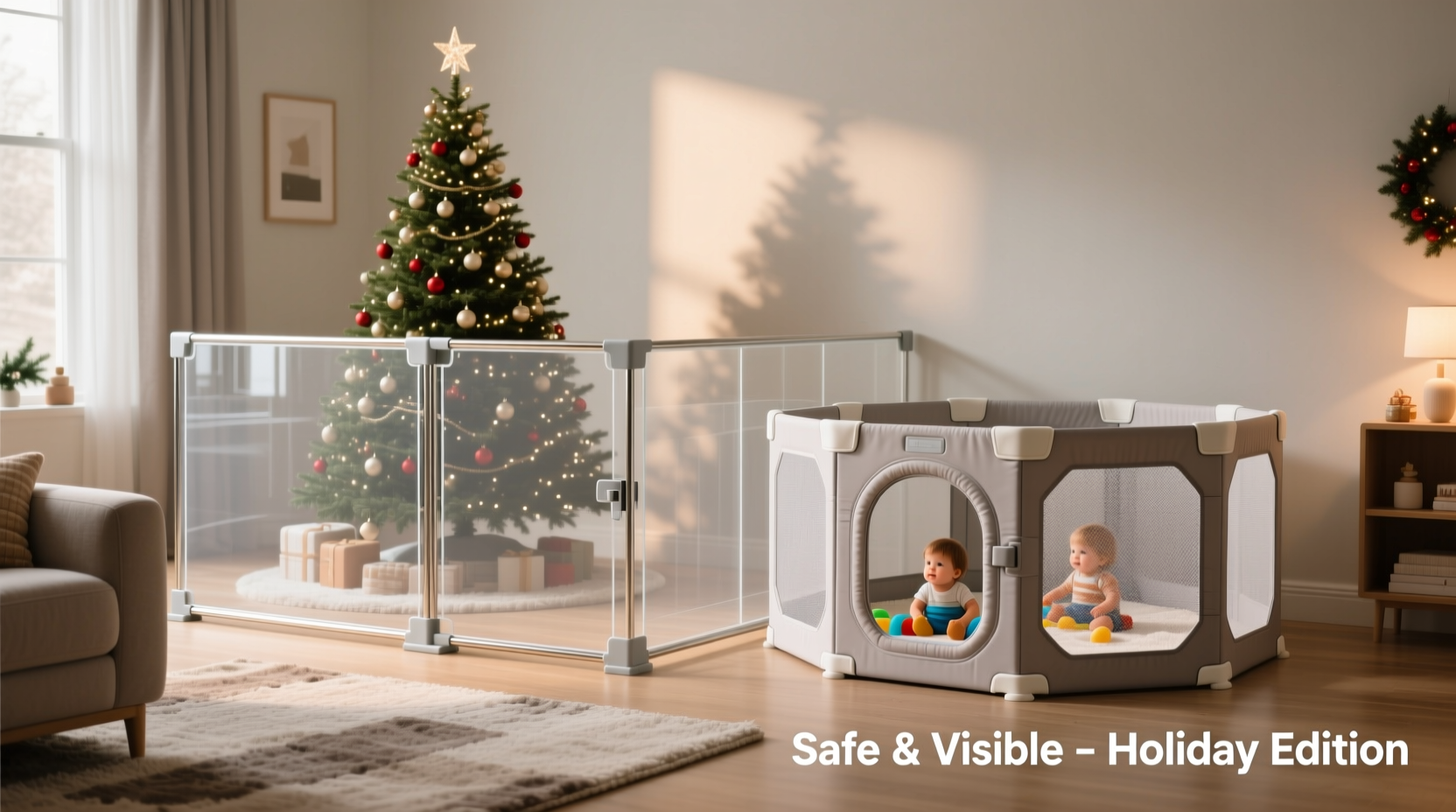
During the holiday season, families gather around the Christmas tree with lights aglow and presents piled beneath its branches. But for parents of toddlers, that same festive centerpiece becomes a potential hazard. Ornaments, tinsel, electrical cords, and even the tree itself pose risks if little hands get too close. The solution? A physical barrier that keeps curious children at a safe distance—without turning your living room into a fortress that ruins the holiday ambiance.
The two most popular options are Christmas tree safety gates and playpen-style barriers. Both aim to protect toddlers, but they differ significantly in design, visibility, ease of use, and long-term practicality. Choosing the right one depends on your home layout, decor preferences, and how much flexibility you need during the busiest time of year.
Understanding the Safety Challenge Around Christmas Trees
Toddlers between 12 and 36 months are naturally drawn to bright, shiny objects—and few things in the home match the allure of a decorated Christmas tree. According to the U.S. Consumer Product Safety Commission (CPSC), thousands of children are treated annually for injuries related to holiday decorations, including falls from trees, cuts from broken ornaments, and ingestion of small parts.
Beyond physical injury, there’s also the risk of electrocution from chewing on cords or pulling down unstable trees. Even artificial trees can topple if not properly secured, especially when a toddler uses them as support to stand or climb. While parental supervision is essential, constant vigilance isn’t always possible—especially during gatherings or cooking prep.
This makes a reliable containment system more than just a convenience; it's a necessity. However, many traditional baby gates obstruct sightlines, clash with holiday decor, or feel overly institutional. Parents increasingly want solutions that offer safety without sacrificing aesthetics—enter the debate between dedicated Christmas tree safety gates and repurposed playpen barriers.
Christmas Tree Safety Gates: Purpose-Built Protection
A Christmas tree safety gate is specifically designed to encircle the base of a tree, creating a protective perimeter. These are typically made from wood, metal, or high-grade plastic and come in circular, hexagonal, or square configurations. Some models feature hinged doors for easy access, while others snap together modularly.
One of the biggest advantages of these gates is their tailored fit. Because they're engineered for this single purpose, manufacturers often prioritize visual appeal—offering finishes like walnut, white gloss, or brushed nickel that blend with modern interiors. Many are also low-profile, standing only 24–30 inches tall, which keeps them out of the primary line of sight while still being effective at deterring crawlers and early walkers.
Installation varies by model. Freestanding versions require no tools and can be assembled in minutes. Others may anchor into floor or wall brackets for added stability—important if your tree is near high-traffic areas or if older siblings might try to lift or tip the gate.
Despite their benefits, these gates have limitations. Most are seasonal, used only a few weeks per year, which raises questions about storage and cost-effectiveness. They also tend to be less versatile—if you want to use the same barrier elsewhere in the house, such as around a fireplace or staircase, it may not adapt well.
Playpen Barriers: Flexible but Less Refined
Playpens are traditionally used for sleep and play zones, but their panel-based design has led many parents to repurpose them as tree enclosures. Standard playards usually consist of four to eight connected panels with mesh or fabric sides, forming a rectangular or octagonal space. When arranged around a tree, they create a large containment area that allows viewing from multiple angles.
The primary advantage of using a playpen barrier is versatility. Unlike tree-specific gates, playpens serve multiple functions throughout the year—safe play zones, nap areas, travel cribs—and thus represent better long-term value. Their lightweight construction makes them easy to move and store, and many meet strict juvenile product safety standards set by ASTM International.
Visibility is another strong point. Mesh walls allow nearly unobstructed views of the tree from across the room, preserving the holiday atmosphere. Children inside can see the lights twinkle, and adults can enjoy the display without peering through slats or bars.
However, drawbacks exist. Most playpens aren't circular, so fitting them snugly around a tree often leaves gaps at the corners unless creatively arranged. Stability can also be an issue—toddlers who lean heavily against the sides may cause the entire structure to shift or collapse, especially on carpeted floors. Additionally, the industrial look of some models clashes with festive decor, making them feel more like temporary cages than elegant solutions.
“Parents often underestimate how quickly a child can scale or destabilize a non-anchored playard. If used near a tree, ensure it’s locked securely and monitored regularly.” — Dr. Lena Peterson, Pediatric Injury Prevention Specialist
Comparing Key Features: A Side-by-Side Analysis
| Feature | Tree Safety Gate | Playpen Barrier |
|---|---|---|
| Visibility | Moderate – slats or solid panels may block partial view | High – mesh sides allow full sightlines |
| Stability | High – often weighted or anchored | Moderate – prone to tipping if leaned on |
| Aesthetic Integration | Excellent – designed to complement decor | Poor to Fair – utilitarian appearance |
| Ease of Assembly | Easy – tool-free setup in minutes | Easy – familiar pop-up or clip systems |
| Year-Round Use | Low – primarily seasonal | High – multi-functional |
| Storage | Bulky – rigid shapes take up space | Compact – folds flat |
| Average Cost | $70–$150 | $80–$200 (if already owned) |
Real-World Scenario: How One Family Navigated the Choice
The Rivera family lives in a mid-century ranch with an open-concept living and dining area. Their six-foot Fraser fir stands in the corner where both rooms meet, making it visible from nearly every seat in the house. With a newly walking 14-month-old daughter, Mia, they needed a solution that kept her safe but didn’t disrupt the flow of their holiday entertaining.
Initially, they tried using their existing playpen. It folded open easily and surrounded the tree with clear mesh. Guests could see the tree, and Mia could sit inside and watch the lights. But within two days, she learned to pull herself up and rock the panels back and forth. On the third night, the entire structure tipped over—luckily, the tree was secured, but several ornaments shattered.
They switched to a wooden hexagonal tree gate with a magnetic latch door. Though slightly more expensive ($129), it blended with their walnut coffee table and remained stable even when Mia pushed against it. The slatted design blocked some views from sharp angles, but head-on sightlines were preserved. They stored it disassembled under the guest bed after the holidays.
“It wasn’t the cheapest option,” said Elena Rivera, “but knowing Mia couldn’t knock it over gave us real peace of mind. And honestly, it looked like part of the decor—not a cage.”
Step-by-Step Guide: Choosing and Installing Your Barrier
- Assess Your Space: Measure the diameter of your tree’s footprint and determine how much clearance you need for trimming, watering, or placing gifts.
- Evaluate Visibility Needs: Walk around your room and identify key viewing angles. Prioritize solutions that preserve sightlines from seating areas.
- Check Stability Requirements: If your toddler is mobile or strong, opt for anchored or weighted barriers. Avoid freestanding mesh walls unless reinforced.
- Match Aesthetic Preferences: Choose a finish or material that complements your furniture. White or natural wood tones tend to blend better than metallic grays or black frames.
- Install and Test: Assemble the barrier according to instructions. Try opening any doors, then let your toddler approach under supervision to test effectiveness.
- Add Secondary Measures: Even with a barrier, secure the tree to a wall anchor, avoid low-hanging breakables, and cover cords with protectors.
Essential Checklist Before Setup
- ✅ Confirm the barrier meets current CPSC or ASTM safety standards
- ✅ Ensure all latches and hinges are secure and toddler-proof
- ✅ Verify there are no gaps larger than 3 inches where a child could squeeze through
- ✅ Make sure the height exceeds your child’s reach when standing
- ✅ Remove any nearby furniture that could be climbed to bypass the barrier
- ✅ Double-check that electrical cords are covered or elevated
- ✅ Keep small ornaments, tinsel, and toxic plants outside the child’s reach—even inside the barrier
Frequently Asked Questions
Can I use a pressure-mounted gate around my Christmas tree?
Pressure-mounted gates can work if they’re specifically rated for pet or child containment and installed correctly. However, they may shift under persistent pushing. For maximum safety, especially with active toddlers, hardware-mounted or freestanding weighted barriers are preferred.
Are playpens safe to use as tree enclosures?
Yes, but with caveats. Only use playpens that lock securely into place and do not wobble. Never leave a child unattended in one used as a tree barrier. Avoid older or recalled models, and ensure mesh is intact with no tears or weak seams.
What’s the ideal height for a tree safety barrier?
A minimum of 28 inches is recommended. Toddlers grow quickly, and a taller barrier prevents climbing attempts. If your child is already pulling up to stand, consider 30+ inches for added security.
Final Thoughts: Balancing Safety, Sightlines, and Sanity
The decision between a Christmas tree safety gate and a playpen barrier ultimately comes down to priorities. If seamless integration with your holiday aesthetic and rock-solid stability are paramount, a purpose-built tree gate is likely worth the investment. If you value multifunctionality, portability, and cost efficiency, adapting a sturdy playpen—with proper precautions—can be an effective alternative.
Neither option eliminates the need for active supervision, but both provide a critical layer of protection during a high-risk time of year. By choosing thoughtfully and installing carefully, you can preserve both your child’s safety and the joyous spirit of the season—without hiding the tree behind a wall of plastic and fear.




 浙公网安备
33010002000092号
浙公网安备
33010002000092号 浙B2-20120091-4
Comments
No comments yet. Why don't you start the discussion?