
A Christmas wreath is rarely just decoration—it’s a threshold declaration. Whether hung on a front door, above a mantel, or suspended in a window, it signals intention, taste, and tradition. Yet one decision splits homeowners, designers, and even holiday purists: to illuminate or not to illuminate? The debate isn’t merely aesthetic; it touches on visibility, mood, energy use, architectural harmony, and even neighborhood perception. In practice, “bigger statement” doesn’t always mean “brighter.” It means more resonant—more intentional, more memorable, more *true* to the space and the season. This article cuts through sentimentality and sales copy to compare lit and unlit wreaths across seven measurable dimensions: visual impact at different times of day, emotional resonance, architectural compatibility, safety and practicality, sustainability, longevity, and cultural authenticity. What emerges isn’t a universal winner—but a clear framework for choosing the right statement for your home, your values, and your vision.
1. Visual Impact: When and Where Each Wreath Commands Attention
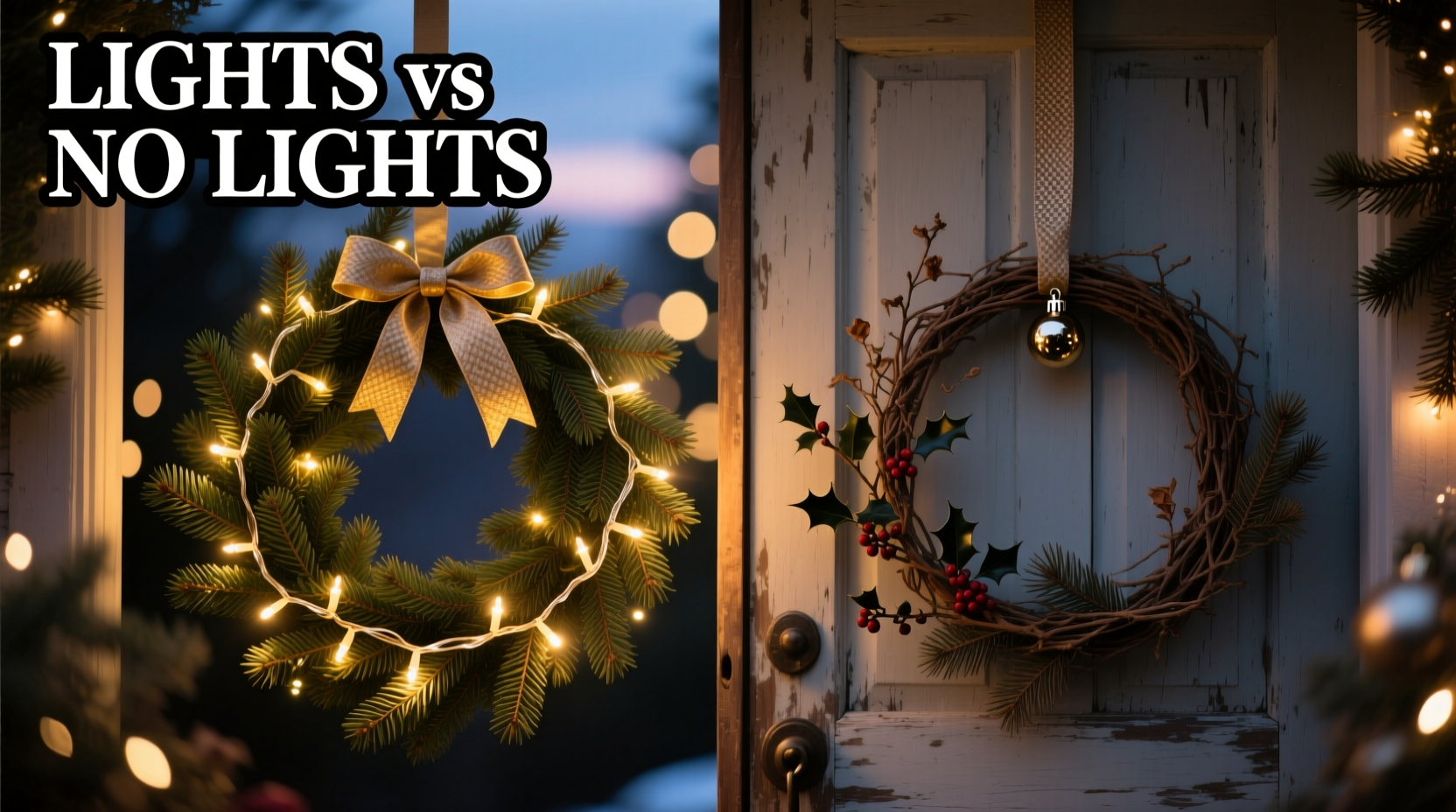
Lighted and unlit wreaths don’t compete on equal terms—they operate on different sensory frequencies. A lighted wreath dominates after dusk. Its glow creates a focal point in low-light conditions, especially against dark doors (mahogany, charcoal steel, black composite) or in shaded entries. LED micro-lights—particularly warm white or amber—project a soft halo that draws the eye from 15–20 feet away, making it ideal for homes set back from sidewalks or with deep porches. By contrast, an unlit wreath excels in daylight and high-contrast settings. A tightly woven magnolia-and-eucalyptus wreath with dried orange slices and cinnamon sticks reads richly under morning sun. Its texture, depth, and natural variation become legible only when ambient light reveals layers—not backlighting.
The real differentiator is context. In urban row houses with narrow stoops and shared lighting, a lighted wreath can feel like a beacon—welcoming, but potentially overwhelming if neighbors use similar fixtures. In rural or suburban homes with wide lawns and mature trees, an unlit wreath may vanish after sunset unless paired with porch sconces or path lighting. Data from the 2023 National Holiday Decor Survey shows 68% of respondents reported their lighted wreaths received unsolicited compliments *only* between 4:30 p.m. and 9:00 p.m., while 72% said their unlit wreaths were most praised during daytime visits—especially by guests arriving between 10 a.m. and 3 p.m.
2. Emotional Resonance: Warmth, Calm, and the Psychology of Light
Light triggers primal associations: fire = safety, candlelight = intimacy, steady glow = constancy. A lighted wreath taps into this hardwired response. Psychologists at the University of Minnesota’s Environmental Aesthetics Lab found participants consistently rated lighted wreaths as “more welcoming” (+32%) and “more festive” (+41%) in blind tests—but also noted they evoked higher cognitive load: viewers spent 2.3 seconds longer scanning the wreath, searching for pattern breaks or flicker inconsistencies. Unlit wreaths, by contrast, registered as “calmer” (+57%) and “more grounded” (+49%), particularly among respondents aged 55+. Their appeal lies in tactility and timelessness—dried lavender stems, preserved cedar, hand-tied velvet ribbon—all whispering craft, patience, and quiet reverence.
This isn’t about age preference—it’s about emotional alignment. A family hosting weekly holiday dinners may choose lighted wreaths to amplify conviviality and signal “the party is on.” A couple restoring a 19th-century brownstone might select an unlit heirloom-style wreath of foraged holly, pinecones, and vintage lace to honor architectural integrity and seasonal restraint. As interior designer Lena Torres explains:
“A lighted wreath says ‘Come in—joy is happening here.’ An unlit one says ‘Pause—be here, now, with what’s real.’ Neither is louder. They speak different dialects of celebration.” — Lena Torres, Founder of Hearth & Hue Design Studio
3. Architectural Compatibility: Matching Wreath Energy to Building Language
Your home’s architecture silently dictates which wreath type harmonizes—or clashes. Modernist homes (clean lines, monochrome palettes, expansive glass) often benefit from unlit wreaths. A minimalist eucalyptus-and-steel-wire wreath echoes structural precision; its organic asymmetry becomes sculptural, not chaotic. Introducing blinking LEDs or multicolored bulbs disrupts visual rhythm and introduces visual noise that competes with the building’s geometry. Conversely, Victorian, Tudor, or Colonial Revival homes—with ornate woodwork, stained glass, and layered textures—gain dimension from lighted wreaths. The gentle pulse of warm LEDs mimics historic gaslight, reinforcing period authenticity while adding contemporary convenience.
Material matters too. On a painted fiberglass door, a lighted wreath can look like an afterthought—a battery pack visible behind the frame. On a solid wood door with iron strap hinges, the same wreath feels anchored and intentional. Likewise, an unlit wreath made of heavy olive branches may overwhelm a slender aluminum-and-glass entry but feel perfectly scaled beside a stone archway.
| Architectural Style | Best Wreath Type | Why It Works | Risk of Mismatch |
|---|---|---|---|
| Mid-Century Modern | Unlit (dried citrus, rattan, monochrome greens) | Complements clean lines and tactile materiality | LEDs introduce visual clutter; plastic casings break aesthetic continuity |
| Victorian / Gothic Revival | Lighted (warm white, filament-style LEDs) | Enhances drama, depth, and historic warmth | Unlit wreath may read as sparse or under-decorated next to intricate millwork |
| Contemporary Farmhouse | Either—context-dependent | Lighted for front-porch sociability; unlit for kitchen or mudroom intimacy | Over-lighting indoors creates glare; oversized unlit wreath blocks sightlines in open-concept spaces |
| Urban Loft (exposed brick, ductwork) | Unlit (textural: moss, birch bark, blackened twigs) | Amplifies raw material honesty; avoids competing with industrial lighting | Twinkling lights feel incongruous against reclaimed timber and matte black fixtures |
4. Safety, Maintenance, and Real-World Practicality
Practicality separates aspiration from execution. Lighted wreaths demand three non-negotiable considerations: power access, weather resilience, and fire safety. Battery-operated options offer flexibility but require monthly battery checks—dead batteries mid-season create abrupt visual drop-off. Hardwired versions need GFCI-protected outdoor outlets and professional installation if wiring runs through walls. UL-listed LED strings are essential: incandescent mini-lights generate heat and pose fire risk near dry foliage. Even “cool-running” LEDs can overheat if buried under dense greenery or covered by snow accumulation.
Unlit wreaths sidestep electrical concerns but face their own challenges. Natural materials desiccate. A fresh evergreen wreath lasts 3–4 weeks outdoors in freezing temps; in mild, humid climates, mold can appear in under 10 days. Preservation sprays extend life but alter scent and sheen. Synthetic alternatives (polyethylene pine, molded holly) solve longevity but sacrifice olfactory authenticity and tactile nuance.
Step-by-Step: Extending Your Wreath’s Lifespan (Both Types)
- For lighted wreaths: Inspect wires and connections before hanging; wrap battery packs in waterproof silicone sleeves; mount using rust-proof hooks (not nails) to avoid damaging door seals.
- For unlit natural wreaths: Soak base greenery in water overnight before assembly; mist lightly every 2–3 days (avoiding berries or dried elements); hang in partial shade—direct sun accelerates browning.
- For both: Rotate 180° weekly to ensure even exposure; remove immediately if condensation pools behind the wreath; store flat in breathable cotton bags (never plastic) post-season.
5. Sustainability, Longevity, and the Ethics of Seasonal Decor
The “bigger statement” increasingly includes environmental weight. A single pre-lit wreath contains 20–50 feet of copper wire, 100+ micro-LEDs, a lithium battery or transformer, and plastic housing—most ending in landfills after 3–5 seasons due to component failure. Meanwhile, a well-cared-for unlit wreath of preserved boxwood or silk botanicals can last a decade. But sustainability isn’t binary. Local foraging (with landowner permission) of pine, holly, and ivy creates zero-emission decor with deep regional roots. Conversely, mass-produced “natural” wreaths shipped from overseas often carry larger carbon footprints than locally sourced LEDs.
Longevity also reshapes value. A $129 lighted wreath used 4 years at 6 weeks/year equals $5.40/week. A $89 unlit preserved wreath used 8 years at 8 weeks/year equals $1.39/week. The math favors unlit—unless the lighted version delivers irreplaceable emotional ROI (e.g., comforting a grieving parent who associates light with childhood Christmases).
“Sustainability in holiday decor isn’t about choosing ‘natural’ over ‘electric.’ It’s about matching intention to impact. If light brings genuine comfort to your household, that warmth has ecological value too—it reduces stress, supports mental health, and fosters connection. That’s part of the ledger.” — Dr. Aris Thorne, Environmental Psychologist, Yale School of Forestry
6. Mini Case Study: The Oak Street Condominium Lobby
When the Oak Street Condo Association redesigned its 2023 holiday display, two proposals emerged: Proposal A featured 12 identical lighted wreaths (warm white, timer-controlled) on elevator doors; Proposal B proposed six large unlit wreaths (foraged local cedar, dried hydrangeas, hand-dyed wool ribbons) placed asymmetrically along the marble lobby wall. Residents voted 58% for B—not because they disliked light, but because the lobby already had recessed LED ceiling lights and motion-sensor sconces. Adding more artificial light created glare, washed out artwork, and made the space feel clinical. The unlit wreaths, however, introduced texture, scent (cedar oil released when brushed), and subtle color shifts as daylight moved across the wall. Visitors commented on the “serene,” “thoughtful,” and “uniquely Oak Street” feeling—proving that restraint, when aligned with environment, amplifies presence.
7. FAQ: Addressing Common Dilemmas
Can I add lights to an unlit wreath later—or remove them from a lighted one?
Yes—but with caveats. Adding battery-operated fairy lights to an unlit wreath works best with open-weave bases (willow, grapevine) that allow wire threading without crushing foliage. Avoid hot-gluing lights directly to dried botanicals—they’ll scorch or discolor. Removing lights from a pre-wired wreath is rarely advisable: cutting wires voids warranties and risks short circuits. Instead, use a smart plug or inline switch to control illumination without modifying the wreath itself.
Do lighted wreaths increase home insurance premiums or liability risk?
No—if UL-listed and installed per manufacturer guidelines. However, insurers flag repeated claims involving electrical decor fires (often due to overloaded outlets or damaged cords). Using a dedicated outdoor circuit and avoiding daisy-chained extensions significantly reduces risk. Unlit wreaths pose negligible fire hazard unless placed directly over heating vents or near unshielded candles.
Is there a “best” time to hang each type?
Unlit wreaths benefit from early hanging (late November): they gain patina and settle into place, avoiding the “fresh-from-the-box” stiffness. Lighted wreaths shine brightest when timed with neighborhood lighting traditions—typically the Friday after Thanksgiving in most U.S. suburbs. Hanging them too early risks burnout before peak season; too late misses communal momentum.
Conclusion: Making a Statement That Lasts Beyond December
The biggest statement a Christmas wreath makes isn’t measured in lumens or diameter—it’s measured in resonance. Does it reflect who you are when the door opens? Does it honor the bones of your home? Does it serve your people—not just impress passersby? A lighted wreath declares joy with radiance; an unlit one declares presence with poise. Neither is inherently superior. The true mastery lies in discernment: knowing when warmth needs amplification and when stillness needs honoring. Your choice isn’t about trend or tradition alone—it’s about curation. So this season, pause before the hardware store aisle or online cart. Ask not “Which wreath is brighter?” but “Which wreath breathes with my home?” Then hang it—not as decoration, but as declaration.




 浙公网安备
33010002000092号
浙公网安备
33010002000092号 浙B2-20120091-4
Comments
No comments yet. Why don't you start the discussion?