
Walking through a city demands more than just fashion—it requires footwear that can endure long hours on concrete, uneven sidewalks, sudden downpours, and unexpected detours. For many urban dwellers, the daily shoe dilemma often comes down to two popular options: chunky loafers and ballet flats. Both have carved out strong identities in modern wardrobes—one celebrated for its bold, contemporary edge, the other for its timeless elegance. But when it comes to actual performance during an all-day city walk, which one truly wins?
This isn’t just about aesthetics. It’s about arch support, shock absorption, slip resistance, breathability, and how your feet feel after eight hours of navigating subways, coffee shops, and cobblestone alleys. Let’s break down both styles with real-world practicality in mind.
Comfort & Support: The Foundation of All-Day Wear
Comfort is not a luxury when you're logging thousands of steps in a single day—it's a necessity. How each shoe supports the foot biomechanically makes a significant difference over time.
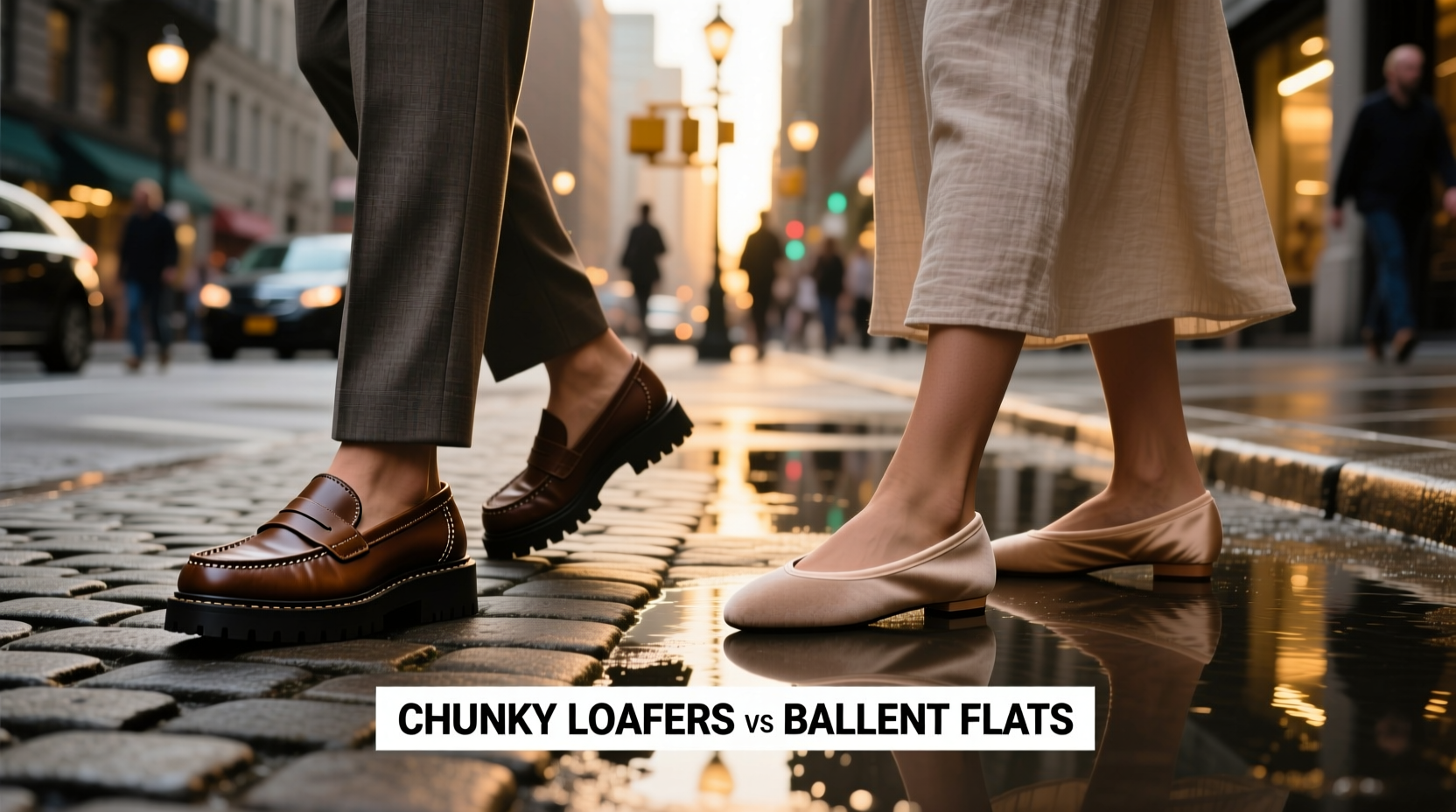
Ballet flats are typically low-cut, thin-soled, and flexible. While they offer excellent freedom of movement and a sleek silhouette, their minimalist construction often lacks sufficient arch support and cushioning. Most traditional versions use flimsy insoles that compress quickly under prolonged pressure. After a few hours, this can lead to plantar fasciitis flare-ups, heel bruising, or general foot fatigue—especially on hard surfaces like asphalt or tile.
In contrast, modern chunky loafers feature thicker soles made from EVA foam, rubber, or dual-density materials designed to absorb impact. Their elevated platform or lug sole adds height without sacrificing stability. Many include molded footbeds that contour to the arch, providing crucial midfoot support. This structural advantage becomes increasingly apparent during extended walking sessions.
Durability & Traction: Surviving Urban Terrain
Cities are unforgiving environments for footwear. From rain-slicked crosswalks to gravel patches near construction zones, traction matters. So does durability.
Ballet flats, particularly those made from delicate leather or satin, wear down quickly. The thin outsole tends to scuff after minimal use, and smooth soles become slippery when wet. Even rubber-tipped versions struggle with grip on steep inclines or polished floors common in office buildings and transit hubs.
Chunky loafers, by design, incorporate rugged outsoles. Many models feature deeply grooved treads that channel water away and maintain contact with the ground. These soles resist abrasion from constant friction against pavement, meaning they last longer even with heavy daily use. Additionally, their uppers are often constructed from thicker leathers or synthetic blends engineered for resilience.
“From a podiatrist’s standpoint, any shoe worn for extended periods on hard surfaces should provide shock absorption and lateral stability. Chunky loafers meet these criteria far more consistently than ballet flats.” — Dr. Lena Torres, DPM, Urban Foot Health Clinic
Style Versatility vs. Functional Design
One might argue that ballet flats win in terms of sheer versatility. They pair effortlessly with dresses, skirts, cropped pants, and tailored shorts. Their dainty profile makes them ideal for formal settings or minimalist styling. However, versatility doesn't equate to functionality.
Chunky loafers have evolved beyond their preppy origins. Today’s designs balance retro charm with utilitarian flair. They work well with wide-leg trousers, midi skirts, jeans, and even some business-casual ensembles. Though slightly bolder in appearance, they’ve gained acceptance in creative workplaces and lifestyle-oriented industries.
The trade-off is subtle but important: ballet flats sacrifice structure for elegance; chunky loafers integrate strength into style. When choosing between the two for city life, ask yourself: do I want to look put-together at 9 a.m., or do I want to still feel good at 7 p.m.?
Real-World Performance Comparison
| Feature | Chunky Loafers | Ballet Flats |
|---|---|---|
| Arch Support | High (often contoured insoles) | Low to none (flat interior base) |
| Shock Absorption | Excellent (thick midsoles) | Poor (minimal padding) |
| Traction | Strong (textured rubber outsoles) | Weaker (smooth or lightly textured) |
| Durability | High (resilient materials and construction) | Moderate to low (prone to scuffing) |
| Weight | Moderate (heavier due to sole) | Light (easy to carry) |
| All-Day Comfort | Recommended | Not recommended without modifications |
Mini Case Study: A Week of City Commuting
Sophie, a graphic designer based in Brooklyn, tested both styles over five consecutive workdays. Her routine involved a 20-minute subway commute, walking to three client meetings across Manhattan, and spending several hours standing during photo shoots.
- Day 1–2 (Ballet Flats): Felt comfortable initially, but by mid-afternoon, she experienced sharp pain under her left heel. By Friday, she developed a blister near her pinky toe due to repeated rubbing.
- Day 3–5 (Chunky Loafers): Noticed slight heaviness at first, but no discomfort. Reported feeling less foot fatigue and greater confidence walking on wet sidewalks. No blisters or pressure points.
She concluded: “I love how ballet flats look with my summer wardrobe, but if I’m going to be on my feet all day, there’s no contest. The loafers saved my feet.”
How to Optimize Ballet Flats for Longer Wear
If you’re emotionally (or stylistically) attached to ballet flats, all hope isn’t lost. You can improve their performance with smart upgrades:
- Add custom insoles: Replace the factory liner with gel or memory foam inserts that provide arch support and cushioning.
- Use heel grips: Prevent slippage that causes blisters and instability.
- Choose reinforced styles: Look for flats with rubber forefoot caps or hidden platforms (0.5”–0.75”) for added protection.
- Limit usage: Reserve them for shorter outings or events where seating is guaranteed.
- Break them in gradually: Wear them around the house before taking them into high-mileage scenarios.
Step-by-Step Guide: Choosing the Right Shoe for Your City Lifestyle
Follow this decision-making process to determine whether chunky loafers or ballet flats suit your needs:
- Assess your daily step count: Are you regularly walking 6,000+ steps? If yes, prioritize cushioning and support.
- Evaluate your route: Does it include stairs, hills, or poorly maintained sidewalks? Rough terrain favors sturdy soles.
- Check weather patterns: Frequent rain increases the need for waterproofing and slip resistance.
- Consider your foot type: Flat feet benefit from structured support; neutral arches may tolerate flatter shoes briefly.
- Test wear for at least 3 hours: Don’t judge comfort based on store trials. Walk up and down stairs, stand still, and simulate your typical pace.
- Review return policies: Buy from retailers with flexible exchanges in case initial comfort doesn’t hold up.
Checklist: What to Look for in All-Day City Footwear
- ✅ Thick, shock-absorbing midsole (EVA or polyurethane)
- ✅ Contoured footbed with arch support
- ✅ Non-slip rubber outsole with deep tread
- ✅ Breathable upper material (perforated leather, mesh-lined)
- ✅ Heel counter that stabilizes the back of the foot
- ✅ Roomy toe box (to prevent crowding)
- ✅ Weight balance (not too front-heavy or clunky)
- ✅ Break-in period under 3 wears
Frequently Asked Questions
Can I wear ballet flats all day if they’re expensive?
Price does not guarantee comfort or support. High-end ballet flats may use premium leather, but many still lack essential ergonomic features. Always inspect the insole and sole thickness regardless of brand prestige.
Do chunky loafers look unprofessional?
Not necessarily. Modern designs in black, oxblood, or dark brown with clean lines are widely accepted in creative offices and hybrid workspaces. Avoid overly exaggerated platforms in conservative environments.
Are there lightweight chunky loafers?
Yes. Advances in materials science have led to ultra-light EVA compounds and honeycomb sole structures that reduce weight without compromising cushioning. Look for terms like “cloud-lite,” “aero-foam,” or “feathercore” in product descriptions.
Final Verdict: Which Wins for All-Day City Walking?
While ballet flats hold undeniable appeal for their grace and simplicity, they fall short when subjected to the physical demands of urban life. Without structural reinforcement, they cannot compete with the biomechanical benefits offered by chunky loafers.
The data, expert opinion, and real-world testing converge on one conclusion: **chunky loafers are superior for all-day city walking**. They deliver lasting comfort, reliable traction, and long-term durability—all while maintaining a fashionable edge.
That said, personal preference still plays a role. If your day involves mostly seated work with brief walks, ballet flats remain a viable option—especially when enhanced with orthotics. But for anyone regularly navigating dynamic cityscapes, investing in supportive, resilient footwear isn’t indulgence. It’s self-care.




 浙公网安备
33010002000092号
浙公网安备
33010002000092号 浙B2-20120091-4
Comments
No comments yet. Why don't you start the discussion?