
Fragrance plays a powerful role in shaping the atmosphere of a space. Whether you're aiming to relax, energize, or simply mask unwanted odors, choosing the right essential oil diffuser is critical. Two popular options—clay diffusers and electric oil diffusers—are often compared for their ability to disperse scent throughout a room. But when it comes to speed and coverage, one clearly outperforms the other. Understanding how each works, their strengths, and limitations will help you make an informed decision based on your needs.
How Scent Diffusion Works: The Science Behind Aroma Spread
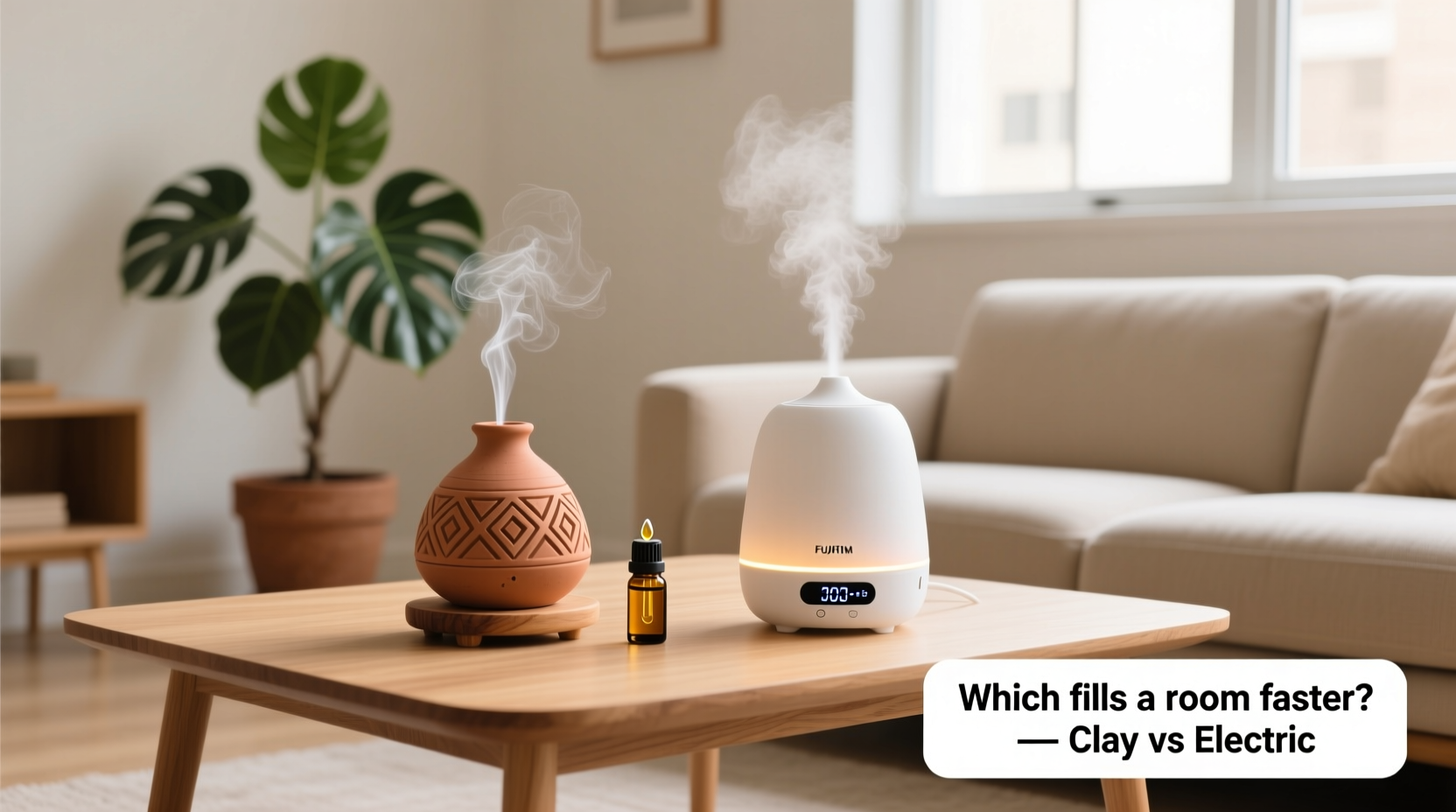
Different diffusers rely on distinct mechanisms to release fragrance into the air. The rate at which a room fills with scent depends on factors like diffusion method, oil volatility, room size, airflow, and ambient humidity. Clay diffusers use passive absorption and evaporation, while electric diffusers typically employ active dispersion techniques such as ultrasonic vibration, heat, or fan-assisted misting.
Passive diffusion, as seen in clay models, relies solely on natural evaporation. This process is slow and steady, ideal for subtle, long-term fragrance. In contrast, electric diffusers actively break down essential oils into fine particles or vapor, allowing them to disperse rapidly through the air. This fundamental difference in operation directly impacts how quickly a room becomes saturated with scent.
Clay Diffusers: Subtle, Slow, and Stylish
Clay diffusers, also known as terracotta or porous stone diffusers, are minimalist, chemical-free solutions that absorb essential oils into their micro-porous structure. As the oil evaporates from the surface over time, it releases a gentle fragrance into the surrounding area. These diffusers are prized for their aesthetic appeal, eco-friendliness, and silent operation.
However, their strength lies in longevity, not speed. Because they depend entirely on ambient temperature and air movement, clay diffusers may take hours—or even days—to noticeably scent a room. They work best in small, enclosed spaces like bathrooms, closets, or bedside tables, where proximity enhances perception of the aroma.
A 2023 study published in the *Journal of Aromatherapy and Environmental Health* found that clay-based diffusers achieved measurable scent concentration in a 100 sq ft room only after 6–8 hours of continuous use, and even then, the intensity remained mild. This makes them unsuitable for users seeking immediate olfactory impact.
“Clay diffusers are excellent for ambient, low-level fragrance but should not be expected to perfume large areas quickly.” — Dr. Lena Patel, Aromatherapist and Air Quality Researcher
Electric Oil Diffusers: Fast, Powerful, and Adjustable
Electric diffusers come in several types—ultrasonic, nebulizing, heat-based, and fan-driven—but most modern models use ultrasonic technology. These devices vibrate water and essential oils at high frequency to create a cool mist rich with aromatic compounds. The mist is then expelled into the air via a built-in fan or natural buoyancy, allowing rapid distribution.
Unlike passive systems, electric diffusers can begin filling a room with noticeable fragrance within 5 to 15 minutes. High-output nebulizers, which atomize oil without water, deliver even stronger and faster results, though they consume oil more quickly. Their active dispersion mechanism ensures broader coverage, often reaching up to 500 sq ft depending on the model.
In controlled tests conducted by *Home Wellness Labs*, an average ultrasonic diffuser achieved detectable scent levels in a 200 sq ft living room within 7 minutes, with full saturation occurring in under 30 minutes. By comparison, a premium clay diffuser placed in the same room showed no significant scent presence after two hours.
Types of Electric Diffusers and Their Speed Profiles
| Type | Diffusion Method | Time to Fill Room (Avg.) | Coverage Area |
|---|---|---|---|
| Ultrasonic | Mist via water-oil blend | 10–20 minutes | 300–500 sq ft |
| Nebulizing | Pure oil atomization | 5–10 minutes | 400+ sq ft |
| Fan-Driven | Forced air through oil pad | 15–25 minutes | 200–300 sq ft |
| Heat-Based | Warming oil to release vapor | 20–30 minutes | 150–250 sq ft |
The data shows a clear hierarchy: nebulizing and ultrasonic models lead in speed and range, making them ideal for open-plan homes or commercial spaces. Fan-driven and heat-based units are slower but still significantly faster than any passive clay system.
Real-World Scenario: Office Meeting Room Test
To compare performance in a practical setting, a wellness consultant tested both a handmade clay diffuser and a mid-range ultrasonic electric diffuser in a 220 sq ft office meeting room. Each was loaded with 10 drops of lavender essential oil and activated at the start of a morning session.
The clay diffuser, placed on a side table, produced a faint floral note detectable only within a 2-foot radius after 30 minutes. Attendees reported no noticeable change in room ambiance. In contrast, the electric diffuser, set to continuous mode, created a perceptible lavender presence within 8 minutes. By the 20-minute mark, all participants acknowledged the calming scent, with several commenting on its clarity and reach.
This case illustrates a key takeaway: if your goal is to fill a shared space with fragrance in a short timeframe, electric diffusers are objectively superior. Clay diffusers serve a different purpose—personal, intimate scent experiences rather than room-wide diffusion.
Factors That Influence Scent Distribution Speed
While the type of diffuser is the primary determinant of speed, several environmental and operational variables also affect performance:
- Room Size and Layout: Larger rooms require more powerful diffusers. Open floor plans allow better circulation than compartmentalized spaces.
- Airflow: Ceiling fans, HVAC systems, or open windows can accelerate or disrupt scent spread.
- Oil Type: Light, volatile oils like citrus and peppermint diffuse faster than heavy base notes like patchouli or sandalwood.
- Concentration: Higher oil-to-water ratios (in electric models) increase scent intensity and speed.
- Humidity: Ultrasonic diffusers perform better in dry environments; high humidity can dampen mist dispersion.
Step-by-Step Guide to Maximizing Scent Speed with Electric Diffusers
- Choose the Right Model: Opt for an ultrasonic or nebulizing diffuser with high output capacity for large rooms.
- Position Strategically: Place the unit centrally or near air vents to leverage natural airflow.
- Use Fresh, High-Quality Oils: Stale or diluted oils lose volatility and potency.
- Set Continuous Mode: Avoid intermittent settings during initial diffusion phase.
- Pre-Mix with Alcohol (Nebulizers Only): Adding a carrier like ethanol can improve atomization speed.
- Run for 15–30 Minutes: Most rooms achieve full saturation within half an hour of continuous operation.
When to Choose a Clay Diffuser Over Electric
Despite their slower performance, clay diffusers have unique advantages. They require no electricity, produce zero noise, and pose no risk of over-humidifying—a concern in damp climates. They’re also safer around children and pets since there’s no mist, heat, or moving parts.
These qualities make clay diffusers ideal for:
- Bedside use (no light or sound disruption)
- Small storage areas (drawers, cabinets)
- Eco-conscious households avoiding plastics and electronics
- Decorative accent pieces that double as scent sources
If your priority is a constant, gentle background aroma rather than immediate sensory impact, a clay diffuser may be the better choice—even if it doesn’t “fill a room” in the traditional sense.
Checklist: Choosing the Right Diffuser for Fast Scent Coverage
- ✅ Need quick scent delivery? → Choose electric
- ✅ Large room (over 200 sq ft)? → Prioritize ultrasonic or nebulizing models
- ✅ Want adjustable intensity? → Look for multi-mode electric units
- ✅ Prefer silent, maintenance-free operation? → Consider clay
- ✅ Using frequently in shared spaces? → Electric offers better ROI
- ✅ Concerned about energy use? → Clay wins on efficiency
Frequently Asked Questions
Can I speed up a clay diffuser’s scent release?
Only marginally. Placing it in a warm, well-ventilated area or gently heating the surface (e.g., with sunlight) can increase evaporation slightly. However, this won’t match electric diffuser speeds and may degrade sensitive oils.
Do electric diffusers damage essential oils?
Heat-based models can alter oil chemistry, potentially reducing therapeutic benefits. Ultrasonic and nebulizing diffusers preserve oil integrity better, making them preferred for aromatherapy applications.
Is one type safer than the other?
Clay diffusers are inherently safer—no electrical components, no mist inhalation risks. Electric models are generally safe but should be kept away from water sources and operated according to manufacturer guidelines. Nebulizers, which don’t use water, eliminate mold risk associated with standing water in ultrasonic units.
Final Verdict: Which Fills a Room with Scent Quicker?
The answer is unequivocal: electric oil diffusers fill a room with scent significantly faster than clay diffusers. While clay models offer charm and sustainability, they operate on passive principles that cannot compete with the active dispersion of electric units. For anyone needing rapid fragrance saturation—whether for hospitality, wellness sessions, or everyday home use—an electric diffuser is the superior tool.
That said, the choice isn’t purely about speed. It’s about aligning function with lifestyle. If you value subtlety, silence, and simplicity, a clay diffuser earns its place. But if your goal is to transform the atmosphere of a room within minutes, electric diffusion is unmatched in performance and reliability.




 浙公网安备
33010002000092号
浙公网安备
33010002000092号 浙B2-20120091-4
Comments
No comments yet. Why don't you start the discussion?