
Choosing between a compact mirror and a full-size mirror for touch-ups isn’t just about size—it’s about context, precision, and practicality. Whether you're refreshing your lipstick before a meeting or adjusting your eyeliner on the go, visibility is critical. But does a smaller mirror compromise that visibility? Or can it offer advantages over its larger counterpart in certain situations? The answer depends on how, where, and why you use your mirror.
While full-size mirrors provide broader reflection and depth perception, compact mirrors are engineered for convenience and targeted viewing. Understanding their strengths—and limitations—helps you decide when each one serves you best, especially during quick cosmetic fixes throughout the day.
Understanding Visibility Needs in Touch-Ups
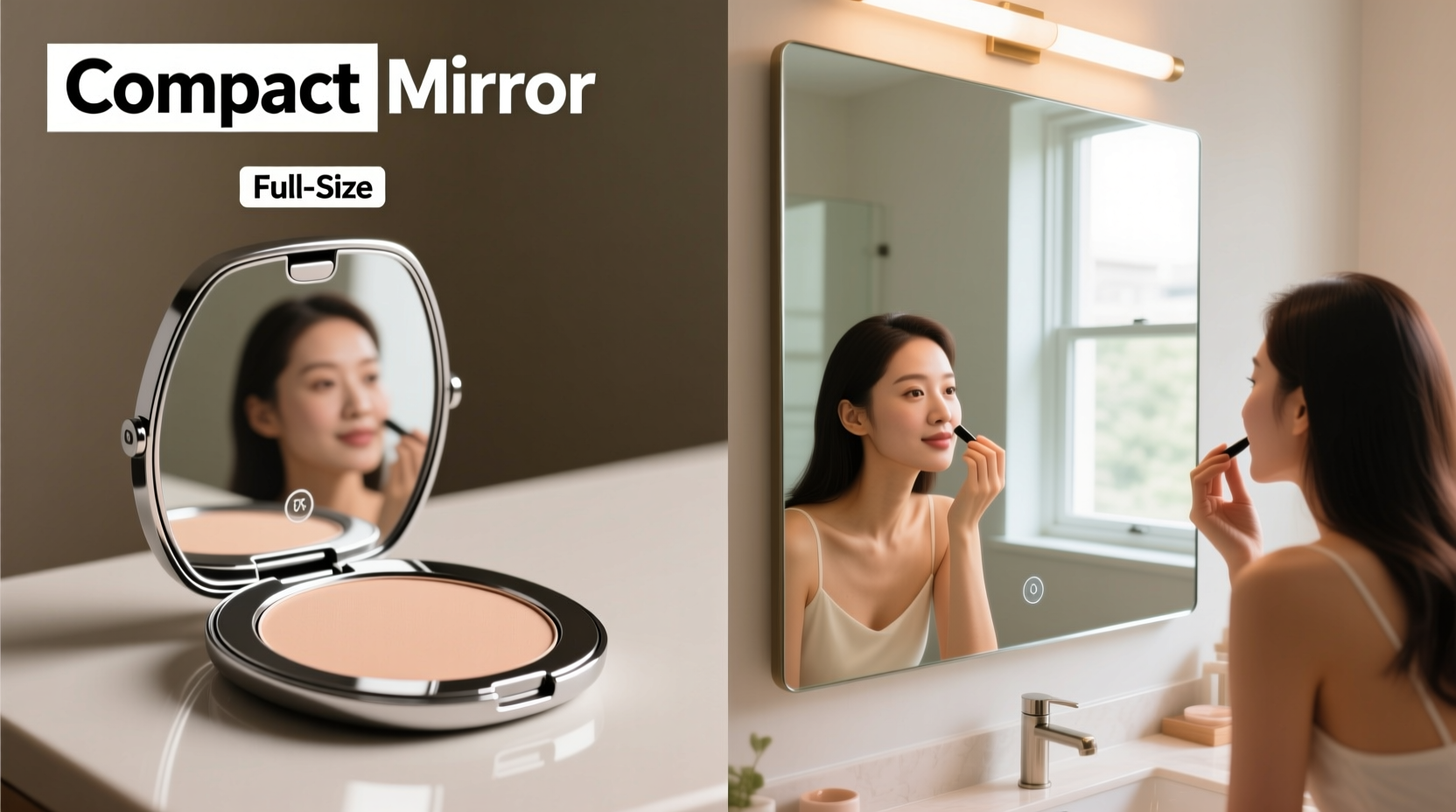
Visibility in the context of makeup or grooming touch-ups refers to more than just seeing your face. It includes clarity of detail, field of view, lighting compatibility, and depth accuracy. A successful touch-up requires identifying small imperfections—a smudged liner, uneven blending, or stray hairs—without distortion.
Full-size mirrors typically offer a wider field of view, allowing users to see their entire face and upper body at once. This makes them ideal for assessing overall appearance and symmetry. They’re commonly mounted on walls or placed on vanities, providing stable, hands-free viewing with consistent alignment.
Compact mirrors, by contrast, are designed for portability. Their smaller surface limits peripheral vision but often includes magnification features to enhance fine detail. Many compacts have dual-sided designs—one standard, one magnified—catering specifically to precision work like eyebrow shaping or mascara application.
“Magnification in compact mirrors can actually improve visibility for detailed tasks, but only if used correctly and under good lighting.” — Dr. Lena Patel, Dermatological Aesthetic Consultant
The trade-off lies in stability and environment. A full-size mirror assumes optimal placement and ambient light, while a compact must adapt to unpredictable settings—restroom lighting, hand tremors, limited space. Thus, visibility isn’t solely determined by mirror size, but by how well the tool aligns with the user’s immediate needs.
Comparative Analysis: Features That Impact Visibility
To evaluate which mirror type delivers superior visibility for touch-ups, several functional aspects must be compared. These include field of view, magnification capability, lighting integration, portability, and ergonomic design.
| Feature | Compact Mirror | Full-Size Mirror |
|---|---|---|
| Field of View | Limited; focuses on specific facial areas | Wide; shows full face and shoulders |
| Magnification | Common (5x–10x); enhances detail visibility | Rare unless specialized; usually 1x |
| Portability | High; fits in pockets, clutches, purses | Low; fixed or bulky |
| Lighting Support | Frequently built-in LED rings or backlights | Dependent on room lighting or separate vanity lamps |
| Ergonomics | Handheld; may cause shakiness | Stable placement; reduces motion blur |
| Best For | On-the-go corrections, precise details | Full-face assessment, routine application |
This comparison reveals that neither mirror is universally superior. Instead, each excels in different scenarios. Compact mirrors shine when portability and detail matter most—like fixing a chipped nail polish or tweezing an errant hair during lunch break. Full-size mirrors dominate when evaluating balance, proportion, and final presentation—such as before entering a client meeting or photograph session.
Real-World Use Cases: When Each Mirror Performs Best
Theoretical advantages mean little without practical validation. Real-life situations often dictate which mirror provides better visibility, regardless of technical specifications.
Scenario 1: Midday Office Touch-Up
A marketing executive finishes a presentation and heads to the restroom to check her appearance. She pulls out a sleek compact mirror from her desk drawer. The built-in LED lights activate automatically, illuminating her face despite the dim bathroom bulbs. Using the magnified side, she notices a slight smudge under her left eye and corrects it swiftly. In this case, the compact mirror offers better visibility due to enhanced lighting and close-up focus—even though the field of view is narrow.
Scenario 2: Pre-Event Makeup Finalization
An event planner prepares for a wedding photoshoot. At home, she stands before her lighted vanity mirror, reviewing her contouring and eyeshadow blend. The wide reflective surface allows her to assess facial symmetry and ensure both sides match. She catches a minor imbalance near her hairline that would have gone unnoticed in a smaller mirror. Here, the full-size mirror clearly wins in terms of holistic visibility and spatial awareness.
Scenario 3: Travel Grooming in Transit
A traveler stuck in a train station uses a pocket-sized compact to reapply lip balm and adjust her fringe. With no access to a wall-mounted mirror, she relies on the mirror’s clarity and brightness. However, shaky hands and flickering overhead lights reduce effectiveness. Despite the compact’s design, visibility suffers—not because of size, but due to external instability. This illustrates that even the best compact cannot compensate for poor conditions.
These examples underscore a key insight: visibility is situational. A compact mirror may technically offer higher detail resolution, but only if held steadily and used under adequate light. Conversely, a large mirror may provide expansive coverage, yet fail to reveal micro-flaws without magnification.
How to Maximize Visibility Regardless of Mirror Type
Instead of treating compact and full-size mirrors as mutually exclusive options, consider integrating both into your routine. Strategic usage enhances overall grooming efficiency and ensures comprehensive visibility across contexts.
Step-by-Step Guide: Optimizing Mirror Use for Touch-Ups
- Assess the task at hand: Determine whether you need a broad view (e.g., checking outfit coordination) or close inspection (e.g., removing mascara flakes).
- Select the appropriate mirror: Choose a full-size mirror for general checks; switch to a compact with magnification for fine adjustments.
- Ensure proper lighting: Natural daylight is ideal. If unavailable, use mirrors with neutral-white LEDs (around 5000K color temperature) to avoid color distortion.
- Stabilize your hands: Rest elbows on a flat surface when using a compact to minimize shaking and improve focus.
- Use both eyes: Avoid closing one eye when examining details—binocular vision improves depth perception and reduces strain.
- Double-check in another setting: After a touch-up, glance in a different mirror (e.g., elevator reflection or smartphone camera) to verify results under alternate angles and lighting.
Checklist: Choosing the Right Mirror for Your Lifestyle
- ✅ Do you frequently touch up away from home? → Prioritize a compact with LED lighting.
- ✅ Do you wear intricate makeup daily? → Look for a compact with adjustable magnification (5x and 10x).
- ✅ Do you struggle with lighting in restrooms or cars? → Choose a mirror with bright, evenly distributed backlighting.
- ✅ Do you value full-face evaluation? → Maintain a high-quality full-size mirror at home or work.
- ✅ Are you prone to misplacing small items? → Opt for a slightly larger compact (3–4 inches) that’s easier to track.
Many professionals now adopt a hybrid approach—keeping a premium compact in their bag while relying on a well-lit full-size mirror for primary application. This layered strategy leverages the strengths of both tools, ensuring optimal visibility at every stage.
FAQ: Common Questions About Mirror Visibility and Use
Can a compact mirror really show enough detail for effective touch-ups?
Yes—especially models with 5x to 10x magnification and integrated lighting. These can reveal finer details like lash glue residue or foundation lines better than a standard full-size mirror. However, prolonged use at high magnification may cause visual fatigue or distort proportions, so always cross-check in a regular mirror when possible.
Why do some compacts have two sides?
Dual-sided compacts feature one standard (1x) reflective side and one magnified side (usually 5x or 10x). The standard side helps orient the user and confirm overall appearance, while the magnified side enables precision work. Switching between them mimics the functionality of dermatologists’ tools, offering versatility in tight spaces.
Is mirror size directly related to image quality?
Not necessarily. Image quality depends more on glass clarity, coating durability, and lighting than physical dimensions. A scratched or foggy full-size mirror will deliver worse visibility than a clean, well-lit compact. Always prioritize optical quality and maintenance over sheer size.
Conclusion: Match the Mirror to the Moment
The debate between compact and full-size mirrors isn’t about declaring a single winner—it’s about recognizing that each serves a distinct purpose. For broad visibility and final assessments, nothing replaces a well-placed, properly lit full-size mirror. But when precision, mobility, and adaptability matter, a high-quality compact can surpass its larger counterpart in functional visibility.
Ultimately, the best grooming routine doesn’t rely on one tool alone. It combines strategic planning, environmental awareness, and the right equipment for the moment. By understanding your personal habits and pain points, you can curate a mirror system that supports flawless touch-ups wherever life takes you.




 浙公网安备
33010002000092号
浙公网安备
33010002000092号 浙B2-20120091-4
Comments
No comments yet. Why don't you start the discussion?