
Travel photography is about capturing moments—spontaneous sunsets, bustling markets, quiet mountain trails. The tools you choose shape not just the quality of your images, but also how freely you move through a destination. Today, two contenders dominate the traveler’s pocket: the compact mirrorless camera and the high-end smartphone. Both promise excellent photo quality, but they serve different priorities. Understanding their strengths and limitations can help you decide which one aligns with your travel style and photographic goals.
Sensor Size and Image Quality: The Core Difference
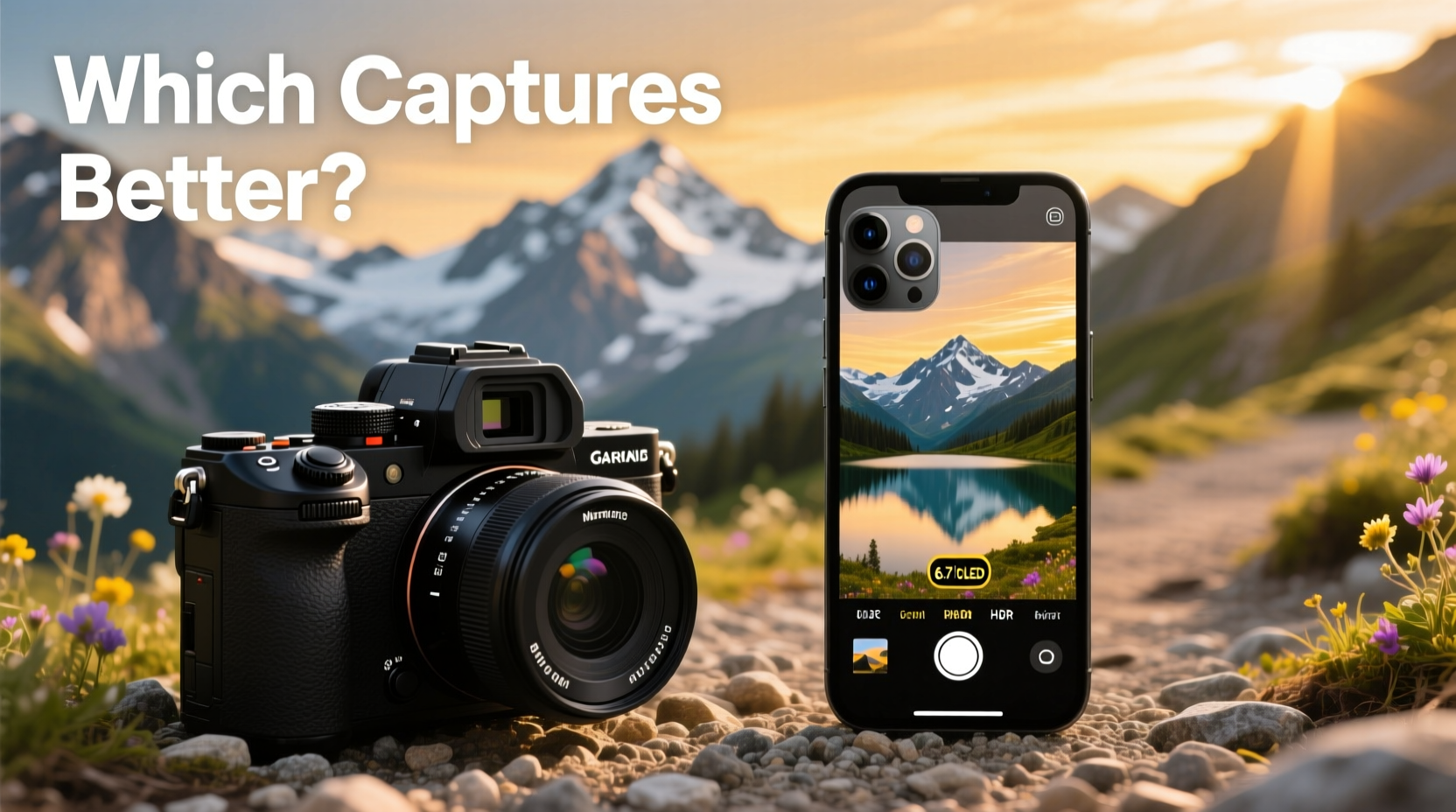
The most significant technical distinction lies in sensor size. Mirrorless cameras, even compact models like the Sony ZV-E10 or Fujifilm X-S10, feature sensors that are dramatically larger than those in smartphones. A full-frame or APS-C sensor captures more light, delivers superior dynamic range, and produces shallower depth of field—critical for professional-looking portraits and low-light scenes.
Smartphones compensate with computational photography. Using AI-driven multi-frame processing, HDR stacking, and night modes, devices like the iPhone 15 Pro, Samsung Galaxy S24 Ultra, and Google Pixel 8 Pro produce stunning results in daylight and surprisingly usable images in dim conditions. However, these are often heavily processed interpretations rather than raw optical captures.
“While smartphone software can simulate depth and brightness, it can’t replace the physical advantage of a large sensor. For true image fidelity, especially in challenging light, mirrorless still wins.” — Lena Torres, Travel Photographer & Imaging Instructor
In practical terms, if you're photographing a candlelit dinner in an Italian trattoria or a misty morning in Kyoto, a mirrorless camera will retain more detail in shadows and highlights without noise. Smartphones may brighten the scene attractively, but often at the cost of natural texture and color accuracy.
Portability and Convenience: Where Smartphones Shine
No discussion about travel gear is complete without addressing weight and accessibility. High-end smartphones weigh between 180–230 grams and fit effortlessly in any pocket. They’re always with you, always on, and require no additional setup. This immediacy leads to more candid, authentic shots—the laughing child chasing pigeons in a plaza, the sudden rainbow over Lisbon.
Mirrorless cameras, while significantly smaller than DSLRs, still demand space. Even the lightest models (300–400g) require a bag, lens changes, battery management, and protection from dust and moisture. Add a second lens or external flash, and you’re carrying over 700g—plus the mental load of gear maintenance.
For backpackers, urban explorers, or minimalist travelers, the smartphone’s all-in-one functionality—camera, GPS, translation tool, communication device—is unbeatable. You don’t need to “decide” to take a photo; you just reach into your pocket and capture the moment.
Image Comparison: Real-World Scenarios
To illustrate the differences, consider three common travel photography situations:
| Scenario | Smartphone Performance | Mirrorless Performance |
|---|---|---|
| Daylight Landscape (e.g., Swiss Alps) | Excellent detail, vibrant colors due to HDR processing. Minor loss in distant textures. | Superior dynamic range, finer detail in shadows and peaks. Natural color rendition. |
| Low-Light Interior (e.g., Moroccan Medina at dusk) | Brightened via Night Mode, but grain appears in fabrics and walls. Colors slightly oversaturated. | Cleaner image with accurate tones. Wider aperture allows faster shutter speed, reducing blur. |
| Action Shot (e.g., street festival dancer) | May struggle with motion blur. Autofocus can hunt in complex scenes. | Better burst rate, phase-detection AF locks quickly. Higher chance of sharp capture. |
The table shows that while smartphones perform admirably in ideal conditions, mirrorless systems offer more consistent results across variable environments. Their interchangeable lenses allow zooming without digital loss, and manual controls give photographers precise input over exposure, focus, and white balance.
Workflow and Sharing: The Smartphone Advantage
One of the smartphone’s strongest arguments is seamless integration. Snap a photo, edit it in Lightroom Mobile, and post it to Instagram—all within 60 seconds. Geotagging, cloud backup, and instant sharing are built-in features that mirrorless cameras lack without additional setup (Wi-Fi transfers, apps, pairing).
Mirrorless users must transfer files via SD card, manage storage on the go, and often carry a tablet or laptop for editing. While this enables higher-quality post-processing, it slows down the feedback loop between capture and audience.
For bloggers, social media creators, or travelers who want to document journeys in real time, the smartphone streamlines the entire creative pipeline. For those who prioritize archival quality and print potential, the extra steps of a mirrorless workflow are justified.
Mini Case Study: Two Photographers in Vietnam
Consider two travelers visiting Hoi An. Maya uses an iPhone 15 Pro Max. She walks through the lantern-lit streets, capturing videos, portraits, and food shots without ever removing a separate camera. Her gallery is cohesive, shared daily, and praised for its authenticity.
Daniel carries a Fujifilm X-T5 with a 27mm f/2.8 prime lens. He pauses more deliberately, composes each shot, and shoots in RAW. His final images have richer tonality and resolution suitable for large prints. But he posts less frequently, as editing takes hours.
Both produced compelling work. Maya’s strength was immediacy and engagement. Daniel’s was depth and fidelity. Neither approach is objectively better—it depends on intent.
When to Choose Which: A Practical Decision Framework
Selecting between a compact mirrorless camera and a high-end smartphone isn’t about which is “better” overall, but which suits your specific needs. Use the following checklist to guide your decision:
✅ Choose a High-End Smartphone If:
- You prioritize convenience and minimal packing.
- You share photos frequently on social media.
- Your trips involve lots of movement—hiking, cycling, public transit.
- You’re comfortable with automatic settings and light mobile editing.
- You already own a flagship phone and don’t want extra gear.
✅ Choose a Compact Mirrorless Camera If:
- You care about maximum image quality and dynamic range.
- You plan to print photos or use them professionally.
- You enjoy manual control over focus, exposure, and composition.
- You shoot in mixed lighting (e.g., interiors, golden hour, night scenes).
- You’re willing to carry extra weight and manage batteries and storage.
Step-by-Step Guide: Optimizing Your Travel Photography Setup
- Define your purpose: Are you documenting memories, building a portfolio, or creating content?
- Assess your travel style: Do you move fast or linger in places? Is weight a concern?
- Evaluate your editing willingness: Will you process RAW files, or prefer instant sharing?
- Test image output: Compare sample shots from your current phone and a rental mirrorless camera.
- Plan your kit: If choosing mirrorless, limit to one lightweight lens (e.g., 24–50mm equivalent). For smartphones, install essential apps (ProCamera, Halide, Snapseed).
- Practice beforehand: Shoot in varied lighting to understand limitations and strengths.
- Pack smart: Bring spare batteries, memory cards, or a portable SSD depending on your choice.
Frequently Asked Questions
Can a smartphone really replace a mirrorless camera for travel?
For many casual and semi-professional travelers, yes—especially with recent advances in computational photography. However, in extreme lighting or when maximum resolution is needed, a mirrorless camera still offers unmatched quality and flexibility.
Do I need both a smartphone and a mirrorless camera?
Some photographers bring both: using the smartphone for quick snaps and stories, and the mirrorless for key compositions. This hybrid approach maximizes versatility but increases baggage and complexity.
Are mirrorless cameras becoming obsolete due to smartphones?
No. While smartphones dominate consumer photography, mirrorless systems continue to innovate—offering better autofocus, video capabilities, and lens ecosystems. They remain essential for those who demand creative control and professional-grade output.
Conclusion: Match Tool to Purpose, Not Trends
The debate between compact mirrorless cameras and high-end smartphones isn’t about technological superiority—it’s about alignment with personal values. A smartphone excels in accessibility, immediacy, and integration. A mirrorless camera delivers optical excellence, creative control, and long-term archival value.
If your goal is to travel lightly and share vivid moments instantly, trust your smartphone. If you seek the deepest possible connection with your subject and the highest fidelity in your images, invest in a compact mirrorless system.
Ultimately, the best camera is the one you enjoy using consistently. Whether it fits in your pocket or hangs around your neck, what matters most is that it empowers you to see more clearly, remember more deeply, and return home with images that feel truly yours.




 浙公网安备
33010002000092号
浙公网安备
33010002000092号 浙B2-20120091-4
Comments
No comments yet. Why don't you start the discussion?