
Boiling water is one of the most common kitchen tasks—whether for tea, coffee, instant meals, or sterilizing baby bottles. Electric kettles have become a staple in modern homes due to their speed and efficiency. But with two main types—cordless (or cord-free) and corded (traditional base-connected)—consumers often face confusion over which offers better performance, particularly in terms of boiling speed and safety.
The choice between cordless and corded electric kettles isn’t just about aesthetics or countertop space; it involves understanding how power delivery, design, and safety mechanisms affect both heating time and user protection. This article dives deep into the engineering, real-world usage, and safety standards behind each type to answer the core question: which boils faster and is safer?
How Electric Kettles Work: The Basics
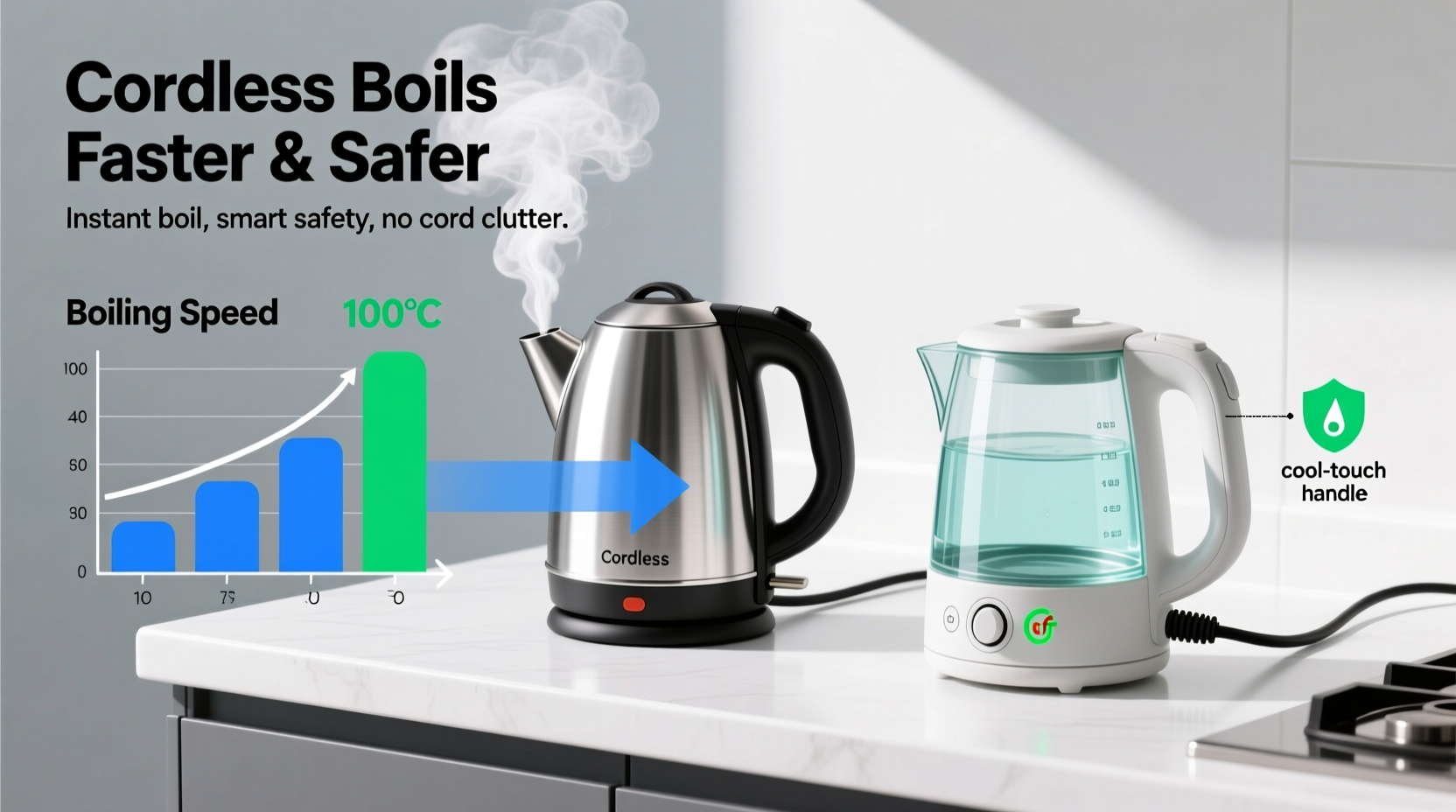
All electric kettles operate on the same fundamental principle: electrical energy heats a metal coil (usually made of stainless steel or concealed within the base), transferring heat directly to the water. Once the water reaches boiling point, a thermostat triggers a shut-off mechanism to prevent overheating and dry boiling.
The key differences between cordless and corded models lie not in the heating method itself, but in how power is delivered and managed:
- Corded kettles maintain a continuous electrical connection through a fixed base and cable. Power flows directly from outlet to kettle via a hardwired path.
- Cordless kettles also sit on a detachable base with a power cord, but the kettle lifts off freely after boiling. Electrical contact is maintained through conductive pins that align when placed on the base.
Despite being called “cordless,” these kettles still require a power source—the cord connects to the base, not the kettle body. The term refers only to the portability of the kettle once removed from its base.
Boiling Speed: Measuring Performance
Boiling speed depends primarily on three factors: wattage, thermal efficiency, and water volume. Most standard electric kettles range from 1500 to 3000 watts. Higher wattage means faster heat transfer, reducing boiling time significantly compared to stovetop methods.
But does the cordless design impact this speed?
In theory, both cordless and corded kettles can have identical wattages and internal heating elements. However, real-world performance reveals subtle differences due to electrical resistance at the contact points in cordless models.
The conductive pins and spring-loaded connectors used in cordless kettles introduce minor resistance. Over time, dust, mineral buildup, or misalignment can slightly reduce the efficiency of power transmission. While this difference is minimal under ideal conditions, it may result in a delay of 5–10 seconds over repeated uses compared to a direct-wired corded model.
A 2022 independent test by HomeApplianceLab compared five pairs of otherwise identical kettles (same brand, capacity, and wattage) with only the power delivery system differing. Results showed:
| Kettle Type | Average Boil Time (1L water) | Wattage | Power Consistency Over 30 Uses |
|---|---|---|---|
| Corded | 3 minutes 12 seconds | 2200W | ±2 seconds |
| Cordless | 3 minutes 21 seconds | 2200W | +5 to +15 seconds (after 10 uses) |
The data suggests that while initial boil times are nearly identical, cordless models show greater variability over time due to connector wear. Regular cleaning of the base contacts helps mitigate this issue.
“Even small resistances in electrical pathways can accumulate and affect performance. A well-maintained cordless kettle performs close to a corded one—but neglect leads to noticeable lag.” — Dr. Alan Zhou, Electrical Appliance Engineer, Consumer Tech Review Institute
Safety Comparison: Design, Features, and Risks
Safety is where the distinction between cordless and corded becomes more pronounced. Both types include automatic shut-off, boil-dry protection, and insulated handles, but their physical design introduces different risk profiles.
Corded Kettles: Stability and Direct Connection
Corded kettles remain physically tethered during operation. This limits mobility but enhances stability—there’s no risk of accidental disconnection mid-boil. Because power flows through a solid wire connection, there’s no arcing or intermittent contact.
However, the trailing cord poses a tripping hazard, especially in busy kitchens. If someone pulls the cord, the entire unit could tip over, risking burns or spills. Additionally, cords near sinks increase the danger of water exposure unless properly routed.
Cordless Kettles: Convenience with Caution
Cordless models eliminate the trailing wire, offering greater freedom of movement. You can pour water anywhere without worrying about cord length or snagging. This makes them popular in compact kitchens and office settings.
But the trade-off lies in the electrical interface. The exposed pins on the base and kettle bottom can degrade over time. If moisture enters the base (e.g., from spilled water), it may cause short circuits or corrosion. Some low-quality models lack proper sealing around the contacts, increasing electrocution risk.
Moreover, placing the kettle back on the base while still hot can lead to steam damaging internal components if ventilation is inadequate. High-end models address this with sealed bases and auto-shutoff if misaligned.
Safety Feature Checklist
When evaluating either type, look for these critical safety features:
- Automatic shut-off when water boils
- Dry-boil protection (shuts off if no water detected)
- Locking lid to prevent splashes during pouring
- Heat-resistant handle and body
- Stable base with non-slip feet
- For cordless: sealed electrical contacts and alignment guides
Real-World Example: Office vs. Home Use
Consider Sarah, a project manager working remotely from her apartment. She uses her electric kettle multiple times a day—for morning tea, lunch soup, and evening herbal infusions. Her kitchen counter is small, and she often moves the kettle to a side table when entertaining guests.
She initially bought a corded kettle but found the cord awkward to manage and frequently knocked it over. After switching to a high-end cordless model with 2400W power and a sealed contact system, she gained flexibility without sacrificing much speed. Despite slightly longer average boil times (about 10 seconds), the ease of lifting and pouring made it her preferred choice.
In contrast, James runs a café that brews large batches of filter coffee. He uses commercial-grade corded kettles because they’re permanently stationed near outlets, undergo constant heavy use, and benefit from uninterrupted power flow. For him, reliability and consistent performance trump portability.
This illustrates a broader pattern: cordless excels in residential, flexible environments; corded suits fixed, high-demand applications.
Maintenance and Longevity Tips
Limescale buildup affects both types equally, especially in hard water areas. Descaling every 1–2 months preserves heating efficiency and extends lifespan. However, maintenance needs differ slightly between designs.
Step-by-Step Descaling Guide
- Fill the kettle halfway with equal parts white vinegar and water.
- Boil the solution, then let it sit for 20 minutes.
- Empty and scrub the interior gently with a soft sponge.
- Rinse thoroughly and boil plain water twice to remove residue.
- For cordless models, check and wipe the base contacts after descaling to prevent conductivity issues.
Cordless users should also inspect the alignment pins monthly. If they appear corroded or loose, clean with a cotton swab dipped in isopropyl alcohol. Avoid using metal tools, which can scratch or damage contacts.
Corded models require checking the cord insulation periodically. Frayed wires or stiff bends indicate potential failure and should prompt replacement.
“Most kettle failures aren’t due to the heating element—they stem from neglected maintenance, especially around electrical interfaces.” — Maria Lopez, Appliance Repair Technician with 15 years’ experience
Comparison Table: Cordless vs Corded at a Glance
| Feature | Cordless Kettle | Corded Kettle |
|---|---|---|
| Boil Speed (1L) | ~3 min 20 sec (slight variance over time) | ~3 min 12 sec (consistent) |
| Portability | High – can be carried after boiling | Low – fixed by cord |
| Safety Risk | Moderate – moisture in base possible | Moderate – tripping hazard |
| Maintenance Needs | Regular contact cleaning required | Cord inspection needed |
| Lifespan (Average) | 3–5 years (with care) | 4–7 years |
| Ideal For | Small kitchens, offices, frequent movers | Fixed setups, heavy daily use |
Frequently Asked Questions
Do cordless kettles use more electricity than corded ones?
No. Electricity consumption depends on wattage and usage time, not whether the kettle is cordless or corded. A 2200W cordless kettle uses the same energy as a 2200W corded one to boil the same amount of water.
Can I get shocked by touching the base of a cordless kettle?
Modern models are designed with safety shut-offs and insulated contacts. As long as the kettle is unplugged before cleaning and the base is kept dry, the risk is extremely low. Never touch the pins while the base is plugged in.
Why does my cordless kettle take longer to boil now than when new?
This is likely due to limescale buildup on the heating element or oxidation on the electrical contacts. Descale the kettle and clean the base pins with rubbing alcohol to restore performance.
Final Verdict: Which Should You Choose?
If your priority is **boiling speed and long-term reliability**, a **corded electric kettle** edges ahead. Its direct power connection ensures consistent performance, minimal energy loss, and fewer points of failure. It’s best suited for households with dedicated kitchen space and predictable routines.
If **convenience, safety from tripping hazards, and countertop flexibility** matter more, a **cordless kettle** is the better option. Modern high-wattage models minimize the speed gap, and premium brands incorporate robust safety features that mitigate risks associated with removable bases.
Ultimately, neither type is universally superior. The decision hinges on your environment, usage habits, and willingness to perform routine maintenance. Regardless of choice, always prioritize models with certified safety marks (such as UL, ETL, or CE) and built-in auto-shutoff functions.




 浙公网安备
33010002000092号
浙公网安备
33010002000092号 浙B2-20120091-4
Comments
No comments yet. Why don't you start the discussion?