
When it comes to evidence-backed supplements for strength, power, and lean mass, few match the track record of creatine. Among its many forms, two stand out in modern fitness conversations: creatine monohydrate and creatine hydrochloride (HCl). One is a decades-proven staple; the other is marketed as a next-generation upgrade with superior absorption. But does that difference actually translate into better gains? And is faster absorption even the bottleneck most people assume?
The debate often centers on one claim: creatine HCl absorbs more efficiently than monohydrate, so you need less, experience fewer side effects, and still get better results. While appealing, this narrative needs scrutiny—especially when backed by supplement marketing rather than clinical outcomes.
Understanding Creatine: Why It Works
Creatine is a naturally occurring compound found primarily in muscle cells. Its main role is to regenerate adenosine triphosphate (ATP), the primary energy currency used during short bursts of intense activity like weightlifting or sprinting. Supplementing increases phosphocreatine stores, allowing for more rapid ATP resynthesis and improved performance during high-intensity efforts.
Over 500 peer-reviewed studies support creatine’s ability to increase strength, power output, lean mass, and training volume. It's one of the most researched ergogenic aids in sports nutrition history. Yet despite this consensus, confusion persists about which form works best.
The core mechanism remains the same across all forms: deliver creatine to muscle tissue. How efficiently different versions do this—and whether those differences matter—is where the real discussion begins.
Comparing Forms: Monohydrate vs HCl
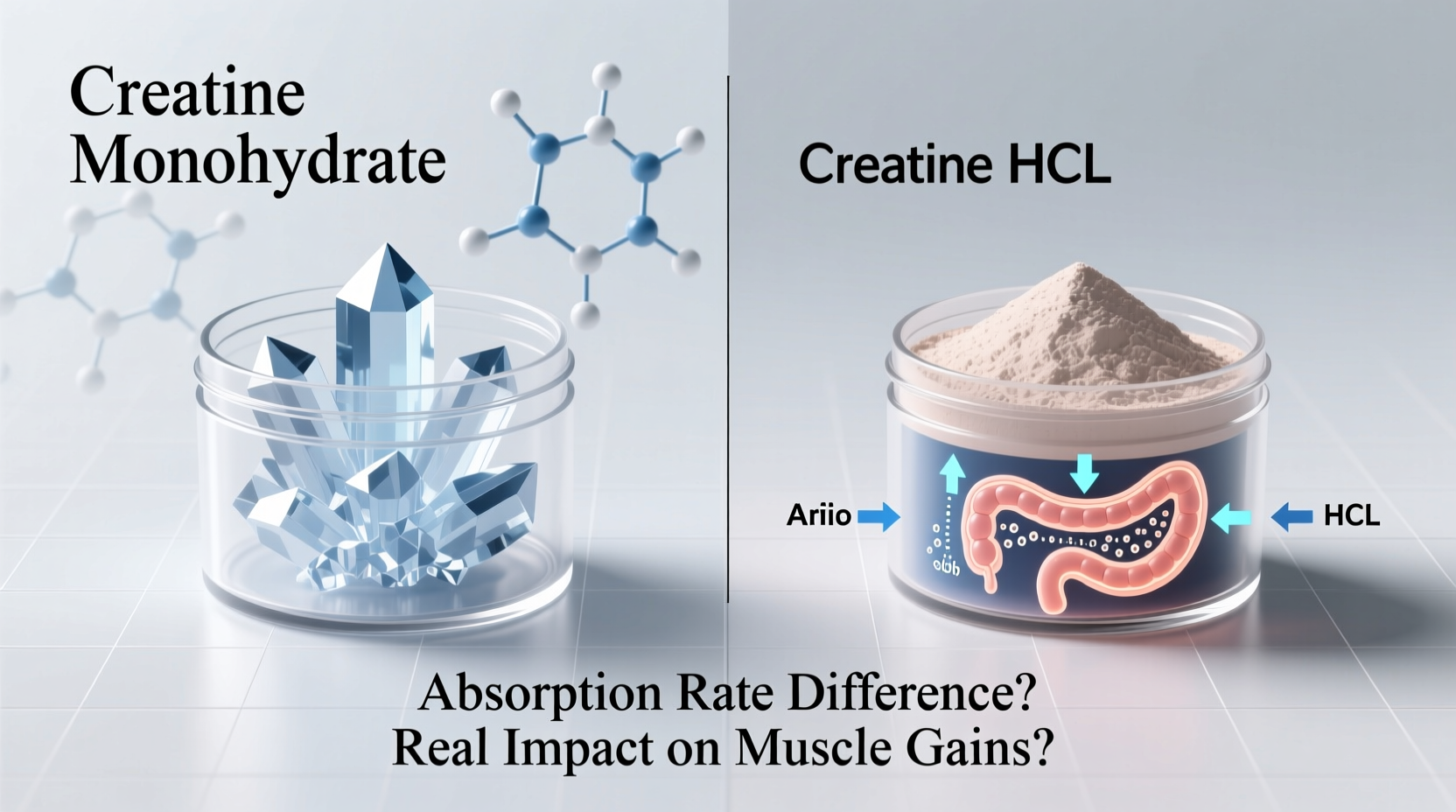
Creatine monohydrate consists of creatine bound to a water molecule. It has been studied since the early 1990s and remains the gold standard due to its safety, efficacy, and low cost. Typical dosing involves either a loading phase (20g/day for 5–7 days) followed by maintenance (3–5g/day), or skipping the load and taking 5g daily for gradual saturation over 3–4 weeks.
Creatine HCl, on the other hand, bonds creatine to hydrochloric acid. Manufacturers claim this enhances solubility and stability in liquid, leading to better gastrointestinal tolerance and higher bioavailability. As a result, recommended doses are much lower—often just 750mg to 1.5g per day.
But here's the catch: enhanced solubility doesn't automatically mean greater muscle uptake or superior results. What matters isn’t how fast it dissolves in your drink—it’s whether more creatine reaches your muscles and stays there long enough to make a functional difference.
“Bioavailability claims must be evaluated not just by absorption rates, but by measurable outcomes—strength, endurance, muscle retention. On those metrics, monohydrate still leads.” — Dr. Stacy Lang, Sports Nutrition Researcher, University of Colorado
Absorption: Does Faster Mean Better?
The central argument for creatine HCl hinges on absorption. Proponents argue that because HCl is more soluble in water, it passes through the gut lining more efficiently, reducing bloating and cramping while requiring smaller doses.
It's true: laboratory tests show creatine HCl dissolves up to six times faster than monohydrate in aqueous solutions. However, solubility in a test tube doesn’t equate to increased plasma concentration or muscle retention in humans.
Human physiology uses active transport mechanisms—specifically the creatine transporter (CrT)—to shuttle creatine from the bloodstream into muscle fibers. This system becomes saturated at relatively low blood concentrations. Once saturated, additional circulating creatine won’t enhance uptake unless transporter density increases (which occurs with training and insulin-sensitive states).
In practical terms, if your goal is full muscle saturation, what matters most is consistent delivery over time—not peak absorption speed. A slowly absorbed dose taken daily can achieve the same intramuscular levels as a rapidly absorbed one, provided total intake supports saturation.
What the Research Says
To date, no independent, peer-reviewed study has demonstrated that creatine HCl produces greater strength, hypertrophy, or performance gains compared to creatine monohydrate when matched for effective dosing.
Conversely, hundreds of studies confirm that 3–5 grams of creatine monohydrate per day significantly improves:
- Muscle phosphocreatine stores (+10–40%)
- One-rep max strength (average +5–15%)
- Work capacity during repeated sprints or sets
- Lean mass gains when combined with resistance training
Creatine HCl lacks comparable human trials. Most supporting data come from in vitro studies or animal models, or are funded directly by supplement companies selling the product. While some anecdotal reports suggest reduced bloating with HCl, these subjective experiences don’t override objective performance measures.
A 2017 comparative study published in the Journal of the International Society of Sports Nutrition examined both forms at equivalent doses (3g/day for 28 days). Results showed no significant difference in body composition, strength gains, or perceived gastrointestinal discomfort between groups. Both forms effectively raised muscle creatine levels.
Practical Considerations: Cost, Convenience, Side Effects
Beyond lab data, real-world usability plays a major role in choosing a supplement. Let’s compare key factors:
| Factor | Creatine Monohydrate | Creatine HCl |
|---|---|---|
| Cost per Month | $5–$10 (generic) | $25–$40 (branded) |
| Daily Dose | 3–5g | 0.75–1.5g |
| Solubility | Moderate; may settle in water | High; mixes easily |
| Gut Tolerance | Generally good; mild bloating possible | Anecdotally better tolerated |
| Research Support | Extensive, long-term | Limited, mostly indirect |
| Muscle Saturation Evidence | Proven | Assumed via solubility analogy |
While HCl wins on solubility and dose size, monohydrate dominates on affordability and scientific validation. For budget-conscious lifters or athletes consuming creatine long-term, monohydrate offers unmatched value.
Regarding side effects: some users report less water retention and bloating with HCl. However, modern micronized creatine monohydrate formulations have minimized these issues for most people. Staying hydrated and spreading intake throughout the day further reduces digestive discomfort.
Mini Case Study: Two Lifters, Two Forms
Consider two experienced gym-goers: Alex and Jordan. Both train five days per week, follow similar programs focused on progressive overload, and aim to add lean mass.
Alex uses micronized creatine monohydrate (5g/day with post-workout shake). After three weeks, he notices improved workout endurance and slightly fuller muscles. His squat increases by 20 pounds over eight weeks. He pays $8/month for his supply.
Jordan chooses a premium creatine HCl product (1.5g/day). She likes that it mixes instantly in her pre-workout and claims no stomach upset. Over the same period, she also gains strength and muscle—but not noticeably faster or more than Alex. Her monthly cost: $35.
Neither reports dramatic differences in results. Blood work shows both achieved similar creatine saturation markers. The divergence lies not in performance, but in price and perception.
This mirrors broader trends: when variables like diet, training consistency, and sleep are controlled, form-specific advantages vanish. The *act* of supplementing consistently matters far more than the chemical suffix attached to \"creatine.\"
Step-by-Step Guide to Choosing & Using Creatine
Follow this sequence to make an informed decision based on goals, budget, and tolerance:
- Define Your Goal: Are you aiming for strength, size, endurance, or recovery? All benefit from creatine, but expectations should align with evidence.
- Start with Monohydrate: Unless you’ve had documented GI issues with monohydrate, begin here. It’s proven, safe, and economical.
- Determine Dosing Strategy:
- Loading: 20g/day (split into 4 doses) for 5–7 days, then 3–5g/day
- No-load: 5g/day continuously for 28 days to reach saturation
- Time Intake Strategically: Take with carbohydrates and protein (e.g., post-workout shake) to spike insulin, which enhances creatine uptake.
- Monitor Response: Track strength changes, reps completed, and subjective energy. Wait at least 3–4 weeks before assessing impact.
- Switch Only If Needed: If bloating or stomach discomfort persists after trying micronized or buffered versions, consider HCl or liquid forms.
- Reassess After 3 Months: Evaluate cost-effectiveness and long-term sustainability.
Frequently Asked Questions
Is creatine HCl better for people who don’t respond to monohydrate?
Non-response to creatine affects roughly 20–30% of users, usually due to already high dietary intake (from meat/fish) or genetic variation in the creatine transporter. There’s no evidence HCl bypasses this limitation. True non-responders typically remain non-responsive regardless of form.
Can I take less creatine HCl and still get the same benefits?
Manufacturers suggest 1–1.5g of HCl replaces 5g of monohydrate. However, without human studies confirming equivalent muscle saturation at these doses, this remains speculative. Until proven otherwise, assume lower doses may under-deliver.
Does creatine cause kidney damage?
No. Decades of research show creatine is safe for healthy individuals, even at high doses and over years. Minor increases in serum creatinine (a waste product) are normal and not indicative of kidney dysfunction. Those with pre-existing renal conditions should consult a physician before use.
Checklist: Making the Right Choice
- ☐ Have I tried creatine monohydrate first?
- ☐ Am I giving it at least 3–4 weeks to assess effects?
- ☐ Is my diet providing adequate carbs/protein to support uptake?
- ☐ Am I staying hydrated throughout the day?
- ☐ Have I ruled out poor training or sleep as limiting factors?
- ☐ Am I paying attention to total cost over time?
- ☐ Am I relying on independent research, not marketing claims?
Conclusion: Focus on What Matters
The idea that creatine HCl delivers superior gains due to faster absorption is compelling—but unsupported by robust evidence. Absorption rate alone does not dictate outcomes. Muscle saturation, consistency, and total daily intake are what drive results.
Creatine monohydrate remains the most effective, affordable, and well-studied option available. Claims about HCl’s superiority rest largely on theoretical advantages and selective interpretation of solubility data. Until large-scale, independent trials demonstrate clear benefits in strength, hypertrophy, or retention, monohydrate should remain the default choice for serious lifters.
If you’ve experimented with HCl and prefer it due to mixability or digestion, that’s valid. Personal preference has value. But don’t assume you’re gaining a physiological edge. The real leverage comes from disciplined use over months and years—not molecular tweaks on a label.




 浙公网安备
33010002000092号
浙公网安备
33010002000092号 浙B2-20120091-4
Comments
No comments yet. Why don't you start the discussion?