
Drawing the letter S may seem simple, but mastering its flowing curves can be surprisingly challenging. Whether you're teaching a child their first cursive strokes, refining your own penmanship, or experimenting with artistic lettering, the S offers a unique opportunity to explore rhythm, balance, and expression. Unlike angular letters, the S relies entirely on smooth transitions and symmetry. This guide breaks down multiple creative techniques to form the S by hand, offering adaptable methods for preschoolers, students, artists, and lifelong learners.
Understanding the Structure of the Letter S
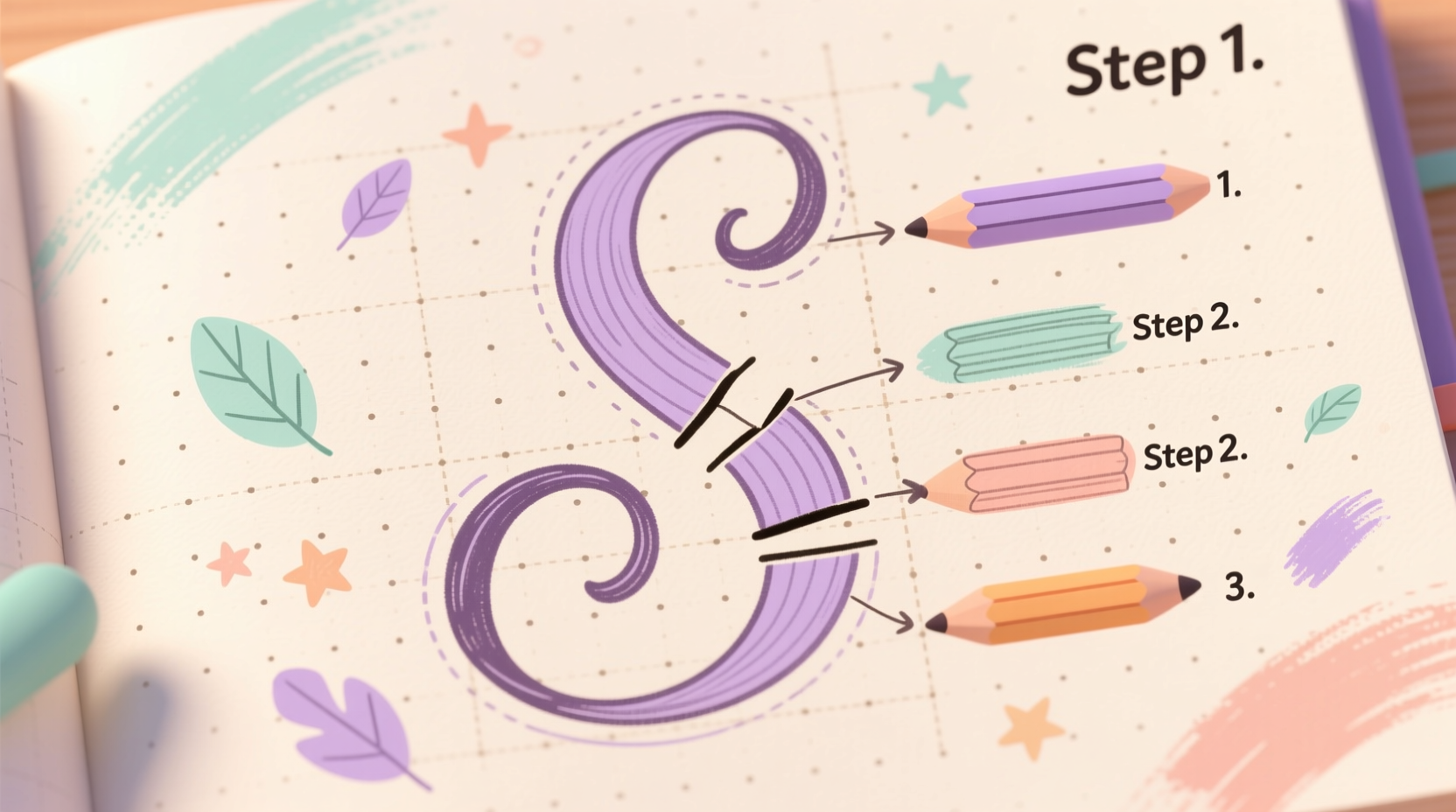
The letter S is defined by two opposing curves connected seamlessly in the middle. In print, it often appears as a symmetrical figure-eight on its side. In cursive, it becomes a fluid stroke that connects to adjacent letters. Its elegance lies in continuity—no sharp corners, no breaks. Before attempting to draw it, it helps to visualize the S within a rectangle or oval, using guidelines to maintain proportion.
There are three primary forms of the handwritten S:
- Print (block) S: A clean, geometric version often taught first in schools.
- Cursive S: A flowing script version used in joined handwriting.
- Decorative/Artistic S: Variants used in calligraphy, logos, or hand-lettered designs.
Each style requires slightly different techniques, but all benefit from structured practice and mindful movement.
Step-by-Step Guide: How to Draw an S for Different Age Groups
One size doesn’t fit all when teaching handwriting. Children, teens, and adults have different motor skills and learning goals. Below is a tiered approach to drawing the S, tailored by age and skill level.
For Ages 3–7: Building Motor Skills with Fun Shapes
- Start with large movements: Use fingers to trace an S in sand, shaving cream, or on a foggy mirror.
- Break the S into parts: Teach it as a “top C” and a “bottom backward C.”
- Use dotted-line worksheets with directional arrows showing where to start and how to curve.
- Incorporate songs or rhymes: “Slide up, loop around, slide down, loop again!”
- Practice on oversized paper with crayons or chalk to build confidence.
For Ages 8–12: Refining Cursive and Print Clarity
- Begin at the top center line. Curve clockwise to form the upper half.
- Without lifting the pen, reverse direction and create a counter-clockwise curve below.
- Ensure both loops are equal in size and aligned vertically.
- Practice connecting the S to other letters like T, I, and A in words (e.g., \"sit,\" \"star\").
- Use lined paper with midline guides to keep proportions consistent.
For Teens and Adults: Exploring Calligraphy and Stylistic Flair
- Choose a tool: Brush pen, fountain pen, or pencil—each creates a different effect.
- Sketch a light guideline frame (about 4 lines high).
- Start at the top with a downward press, widening the stroke slightly (for brush pens).
- Curve smoothly into the center, then lift slightly before descending into the lower arc.
- Add flair: Extend the tail, add a swirl, or vary thickness for visual interest.
“Handwriting is not just communication—it’s self-expression. The way someone draws an S reveals rhythm, patience, and even mood.” — Dr. Lena Torres, Handwriting Analyst & Educator
Creative Techniques to Make Learning the S Engaging
Making the S memorable involves more than repetition. Creative engagement strengthens muscle memory and keeps learners motivated. Try these unconventional yet effective approaches:
1. Nature-Inspired S Drawing
Ask learners to observe natural S-shapes: a snake’s body, a winding river, or a vine climbing a trellis. Then, mimic those organic curves on paper. This builds observational skills and connects writing to the real world.
2. Motion-Based Learning
Have children “write” the S in the air with their whole arm, turning it into a dance move. Add music to reinforce rhythm. Kinesthetic learning helps internalize the shape.
3. Artistic Fusion
Turn the S into a drawing canvas. For example, transform the upper loop into a snail’s shell and the lower into its trail. Or design a serpent-themed S with eyes and scales. This encourages creativity while reinforcing structure.
4. Digital Hybrid Practice
Draw the S on a tablet with a stylus, using apps that provide real-time feedback on stroke order and pressure. Then replicate it on paper. This bridges digital and analog skills.
Common Mistakes and How to Fix Them
Even experienced writers fall into habits that distort the S. Recognizing these issues is the first step toward improvement.
| Mistake | Why It Happens | Solution |
|---|---|---|
| Uneven loops (one bigger than the other) | Lack of spatial awareness or rushing | Use grid paper; count boxes to ensure symmetry |
| Sharp angles instead of curves | Tension in hand or incorrect starting point | Loosen grip; practice slow, circular warm-ups first |
| S leans too far left or right | Poor posture or slanted baseline | Align paper correctly; use a slant ruler if needed |
| Broken stroke (lifting pen mid-S) | Overthinking or lack of flow | Practice one continuous motion with exaggerated slowness |
Mini Case Study: Teaching the S in a Multilevel Classroom
In Ms. Rivera’s mixed-grade art and literacy workshop, students aged 6 to 10 all struggled with the S—but for different reasons. Six-year-olds couldn’t control the curve direction, while older kids made stiff, mechanical versions lacking flair. Ms. Rivera introduced a tiered project: each student created a “Safari S” featuring an animal whose body formed the letter—snakes, cheetahs, and seahorses. Younger students traced pre-drawn S outlines, while older ones designed original illustrations. After two sessions, every student could confidently write and draw the S, and their work was displayed in the school hallway. The key? Connecting form to function through storytelling.
Frequently Asked Questions
Can left-handed people learn to write the S easily?
Absolutely. Left-handed writers may need to adjust their paper angle (tilted clockwise) to avoid smudging and improve visibility. Using quick-dry ink or pencil helps. With proper technique, left-handers can achieve smooth, elegant S curves just like right-handers.
How long does it take to master the handwritten S?
With daily practice of 5–10 minutes, most children develop legible S forms within 2–3 weeks. Adults refining cursive or calligraphy may take several months to achieve stylistic consistency, depending on frequency and tools used.
Is there a “correct” way to write the S?
There’s no single correct version. Regional styles vary—some cursive S forms resemble a small “o” connected to a hook, while others are fully rounded. Legibility and consistency matter more than rigid adherence to one model.
Checklist: Mastering the Handwritten S
- ✅ Understand the basic shape: two connected curves
- ✅ Practice large motions before small writing
- ✅ Use guidelines (lined or grid paper) for alignment
- ✅ Break the S into two halves for beginners
- ✅ Apply creative techniques to boost engagement
- ✅ Review common mistakes and correct them early
- ✅ Practice daily for at least 5 minutes
- ✅ Experiment with different tools (pencil, pen, brush)
Conclusion: Make Every S a Signature Move
The letter S is more than a symbol—it’s a gesture. From a child’s first wobbly attempt to an artist’s flourished signature, each S carries intention. By combining structure with creativity, anyone at any age can learn to form this elegant letter with confidence and style. Whether you’re guiding a kindergartener’s pencil or designing your own monogram, remember that mastery comes not from perfection, but from practice, patience, and play.




 浙公网安备
33010002000092号
浙公网安备
33010002000092号 浙B2-20120091-4
Comments
No comments yet. Why don't you start the discussion?