
Anime has exploded in popularity over the past decade, becoming a global phenomenon with millions of fans seeking high-quality, subtitled content. As streaming platforms compete to capture this growing audience, two services stand out: Crunchyroll and Hulu. Both offer extensive libraries of Japanese animation, but when it comes to subtitled anime, they differ significantly in scope, depth, and accessibility. For viewers who prefer authentic experiences through subtitles rather than dubs, choosing the right platform can make all the difference.
This article dives deep into the subtitled anime offerings on Crunchyroll and Hulu, comparing licensing strength, catalog diversity, release speed, interface usability, and regional availability. Whether you're a longtime otaku or a newcomer exploring anime beyond mainstream hits, understanding these distinctions will help you decide where to invest your time and subscription fees.
Understanding Subtitled Anime: Why It Matters
For many anime enthusiasts, subtitles are more than just translated dialogue—they represent fidelity to the original performance. Subbed anime preserves voice acting nuances, cultural context, and emotional timing that can be lost in dubbing. Fans often cite authenticity as their primary reason for preferring subtitles, especially for series rooted in Japanese traditions, humor, or linguistic wordplay.
Streaming platforms that prioritize subbed content typically attract a core fanbase that values accuracy and immediacy. This includes simulcasts—episodes released shortly after airing in Japan—often with English subtitles within hours. The ability to access these quickly is a major factor in platform loyalty.
“Subtitles maintain the integrity of the original production. You hear the actors’ intended performances, the music cues, and even the breaths between lines.” — Akira Tanaka, Anime Localization Producer
Crunchyroll’s Dominance in Subbed Anime
Founded in 2006, Crunchyroll has long been synonymous with anime streaming. Originally a community-driven site, it evolved into the industry leader for legal, licensed anime distribution—particularly for subtitled content. Today, Crunchyroll operates under Sony’s umbrella and holds exclusive rights to hundreds of titles across genres, seasons, and regions.
The platform's library exceeds 1,300 anime series, with nearly every title available in subtitled format. From seasonal simulcasts like *Jujutsu Kaisen* and *Oshi no Ko* to deep-cut classics such as *Cowboy Bebop* and *Neon Genesis Evangelion*, Crunchyroll offers unmatched breadth. Its editorial team curates genre-specific lists (e.g., “Top 50 Isekai,” “Best Shojo Romance”) that help users navigate its vast catalog.
One of Crunchyroll’s standout features is its **simulcast schedule**. During peak anime seasons (spring, summer, fall, winter), new episodes are uploaded within one hour of Japanese broadcast, complete with professionally translated subtitles. These translations are handled by in-house linguists and reviewed for consistency in tone, character voice, and cultural references.
Licensing Strength and Exclusivity
Crunchyroll’s partnerships with major Japanese studios—including Toei Animation, Aniplex, and MAPPA—give it first-window rights to many titles. This means certain shows appear exclusively on Crunchyroll before being licensed elsewhere, if at all. Recent examples include *Chainsaw Man*, *Spy x Family*, and *Demon Slayer: Kimetsu no Yaiba*, all of which debuted with subtitles on Crunchyroll weeks or months ahead of other platforms.
In contrast, Hulu relies on secondary licensing deals, often acquiring titles after their initial run. While this allows Hulu to feature popular shows, it rarely matches Crunchyroll’s timeliness or exclusivity.
Hulu’s Approach to Subbed Anime
Hulu positions itself as a general entertainment service with a strong emphasis on American TV, movies, and originals. However, it also maintains a notable anime section, particularly appealing to casual viewers who discover anime through cross-promotions or bundled Disney+/ESPN+ subscriptions.
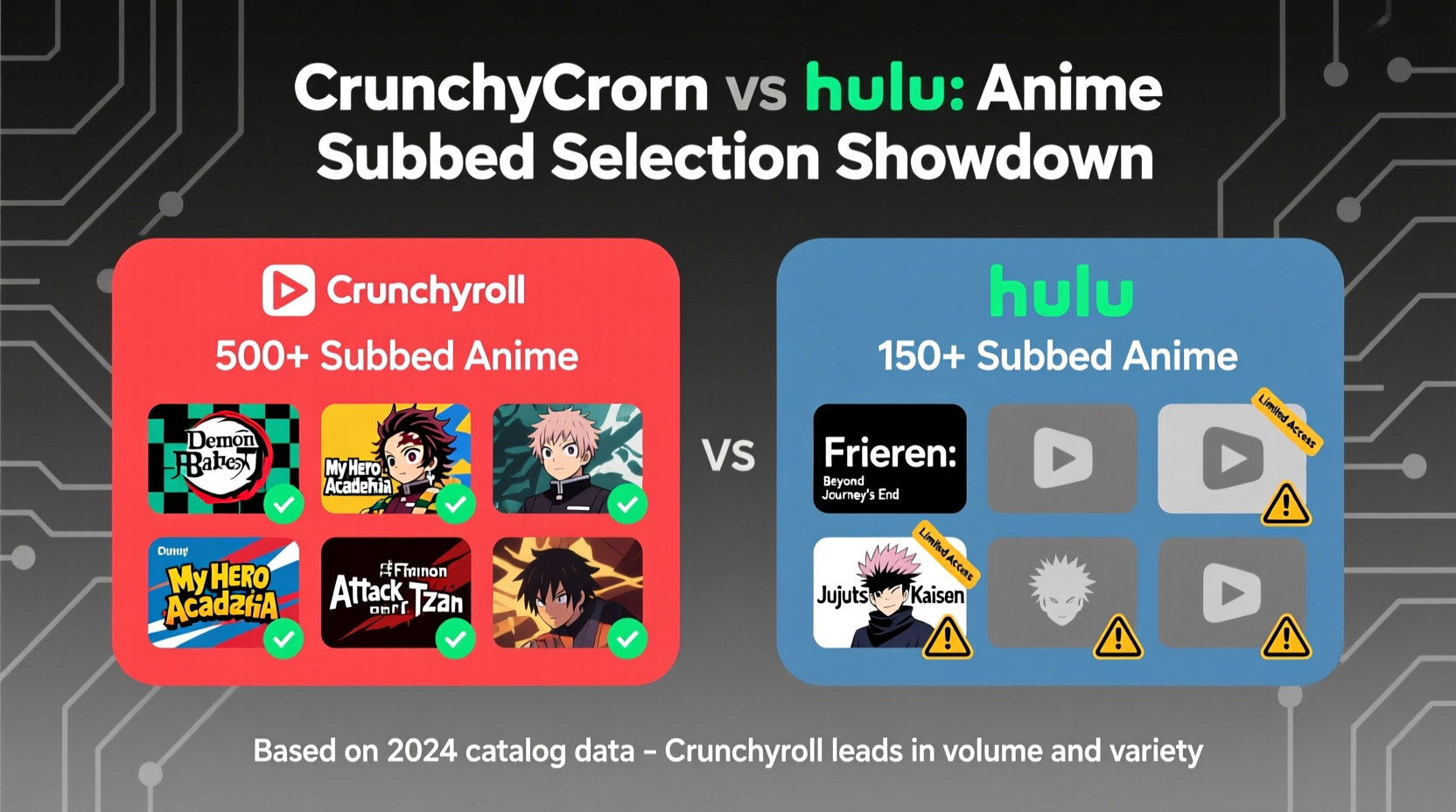
Hulu’s anime catalog includes around 150–200 titles, many of which overlap with Crunchyroll’s offerings. Popular series like *My Hero Academia*, *Tokyo Revengers*, and *Haikyuu!!* are available with English subtitles. But unlike Crunchyroll, Hulu does not focus on simulcasts. Most anime arrive on Hulu months after their original season ends, sometimes only after physical releases or international DVD distribution.
This delayed rollout limits Hulu’s appeal for fans seeking real-time engagement. Without weekly episode drops, viewers risk spoilers from social media or online discussions. Additionally, Hulu lacks dedicated anime curation tools, making discovery more difficult compared to Crunchyroll’s robust tagging and recommendation engine.
Regional Availability and Library Differences
It’s important to note that Hulu’s anime selection varies significantly by region. Outside the United States, Hulu is unavailable, while Crunchyroll operates in over 200 countries. Even within the U.S., Hulu’s library fluctuates due to expiring licenses. For example, *Attack on Titan* was removed from Hulu in 2022 after Funimation regained distribution rights, whereas Crunchyroll retained access via its merger with Funimation Global Group.
Furthermore, some anime on Hulu are offered only in dubbed versions. While subtitles are present for many titles, they aren’t guaranteed. Users must manually check each show’s audio and subtitle options—a process that adds friction for those prioritizing subbed content.
“We license anime based on projected audience size and integration potential with our broader content mix.” — Hulu Content Acquisition Team (via press statement)
Detailed Comparison: Crunchyroll vs Hulu
| Feature | Crunchyroll | Hulu |
|---|---|---|
| Total Subbed Anime Titles | 1,300+ | ~180 |
| Simulcasts (New Episodes Weekly) | Yes – 50+ per season | No |
| Exclusive Titles | Yes – e.g., *Chainsaw Man*, *Frieren* | Limited – mostly shared licenses |
| Subtitle Accuracy & Consistency | High – professional translation teams | Moderate – varies by title |
| Availability Outside U.S. | Yes – 200+ countries | No – U.S. only |
| Ad-Supported Tier with Subtitles | Yes (limited ads) | Yes (more frequent ads) |
| Offline Viewing (Download) | Yes – Premium plan | Yes – with download-enabled plans |
| Genre Filtering & Recommendations | Advanced – tags, themes, mood | Basic – minimal categorization |
Real-World Example: Following a Seasonal Anime
Consider the case of *Frieren: Beyond Journey’s End*, a critically acclaimed fantasy anime that premiered in Fall 2023. Here’s how the viewing experience differs between platforms:
- On Crunchyroll: New episodes were uploaded every Monday morning (U.S. time) with English subtitles. Fans could watch immediately, participate in live chats, and engage with official discussion threads. The entire season remained accessible after completion.
- On Hulu: The full season did not appear until March 2024—four months after the finale aired in Japan. No weekly updates were available, forcing viewers to either wait or seek alternative sources.
This delay illustrates a fundamental gap: Crunchyroll serves active anime communities; Hulu caters to passive, on-demand viewers. For fans invested in ongoing narratives, Crunchyroll’s model fosters connection and continuity.
Actionable Tips for Maximizing Subbed Anime Access
Whether you’re using Crunchyroll, Hulu, or both, here are practical steps to enhance your subtitled anime experience:
- Set subtitle preferences early: Configure default subtitle language and font size in your account settings to avoid manual adjustments per episode.
- Enable notifications: On Crunchyroll, opt-in for email or push alerts when new episodes drop. This ensures you don’t miss timely releases.
- Use playlists or watchlists: Organize upcoming and ongoing series to track progress and avoid missing installments.
- Check licensing notes: Before committing to a show on Hulu, verify whether subtitles are confirmed and whether the series will receive future seasons.
- Combine services strategically: Subscribe to Crunchyroll for current anime and use Hulu for hybrid viewing (e.g., anime alongside live-action favorites).
Frequently Asked Questions
Can I watch all anime on Hulu with subtitles?
No. While most anime on Hulu offer English subtitles, some older or lower-priority titles may only include dubbed audio. Always check the audio/subtitle menu before playing an episode.
Is Crunchyroll worth the cost for subbed anime alone?
Yes. At $7.99/month (ad-supported) or $9.99/month (ad-free), Crunchyroll delivers unparalleled value for anime fans. With dozens of new subtitled episodes weekly and a deep back catalog, it remains the most cost-effective option for serious viewers.
Does Hulu have any advantages over Crunchyroll for anime?
Hulu’s main advantage is bundling. If you already subscribe to Hulu for its TV shows or movies, accessing select anime at no extra cost can be convenient. However, for dedicated anime consumption, Crunchyroll is superior in every measurable category.
Final Verdict: Which Platform Offers Better Subbed Anime?
When evaluating solely for subtitled anime selection, **Crunchyroll is the clear winner**. Its combination of scale, speed, exclusivity, and global reach makes it the definitive destination for fans who want authentic, timely access to Japanese animation. From niche indie productions to blockbuster franchises, Crunchyroll treats anime as a central pillar of its identity—not an afterthought.
Hulu, while offering a respectable lineup of popular titles, functions more as a supplementary source. It lacks simulcasts, has inconsistent subtitle availability, and provides limited support for deeper exploration. For viewers whose primary interest is anime—especially those following ongoing seasons—Hulu cannot compete.
That said, hybrid viewers who enjoy anime alongside Western content might find value in maintaining both subscriptions. But if you're focused on maximizing your subtitled anime experience, Crunchyroll stands alone at the top.




 浙公网安备
33010002000092号
浙公网安备
33010002000092号 浙B2-20120091-4
Comments
No comments yet. Why don't you start the discussion?