
For decades, the chocolate advent calendar has been a quiet ritual—a small, predictable joy behind each numbered door. But as screens dominate daily life and attention spans contract, digital alternatives have surged: interactive apps, AR experiences, video messages from grandparents, daily micro-challenges, and even AI-generated stories unlocked at midnight. The question is no longer just “what’s new?” but “what actually works better at building genuine, sustained excitement?” Not fleeting dopamine hits—but layered, evolving anticipation that deepens over 24 days. This isn’t about nostalgia versus novelty. It’s about how human psychology processes reward, memory, social connection, and narrative—and why one format consistently outperforms the other in cultivating emotional resonance.
The Psychology of Anticipation: Why Timing Alone Isn’t Enough
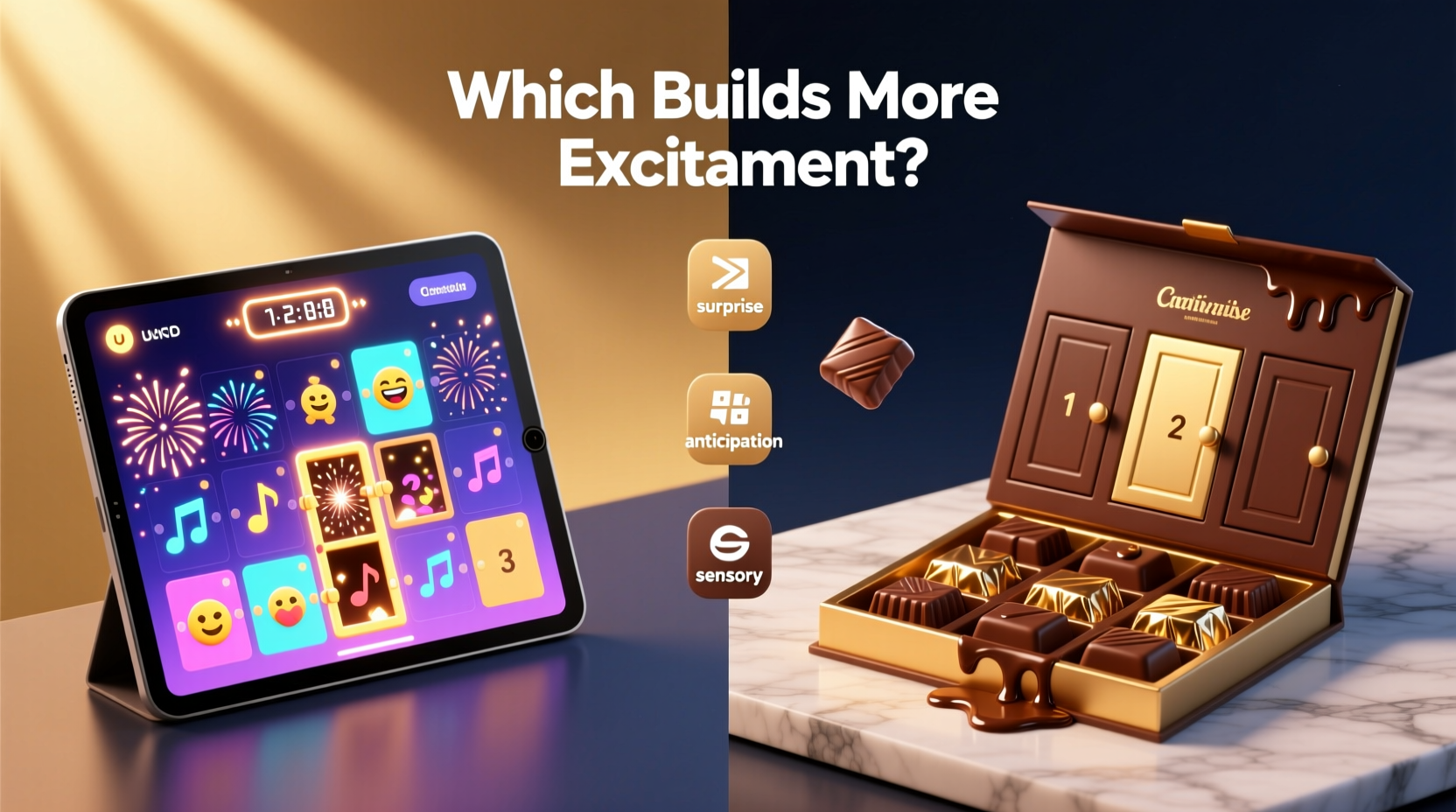
Excitement isn’t generated solely by the *presence* of a reward—it’s shaped by its *structure*. Behavioral economists distinguish between “consumption utility” (the pleasure of eating chocolate) and “anticipatory utility” (the pleasure of waiting for it). A landmark 2014 study in the Journal of Consumer Research found that people reported higher overall happiness when they spent time anticipating a positive event—even when the event itself was modest—compared to immediate gratification. But crucially, that anticipatory boost only held when the wait involved active engagement: planning, imagining, discussing, or preparing.
Traditional chocolate calendars deliver passive anticipation. Each day offers a nearly identical experience: peel foil, eat milk chocolate, move on. There’s little variation in sensory input, no narrative arc, minimal personalization, and almost no opportunity for shared meaning-making. The brain quickly habituates—by Day 7, the dopamine response drops significantly, as confirmed by fMRI studies on repeated reward delivery.
Digital calendars, by contrast, can be engineered to sustain and escalate engagement. They introduce novelty (a new animation every day), interactivity (drag-and-drop puzzles, voice-recorded clues), social scaffolding (family members contribute videos or photos), and narrative progression (a story unfolds across doors, with choices affecting outcomes). This aligns with the “peak-end rule” from Nobel laureate Daniel Kahneman: people remember experiences not by their average intensity, but by their most intense moment and how they conclude. A well-designed digital calendar builds toward both.
“Anticipation becomes meaningful when it invites participation—not just patience. Chocolate gives you a treat. A thoughtful digital calendar gives you a reason to gather, wonder, and co-create.” — Dr. Lena Torres, Developmental Psychologist & Author of The Ritual Economy of Childhood
Comparing Engagement Depth: A Side-by-Side Analysis
Excitement isn’t monolithic. It manifests in different dimensions: cognitive (curiosity, problem-solving), emotional (joy, surprise, warmth), social (shared laughter, collaborative effort), and sensory (taste, sound, visual richness). Here’s how the two formats stack up across measurable dimensions:
| Dimension | Chocolate Calendar | Digital Calendar (Well-Designed) |
|---|---|---|
| Cognitive Engagement | Low: Minimal mental effort required; no problem-solving or decision-making beyond opening doors. | High: Daily riddles, pattern recognition, memory games, cause-effect exploration (e.g., “If you water the pixel plant today, it blooms tomorrow”). |
| Emotional Resonance | Moderate: Pleasure tied to taste and tradition; diminishes after initial novelty wears off. Rarely evokes surprise or awe. | High to Very High: Customized messages (“Grandma recorded this just for you”), milestone celebrations (Day 12 unlocks a family photo album), emotionally textured audio (original lullabies, ambient winter soundscapes). |
| Social Co-Construction | Low-Moderate: Often individual consumption; may prompt brief sharing (“Look what I got!”), but rarely invites collaboration. | High: Built-in features like “add your own drawing,” “record a wish for Day 24,” or “vote as a family on tomorrow’s activity.” Encourages dialogue before and after unlocking. |
| Sensory Variety | Narrow: Dominated by taste and tactile foil-peeling; limited auditory/visual input. | Broad: Combines high-fidelity sound design, dynamic visuals, haptic feedback (on supported devices), and optional real-world extensions (e.g., “Scan this code to print your snowflake craft”). |
| Memory Encoding Strength | Weak: Highly repetitive; few distinctive anchors for long-term recall. Adults rarely remember specific chocolate days from childhood. | Strong: Unique daily experiences create distinct episodic memories. Families report recalling specific digital moments years later (“Remember when the robot reindeer glitched on Day 9?”). |
Real-World Impact: A Mini Case Study from Oslo
In December 2022, the Norwegian family of four—Elin (38), Henrik (41), and their children Maja (9) and Silas (6)—switched from their 12-year tradition of Lindt chocolate calendars to a custom-built digital version created with a local educator and an app developer. Their calendar wasn’t gamified with points or leaderboards. Instead, it centered on “The Lightkeeper’s Journal”: a fictional character who’d lost her lantern light and needed daily help restoring it through small acts of kindness, observation, and creativity.
Each day offered something different: • Day 1: A 90-second animated story introducing the Lightkeeper, followed by a prompt: “Draw one thing that makes you feel warm inside.” • Day 5: An audio recording from Elin’s mother in Bergen describing her childhood Christmas tree, ending with, “What’s your favorite tree memory?” • Day 13: A simple coding puzzle where dragging stars into constellations revealed a hidden message: “Your kindness shines brightest.” • Day 22: A collaborative family photo challenge—“Capture one moment of quiet joy today”—with all submissions compiled into a shared slideshow.
By December 24th, the family hadn’t just counted down—they’d co-authored a story, deepened intergenerational bonds, practiced emotional literacy, and built tangible artifacts (drawings, recordings, photos). When asked in January what they remembered most, Maja said, “The night we all sat on the floor listening to Grandma’s voice and then drew our warm things.” Silas pointed to the slideshow: “That’s us being happy together.” Not the chocolate. Not the countdown. The shared, scaffolded, emotionally textured experience.
When Chocolate Still Wins—and How to Bridge the Gap
It would be reductive to declare digital calendars universally superior. Chocolate calendars retain distinct advantages: universal accessibility (no device, battery, or Wi-Fi required), sensory immediacy (the snap of foil, the melt of cocoa), and cultural weight (they’re embedded in decades of collective ritual). For children with sensory processing differences, the predictability and concrete reward of chocolate can be deeply regulating—where abstract digital interactions may cause anxiety.
The most effective approach isn’t choosing one over the other, but designing intentional hybrids. Consider these evidence-backed integrations:
- The “Anchor + Amplifier” Model: Use the chocolate calendar as the consistent daily anchor (providing reliability and sensory grounding), while adding a single, low-friction digital layer—like scanning a QR code on the back of each door to unlock a 20-second audio message from a relative.
- The “Tactile Trigger” Strategy: Place a small physical object beside the digital device each morning (a cinnamon stick, a sprig of rosemary, a smooth stone) that corresponds to that day’s theme—engaging smell, touch, and sight alongside the screen.
- The “Shared Output” Principle: Ensure every digital interaction produces something tangible: a printed poem, a saved voice memo, a collage made in a simple app and then taped to the fridge. This prevents digital experiences from feeling ephemeral.
Crucially, avoid “feature bloat.” A digital calendar with 12 mini-games, three video streams, and five notification settings overwhelms rather than excites. Research from the University of Cambridge’s Children & Technology Lab shows that children aged 5–10 exhibit peak engagement and retention with digital rituals offering just one primary interaction per day, lasting under 90 seconds, and requiring no reading or complex navigation.
A Practical 5-Step Framework for Building Sustained Excitement
If you’re considering a digital calendar—or refining an existing one—follow this behaviorally grounded framework. It prioritizes emotional architecture over technical complexity.
- Define Your Core Emotional Goal: Is it connection? Wonder? Calm? Agency? Choose one. (e.g., “We want evenings to feel slower and more connected.”)
- Select One Consistent Medium: Stick to one platform—email, a simple web page, or a dedicated app. Avoid switching between platforms mid-calendar.
- Design for “Before, During, and After”: Include a 30-second prompt *before* unlocking (“Take a breath and think of someone you’re grateful for”), a 60-second experience *during*, and a 20-second reflection *after* (“Tell one person what you noticed”).
- Embed Human Voice Early: By Day 3, include a real voice recording—even if just 15 seconds from a parent saying, “I love watching you discover this.” Authenticity trumps production value.
- Build Toward a Shared Artifact: Design Days 22–24 to converge into one tangible outcome: a family playlist, a “gratitude chain” of paper links, or a printed booklet of daily reflections. This transforms anticipation into legacy.
FAQ: Addressing Common Concerns
Won’t screens before bed disrupt sleep and reduce excitement?
Yes—if used without boundaries. Blue light exposure suppresses melatonin. The solution isn’t banning screens, but redesigning timing and tone. Move digital calendar time to early evening (6:30–7:00 p.m.), use device “Night Shift” modes, and choose audio-first or dimmed-visual experiences. Many families report that calm, voice-led digital moments actually improve bedtime routines—when they replace frantic scrolling or TV.
Is it worth the effort to build a custom digital calendar?
Not necessarily. Several thoughtfully designed, privacy-focused, ad-free options exist (e.g., “Adventures in Light,” “The Story Tree Calendar”) that require zero tech skills—just setup and personalization. What matters isn’t DIY complexity, but whether the experience reflects your family’s values and rhythms. A $5 app used intentionally outperforms a $200 custom build used haphazardly.
Can digital calendars work for multigenerational households?
They excel at this—when designed inclusively. Features like large-print text, voice navigation, simplified icons, and offline access (downloadable audio/video) make them more accessible than ever. Grandparents can contribute recordings via phone call; elders with mobility limits can participate fully from their armchair. The key is co-creation: involve older relatives in choosing themes or selecting music.
Conclusion: Excitement Is a Practice, Not a Product
Whether wrapped in foil or rendered in pixels, an advent calendar is never just a countdown tool. It’s a vessel for intention—how we choose to mark time, share attention, and cultivate presence during a season saturated with noise and obligation. Chocolate calendars offer comfort in repetition; digital calendars offer possibility in variation. But neither inherently builds excitement. That emerges only when the format serves human needs: the need to feel seen, to contribute meaningfully, to anticipate with curiosity rather than impatience, and to look back and say, “That mattered.”
The most exciting calendars—the ones remembered decades later—are those where the door-opening moment is less important than what gathered around it: the shared silence before a story begins, the laughter when a puzzle clicks, the hand that reaches for yours while listening to a loved one’s voice. That’s not delivered by chocolate or code. It’s cultivated by choice. So this year, ask not “Which calendar should I buy?” but “What kind of attention do I want to practice—and who do I want to practice it with?” Then choose the tool that helps you show up, consistently and tenderly, for the quiet magic of waiting together.




 浙公网安备
33010002000092号
浙公网安备
33010002000092号 浙B2-20120091-4
Comments
No comments yet. Why don't you start the discussion?