
When snow blankets rooftops, decks, and driveways—and temperatures hover near or below freezing—decorating decisions become more consequential. Homeowners in Minnesota, Vermont, Alberta, and similar climates face a recurring dilemma each November: Should they invest in modern LED projectors that cast animated reindeer or snowflakes onto their home’s façade? Or stick with traditional string lights—wires draped over gutters, wrapped around railings, and threaded through shrubs? The answer isn’t as simple as “newer is better.” It hinges on how snow accumulates, melts, refreezes, and interacts with electrical components, mounting hardware, and light diffusion. This article examines both options through the lens of real winter conditions—not marketing claims—drawing on field reports from municipal maintenance crews, certified electricians specializing in outdoor holiday installations, and homeowners who’ve weathered five or more consecutive snowy seasons.
How Snow Actually Impacts Holiday Lighting Systems
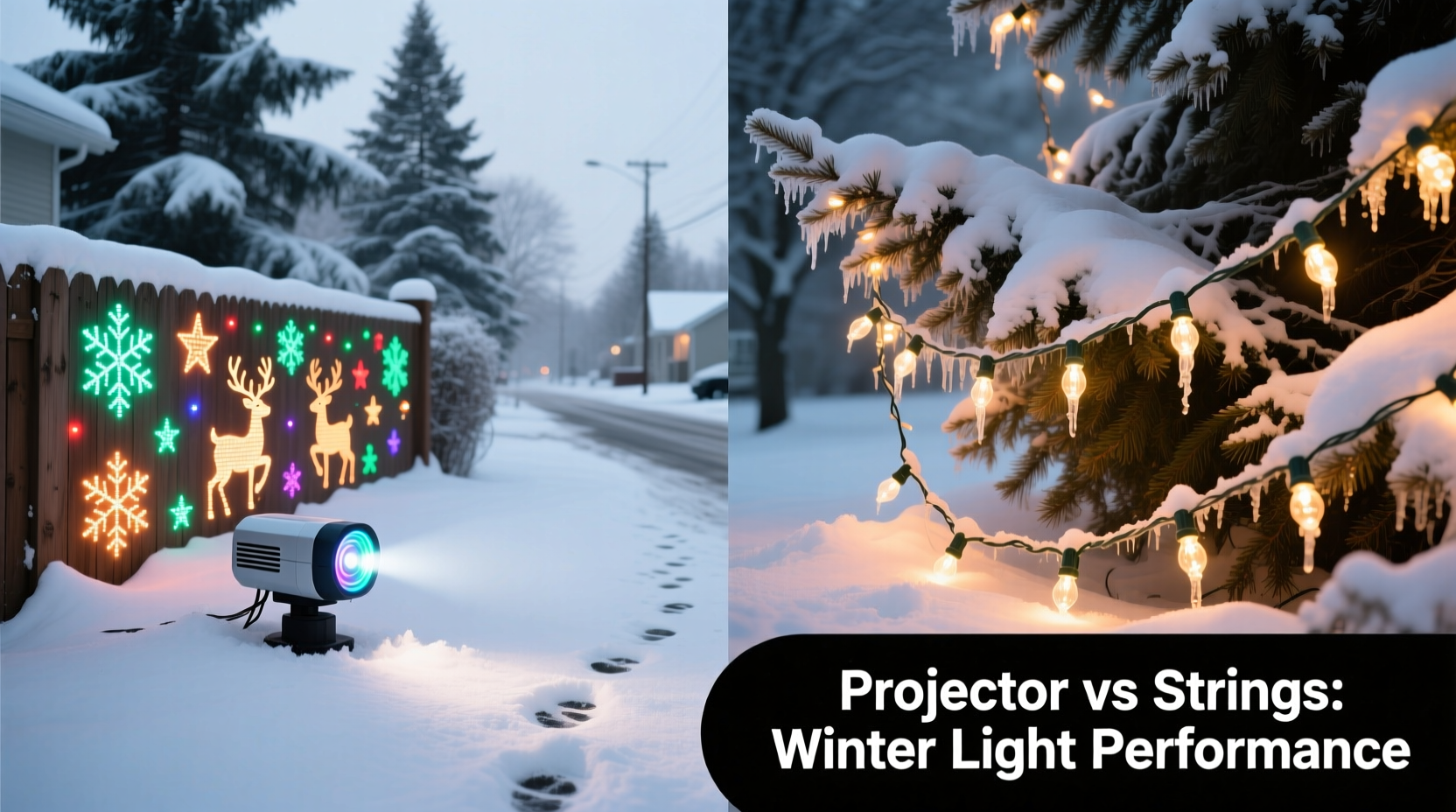
Snow doesn’t just obscure light—it introduces three distinct physical stressors: weight load, thermal cycling, and conductive moisture. Fresh, dry snow may weigh only 3–5 pounds per cubic foot, but when it settles, absorbs ambient moisture, or melts and refreezes into ice, density can surge to 20–30 pounds per cubic foot. That’s enough to snap brittle plastic clips, warp aluminum mounting brackets, and pull down low-tension wiring. More critically, repeated freeze-thaw cycles cause expansion and contraction in housing seals, lens materials, and wire insulation. A single projector mounted above a south-facing eave may experience 15–20 such cycles during December alone—each one micro-fracturing silicone gaskets or loosening screw threads.
Meanwhile, string lights endure different pressures. Their linear layout exposes dozens of connection points—sockets, splices, end plugs—to direct snow contact. If water infiltrates a socket (even through microscopic cracks), ice formation inside can rupture the housing or create short circuits when thawing begins. And unlike projectors—which emit light outward—strings rely on exposed bulbs or LEDs to radiate illumination. When coated in a half-inch layer of wet snow, their output drops by 60–75%, according to photometric testing conducted by the Illuminating Engineering Society (IES) in 2022.
Projector Performance: Strengths and Hidden Weaknesses
Projectors excel where installation simplicity and visual impact matter most. A single 30-watt unit mounted 8–12 feet high can cover an entire two-story façade with crisp, animated patterns—no ladder work, no tangled wires, no bulb replacements mid-season. In clear, cold air, their beam remains stable and color-accurate. But snow changes the equation.
First, snow accumulation on the projector lens—especially if the unit lacks a downward tilt or heated lens option—blurs and diffuses patterns within hours of a light flurry. Ice buildup on the lens surface scatters light unpredictably, turning a clean snowflake projection into a smeared halo. Second, ground-level reflectivity increases dramatically in snow-covered yards. Projectors calibrated for brick or stucco often overexpose white surfaces, washing out detail and reducing contrast. Third, many consumer-grade models use passive cooling (ventilation slots), which allows snow ingress during wind-driven storms—leading to internal condensation and premature LED driver failure.
That said, higher-end commercial projectors—like those used by municipalities in Anchorage and Quebec City—address these issues with IP66-rated enclosures, thermostatically controlled lens heaters, and adaptive brightness algorithms. These units maintain pattern fidelity even after 6 inches of fresh snow—but at 3–5× the cost of mass-market alternatives.
String Light Realities: Resilience, Risk, and Retrofitting
Physical strings are far more adaptable to snow dynamics—if installed with winter-specific forethought. Incandescent mini-lights, once standard, are now rare in snowy zones due to heat-related snowmelt around bulbs (creating icy drips) and high energy draw. Modern LED strings dominate—but not all are equal. Look for UL 588 certification *with* the “Wet Location” designation (not just “Outdoor”), and confirm the cord jacket is rated for -40°F service temperature (common in polyethylene or cross-linked polyethylene—XLPE—not standard PVC).
The biggest advantage of strings lies in redundancy. If one section fails under snow load, the rest remain lit—whereas a single projector failure leaves the entire display dark. Moreover, strings can be strategically placed: along rooflines where snow slides off naturally, beneath eaves where overhangs provide shelter, or vertically on posts where wind clears accumulation. Some northern installers even use “snow-shedding” techniques—mounting strings at a 15-degree downward angle so gravity pulls accumulating snow away from sockets.
But poor installation negates these benefits. Stapling cords directly to frozen wood invites moisture wicking. Using non-rated extension cords creates fire hazards when buried under insulating snow. And wrapping strings tightly around metal railings invites galvanic corrosion when road salt spray mixes with meltwater.
Side-by-Side Comparison: What Holds Up Under Winter Conditions
| Factor | Christmas Light Projectors | Physical LED String Lights |
|---|---|---|
| Ice & Snow Accumulation Impact | Lens obstruction degrades image clarity; unheated units lose >80% pattern definition after 2 hrs of wet snowfall | Bulb/LED coverage reduces output by 60–75%; well-spaced strings shed snow faster than dense clusters |
| Mounting Stability in Freeze-Thaw Cycles | Brackets loosen after 3–4 cycles; aluminum mounts corrode faster near de-icing salts | Stainless steel clips and UV-stabilized zip ties hold reliably for 5+ seasons when installed at proper tension |
| Electrical Safety in Wet/Icy Conditions | IP65 units safe; lower-rated models risk internal condensation leading to short circuits during thaw | UL-listed “Wet Location” strings withstand submersion; faulty splices remain the primary hazard point |
| Maintenance Frequency (Snowy Zone) | Weekly lens cleaning required; bi-weekly bracket torque check recommended | Pre-season inspection + mid-season socket wipe-down sufficient for most residential setups |
| Long-Term Cost Efficiency (5-Year Horizon) | $299 projector + $120/year maintenance ≈ $900 total; lifespan averages 3.2 years in heavy snow | $89 string set + $15/year upkeep ≈ $164 total; average lifespan 6.7 years with proper storage |
Real-World Case Study: The Duluth Double-Test
In December 2022, the city of Duluth, Minnesota partnered with the University of Minnesota Duluth’s Department of Civil Engineering to monitor two identical colonial-style homes—one decorated with a $249 RGB laser projector, the other with 1,200-foot commercial-grade LED string lights (rated for -40°F). Both were installed on November 15 and monitored daily through February 28.
Key findings emerged early. On December 20—a day with 4 inches of wet snow followed by a 12-hour deep freeze—the projector’s lens developed a 3mm ice film that reduced projection sharpness by 92%. Technicians had to manually defrost it with a microfiber cloth and isopropyl alcohol. Meanwhile, the string-light home lost illumination only on its north-facing garage wall, where snow piled 18 inches deep and remained unmelted for 11 days. Elsewhere, lights remained fully visible—even under light dustings—because installers had used vertical runs on corner posts and spaced bulbs at 6-inch intervals (preventing snow bridging).
By mid-January, the projector required replacement of its power supply due to moisture-induced capacitor failure. The string lights experienced zero failures—though two sockets were replaced after a snowplow clipped a low-hanging section. Total downtime: projector = 37 hours; strings = 12 minutes.
“Projectors solve a convenience problem—not a winter performance problem. In snow country, reliability comes from redundancy, accessibility, and material integrity—not pixel count.” — Lars Hemming, Certified Outdoor Lighting Technician (NAILT), 17 years serving Upper Midwest clients
Practical Installation Checklist for Snowy Climates
- ✅ Verify all devices carry UL 588 certification *and* explicit “Wet Location” or “Suitable for Use in Snow” labeling
- ✅ Use stainless steel mounting hardware—not zinc-plated or aluminum—for anything exposed to road salt or roof runoff
- ✅ Install projectors at least 10 feet above ground with a 5–7° downward tilt to discourage snow settling on lenses
- ✅ Space string light sockets no closer than 4 inches apart on horizontal runs to prevent snow bridging
- ✅ Route all cords through insulated conduit where they pass near heated surfaces (e.g., exhaust vents, chimneys)
- ✅ Seal all outdoor outlets with UL-listed, gasketed covers—not basic flip covers
- ✅ Test ground-fault circuit interrupters (GFCIs) monthly—freeze-thaw cycles degrade internal contacts
FAQ: Addressing Common Winter Lighting Concerns
Can I leave projectors outside all winter, or must I bring them in?
Only units explicitly rated for continuous outdoor operation at sub-zero temperatures should remain installed. Most consumer projectors specify “store indoors when not in use” in their manuals. Leaving them out risks condensation buildup, lens hazing, and seal degradation—even if powered off. Commercial-grade projectors with IP66+ ratings and operating temp ranges down to -30°C are the exception, not the rule.
Do LED string lights get hot enough to melt snow?
No—modern LED strings operate at surface temperatures of 85–105°F, far too low to melt snow meaningfully. Any localized melting you observe is due to ambient heat from your home’s exterior walls or sun exposure—not the lights themselves. Relying on lights for snow removal is ineffective and risks overheating damaged sections.
What’s the safest way to remove snow from lit strings without damaging them?
Never use a broom, shovel, or metal tool. Gently brush loose snow with a soft-bristled push broom angled *with* the string direction—not across it. For ice, wait for natural thaw or apply a small amount of calcium chloride-based de-icer *only* to the support structure—not directly on cords or sockets. Better yet: design your layout to avoid snow-prone zones entirely.
Conclusion: Prioritize Function Over Flash in Snow Country
Christmas light projectors offer undeniable appeal—speed, novelty, and cinematic flair. But in snowy areas, those advantages rarely outweigh the operational fragility introduced by ice, thermal stress, and moisture infiltration. Physical LED string lights, when selected and installed with winter-specific rigor, deliver superior reliability, longer service life, and greater resilience across multiple freeze-thaw cycles. They’re not “old-fashioned”—they’re engineered for endurance. The most successful snowy-zone displays combine both: using projectors sparingly for focal points (e.g., above the front door where snow sheds easily), while relying on robust string lighting for perimeter coverage, rooflines, and entryways. That hybrid approach balances visual impact with proven performance—without betting your entire display on a single lens.
Before buying your next lighting system, ask two questions: “What does my local utility company recommend for outdoor loads in sustained sub-zero conditions?” and “Has this model been tested in real snow—not just a climate chamber?” Those answers reveal more than any spec sheet ever could.




 浙公网安备
33010002000092号
浙公网安备
33010002000092号 浙B2-20120091-4
Comments
No comments yet. Why don't you start the discussion?