
As the search for youthful, resilient skin continues, collagen supplements have surged in popularity. Marketed as a solution to fine lines, sagging skin, and loss of firmness, these powders, pills, and drinks promise visible improvements in just weeks. But do they actually work? More specifically, can ingesting collagen peptides truly enhance skin elasticity—the skin’s ability to stretch and bounce back? To answer this, we turn not to marketing claims, but to peer-reviewed research, dermatological consensus, and real-world results.
Skin elasticity declines with age due to a natural reduction in collagen production—starting as early as our mid-20s. Environmental stressors like UV exposure and pollution accelerate this process. With over $5 billion spent annually on collagen products globally, understanding their actual impact is essential for informed decisions. This article examines the scientific evidence behind collagen supplementation, analyzes key clinical trials, and offers practical guidance based on what the data reveals.
The Role of Collagen in Skin Health
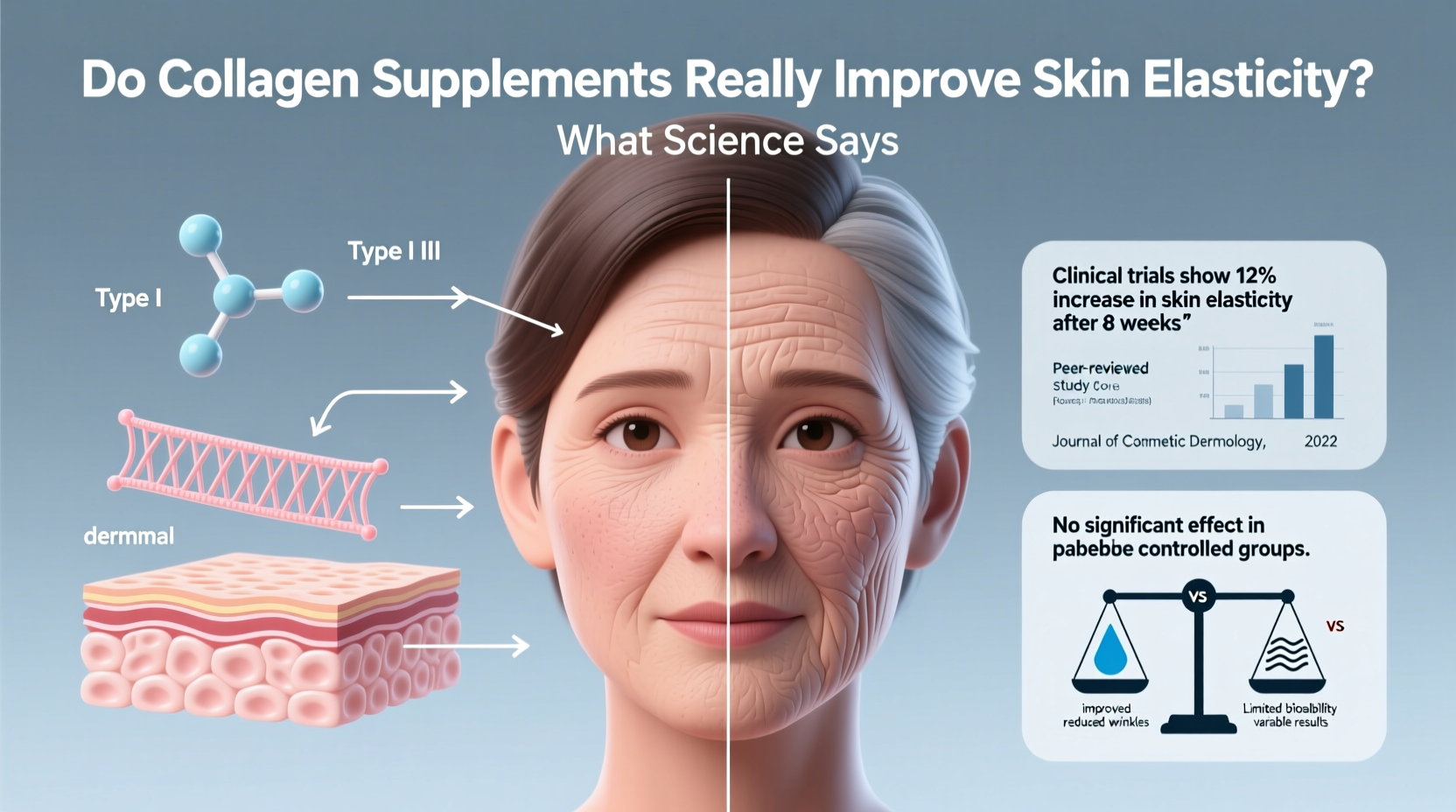
Collagen is the most abundant protein in the human body, making up about 75% of the skin’s dry weight. It forms a fibrous network in the dermis that provides structural support, strength, and elasticity. Type I and Type III collagen are particularly vital for maintaining skin integrity. As we age, collagen synthesis slows while degradation increases, leading to thinner, less elastic skin.
Topical skincare products often claim to deliver collagen directly into the skin. However, collagen molecules are too large to penetrate the epidermis effectively. This limitation has led to interest in oral supplementation—consuming hydrolyzed collagen peptides that are broken down into smaller, absorbable units.
When ingested, these peptides are digested in the gut and released into the bloodstream as amino acids and bioactive dipeptides such as hydroxyproline. Research suggests these components may signal fibroblasts—the cells responsible for collagen production—to increase endogenous collagen synthesis.
“Oral collagen doesn’t replace lost collagen directly, but it appears to stimulate the body’s own repair mechanisms.” — Dr. Rebecca Tan, Dermatologist and Clinical Researcher
Clinical Evidence: What Do Studies Say?
Over the past decade, numerous randomized controlled trials (RCTs) have investigated the effects of collagen supplementation on skin elasticity. The results are not uniform, but a growing body of evidence supports modest yet measurable benefits.
A 2019 meta-analysis published in Advances in Nutrition reviewed 19 clinical trials involving 1,125 participants. The analysis found that daily intake of 2.5–10 grams of hydrolyzed collagen over 8–24 weeks led to a statistically significant improvement in skin elasticity compared to placebo groups. The effect size was moderate but consistent across multiple studies.
One frequently cited study from 2014 in the journal Skin Pharmacology and Physiology examined 69 women aged 35–55 who took 2.5 grams of collagen peptides daily for 8 weeks. The treatment group showed an average increase of 7.2% in skin elasticity versus 1.8% in the control group. Participants also reported improved skin hydration and reduced roughness.
Another double-blind RCT conducted in 2019 followed 72 women using 5 grams of marine collagen daily for 12 weeks. Using cutometry—a non-invasive method to measure skin firmness—the researchers observed a 15% improvement in elasticity in the supplement group, compared to no change in the placebo group.
How Collagen Supplements Work: The Biological Mechanism
The mechanism behind oral collagen’s effect involves more than simple nutrient replacement. Unlike vitamins, collagen isn’t directly incorporated into the skin after ingestion. Instead, the process follows a signaling pathway:
- Digestion: Collagen peptides are broken down in the gastrointestinal tract into small peptides and free amino acids.
- Absorption: These compounds enter the bloodstream via the small intestine.
- Targeting: Specific collagen-derived peptides accumulate in the dermis.
- Stimulation: They activate fibroblasts, promoting the synthesis of new collagen, elastin, and hyaluronic acid.
This “molecular mimicry” theory suggests that the presence of collagen fragments signals the body that collagen levels are low, prompting increased production. Animal models and in vitro studies support this model, showing upregulation of genes related to extracellular matrix formation after collagen peptide exposure.
Additionally, many collagen supplements are enriched with vitamin C, which is a cofactor for prolyl hydroxylase—an enzyme critical for stabilizing the collagen triple helix. Without adequate vitamin C, collagen synthesis falters, making its inclusion in formulations biologically sound.
Types of Collagen and Sources: What Works Best?
Not all collagen supplements are created equal. The source and type influence bioavailability and efficacy. Here’s a breakdown of common options:
| Type | Source | Best For | Notes |
|---|---|---|---|
| Type I & III | Bovine (beef), Porcine (pork) | Skin, hair, nails | Most abundant in skin; bovine collagen is widely studied. |
| Type I | Marine (fish) | Skin elasticity | Smaller peptides may offer higher absorption; sustainable sourcing matters. |
| Type II | Chicken sternum | Joints, cartilage | Less relevant for skin; primarily used for joint health. |
| Vegan \"Collagen\" | Plant-based amino acids + nutrients | Supporting natural collagen | Doesn't contain actual collagen; aims to boost endogenous production. |
Marine collagen, derived from fish scales or skin, has gained favor due to its lower molecular weight and high concentration of Type I collagen. Some studies suggest it may be up to 1.5 times more bioavailable than bovine sources.
“While plant-based formulas can support collagen synthesis through nutrients like vitamin C and silica, they don’t provide the peptide triggers that animal-derived hydrolysates do.” — Dr. Lena Patel, Nutritional Biochemist
Real-World Results: A Mini Case Study
Sarah, a 42-year-old marketing executive, began noticing her skin felt looser around the jawline and lacked its former resilience. Despite using retinoids and SPF daily, she wanted additional support. After researching clinical studies, she started taking 5 grams of marine collagen peptides each morning mixed into her smoothie.
She committed to the regimen for 12 weeks, pairing it with a diet rich in antioxidants and consistent sun protection. At week 4, she noticed improved hydration. By week 8, her makeup applied more smoothly, and her daughter commented that her skin looked “glowy.” At the 12-week mark, Sarah underwent a professional skin assessment using a cutometer. The results showed a 13% improvement in elasticity on her cheek and a noticeable reduction in transepidermal water loss.
While Sarah acknowledges lifestyle factors played a role, she attributes the most significant change to the collagen supplement, especially since she made no other major changes during the period.
What Experts Recommend: A Balanced View
Dermatologists and nutrition scientists agree: collagen supplements can be a useful tool—but not a miracle cure. Their effectiveness depends on several factors, including age, baseline collagen levels, overall diet, and lifestyle habits.
Dr. Alan Zhou, a cosmetic dermatologist, notes: “We see the best results in individuals aged 30–50, where collagen decline is underway but not severe. In older adults, the response may be slower due to reduced fibroblast activity.”
Experts also emphasize that supplements should complement—not replace—foundational skin health practices:
- Using broad-spectrum sunscreen daily
- Maintaining a balanced diet rich in protein, vitamin C, and antioxidants
- Avoiding smoking and excessive alcohol consumption
- Getting adequate sleep and managing stress
In short, collagen supplements are most effective when integrated into a holistic approach to skin longevity.
Practical Guide: How to Choose and Use Collagen Supplements
With hundreds of products on the market, selecting the right one can be overwhelming. Follow this step-by-step guide to make an informed decision:
- Determine your goal: Focus on skin elasticity? Choose Type I collagen from marine or bovine sources.
- Check the label: Ensure it contains hydrolyzed collagen peptides (not gelatin or whole collagen).
- Dose matters: Aim for 2.5–10 grams per day. Most effective studies used 5 grams.
- Look for added nutrients: Vitamin C, hyaluronic acid, or biotin can enhance results.
- Assess quality: Choose third-party tested brands with transparent sourcing (e.g., grass-fed, wild-caught).
- Be patient: Start tracking changes after 8 weeks. Take photos under consistent lighting.
- Monitor tolerance: Some report mild digestive discomfort initially; taking with food can help.
Collagen Supplement Checklist
- ✅ Contains hydrolyzed collagen peptides
- ✅ Minimum 2.5g per serving (ideally 5g)
- ✅ Sourced from reputable supplier (marine, bovine, etc.)
- ✅ Includes vitamin C or taken with vitamin C-rich food
- ✅ Free from unnecessary fillers and artificial additives
- ✅ Third-party tested for purity and heavy metals
- ✅ Used consistently for at least 8 weeks
Frequently Asked Questions
Are collagen supplements safe?
Yes, for most people. Hydrolyzed collagen is generally well-tolerated. Mild side effects may include bloating or a feeling of fullness. Individuals with fish or egg allergies should avoid marine or egg-based collagen. Always consult a healthcare provider if you have kidney disease or are pregnant or breastfeeding.
Can vegans benefit from collagen supplements?
True collagen is animal-derived, so there is no vegan collagen. However, some plant-based supplements contain nutrients like lysine, proline, vitamin C, and bamboo extract (a source of silica) that support the body’s natural collagen production. While promising, these lack the direct peptide signaling of animal-based collagen and have less clinical backing for improving elasticity.
How long does it take to see results?
Most clinical studies report measurable improvements in skin elasticity after 8–12 weeks of daily use. Some users notice better hydration and texture within 4 weeks, but structural changes take longer. Consistency is critical—results typically reverse if supplementation stops.
Conclusion: Separating Hype from Hope
The question isn’t whether collagen supplements work at all, but how much they can realistically contribute to skin elasticity. Science suggests they offer a modest but meaningful benefit, particularly for adults experiencing early signs of aging. The mechanism—stimulating the body’s own collagen production—is biologically plausible and supported by clinical data.
However, supplements are not a substitute for sun protection, healthy eating, or good skincare habits. They function best as part of a broader strategy. When choosing a product, prioritize quality, dosage, and consistency. Set realistic expectations: improvements are gradual and subtle, not dramatic overnight transformations.
If you’re curious about trying collagen, start with a reputable brand offering 5 grams of hydrolyzed peptides daily. Pair it with a vitamin C source and give it at least two months. Track your progress with photos and how your skin feels. Your experience may vary, but the science indicates it’s worth a thoughtful trial.




 浙公网安备
33010002000092号
浙公网安备
33010002000092号 浙B2-20120091-4
Comments
No comments yet. Why don't you start the discussion?