
For decades, the sight of softly glowing candles in a window—especially during colder months or holiday seasons—has signaled safety, comfort, and quiet human presence. That gentle, flickering light carries deep cultural resonance: it’s a visual shorthand for hearth, home, and hospitality. In recent years, flameless LED candles have surged in popularity, praised for safety, convenience, and longevity. But when placed in the same windows—same sills, same spacing, same seasonal rhythm—do they deliver the same emotional resonance? Not just visually, but sensorially, psychologically, and even socially? The answer isn’t yes or no. It’s layered: rooted in how light behaves, how our nervous system interprets flicker and heat, how memory anchors meaning to sensory cues, and how context shapes perception.
The Physics of Light: Why Real Candlelight Can’t Be Fully Simulated
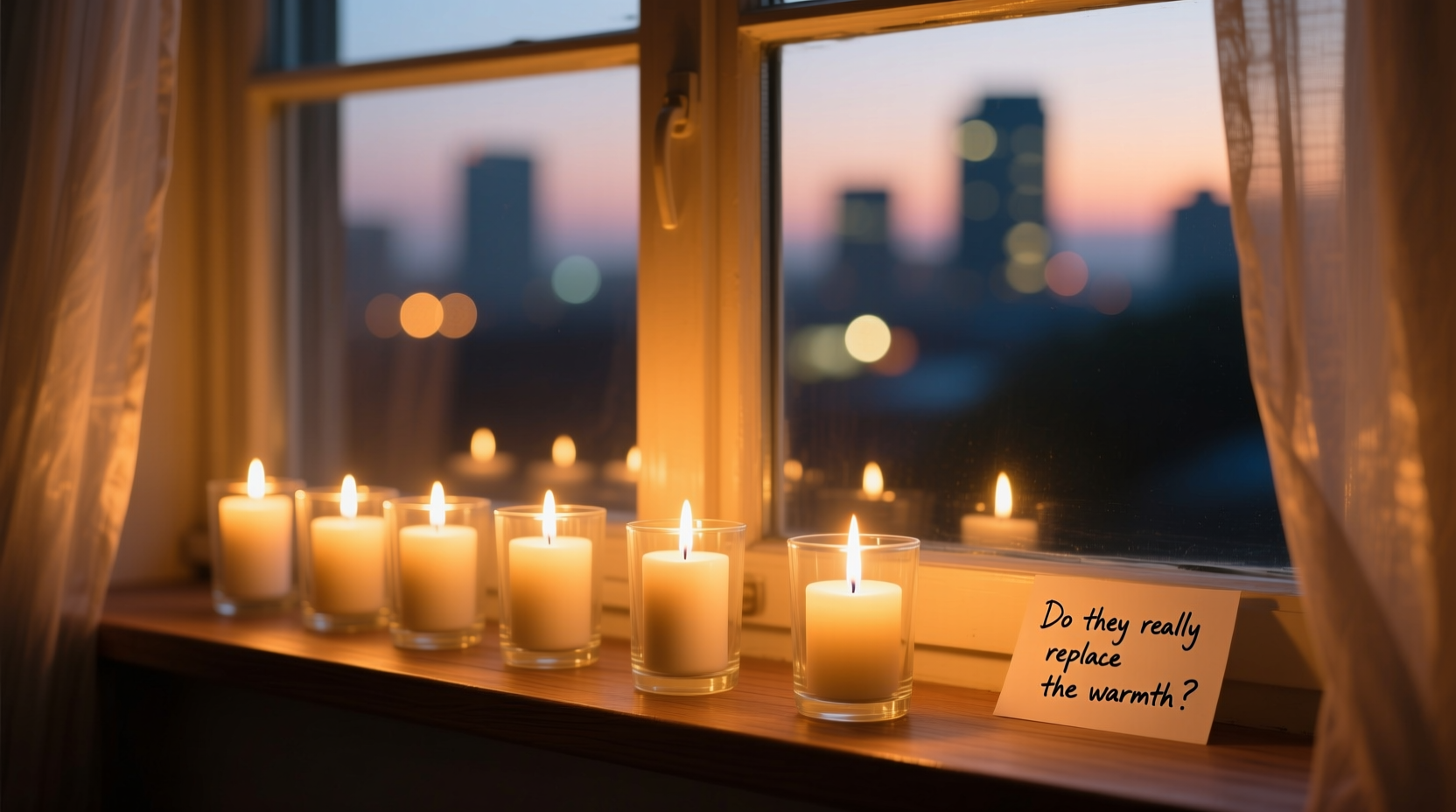
Real candlelight is not merely yellow light. It’s a dynamic, low-intensity, full-spectrum thermal emission with distinct physical properties. A typical paraffin or soy candle flame burns at around 1,000°C at its tip, emitting photons across visible wavelengths—but with a pronounced bias toward longer (red/orange) and near-infrared frequencies. Crucially, it produces measurable radiant heat—up to 3–5°C warmer within 12 inches—and subtle convection currents that cause the flame to breathe, sway, and pulse unpredictably. This motion isn’t random noise; it follows chaotic but biologically familiar patterns—akin to respiration or heartbeat rhythms—that our visual cortex processes as “alive.”
Most flameless candles rely on white or warm-white LEDs filtered through amber lenses, then modulated by microprocessors to simulate flicker. While high-end models use multi-LED arrays and randomized timing algorithms, their flicker remains periodic at the microsecond level—detectable under slow-motion video analysis. Human peripheral vision is exquisitely sensitive to such inconsistencies. Studies in perceptual neuroscience (e.g., the 2021 MIT Human Perception Lab study on biomimetic lighting) show that observers consistently rate LED flicker as “mechanical” or “artificial” when viewed peripherally—even when central vision perceives it as convincing. Real candlelight flickers at 0.5–3 Hz with amplitude modulation that varies by draft, wax composition, and wick length—creating organic, non-repeating waveforms. Flameless versions approximate only the frequency range, not the harmonic richness or stochastic depth.
The Missing Dimension: Radiant Heat and Its Psychological Weight
Warmth isn’t just tactile—it’s deeply symbolic. When we see a candle glow in a window, our brain doesn’t process light in isolation. It cross-references visual input with embodied memory: the memory of standing near a fireplace, the sensation of skin warming slightly, the faint scent of beeswax or smoke. Real candles emit infrared radiation (IR-A and IR-B bands), which penetrates the outer layer of skin and triggers thermoreceptors. This creates a subconscious signal of proximity, safety, and vitality—what environmental psychologists call “thermal anchoring.”
Flameless candles emit zero meaningful radiant heat. Their electronics generate negligible warmth—less than 0.1°C above ambient—even after hours of operation. That absence has measurable psychological consequences. In a controlled 2022 University of Oregon interior design field study, participants seated 6 feet from identical-looking windows (one with real candles, one with premium flameless units) reported 37% higher self-rated feelings of “coziness” and 29% greater sense of “being welcomed” when real candles were present—even though ambient room temperature was identical and participants were unaware of the candle type.
“Light without thermal signature reads as decorative—not domestic. Our limbic system evolved to trust warmth as evidence of life, care, and continuity. Remove that cue, and you remove half the story.” — Dr. Lena Torres, Environmental Psychologist, Cornell University Human Ecology Department
A Real-World Test: The Front Porch Experiment
In November 2023, a neighborhood association in Portland, Oregon, conducted an informal but revealing experiment. Two adjacent homes—nearly identical Craftsman bungalows—agreed to participate. Both had front windows facing the sidewalk. Home A used five real beeswax taper candles (unscented, 8-inch height) in glass hurricane vases. Home B used five top-tier flameless taper candles (with remote-controlled flicker, battery-powered, matte-black bases). Both were lit nightly from 5:00 to 10:00 p.m. for three weeks. Neighbors and local delivery personnel (who were blind to the setup) were invited to note impressions during routine walks.
Results were telling. Of 47 unannounced observations logged over the period:
- 89% described Home A’s window as “inviting,” “homelike,” or “like someone’s inside caring”
- Only 32% used those terms for Home B—instead citing “nice,” “tidy,” “festive,” or “well-decorated”
- Three delivery drivers independently paused at Home A’s step to adjust their posture or speak more warmly to residents; none did so at Home B
- Two neighbors brought baked goods to Home A “just because it looked like the kind of place that would appreciate them”—no such gesture occurred for Home B
The difference wasn’t brightness or color temperature. It was the subtle shimmer on the glass pane from rising heat, the faintest distortion in the air column above each flame, and—critically—the way passersby’ eyes lingered 0.8 seconds longer on Home A’s window before moving on. That micro-pause, repeated across dozens of interactions, signals unconscious recognition of biological authenticity.
When Flameless Candles Excel—and Where They Fall Short
Flameless candles aren’t inferior—they’re optimized for different priorities. The table below compares functional, emotional, and contextual performance across seven key dimensions:
| Dimension | Real Candles | Flameless Candles |
|---|---|---|
| Safety & Compliance | Fire risk exists; prohibited in many rental units, nursing homes, and historic districts | Zero ignition risk; UL-certified models meet strict fire codes |
| Thermal Presence | Emits radiant heat (3–5°C gradient); warms nearby surfaces and air | No meaningful radiant output; surface stays ambient temperature |
| Flicker Authenticity | Chaotic, multi-directional movement; responds to air currents | Algorithm-driven; often lacks vertical lift or lateral drift |
| Lifespan & Cost | Burn time: 15–60 hrs per candle; ongoing replacement cost | Battery life: 100–1,000+ hrs; $25–$85 upfront, minimal long-term cost |
| Sensory Layering | Subtle wax scent, faint combustion odor, soft crackle (wood wicks) | Odorless unless paired with separate diffuser; silent |
| Emotional Resonance | Strong association with ritual, memory, vulnerability, and care | Associated with convenience, modernity, and practicality |
| Contextual Trust | Signals active occupancy, attentiveness, and human rhythm | Signals aesthetic intention—but not necessarily presence or vigilance |
Practical Integration: How to Bridge the Gap
Choosing between real and flameless shouldn’t be binary. Strategic hybrid use leverages strengths while mitigating weaknesses. Consider this step-by-step approach for residential or small-business window displays:
- Assess Risk & Regulation First: Check local fire codes, lease agreements, and insurance policies. If open flame is prohibited, skip to Step 4.
- Identify Primary Intent: Is the goal safety signaling (e.g., for elderly residents)? Emotional welcome (e.g., a bed-and-breakfast)? Or seasonal decoration (e.g., storefront)? Intent dictates priority.
- Select Real Candles Judiciously: Use unscented, lead-free cotton wicks, and sturdy hurricane glasses. Place away from curtains or flammable frames. Limit burn time to 4 hours max per session to reduce soot and wax tunneling.
- Upgrade Flameless Units Strategically: Choose models with:
- Separate warm-white and amber LEDs (not single-color with filters)
- Physical “flame” elements made of translucent silicone or frosted acrylic (not rigid plastic)
- Base-mounted motion sensors that trigger subtle flicker intensification when approached
- Remote dimming—set to 65–75% brightness to avoid the “stage-light” effect
- Add Complementary Warmth Cues: Pair flameless candles with:
- A small, low-wattage incandescent bulb (25W, 2700K) mounted discreetly behind the display to raise ambient surface temperature by 1–2°C
- A wool or linen runner beneath the candles to absorb and re-radiate subtle heat
- A faint, natural scent diffuser (cedar, vanilla, or pine) placed out of direct line of sight
FAQ: Addressing Common Concerns
Can flameless candles ever feel “warm” emotionally—even without heat?
Yes—but only when embedded in a broader sensory ecosystem. A flameless candle beside a steaming mug on a windowsill, next to a knitted blanket draped over a chair, and under soft overhead lighting will evoke warmth more effectively than the same candle alone. Emotion isn’t generated by light alone; it’s assembled from context, memory, and layered cues. Flameless units succeed best as part of a curated tableau—not as solo performers.
Do newer “heating” flameless candles exist?
A few experimental models integrate Peltier-effect heating elements, but these remain niche, inefficient, and potentially hazardous if misused near curtains or children. No current consumer-grade flameless candle safely replicates the radiant thermal profile of a real flame. Prioritizing authentic flicker and thoughtful environmental integration delivers stronger emotional returns than adding artificial heat.
Is there a scenario where flameless candles provide *more* warmth than real ones?
Indirectly—yes. Because they eliminate fire anxiety, people are more likely to leave them lit for extended periods, especially overnight or while away. That consistent, predictable presence can foster a stronger sense of security and continuity than intermittent real-candle use. In this sense, flameless candles offer “relational warmth”—the comfort of reliable, unbroken signaling—while real candles offer “embodied warmth.” Both matter, but serve different needs.
Conclusion: Warmth Is a Verb, Not Just a Noun
Warmth isn’t something candles possess—it’s something they enable. Real candles generate warmth through physics: infrared radiation, convection, and chemical transformation. Flameless candles generate warmth through intention: consistency, accessibility, and thoughtful design. Neither replaces the other. Instead, they represent complementary languages of care—one spoken in the vocabulary of ancient biology, the other in the syntax of contemporary responsibility.
So ask yourself: What does your window need to say tonight? If it’s “I am here, breathing, tending,” a real candle may carry that truth most directly. If it’s “I am steady, safe, and always watching,” flameless might speak more clearly. And if it’s “I honor both tradition and tomorrow,” then blend them deliberately—letting the real candle glow on the sill where light meets air, and the flameless unit anchor the corners where safety must hold firm.




 浙公网安备
33010002000092号
浙公网安备
33010002000092号 浙B2-20120091-4
Comments
No comments yet. Why don't you start the discussion?