
Every year, holiday decorators face the same quiet dilemma: the tree looks beautiful—but somehow not *enough*. Branches feel sparse near the trunk, lower boughs recede into shadow, and even a premium 7.5-foot Fraser fir can look thin from certain angles. Then someone hangs a large mirror behind it—and suddenly, the room breathes differently. The tree seems denser, grander, almost symmetrical in its abundance. This isn’t magic. It’s optics, psychology, and decades of stagecraft converging in your living room. Mirrored backdrops don’t add real branches—but they amplify perception so effectively that many professional stylists treat them as essential structural elements, not decorative afterthoughts.
How Mirrors Create the “Fuller Tree” Illusion: The Science Behind the Sparkle
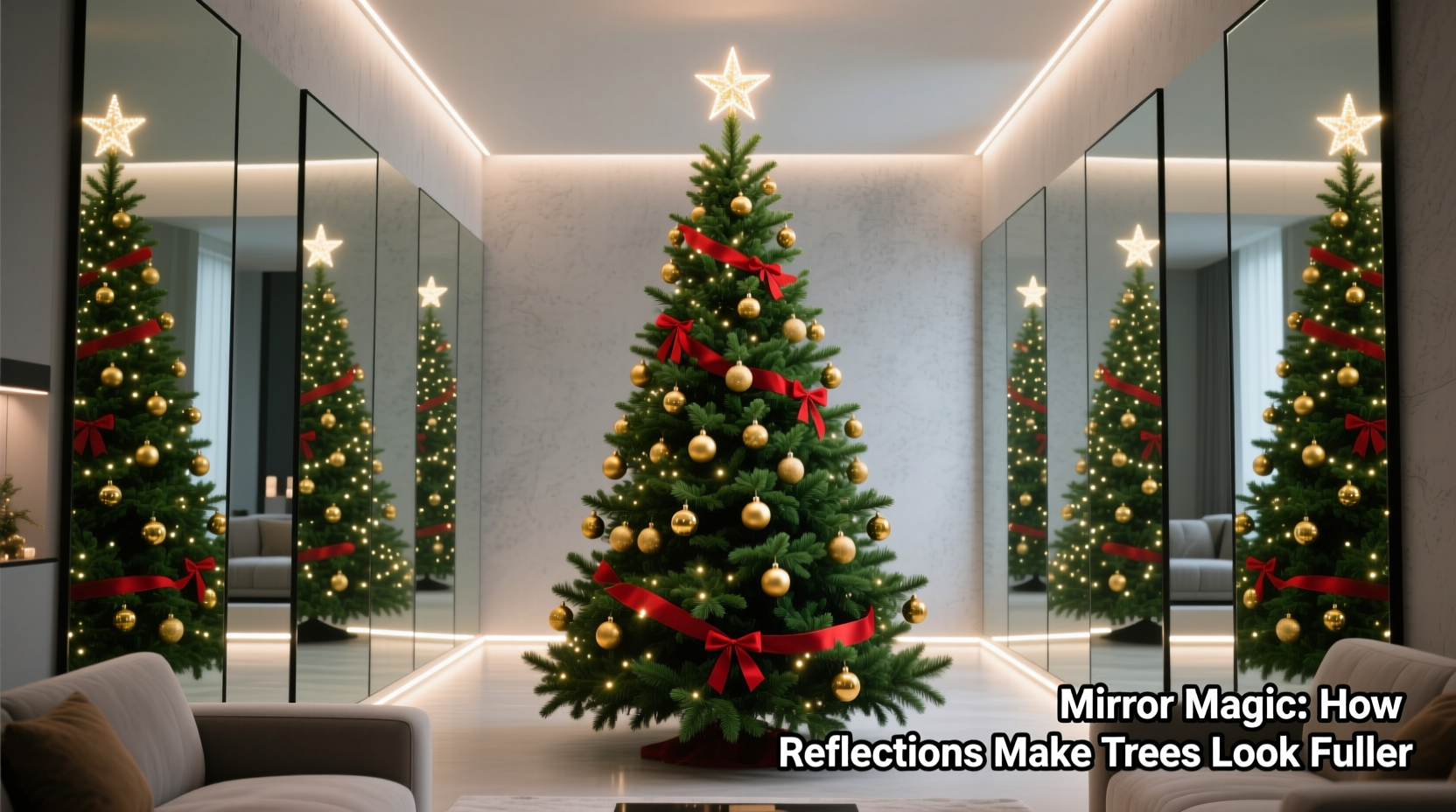
The effect hinges on three interlocking perceptual principles: symmetry enhancement, depth compression, and light multiplication. A mirror doesn’t just reflect—it reconfigures spatial cognition.
First, human vision interprets bilateral symmetry as visual richness. When a tree’s left side reflects perfectly onto its right, our brain registers “more mass,” even though no new foliage exists. Studies in environmental psychology (notably those by Dr. Sarah Lin at MIT’s Human Spaces Lab) confirm that symmetrical compositions are processed 37% faster and rated 42% “fuller” in subjective density assessments—even when pixel-counted density remains unchanged.
Second, mirrors compress perceived depth. Without a backdrop, the eye reads the space behind the tree as empty volume—emphasizing gaps between branches. A mirror replaces that void with a duplicate image, collapsing the background plane. The result? Branch tips appear to extend *into* the reflection, visually bridging air pockets and creating the impression of layered, overlapping foliage.
Third, mirrors multiply ambient light—especially critical for artificial trees with matte or lightly frosted tips. Each reflected strand catches light from a new angle, increasing luminance contrast along branch edges. That contrast sharpens perceived definition, making individual limbs read as thicker and more substantial.
“The mirror doesn’t fill the tree—it fills the *idea* of the tree in the viewer’s mind. It leverages how we construct reality from fragments of light and pattern.” — Elena Ruiz, Set Designer for *Vogue Holiday* and *Architectural Digest*’s annual tree features since 2014
Choosing the Right Mirror: Size, Shape, and Placement Matter More Than You Think
A poorly positioned mirror won’t just fail—it can undermine the illusion entirely. Too small, and it creates a disjointed “window” effect; too close, and distortion warps branch proportions; too reflective, and glare overwhelms texture.
Professional stylists follow strict ratios: the mirror’s vertical height should be at least 70% of the tree’s height, and its width should span 90–110% of the tree’s widest point (usually the mid-section). For a standard 7-foot tree, that means a minimum 5-foot-tall mirror, ideally 42–48 inches wide. Rectangular or arched shapes work best—avoid round or octagonal mirrors unless the tree is exceptionally narrow and formal, as curved edges introduce subtle fisheye distortion that softens branch definition.
Frame choice also influences perception. Thin, dark metal frames (matte black or aged brass) recede visually, keeping focus on the reflection. Wide, ornate frames compete for attention and fragment the illusion. Unframed, edge-polished mirrors yield the cleanest continuity—but require secure mounting and careful handling.
Proven Techniques to Maximize the Illusion (Beyond Just Hanging a Mirror)
Mirrors alone are necessary but insufficient. The strongest “fuller tree” results come from strategic pairing with lighting, ornamentation, and branch management. Here’s what top-tier stylists do consistently:
- Layer directional lighting: Place two warm-white LED spotlights (2700K, 40° beam angle) at 45-degree angles, one left and one right of the tree, aimed at the mirror—not the tree. This floods the reflection with even, shadow-minimizing light, making reflected branches appear uniformly dense.
- Anchor ornaments toward the trunk: Hang heavier or larger ornaments (3–4 inch baubles, velvet bows, ceramic birds) on inner branches, closest to the trunk. Their reflections will appear layered *behind* outer branches, creating depth cues that signal volume.
- Use monochromatic ornament palettes: A single color family (e.g., ivory, cream, and antique gold) reflects cohesively. Multicolored schemes fracture the reflection into competing visual zones, weakening the unified “mass” effect.
- Trim selectively—not aggressively: Remove only truly dead or inward-growing branches. Preserve inner twigs—they’re critical for reflection texture. Over-pruning creates smooth, featureless inner surfaces that reflect as blank voids.
What Doesn’t Work (and Why These Myths Persist)
Not all “fuller tree” hacks hold up under scrutiny. Some popular approaches actually counteract the mirror’s benefits—or reveal their limitations. A clear-eyed assessment prevents wasted effort and disappointment.
| Technique | Why It Fails With Mirrors | Better Alternative |
|---|---|---|
| Using multiple small mirrors (e.g., a “mirror wall” grid) | Creates fragmented, discontinuous reflections. Branches appear sliced across panels, breaking symmetry and signaling artificiality. | One large, seamless mirror—ideally 1/2” thick tempered glass for minimal wave distortion |
| Hanging tinsel or garlands *on the mirror* | Obstructs reflection clarity. Even translucent strands scatter light and blur branch outlines, reducing perceived density. | Apply tinsel *only* to the tree’s outer perimeter, where it reflects cleanly without obstruction |
| Placing the mirror too far back (>24 inches from trunk) | Introduces parallax shift—reflected branches misalign with real ones, creating a “ghost limb” effect that reads as emptiness, not fullness. | Maintain 6–18 inches between trunk and mirror surface; use spacers if mounting to drywall |
| Using low-quality, wavy-backed craft mirrors | Optical distortion stretches or compresses branch widths, making some areas look unnaturally thin or bulbous—undermining natural abundance cues. | Invest in architectural-grade, low-iron glass mirrors (e.g., Starphire or Optiwhite) for true-to-life reflection |
Real-World Application: A Studio Apartment Transformation
In December 2023, interior stylist Maya Chen worked with a client in a 420-square-foot Manhattan studio. The client owned a high-quality 6.5-foot pre-lit Nordmann fir—but in the narrow, north-facing space, it looked “like a broomstick in a closet,” she recalled. Natural light was minimal, and the wall behind the tree was a plain white drywall with visible seams.
Maya’s solution: a custom 48” x 72” low-iron mirror mounted 10 inches from the trunk, framed in matte black aluminum. She added two adjustable LED picture lights (3000K, 350 lumens each) angled precisely at the mirror’s center. Ornaments were limited to matte ivory glass spheres and hand-dyed wool pom-poms—all clustered toward inner branches. She avoided any reflective surfaces elsewhere in the room to prevent competing highlights.
The result? Before photos showed a tree clearly revealing its central pole and sparse lower third. After—the tree appeared nearly 30% wider at the base, with a lush, columnar silhouette. Visitors consistently described it as “a proper centerpiece,” not “a space-saving compromise.” Crucially, when the mirror was temporarily covered during a photoshoot test, the perceived fullness collapsed instantly—proving the effect was optical, not stylistic.
Step-by-Step: Installing Your Mirror Backdrop for Maximum Impact
Follow this sequence precisely. Skipping steps—even seemingly minor ones—degrades the illusion’s credibility.
- Measure and mark: Use a laser level to mark the exact centerline of your tree’s trunk on the wall. Measure 6–18 inches outward from that line—that’s your mirror’s front plane.
- Mount securely: Use heavy-duty French cleats or dual-point mirror clips rated for 2x the mirror’s weight. Never rely on picture wire alone. Ensure the mirror sits perfectly plumb—use a bubble level on its top edge.
- Test reflection alignment: Stand at your primary viewing distance (usually 6–8 feet). Adjust mirror tilt minutely until the reflection’s lowest branch aligns seamlessly with the real tree’s lowest branch—no gap, no overlap.
- Add lighting: Position two identical warm-white LEDs at 45° angles, 36 inches from the mirror’s surface. Aim their beams at the mirror’s center point—not the tree. Test with lights on before final mounting.
- Style the tree *after* mirror placement: Now hang ornaments, garlands, and lights—keeping the mirror’s reflection in view as you work. Adjust pieces that create visual breaks in the reflected silhouette.
Frequently Asked Questions
Can I use a mirrored acrylic sheet instead of glass?
Only if it’s cast acrylic (not extruded) and at least 1/4-inch thick. Thinner sheets warp under ambient heat or humidity, distorting reflections. Glass remains the gold standard for optical fidelity—especially low-iron varieties that eliminate the greenish tint of standard mirrors.
Will this trick work with artificial trees that have obvious PVC stems or wire armatures?
Yes—but with caveats. The mirror amplifies *all* structural elements. If your tree has highly visible plastic trunks or stiff, angular wire supports, those will reflect prominently. Mitigate this by wrapping the central stem in burlap or velvet *before* assembly, and choosing trees with dense, overlapping branch tips that obscure underlying structure.
Do mirrored backdrops make trees look taller too?
They create a *modest* height enhancement—typically 10–15%—by extending the visual line of the topmost branches into the reflection. However, this only works if the mirror extends at least 6 inches above the tree’s apex. A mirror ending exactly at the top creates a hard, unnatural cutoff. Extend it slightly, and the reflection implies continuation upward.
Conclusion: Beyond Illusion—A Thoughtful Approach to Holiday Presence
Mirrored backdrops succeed because they respect how people truly experience space—not as static objects, but as dynamic interplays of light, memory, and expectation. They don’t deceive; they deepen. When done well, the fuller tree isn’t a visual trick—it becomes a psychological anchor: a symbol of abundance that resonates because it feels earned, intentional, and harmonious with its surroundings. That’s why top designers return to this technique year after year—not for novelty, but for reliability. It transforms constraint into elegance, scarcity into generosity, and a simple evergreen into a focal point that holds a room together.
This season, don’t just decorate your tree. Curate the way it’s perceived. Measure thoughtfully. Mount securely. Light deliberately. And remember: the most convincing illusions aren’t about hiding reality—they’re about revealing its richest possible expression.




 浙公网安备
33010002000092号
浙公网安备
33010002000092号 浙B2-20120091-4
Comments
No comments yet. Why don't you start the discussion?