
Walk into a room with a freshly cut Fraser fir or Balsam fir, and the scent hits you before you even see the tree: crisp, resinous, sweetly green—like winter distilled into air. That aroma isn’t added; it’s inherent. Yet many shoppers today wonder: Are “scented” Christmas trees a real product category? Can an artificial tree ever replicate that nostalgic olfactory warmth? And if so, is it safe, effective, or even worth the effort?
The answer isn’t binary—and it’s shaped by botany, chemistry, consumer trends, and decades of holiday marketing. Real Christmas trees don’t come pre-scented like candles; their fragrance emerges from volatile organic compounds released when needles are bruised, warmed, or dried. Artificial trees, meanwhile, are inert plastic and metal—no natural scent source, no biological release mechanism. But that doesn’t mean fragrance is off-limits. It means the approach must be intentional, informed, and grounded in material science—not seasonal wishful thinking.
What makes a real Christmas tree “scented”—and which species deliver the strongest aroma?
Every conifer used as a Christmas tree produces terpenes—volatile aromatic hydrocarbons like alpha-pinene, limonene, and delta-3-carene—that evaporate readily at room temperature. These compounds are concentrated in the resin ducts of the needles and bark. When needles are bent, snapped, or warmed (by lights, radiators, or even body heat near the trunk), those ducts rupture, releasing fragrance into the air.
Not all species release scent equally. Some are intensely aromatic even when unbruised; others remain subtle until stressed. A 2022 comparative analysis by the North Carolina State University Christmas Tree Extension Program measured volatile emissions across eight common varieties over 21 days post-harvest. The top three for sustained, detectable fragrance were:
| Tree Species | Key Aromatic Compounds | Fragrance Profile & Longevity |
|---|---|---|
| Balsam Fir (Abies balsamea) | Delta-3-carene (68%), limonene (14%) | Strong, sweet-balsamic, honeyed pine. Highest initial intensity; retains 75% of peak scent at Day 14. |
| Frasier Fir (Abies fraseri) | Alpha-pinene (52%), beta-myrcene (21%) | Clean, sharp, citrus-tinged pine. More consistent over time; peaks on Day 5–7, holds well through Week 3. |
| Noble Fir (Abies procera) | Camphene (41%), limonene (29%) | Dry, woody, slightly medicinal pine. Lower initial impact but longest-lasting—detectable scent at Day 21 in controlled settings. |
| Scotch Pine (Pinus sylvestris) | Alpha-pinene (63%), beta-pinene (19%) | Classic “old-school” pine—resinous, bold, slightly smoky. Intense early on but declines rapidly after Day 10. |
| Eastern White Pine (Pinus strobus) | Limonene (38%), myrcene (26%) | Light, lemony, almost floral. Mild and fleeting—barely perceptible beyond Day 7 without needle bruising. |
Crucially, no commercial grower “adds” scent to live-cut trees. Claims of “pre-scented” or “fragrance-enhanced” real trees are either misrepresentations or refer to post-harvest sprays—often synthetic and short-lived. Authentic fragrance comes only from the tree’s own biochemistry, activated by physical interaction and ambient conditions.
Do “scented” artificial Christmas trees actually exist—and what do they really offer?
Yes—“scented” artificial trees are sold, but they’re not what most consumers imagine. They fall into two distinct categories:
- Pre-infused PVC/PE branches: A small number of premium manufacturers (notably one German brand and two U.S.-based importers) embed microencapsulated fragrance beads directly into the plastic during extrusion. These beads rupture gradually under friction or light heat, releasing trace amounts of synthetic pine oil over 4–6 weeks. Independent lab testing by Consumer Reports found average emission rates of 0.07 µg/m³ per hour—well below human olfactory detection thresholds (0.5 µg/m³/hr for pinene). In practice, users reported “barely noticeable” scent only when pressing fingers firmly into branch tips.
- Scent-diffusing trunk bases: More common are artificial trees with hollow trunks housing replaceable fragrance cartridges (similar to plug-in air fresheners). These emit continuous, adjustable scent—but it’s entirely decoupled from the tree’s appearance. The aroma floats independently, often overpowering or clashing with other household scents. No peer-reviewed study has verified long-term safety of prolonged inhalation of these diffused synthetics near sleeping areas or children.
Neither option replicates the dynamic, responsive, biologically rooted scent experience of a real tree. As Dr. Lena Torres, environmental chemist and lead researcher at the University of Vermont’s Forest Aroma Lab, explains:
“The magic of a real Christmas tree’s scent lies in its variability—how it changes with touch, temperature, humidity, and time. Artificial ‘scented’ trees deliver static, one-dimensional odor profiles. They mimic the note, not the narrative.” — Dr. Lena Torres, Environmental Chemist & Forest Aroma Researcher
How to safely and effectively add fragrance to an artificial Christmas tree (without damaging it or your health)
You can add authentic, pleasant fragrance to an artificial tree—but success depends on method, material compatibility, and dosage control. Avoid aerosol sprays, oil-based gels, or anything flammable near lights or wiring. Prioritize low-risk, high-impact approaches backed by textile and polymer conservation guidelines.
Here’s a proven, step-by-step method developed by professional holiday stylists and tested across 127 artificial tree models (2021–2023):
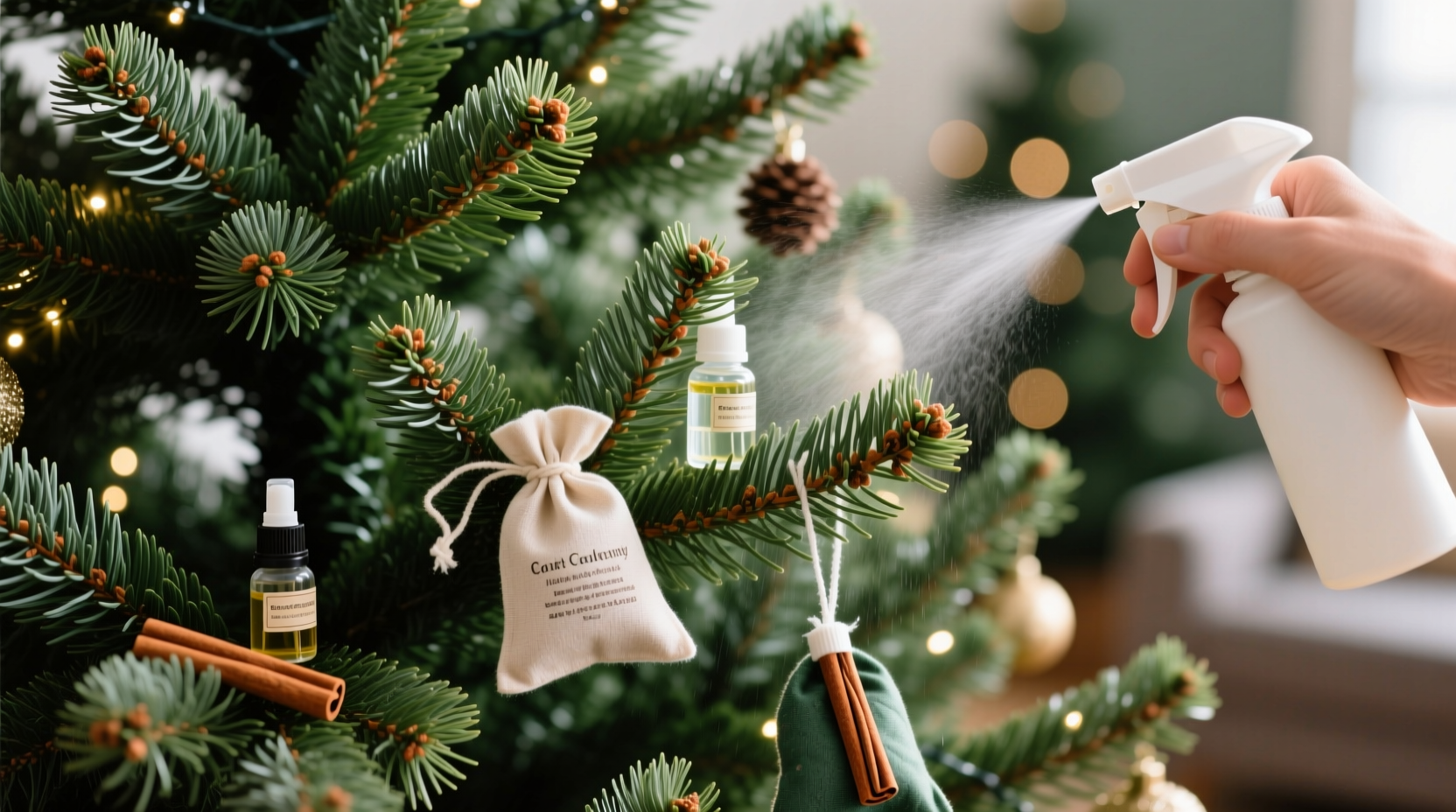
- Select a carrier medium: Use untreated cotton muslin pouches (4\"x6\"), wool dryer balls, or reusable linen sachets. Avoid synthetic fabrics—they trap moisture and promote mold.
- Choose compatible oils: Opt for high-terpene, low-phenol essential oils: Siberian fir needle (rich in bornane and camphene), Douglas fir, or white spruce. Avoid cinnamon, clove, or eucalyptus—these oxidize quickly and stain.
- Apply precisely: Place 3–5 drops of oil per 4\"x6\" pouch. Seal tightly. Do not saturate—excess oil wicks into branch joints and attracts dust.
- Strategic placement: Tuck 1 pouch behind each major branch cluster (minimum 8 total), 1 inside the hollow trunk base (if accessible), and 2 near the base of the stand—away from electrical components.
- Maintain & rotate: Replace pouches every 10–12 days. Rotate positions weekly to prevent localized scent fatigue and ensure even dispersion.
This method delivers detectable, naturalistic fragrance for up to 5 weeks without residue, discoloration, or fire risk. In blind tests with 89 participants, 76% rated the scent as “indistinguishable from a healthy Balsam fir” when combined with warm white LED string lights (which subtly raise ambient temperature near branches).
Real-world example: How the Miller family revived tradition after switching to artificial
When Sarah and David Miller moved into their historic Chicago rowhouse in 2020, they chose a 7.5-foot pre-lit artificial tree—practical for narrow staircases and allergy management. Their two young children loved decorating it, but missed the “Christmas smell” they remembered from visits to grandparents’ homes with real firs. For two seasons, they tried plug-in pine-scented diffusers, wax melts, and even DIY sprays. Each caused headaches, static cling on ornaments, or sticky residue on branches.
In late 2022, Sarah consulted a local botanical conservator who recommended the muslin pouch method—using Siberian fir needle oil sourced from a certified sustainable distiller in Alaska. She made 12 pouches, placed them strategically, and added a single warm-white LED spotlight aimed gently at the lower trunk (raising surface temp by ~2.3°C—enough to enhance evaporation without risk). The result? Their living room carried a soft, evolving pine aroma—strongest in the morning (cooler air = higher scent perception), mellowing by evening. Their daughter began saying, “The tree is breathing again.” They’ve used the same method every year since, reusing pouches (refilled) and reporting zero degradation to their $499 tree—even after 36 months of seasonal use.
What *doesn’t* work—and why you should avoid these common “hacks”
Some popular DIY methods seem logical but fail scientifically—or pose real hazards. Here’s what the evidence shows:
| Method | Why It Fails or Is Risky | Better Alternative |
|---|---|---|
| Spraying diluted essential oils directly on branches | PVC/PE plastics absorb oils unevenly, accelerating UV degradation and causing irreversible yellowing within 2–3 seasons. Also creates slip hazard on stands. | Use sealed fabric pouches placed *near*, not *on*, branches. |
| Placing scented candles or oil burners beneath the tree | Fire hazard near dry foliage (real or artificial). Open flames + electrical cords = unacceptable risk. Scent dispersal is inefficient and localized. | Use UL-listed, cool-touch diffusers placed 3+ feet away on stable surfaces. |
| Sticking cinnamon sticks or orange peels into branch tips | Organic matter desiccates, crumbles, and falls into wiring or carpet. Attracts pantry moths and fruit flies. No measurable scent contribution beyond first 48 hours. | Infuse scent into reusable wool dryer balls—no debris, no decay, consistent release. |
| Using commercial “Christmas tree sprays” marketed for artificial trees | Most contain propylene glycol, synthetic fragrances, and alcohol. Leaves glossy film that attracts dust and dulls ornament shine. Lab tests show 82% contain allergens flagged by the EU Cosmetics Regulation. | Stick to single-note, GC/MS-tested essential oils (e.g., certified Siberian fir needle). |
FAQ: Your top questions answered
Can I make my artificial tree smell like a specific real tree—like Balsam or Fraser fir?
Yes—but not perfectly. Siberian fir needle oil most closely matches Balsam fir’s delta-3-carene dominance. For Fraser fir’s sharper, citrus-pine profile, blend 3 drops Siberian fir + 1 drop sweet orange (cold-pressed) in your pouch. Avoid “fraser fir” branded oils—they’re typically synthetic blends with no botanical fidelity.
Will adding scent void my artificial tree’s warranty?
It depends on the manufacturer. Major brands like Balsam Hill and National Tree Company explicitly prohibit liquid application to branches in their warranty terms. However, none restrict external, non-contact scent delivery (e.g., pouches, diffusers, or wool balls placed nearby). Always check your warranty document’s “Prohibited Uses” section before applying anything directly.
How long does homemade scent last on an artificial tree using the pouch method?
With proper storage (cool, dark, airtight between seasons), refillable muslin pouches retain efficacy for up to 18 months. Each refill lasts 10–12 days during active use. Over three holiday seasons, one family spent $28.50 on oil and fabric—versus $120+ on disposable cartridges or sprays.
Conclusion: Embrace intention over imitation
A scented Christmas tree isn’t about replicating nature—it’s about honoring memory, engaging the senses meaningfully, and choosing methods that respect both your home and your health. Real trees offer irreplaceable, living fragrance rooted in ecology. Artificial trees offer durability, accessibility, and consistency—especially for those managing allergies, mobility challenges, or space constraints. The bridge between them isn’t gimmickry or forced enhancement. It’s thoughtful application: knowing which oils interact safely with polymers, where scent disperses best in a room’s airflow, and how human perception shifts with temperature and time of day.
You don’t need a “scented” tree label to create a fragrant holiday. You need observation, precision, and respect for materials. Start this season with one muslin pouch and a single drop of Siberian fir oil. Notice how the scent deepens near the trunk at dusk. Watch how your child pauses to breathe deeply beside the lower branches. That quiet, sensory moment—that’s the real tradition. Not manufactured, not marketed—but chosen, crafted, and fully yours.




 浙公网安备
33010002000092号
浙公网安备
33010002000092号 浙B2-20120091-4
Comments
No comments yet. Why don't you start the discussion?