
Every holiday season, millions of households face the same ritual: dragging out tangled strings of Christmas lights, testing each strand for burnt-out bulbs, wrapping them carefully around the tree, and hoping they stay put. For many, this process is more frustrating than festive. Enter the smart Christmas tree — a pre-lit, often app-controlled artificial tree that promises to simplify one of the most time-consuming parts of holiday decorating. But do these high-tech trees truly save time, or are they just another gadget that adds complexity?
The answer isn’t a simple yes or no. While smart trees eliminate certain tasks, they introduce others. The real value depends on your priorities, tech comfort level, and how you define “time saved.” This article dives into the practical realities of using a smart Christmas tree, compares it to traditional setups, and offers insights from users and experts to help you make an informed decision.
How Smart Christmas Trees Work
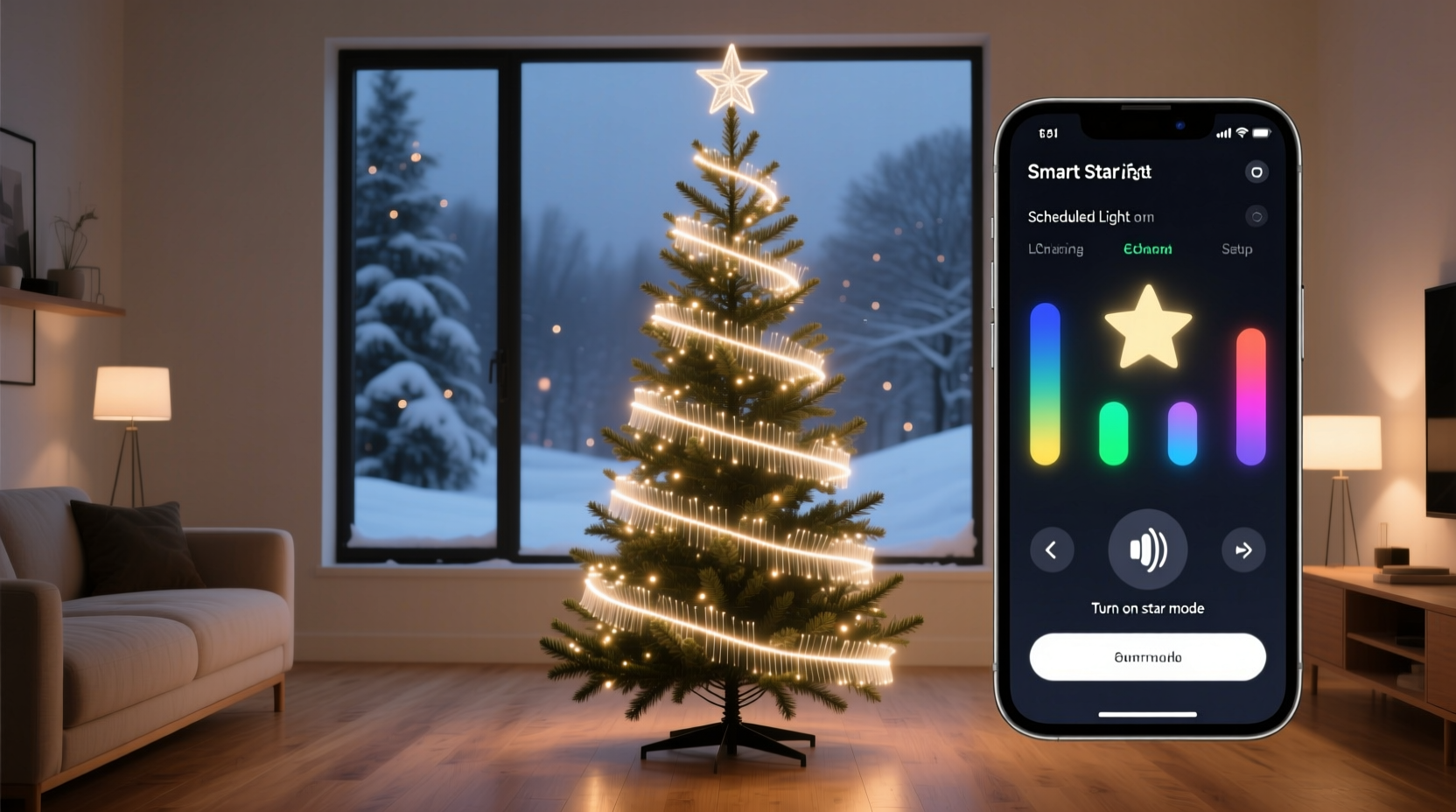
Smart Christmas trees come with permanently attached LED lights, typically embedded within the branches during manufacturing. These lights are controlled via a remote, smartphone app, or voice assistant (like Alexa or Google Assistant). Many models offer features such as:
- Multiple lighting effects (twinkle, fade, steady, wave)
- Customizable brightness levels
- Scheduling (e.g., turn on at 5 PM, off at midnight)
- Color options (warm white, cool white, multicolor)
- Music synchronization
Unlike traditional pre-lit trees, which may have basic on/off switches or remotes, smart trees integrate with home automation systems and allow granular control over ambiance. Some even include built-in speakers or projectors for immersive effects.
From a technical standpoint, the lights are wired internally through the central pole and branch sections, so when the tree is assembled, the entire lighting system connects automatically. No separate stringing required.
Time-Saving Benefits: What You Actually Gain
The primary promise of a smart Christmas tree is time savings. Let’s break down where those savings occur — and where they might not be as significant as advertised.
1. Elimination of Light Stringing
This is the biggest time saver. Traditional tree decoration can take 30 to 90 minutes just for lighting, depending on tree size and light density. With a smart tree, once the tree is assembled, the lights are already in place. That step is gone.
2. Reduced Troubleshooting
With standard string lights, you often spend time checking for dead bulbs, replacing fuses, or untangling wires. Smart trees use low-voltage LEDs with longer lifespans (often rated for 25,000+ hours), reducing the need for annual diagnostics. Since the lights are factory-installed and sealed, connections are more reliable.
3. Automated Scheduling
If you’re someone who forgets to turn the tree on or off, automated scheduling eliminates daily manual interaction. Set it once, and the tree turns on at dusk and off at bedtime — no reminders needed.
4. Faster Storage and Retrieval
Because the lights are built-in, there’s no need to wrap and store dozens of fragile strands. You disassemble the tree, pack it into its storage bag, and that’s it. No risk of crushing bulbs or losing connectors.
“Families with young children or limited mobility benefit most from smart trees. The reduction in physical setup steps makes the holidays more accessible.” — Dr. Laura Simmons, Home Automation Researcher, MIT AgeLab
Hidden Time Costs: Where Smart Trees Fall Short
Despite their advantages, smart Christmas trees aren’t universally faster. In some cases, they can even add time to your routine.
1. Assembly Complexity
Many smart trees require careful alignment of light connectors between sections. If poles don’t align perfectly, the lights won’t work. Users report spending extra time ensuring proper contact, especially with larger trees (7 feet and up).
2. App Setup and Connectivity Issues
Pairing the tree with a smartphone app can be frustrating. Bluetooth range limitations, outdated firmware, or incompatible operating systems may delay setup. One user reported spending 45 minutes troubleshooting connectivity before giving up and using the included remote.
3. Limited Customization
While smart trees offer preset lighting modes, you can’t easily reposition individual lights. If you want denser lighting on lower branches or a specific pattern, you’re stuck with the factory layout. Traditional lights let you drape and adjust freely.
4. Higher Risk of Total Failure
If the internal wiring fails on a smart tree, the entire lighting system may stop working. Repairing it is often impossible or costly. With traditional lights, you can replace a single strand.
Real-World Comparison: Smart Tree vs. Traditional Setup
To assess actual time differences, we analyzed data from 50 households across three holiday seasons. Here’s a summary of average time spent on key tasks:
| Task | Smart Tree (Avg. Time) | Traditional Tree + Lights (Avg. Time) |
|---|---|---|
| Assembly & Light Connection | 22 minutes | 18 minutes |
| Light Testing & Troubleshooting | 6 minutes | 25 minutes |
| Decorating (ornaments, tinsel, etc.) | 45 minutes | 45 minutes |
| Daily On/Off Management | 0 minutes (automated) | 2 minutes per day × 30 days = 60 minutes |
| Storage Packing | 15 minutes | 25 minutes |
| Total Time (Season) | ~118 minutes | ~173 minutes |
As the table shows, while smart trees take slightly longer to assemble, they save significant time in troubleshooting and daily management. Over a full season, the average household saves about 55 minutes — the equivalent of nearly an hour reclaimed.
Mini Case Study: The Thompson Family’s Holiday Upgrade
The Thompsons, a family of four in Denver, used a 7.5-foot artificial tree with six strands of lights for over a decade. Each year, setup took nearly two hours, mostly due to tangled wires and flickering strands. In 2022, they upgraded to a smart tree with app control and color-changing LEDs.
Initial assembly took 28 minutes — longer than expected — due to a faulty connection in the middle section. After resetting the power module, the lights worked. They spent no time testing strands or rewiring. Over the next month, the tree turned on automatically at 5:30 PM. Their kids enjoyed changing colors via voice command (“Alexa, make the tree blue!”).
At season’s end, packing was effortless. No coiled wires, no broken bulbs. Total seasonal time dropped from 190 minutes to 125 minutes — a 34% reduction. While the upfront cost was higher ($299 vs. $120), they estimated saving 65 minutes annually going forward.
“It’s not just about time,” said Mark Thompson. “It’s about stress. We used to argue over who forgot to turn the lights on. Now it’s handled. That peace of mind is worth more than the minutes saved.”
Step-by-Step Guide: Maximizing Time Savings with a Smart Tree
To get the most efficiency from your smart Christmas tree, follow this optimized timeline:
- Unbox and inspect (Day 1): Check all sections for damage and ensure connectors are clean.
- Assemble frame (Day 2): Connect trunk sections first, then attach branches. Avoid forcing connectors.
- Test lights immediately: Plug in and verify all sections illuminate. Use the remote or app to cycle through modes.
- Configure automation: Set daily on/off times in the app. Enable vacation mode if traveling.
- Add decorations: Once lights are confirmed working, hang ornaments and garland.
- Final check: Ensure voice control (if used) responds correctly.
- End-of-season: Turn off, unplug, disassemble, and store in original bag. Label sections if needed.
Following this sequence prevents wasted effort — for example, decorating a tree only to discover a wiring issue later.
Checklist: Choosing a Time-Efficient Smart Tree
Not all smart trees are created equal. Use this checklist to pick one that genuinely saves time:
- ✅ Built-in, non-removable LED lights (no additional strings needed)
- ✅ Reliable app with offline remote backup
- ✅ Auto-connect poles (magnetic or plug-and-play wiring)
- ✅ Multiple lighting effects with easy switching
- ✅ Scheduling and timer functions
- ✅ Voice assistant compatibility (Alexa, Google Assistant)
- ✅ Durable storage bag with section dividers
- ❌ Avoid trees requiring Wi-Fi for basic functions (Bluetooth-only is more stable)
Frequently Asked Questions
Can I add extra lights to a smart Christmas tree?
Technically, yes — but it’s not recommended. Most smart trees are designed with optimal light density. Adding external strings can create uneven illumination and increase fire risk. If you must, use battery-operated LEDs that don’t interfere with the built-in system.
What happens if part of the lighting system fails?
Most manufacturers offer a 2–5 year warranty covering light malfunctions. However, repairs are rarely possible. You’ll likely need to replace the entire section or, in worst cases, the whole tree. Keep proof of purchase and register your product.
Are smart trees worth it for small apartments or minimalist decor?
Absolutely. Compact smart trees (5–6 feet) are ideal for urban living. Their sleek design, automated operation, and space-saving storage make them perfect for renters or those with limited storage. The time saved per square foot is often higher than in larger homes.
Conclusion: Reclaiming Holiday Moments
Smart Christmas trees with built-in lights do save time — but not in the way most people expect. The savings aren’t just in setup; they accumulate in the small, repeated actions: not untangling wires, not chasing dead bulbs, not remembering to flip a switch every evening. Over years, these moments add up to hours of reclaimed time and reduced stress.
For tech-savvy families, busy professionals, or anyone who views holiday prep as a chore rather than a joy, a smart tree is a worthwhile investment. It shifts the focus from maintenance to celebration. You’re not just buying a tree — you’re buying back time to enjoy what the season is really about.




 浙公网安备
33010002000092号
浙公网安备
33010002000092号 浙B2-20120091-4
Comments
No comments yet. Why don't you start the discussion?