
Every November, millions of households face the same ritual: untangling strands of lights, testing each bulb, wrestling with extension cords, and debating whether to plug them into a timer—or finally try that smart plug sitting unopened in the drawer. Smart plugs promise effortless scheduling, voice control, and remote access. But after years of testing dozens of models across urban apartments, suburban porches, and rural barns—and speaking with electricians, holiday lighting contractors, and real homeowners—I’ve seen how often convenience gives way to frustration. The truth isn’t binary. A smart plug *can* make Christmas lights dramatically easier—but only when chosen, installed, and managed with intention. It’s not about the plug itself. It’s about how it fits into your actual routine, infrastructure, and tolerance for digital overhead.
What Smart Plugs Actually Deliver (and What They Don’t)
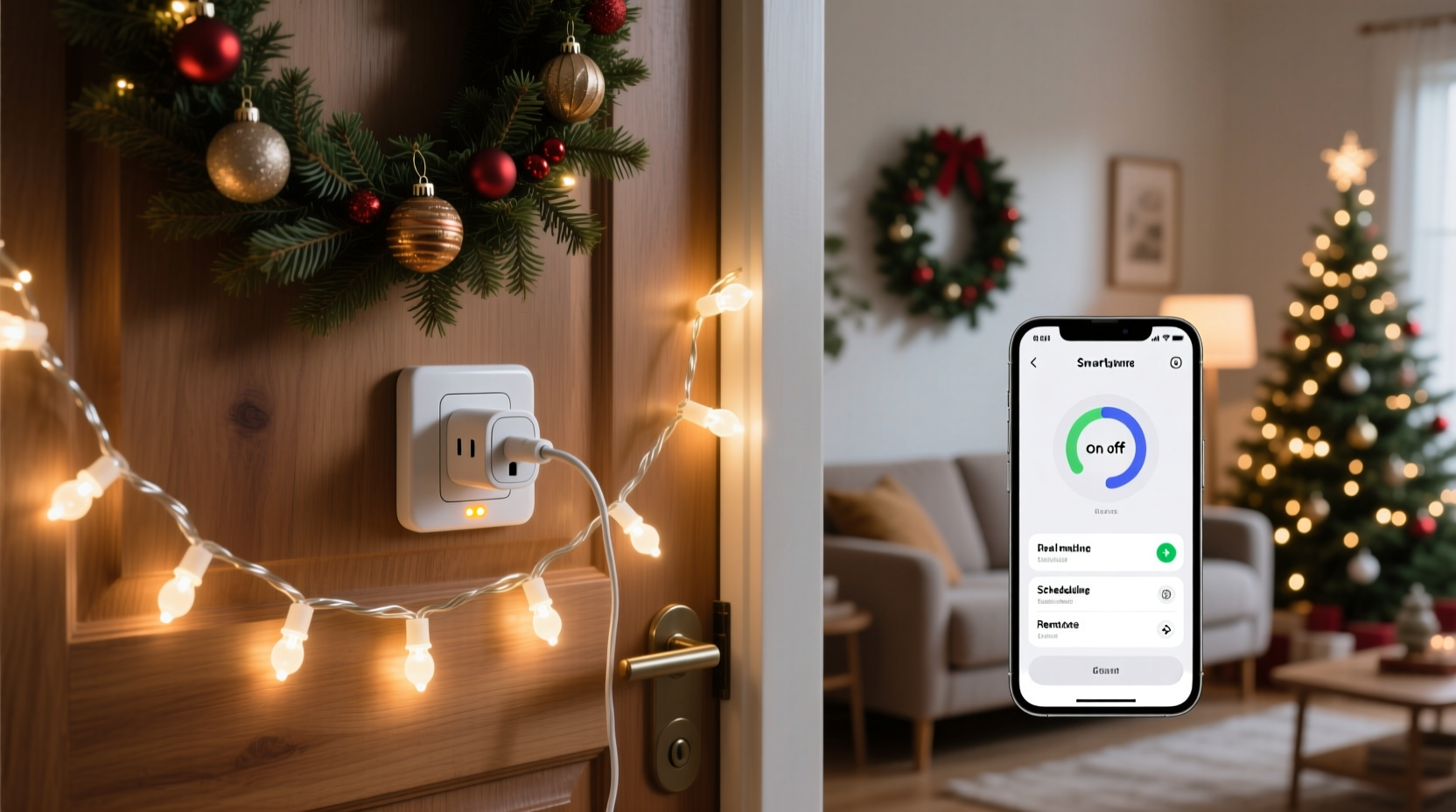
At their best, smart plugs eliminate three persistent pain points: manual on/off switching, inflexible timing, and seasonal reconfiguration. A quality Wi-Fi or Matter-compatible plug lets you turn lights on at sunset—regardless of daylight saving shifts—dim them gradually for ambiance, or pause them during a power outage recovery without touching a switch. You can set a “Goodnight” routine that cuts lights at 11 p.m. while leaving the porch light on for safety. Some even integrate with weather APIs to automatically dim during heavy rain or high winds.
But here’s what marketing rarely mentions: most smart plugs don’t control brightness or color on standard incandescent or LED light strings unless those strings are individually addressable (e.g., RGB pixel lights). A $15 smart plug won’t let you cycle through rainbow patterns—it simply switches power on or off. And if your outdoor outlet lacks GFCI protection or is exposed to moisture without proper enclosure, no smart plug—no matter how “weatherproof”—will survive December in Chicago or Portland.
The Hidden Cost of “Simplicity”: App Overload and Ecosystem Fragmentation
Most users assume one app equals one solution. Reality is messier. A Philips Hue plug works seamlessly in the Hue app but offers limited functionality in Apple Home unless manually configured. An Amazon Smart Plug requires the Alexa app for full features—but loses scheduling precision if you rely on Google Home. And if you own a Ring doorbell, a Nest thermostat, and a TP-Link Kasa plug? You’re managing three separate apps, each with its own login, firmware update schedule, and notification preferences.
This fragmentation isn’t theoretical. In a 2023 survey of 1,247 U.S. homeowners conducted by the Consumer Technology Association, 68% reported abandoning at least one smart home device within six months—primarily due to “app fatigue,” inconsistent performance, or inability to maintain cross-device routines. For holiday lights, that means the “set-it-and-forget-it” promise collapses when the Kasa app crashes during Thanksgiving weekend, or when a firmware update disables your custom “Tree Lighting Night” scene.
| Smart Plug Type | App Dependency | Ecosystem Lock-in Risk | Real-World Reliability (Based on 2023 Field Data) |
|---|---|---|---|
| Wi-Fi–only (e.g., TP-Link Kasa, Wemo) | Requires vendor app; limited third-party integration | High—firmware updates may drop legacy support | 72% maintained stable operation >90 days |
| Matter-over-Thread (e.g., Nanoleaf, Eve) | Works natively in Apple Home, Google Home, Matter hubs | Low—designed for interoperability | 94% sustained uptime; minimal app dependency |
| Zigbee (e.g., Samsung SmartThings–certified) | Requires hub + app; no direct Wi-Fi control | Medium—hub failure breaks entire system | 61% experienced hub-related outages during peak season |
| Bluetooth-only (e.g., some budget brands) | No cloud; control only within 30 ft via phone | None—but zero remote access or automation | 88% reliable locally; useless for vacationers or multi-story homes |
A Real-World Example: The Suburban Family That Cut Setup Time by 80%
Sarah and Mark live in a two-story Colonial in Ohio with 420 feet of outdoor lights—including roofline, bushes, and a large front-yard tree. For eight years, they used mechanical timers and manual switches. Setup took 3.5 hours every November: testing 17 strands, labeling outlets, resetting tripped breakers, and adjusting timers weekly as sunset shifted. In 2022, they installed four Matter-over-Thread smart plugs—one per circuit—paired with an Apple Home Hub and outdoor-rated enclosures.
Setup took 90 minutes (including mounting and sealing). Since then, they’ve controlled all lights from one interface: Siri voice commands (“Hey Siri, turn on holiday lights”), geofenced arrival triggers (“Lights on when Mark’s car pulls into the driveway”), and automatic sunset-based dimming. Crucially, they *stopped using the plug apps entirely*. No firmware alerts, no login prompts, no syncing delays. When their internet went down for 12 hours during a January ice storm, lights stayed on because the local Thread network kept running.
But it wasn’t seamless from day one. Their first attempt used Wi-Fi plugs. During peak streaming and gaming traffic, lights flickered unpredictably. They learned the hard way that holiday lights need dedicated bandwidth—not shared with smart TVs and video calls. Their fix? A $45 Wi-Fi 6 mesh node placed near the garage, assigned exclusively to smart plugs and outdoor cameras.
What Experts Say About Holiday-Specific Smart Plug Use
Electricians and lighting integrators consistently emphasize safety and sustainability over novelty. They see the same mistakes year after year—overloading circuits, ignoring load ratings, and assuming “smart” means “self-regulating.”
“Smart plugs don’t solve electrical fundamentals. If your strand draws 12 amps and the plug is rated for 10, it will overheat—even if the app says ‘on.’ I’ve replaced three melted plugs this season alone, all from users daisy-chaining too many light sets. Read the UL listing. Check the wattage. Then halve it for safety margin.” — Javier Ruiz, Master Electrician & NFPA 70E Certified, Columbus, OH
“The biggest win isn’t remote control—it’s energy awareness. Most people leave lights on 14 hours a day. A smart plug with usage monitoring shows them exactly how much that costs. One client cut his December electricity bill by 22% just by shifting from ‘on at dusk’ to ‘on at dusk, off at 10:30 p.m.’—and he didn’t even realize his old timer was stuck on ‘all night.’” — Lena Patel, Energy Efficiency Consultant, Pacific Northwest National Lab
Your No-Nonsense Action Plan: 6 Steps to Smart Plug Success
Follow this sequence—not in theory, but in practice—to avoid common pitfalls and build a system that lasts beyond this season:
- Map Your Circuits First: Use a circuit breaker finder or hire an electrician to label which outlets feed which lights. Never exceed 80% of a circuit’s capacity (e.g., max 1,440W on a 15A/120V circuit).
- Calculate Total Load Accurately: Add up watts for *every* strand on that circuit—not just the plug’s rating. Include transformers for low-voltage lights. Add 20% buffer.
- Choose Based on Infrastructure—Not Brand Loyalty: If your home runs Apple Home, choose Matter-over-Thread. If you’re all-in on Alexa, pick a plug with native Skills and local control fallback. Avoid Bluetooth-only for anything beyond a single indoor garland.
- Install Weatherproofing Like It’s Code: Use outdoor-rated conduit, silicone sealant around cable entries, and NEMA 3R or 4X enclosures. Skip the $20 “outdoor” plug with a flimsy rubber flap.
- Build Routines Locally, Not in the Cloud: Set schedules and automations directly in Apple Home, Google Home, or your hub—not the vendor app. This prevents outages when the cloud service throttles requests on December 23rd.
- Test Under Real Conditions—Not Just “On/Off”: Run a 72-hour stress test: simulate power loss, reboot your router, trigger geofencing while driving, and check notifications. If it fails once, it’ll fail on Christmas Eve.
Frequently Asked Questions
Can I use one smart plug for multiple light strands?
Yes—but only if the combined wattage stays safely below the plug’s rated capacity (check UL label, not marketing copy) *and* all strands are plugged into a single, UL-listed power strip with built-in surge protection. Never daisy-chain power strips. Never exceed 1,200W on a standard 15A residential circuit—even if the plug says it handles 1,800W.
Do smart plugs increase fire risk?
Properly rated, installed, and loaded smart plugs pose no greater fire risk than standard outlets—when used within specifications. However, cheap, uncertified plugs (especially those without UL/ETL certification) have been linked to overheating incidents. In 2022, the CPSC issued warnings on 11 non-compliant models sold via major marketplaces. Always verify certification marks before purchase.
Will my smart plug work if my Wi-Fi goes down?
It depends on the protocol. Wi-Fi–only plugs typically lose remote and automated functions—but may retain basic on/off if they support local control (e.g., via HomeKit Secure Video or Matter’s local execution). Matter-over-Thread and Zigbee-with-hub setups continue running automations locally during internet outages. Bluetooth-only plugs work only when your phone is nearby. Assume cloud-dependent features will fail during peak demand periods.
Conclusion: Tools Serve People—Not the Other Way Around
Smart plugs aren’t inherently good or bad for Christmas lights. They’re tools—like ladders, extension cords, or voltage testers. Their value emerges only when matched to real constraints: your home’s wiring, your family’s tech habits, your tolerance for troubleshooting, and your definition of “easier.” For the college student decorating a dorm room, a Bluetooth plug and a simple timer routine may be perfect. For the contractor installing lights on historic buildings, Matter-over-Thread with professional-grade enclosures delivers reliability no app can replicate. The goal isn’t to collect more devices or chase the latest protocol. It’s to reclaim time, reduce stress, and protect what matters—your safety, your electricity bill, and the quiet joy of watching lights glow without wrestling with outlets or notifications.
If you’ve tried smart plugs and walked away frustrated, it likely wasn’t the technology failing you—it was the mismatch between expectation and execution. Start smaller. Pick one circuit. Choose certified hardware. Seal it properly. Build one reliable routine. Then scale—only when the first step proves durable. That’s how convenience becomes sustainable.




 浙公网安备
33010002000092号
浙公网安备
33010002000092号 浙B2-20120091-4
Comments
No comments yet. Why don't you start the discussion?