
For millions of students, remote workers, and creatives, the soft crackle of vinyl, mellow piano loops, and distant jazz samples have become the unofficial soundtrack to productivity. Lofi hip-hop, with its low-fidelity textures and repetitive instrumental beats, has exploded in popularity over the past decade, particularly through 24/7 YouTube streams and curated Spotify playlists labeled “Study Beats” or “Focus Flow.” But beyond aesthetic appeal and internet culture, a growing number of people are asking: does listening to lofi music actually boost concentration?
The answer isn’t a simple yes or no. While many report improved focus when using lofi as background audio, the real impact depends on individual neurology, task type, and the specific qualities of the music. To understand whether lofi truly enhances concentration, we need to examine the psychology of attention, the neuroscience of auditory processing, and the subtle design elements that make this genre uniquely suited—or occasionally unsuited—for deep work.
The Cognitive Science of Background Music and Focus
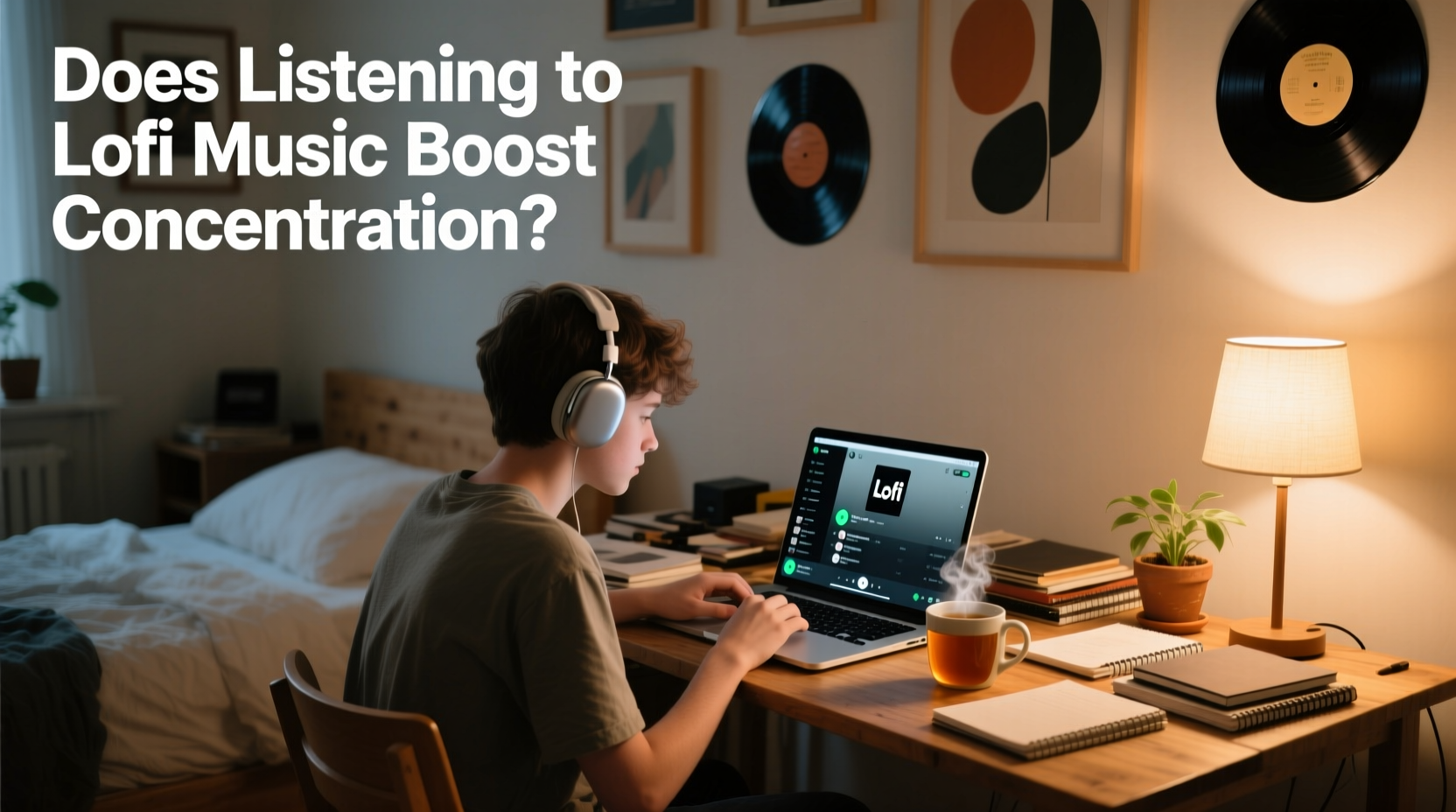
Human attention operates within a limited cognitive bandwidth. The brain constantly filters sensory input, prioritizing relevant stimuli while suppressing distractions. When attempting focused tasks—especially those involving language, memory, or problem-solving—the presence of certain sounds can either support or disrupt this filtering process.
Music influences cognition through several mechanisms:
- Mood modulation: Pleasant music can reduce stress and elevate mood, indirectly supporting sustained attention.
- Arousal regulation: Tempo and rhythm affect alertness; too fast may cause distraction, too slow may induce drowsiness.
- Attentional capture: Sudden changes in volume, lyrics, or melody can pull focus away from primary tasks.
Lofi music often avoids high-arousal elements. Its tempos typically range between 70–90 BPM—close to resting heart rate—which promotes calm alertness without overstimulation. More importantly, most lofi tracks are instrumental, eliminating lyrical content that competes for verbal processing resources in the brain.
“Background music with lyrics engages the same neural pathways used for reading and writing, creating interference. Instrumental music, especially with predictable patterns, is less likely to hijack attention.” — Dr. Elena Torres, Cognitive Psychologist at University of Toronto
Why Lofi Works (And When It Doesn’t)
Lofi hip-hop wasn’t designed as a productivity tool—it evolved from underground beat-making culture. Yet its characteristics align surprisingly well with principles from environmental psychology and cognitive ergonomics. Key features include:
- Repetitive chord progressions that establish predictability
- Minimal dynamic variation (no sudden drops or builds)
- Lo-fi textures like tape hiss or record static that mask distracting ambient noise
- Absence of vocals or prominent melodic hooks
This combination creates what researchers call an “acoustic buffer”—a consistent sonic backdrop that occupies just enough auditory space to prevent jarring interruptions from external sounds (like traffic, chatter, or household noise) without demanding active listening.
However, effectiveness varies by task type. A 2022 study published in *Applied Cognitive Psychology* found that participants performed better on reading comprehension and logical reasoning tasks in silence compared to any form of background music—even instrumental. The researchers concluded that “any auditory input, regardless of complexity, introduces a baseline level of cognitive load.”
In contrast, during mechanical or imaginative work—such as sketching, coding, data entry, or brainstorming—lofi listeners reported higher levels of flow and fewer distractions than those working in silence or with ambient noise.
Comparing Soundscapes for Concentration
Not all background audio is created equal. Below is a comparison of common auditory environments and their typical effects on concentration.
| Soundscape | Pros | Cons | Best For |
|---|---|---|---|
| Lofi Music | Calming, masks noise, supports mood | Potential distraction if too rhythmic or evolving | Creative work, light cognitive tasks |
| Nature Sounds | Reduces stress, non-intrusive | Bird calls or waterfalls may draw attention | Relaxation, meditation, low-focus tasks |
| White Noise | Effective sound masking, neutral frequency | Can feel monotonous or fatiguing over time | Noisy environments, sleep, infants |
| Silence | Zero auditory competition | Amplifies small disturbances (e.g., typing, creaks) | Deep reading, learning, analytical thinking |
| Classical Music | Can enhance mood and arousal | Dramatic shifts in dynamics may distract | Writing, moderate-focus tasks |
The table illustrates that lofi occupies a middle ground—more engaging than white noise, less disruptive than lyrical pop. Its strength lies not in boosting raw cognitive power, but in creating a psychologically safe auditory environment where focus can emerge more naturally.
Designing Your Optimal Focus Playlist
If you’re considering incorporating lofi into your workflow, a strategic approach yields better results than simply playing a random stream. Follow these steps to tailor your listening experience:
- Assess your task type: Is it analytical (e.g., math, proofreading), creative (e.g., writing, designing), or procedural (e.g., organizing files)? Reserve lofi for non-verbal, lower-stakes activities.
- Select tracks with minimal variation: Look for songs without dramatic tempo changes, vocal samples, or complex transitions. Artists like Nujabes, J Dilla, or independent producers on Bandcamp often craft beats ideal for focus.
- Control volume: Keep the music at a low-to-moderate level—just loud enough to hear, but not so loud it becomes the center of attention.
- Use timed sessions: Pair lofi with techniques like the Pomodoro method (25 minutes work, 5 minutes rest). After each session, evaluate whether the music helped or hindered.
- Monitor mental fatigue: If you notice increased tiredness or zoning out, switch to silence or nature sounds. Over-reliance on background audio can reduce your tolerance for quiet.
Checklist: Optimizing Lofi for Productivity
- ✅ Choose instrumental-only tracks
- ✅ Avoid songs with sudden beats or vocal snippets
- ✅ Limit playlist length to avoid decision fatigue
- ✅ Use noise-canceling headphones in noisy spaces
- ✅ Take regular breaks without music to reset auditory sensitivity
- ✅ Test performance with and without music weekly
Real-World Example: A Student’s Experience
Maya, a third-year university student majoring in computer science, struggled with maintaining focus during late-night coding sessions. Her apartment was near a busy intersection, and even with closed windows, sirens and conversations disrupted her flow. She experimented with various backgrounds: pop music (too distracting), complete silence (made small noises unbearable), and finally, a lofi study stream on YouTube.
After two weeks of tracking her productivity using time logs and self-ratings, she found she completed bug-fixing tasks 18% faster with lofi than in silence. More importantly, she reported feeling “less mentally drained” after three-hour sessions. However, when preparing for exams requiring memorization of technical terms, she switched to silence and saw better retention.
Her takeaway: lofi wasn’t a universal solution, but a situational tool. “It’s like wearing noise-canceling glasses,” she said. “You don’t need them all the time, but when the world gets too sharp, they help soften the edges.”
Expert Insights on Auditory Environment Design
Dr. Arun Patel, a neuroscientist specializing in music cognition, emphasizes that context determines efficacy. “We often treat music as a binary—helpful or harmful—but it’s more accurate to think in gradients. Lofi works because it reduces the cognitive cost of environmental unpredictability. It’s not enhancing focus per se; it’s reducing the effort needed to maintain it.”
He warns against overgeneralizing: “Just because millions listen to lofi while studying doesn’t mean it’s optimal. We’re seeing a cultural trend mistaken for a scientific consensus. The brain thrives on variety. Relying on one type of stimulation long-term can diminish adaptability.”
“The best auditory environment is one you can control and vary intentionally—not one you passively consume for hours.” — Dr. Arun Patel, Neuroscientist, Max Planck Institute for Human Cognitive Sciences
Frequently Asked Questions
Can lofi music improve memory retention?
Generally, no. Research consistently shows that silence or very low-level ambient noise (like white noise) supports better encoding of new information. Lofi may help with mood and stamina during long study sessions, but it does not enhance memorization. For learning vocabulary, formulas, or concepts, silence remains superior.
Is lofi better than classical music for concentration?
It depends on the individual and the piece. Baroque music (e.g., Bach, Vivaldi) with steady tempo and structure—sometimes called the “Mozart Effect”—can support focus similarly to lofi. However, classical compositions often feature dynamic shifts and emotional crescendos that may interrupt concentration. Lofi’s predictability gives it an edge for extended periods of repetitive work.
How long should I listen to lofi music while working?
Limit continuous listening to 60–90 minutes before taking a break without music. Prolonged exposure to any auditory stimulus can lead to sensory adaptation or fatigue. Use music strategically during peak distraction times (e.g., mid-afternoon slump), then transition to quieter modes for deeper analysis.
Final Thoughts: Using Lofi Wisely
Lofi music doesn’t magically unlock superhuman focus. What it offers is a culturally accessible, emotionally soothing way to manage modern distractions. Its value lies not in boosting brainpower, but in smoothing the rough edges of our chaotic environments. For many, it acts as a psychological cue—a signal to the mind that it’s time to settle into work.
But like any tool, its effectiveness depends on mindful application. Used indiscriminately, lofi can become another form of procrastination disguised as productivity. Played during tasks that demand linguistic precision or deep analytical thought, it may subtly undermine performance. The key is intentionality: choosing when to use it, when to pause it, and when to let silence speak.




 浙公网安备
33010002000092号
浙公网安备
33010002000092号 浙B2-20120091-4
Comments
No comments yet. Why don't you start the discussion?