
Leaving lights on when not in use is a common household habit, often dismissed as a minor expense. But over time, unnecessary lighting can contribute significantly to energy bills and carbon emissions. One frequently recommended solution is the use of timers—mechanical or digital devices that automatically turn lights on and off at set times. But does this simple switch really deliver measurable electricity savings? The answer isn’t just “yes” or “no.” It depends on usage patterns, fixture types, and how strategically the timers are implemented.
This article examines the real impact of light timers on energy consumption, backed by data, practical examples, and expert insights. Whether you're looking to cut costs, reduce environmental impact, or enhance home security, understanding the measurable effects of timers is essential.
How Light Timers Work and Where They’re Used
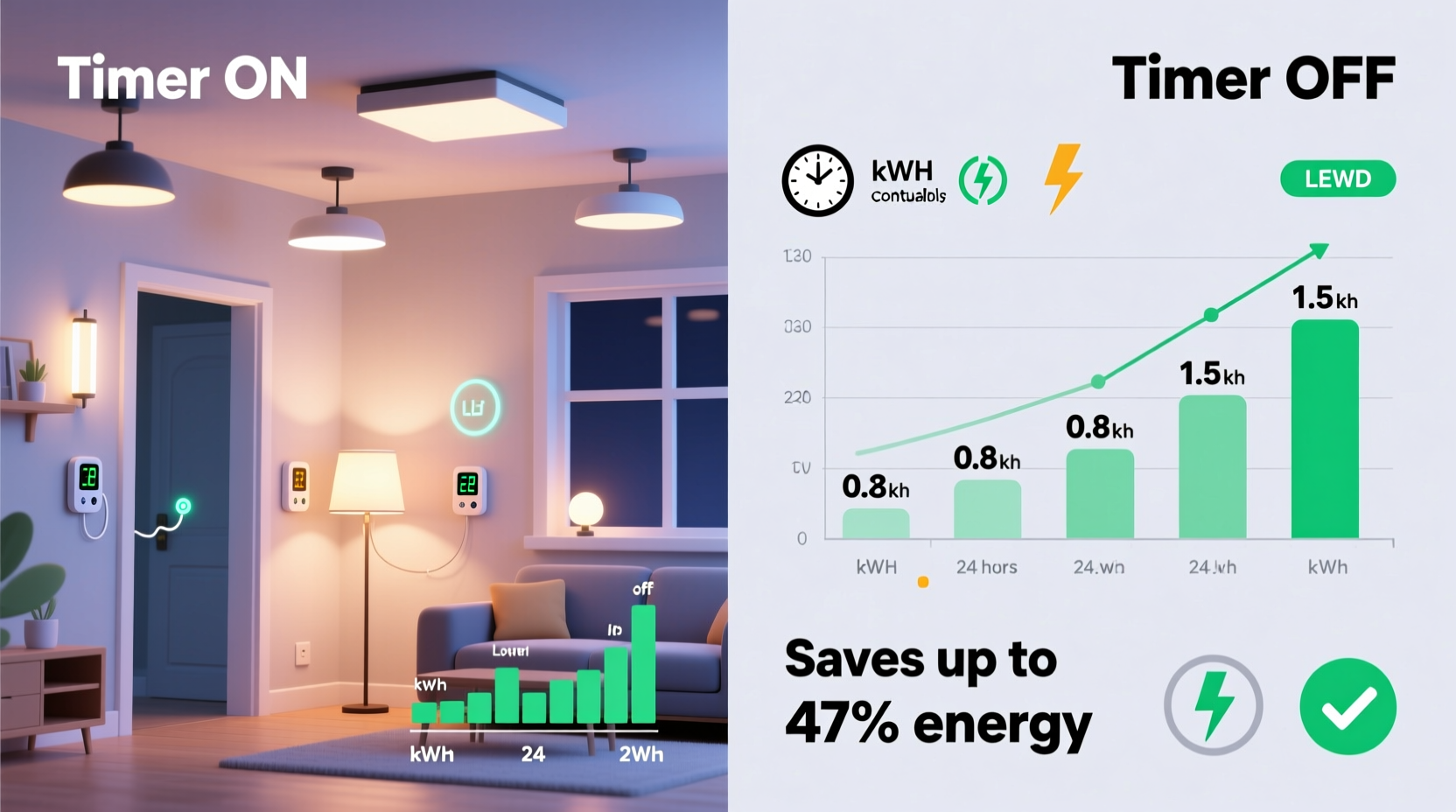
Light timers are control devices that automate when a light turns on or off based on a preset schedule. They come in several forms:
- Mechanical rotary timers: Analog dials with movable pins to set intervals; commonly used for outdoor holiday lighting.
- Digital plug-in timers: Programmable units that plug into standard outlets, ideal for lamps or string lights.
- In-wall timer switches: Hardwired replacements for traditional light switches, offering precise scheduling.
- Smart timers (Wi-Fi/Zigbee): Connected devices controllable via smartphone apps, often integrated with smart home systems.
Timers are most often deployed in areas where occupancy is predictable or intermittent: porches, garages, hallways, bathrooms, and outdoor landscaping. Their primary goals include convenience, security, and—importantly—energy efficiency.
Measuring the Real Electricity Savings
To assess whether timers save measurable electricity, we must consider two key factors: baseline usage without a timer and the reduction achieved through automation.
Consider a typical household scenario: a 60-watt equivalent LED porch light (actual draw: 9 watts) left on from 6 PM to 6 AM every night—that’s 12 hours. Without a timer, it consumes:
9 watts × 12 hours = 108 watt-hours per day, or about 39 kWh annually.
Now, install a timer that limits operation to 6 PM to 11 PM. Usage drops to:
9 watts × 5 hours = 45 watt-hours per day, or 16.4 kWh annually.
The difference? A reduction of **22.6 kWh per year**. At an average U.S. electricity rate of $0.15/kWh, that’s **$3.39 saved annually per fixture**.
While this may seem modest, multiply it across multiple fixtures—a garage light, bathroom exhaust fan light, hallway lamp, and outdoor path lights—and the savings become meaningful. Ten such lights, each saving 20 kWh/year, cut 200 kWh from annual consumption—worth **$30 or more**.
“Even small reductions add up when applied consistently across a home. Timers eliminate human error—the tendency to forget to turn lights off—which is responsible for up to 10% of residential lighting waste.” — Dr. Lena Patel, Energy Efficiency Researcher, National Institute of Building Sciences
When Timers Deliver Maximum Impact
Not all lighting scenarios benefit equally from timers. The greatest measurable savings occur under specific conditions:
- High-wattage or long-duration use: Halogen floodlights, old incandescent bulbs, or lights in frequently unoccupied spaces (e.g., basements, attics).
- Predictable but inconsistent human behavior: Teens leaving bathroom lights on, guests forgetting to switch off guest room lights.
- Outdoor lighting: Pathway, security, or decorative lights that don’t need to run all night.
- Vacation homes or rentals: Where occupancy is irregular and manual control is impossible.
A study by the Lawrence Berkeley National Laboratory found that automated controls—including timers—reduced lighting energy use in residential settings by **12–27%**, depending on household size and habits. The largest gains were seen in homes with children and multi-generational living, where coordination of light use is more challenging.
Case Study: The Johnson Family Home
The Johnsons, a family of five in suburban Ohio, struggled with high electricity bills despite switching to LED bulbs. An energy audit revealed their biggest source of avoidable usage was exterior and hallway lighting left on overnight.
They installed digital plug-in timers on four outdoor fixtures and replaced two bathroom switches with programmable in-wall timers. Each outdoor light was limited to 6 PM–11 PM; bathroom lights turned off automatically after 11:30 PM.
Results after three months:
- Exterior lighting energy use dropped by 58%.
- Bathroom lighting decreased by 41%.
- Overall household lighting consumption fell by 18%, saving approximately $22/month.
The initial investment—$75 in timers and installation—paid for itself in under four months. The family also reported improved sleep hygiene due to reduced nighttime light pollution indoors.
Limitations and Common Mistakes
Timers aren't a universal fix. Poor implementation can negate benefits or even increase consumption. Common pitfalls include:
- Over-scheduling: Setting lights to turn on too early or stay on too late “just in case.”
- Ignoring natural light: Not adjusting seasonal schedules, leading to daytime operation.
- Using timers with incompatible bulbs: Some older CFLs degrade faster with frequent cycling.
- Replacing smarter tech: Using a basic timer instead of motion sensors or daylight harvesting systems where appropriate.
For example, a motion sensor might be more efficient than a timer in a rarely used storage closet. Similarly, photocell-controlled lights adjust dynamically to sunset times, eliminating the need for seasonal timer recalibration.
Do’s and Don’ts of Timer Use for Energy Savings
| Action | Recommendation |
|---|---|
| Do: Use timers on outdoor lights needed only during early evening | Saves 50–70% compared to all-night operation |
| Don’t: Set indoor lights to run from dusk to dawn unnecessarily | Increases usage; consider occupancy sensors instead |
| Do: Pair timers with LED bulbs | Maximizes savings due to low wattage and durability |
| Don’t: Use mechanical timers in damp locations | Risk of short circuits; opt for weatherproof digital models |
| Do: Review and adjust timer settings seasonally | Prevents daytime operation as daylight hours shift |
Step-by-Step Guide to Optimizing Light Timers for Energy Savings
Follow this process to ensure your timers deliver measurable reductions in electricity use:
- Conduct a lighting audit: Walk through your home and note which lights are frequently left on, especially in unoccupied areas.
- Identify candidates for timing: Focus on outdoor lights, hallways, bathrooms, and utility rooms with predictable but inconsistent use.
- Calculate current usage: Note bulb wattage and estimate daily runtime. Multiply to get daily kWh.
- Set realistic timer schedules: Determine the minimum necessary on-time (e.g., 6 PM–10 PM instead of 5 PM–7 AM).
- Install appropriate timers: Choose plug-in models for lamps, in-wall units for hardwired fixtures, and weather-rated versions outdoors.
- Monitor and adjust: After one month, compare energy bills or use a plug-in power meter to verify reductions.
- Scale up: Apply successful strategies to additional fixtures or integrate with smart home systems for adaptive scheduling.
Comparing Timers to Other Lighting Controls
Timers are just one tool in the energy-saving toolkit. How do they stack up against alternatives?
| Control Type | Energy Savings Potential | Best For | Limits |
|---|---|---|---|
| Basic Timer | 15–30% | Predictable schedules (e.g., evening outdoor lighting) | Inflexible; requires manual updates |
| Motion Sensor | 30–50% | Intermittent-use areas (closets, garages, bathrooms) | May not trigger for slow movement |
| Photocell (Dusk-to-Dawn) | 20–40% | Security lighting needing full-night operation | Runs entire night; no partial scheduling |
| Smart Lighting (App/Schedule) | 25–60% | Homes with variable routines or remote access needs | Higher upfront cost; requires Wi-Fi |
For maximum savings, combine technologies. Use timers for routine evening lighting, motion sensors for internal utility areas, and photocells for safety-critical perimeter lighting.
Frequently Asked Questions
Can timers increase my electricity bill?
Yes—if misconfigured. A timer that turns lights on during daylight hours or runs them longer than needed will consume more energy than manual use. Always validate schedules and monitor usage after installation.
Are timers worth it with LED lights?
Yes, especially when managing multiple fixtures or addressing habitual overuse. While individual LED savings are small, cumulative reductions across a home can exceed $20–$50 annually. Plus, automation reduces wear from frequent manual switching.
Do smart timers save more than basic ones?
Often, yes. Smart timers can adapt to changing daylight, occupancy patterns, and user behavior via learning algorithms or geofencing. They also provide usage reports, enabling fine-tuning for maximum efficiency.
Conclusion: Small Changes, Measurable Results
Using timers for lights does save measurable electricity—but only when applied thoughtfully. The savings per fixture may appear minor, but across a modern home with numerous lighting points, the cumulative effect is both financially and environmentally significant. When paired with efficient bulbs and strategic placement, timers eliminate wasteful human habits and deliver consistent reductions in energy use.
The technology is accessible, affordable, and easy to implement. Whether you're motivated by lower bills, sustainability, or convenience, installing timers on high-usage or frequently forgotten lights is a proven step toward smarter energy management.




 浙公网安备
33010002000092号
浙公网安备
33010002000092号 浙B2-20120091-4
Comments
No comments yet. Why don't you start the discussion?