
Choosing your first serious camera is one of the most exciting steps in becoming a photographer. In 2025, that decision often comes down to two main options: DSLR or mirrorless. While both have their roots in decades of photographic evolution, the landscape has shifted dramatically over the past decade. Mirrorless cameras now dominate new product development, while DSLRs remain available primarily through legacy stock and niche models. For beginners, this shift raises an important question: where should you invest your time, energy, and money?
The answer isn’t as simple as “mirrorless is better.” It depends on what kind of photography you plan to do, how quickly you want to learn, your budget, and how long you expect your gear to stay relevant. This guide breaks down every critical factor—from autofocus performance to lens ecosystems—and helps you make a confident choice based on real-world use.
Understanding the Core Differences
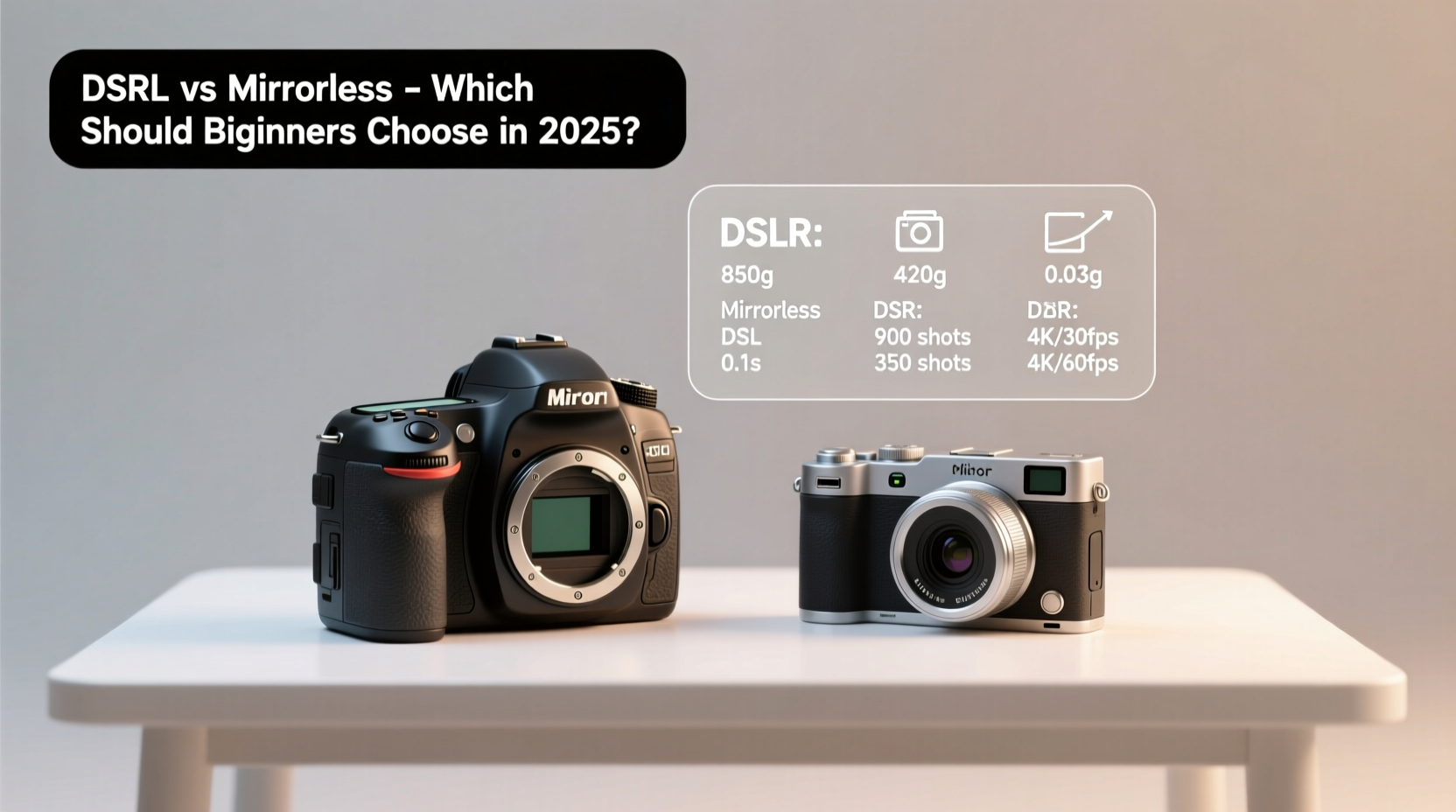
The fundamental distinction between DSLR and mirrorless cameras lies in their internal design. DSLRs (Digital Single-Lens Reflex) use a mirror mechanism to reflect light from the lens up into an optical viewfinder. When you press the shutter, the mirror flips up, allowing light to hit the sensor and capture the image. This system has been the standard for professional photography since the film era.
Mirrorless cameras eliminate the mirror entirely. Light passes directly from the lens to the image sensor, which feeds a live preview to either an electronic viewfinder (EVF) or the rear LCD screen. Without the need for mechanical flipping, mirrorless systems can be smaller, lighter, and faster—especially when shooting video or continuous bursts.
This architectural difference affects more than just size. It influences battery life, autofocus behavior, noise levels, and even how you compose your shots. For example, an EVF shows you exactly what the sensor sees—including exposure and white balance adjustments—before you take the photo. An optical viewfinder, by contrast, gives a pure, lag-free representation of the scene but doesn’t preview settings changes.
Performance Comparison: Speed, Focus, and Video
In 2025, mirrorless cameras hold a clear edge in speed and autofocus intelligence. Most modern mirrorless models use on-sensor phase detection, enabling features like eye-tracking, animal subject recognition, and real-time focus tracking during video recording. These capabilities are now standard even in entry-level models from Sony, Canon, and Nikon.
DSLRs rely on a separate autofocus module beneath the mirror, which works well for stills but struggles with moving subjects and video. Their contrast-detection-based live view focusing tends to hunt and lag, making them less ideal for vlogging, action shots, or fast-paced events like children’s sports.
Video functionality is another area where mirrorless leads decisively. Nearly all new mirrorless cameras support 4K at multiple frame rates, high-bitrate recording, log profiles, and external microphone/headphone jacks—even in beginner-friendly bodies like the Canon EOS R50 or Sony ZV-E10. DSLRs, meanwhile, often cap out at 1080p with limited manual controls, outdated codecs, and no stabilization beyond digital cropping.
“By 2025, choosing a DSLR for video is like buying a DVD player in the streaming age—you’re locking yourself out of current creative workflows.” — Lena Torres, Professional Cinematographer & Educator
Lens Ecosystems and Future-Proofing Your Investment
One argument still cited in favor of DSLRs is their mature lens selection. Canon EF and Nikon F-mount lenses span over 30 years of production, offering vast choices across price points and specialties. But here’s the catch: both companies have largely stopped developing new DSLR lenses. Canon hasn’t released a new EF lens since 2022, and Nikon ended its F-mount DSLR development in 2023.
Conversely, mirrorless lens lines—Canon RF, Nikon Z, Sony E-mount, OM System M.Zuiko, Fujifilm X/GFX—are actively expanding. New primes, zooms, and compact pancake lenses are being introduced annually, often with superior optics, faster apertures, and built-in stabilization.
If you’re starting fresh, building a kit around a mirrorless system ensures access to ongoing innovation. Adapters allow DSLR lenses to work on mirrorless bodies, but not the reverse. That means going mirrorless keeps your options open; starting with a DSLR may limit your upgrade path within five years.
| Feature | DSLR (2025 Status) | Mirrorless (2025 Status) |
|---|---|---|
| New Model Development | Largely discontinued | Active and growing |
| Autofocus (Stills) | Good for static subjects | Excellent, including tracking |
| Autofocus (Video) | Poor to fair | Fast, reliable, intelligent |
| Video Capabilities | Mostly 1080p, limited control | 4K+, log profiles, full manual |
| Battery Life | Longer (300–1200 shots) | Shorter (250–500 shots) |
| Size & Weight | Heavier, bulkier | Compact, travel-friendly |
| Lens Selection Growth | None (legacy only) | Ongoing expansion |
Real-World Learning Curve: Which Helps Beginners Improve Faster?
A camera should do more than take pictures—it should help you understand photography. Mirrorless cameras offer several learning advantages. The electronic viewfinder displays exposure simulation in real time, so you see how changing ISO, aperture, or shutter speed affects brightness before pressing the shutter. This immediate feedback accelerates understanding of exposure fundamentals.
Touchscreens, intuitive menus, and guided user interfaces on models like the Fujifilm X-S20 or Panasonic G100 make navigation easier for newcomers. Many also include in-body image stabilization (IBIS), reducing blur from shaky hands—a common issue for beginners using slower shutter speeds.
DSLRs, while mechanically robust, provide less visual guidance. You must review each shot afterward to assess exposure, increasing trial-and-error cycles. However, some beginners appreciate the tactile precision of physical dials and the clarity of optical viewfinders in bright sunlight—though modern EVFs have closed this gap significantly with high-resolution OLED panels and brightness boosts.
Mini Case Study: Maya’s First Year with a Mirrorless Camera
Maya, a college student interested in street and portrait photography, bought a used Nikon D3500 DSLR in early 2024. She found the optical viewfinder comfortable but struggled with blurry indoor shots and inconsistent exposures. After six months, she traded up to a Sony a6100 mirrorless body with a 35mm f/1.8 lens.
Within weeks, her hit rate improved dramatically. The eye autofocus locked instantly on people, even in crowded markets. The EVF showed her when images were underexposed, helping her adjust settings proactively. She began experimenting with video, creating short documentaries for her journalism class using the camera’s clean HDMI output and mic input.
“I wish I’d started with mirrorless,” she said. “It didn’t just take better photos—it taught me how to take better photos.”
Cost Considerations and Budget-Friendly Paths
On paper, entry-level DSLRs can appear cheaper. Used Canon T7i or Nikon D5600 bodies are widely available for $300–$500. But consider total cost of ownership. Older DSLRs lack modern features like Wi-Fi, touchscreens, or 4K video. Upgrading later may require replacing both body and lenses.
Mirrorless starter kits are now competitively priced. The Canon EOS R100, Sony ZV-E10, and OM System OM-5 all offer strong performance for $400–$700 new. Used mirrorless models from the past three years retain value well due to ongoing demand.
Moreover, many mirrorless systems offer excellent “kit + prime” bundles. Adding a 50mm f/1.8 lens for around $125 dramatically improves low-light capability and background blur (bokeh), giving beginners a tangible leap in image quality without breaking the bank.
Step-by-Step Guide: Choosing Your First Camera in 2025
- Define your primary use: Will you shoot portraits, landscapes, video blogs, sports, or travel? Video-heavy creators should lean mirrorless.
- Set a realistic budget: Include space for a second lens, SD card, extra battery, and basic bag. Aim for $600–$900 total.
- Test ergonomics: Visit a camera store if possible. Does the grip feel secure? Are buttons easy to reach?
- Check lens roadmap: Research whether the brand is still releasing new lenses for the mount. Avoid dead-end systems.
- Buy from trusted sources: Purchase new from authorized dealers or certified refurbished programs to avoid scams.
- Start shooting immediately: Don’t wait for “perfect” conditions. Use automatic modes at first, then gradually switch to manual.
Frequently Asked Questions
Can I use my old DSLR lenses on a mirrorless camera?
Yes, in most cases—with an adapter. Canon, Nikon, and third-party manufacturers make high-quality adapters that preserve autofocus and aperture control. However, autofocus will be slightly slower than native lenses, and you’ll add bulk. It’s a practical bridge, but not a long-term solution.
Do mirrorless cameras wear out faster because of electronic viewfinders?
No. While EVFs consume more power than optical viewfinders, they don’t degrade with normal use. Modern sensors and processors are rated for hundreds of thousands of actuations. Battery life is shorter, but carrying spares solves this easily.
Is a smartphone enough for learning photography?
Smartphones are excellent tools for composition and editing practice, but they lack manual control over aperture, shutter speed, and interchangeable lenses. To truly understand exposure and depth of field, a dedicated camera remains essential.
Final Checklist Before You Buy
- ✅ Decide your main genre: stills, video, or both?
- ✅ Confirm the camera has manual mode (M, A/Av, S/Tv)
- ✅ Ensure it supports SD cards and has a headphone/mic jack if needed
- ✅ Check availability of affordable prime lenses (e.g., 35mm or 50mm f/1.8)
- ✅ Verify firmware is up to date and manufacturer still supports the model
- ✅ Read recent user reviews focusing on reliability and customer service
“The best camera for a beginner is the one they’ll actually use consistently. But in 2025, that camera is almost certainly mirrorless.” — David Kim, Photography Instructor at Pacific Media Arts
Conclusion: Start With Mirrorless, Build With Confidence
The debate between DSLR and mirrorless is no longer balanced. By 2025, mirrorless technology offers better autofocus, superior video, smaller form factors, and a clear path forward through active lens development and firmware updates. While DSLRs aren’t obsolete overnight, they represent a fading chapter in photographic history—one that limits growth rather than enabling it.
Beginners today have unprecedented access to powerful, intuitive tools. Mirrorless cameras lower the barrier to mastery by showing you the results of your decisions in real time, accelerating learning and boosting confidence. They integrate seamlessly with smartphones, cloud storage, and social platforms—where much of modern photography lives.
You don’t need the most expensive model to succeed. What matters is choosing a system that grows with you, supports your curiosity, and stays relevant for years. In 2025, that system is mirrorless.




 浙公网安备
33010002000092号
浙公网安备
33010002000092号 浙B2-20120091-4
Comments
No comments yet. Why don't you start the discussion?