
In an era where smartphones are designed to be sleeker, smarter, and more efficient, the inclusion of dual SIM functionality has become standard across many mid-range and flagship devices. But while manufacturers tout this feature as a major convenience, users are increasingly asking: is it genuinely useful, or does it simply add unnecessary complexity to an already crowded settings menu? For some, dual SIM is a game-changer. For others, it’s a forgotten toggle buried under layers of digital noise. The truth lies somewhere in between — and depends entirely on how you use your phone.
As mobile technology evolves, so do our communication needs. Whether you're juggling personal and professional lives, traveling frequently, or managing multiple data plans, dual SIM capability can offer tangible benefits. Yet, for those who only need one line, the extra settings, labels, and call routing options may feel like digital bloat. This article examines both sides of the debate, offering practical insights, real-world examples, and actionable advice to help you decide whether dual SIM is essential or excess.
The Rise of Dual SIM Technology
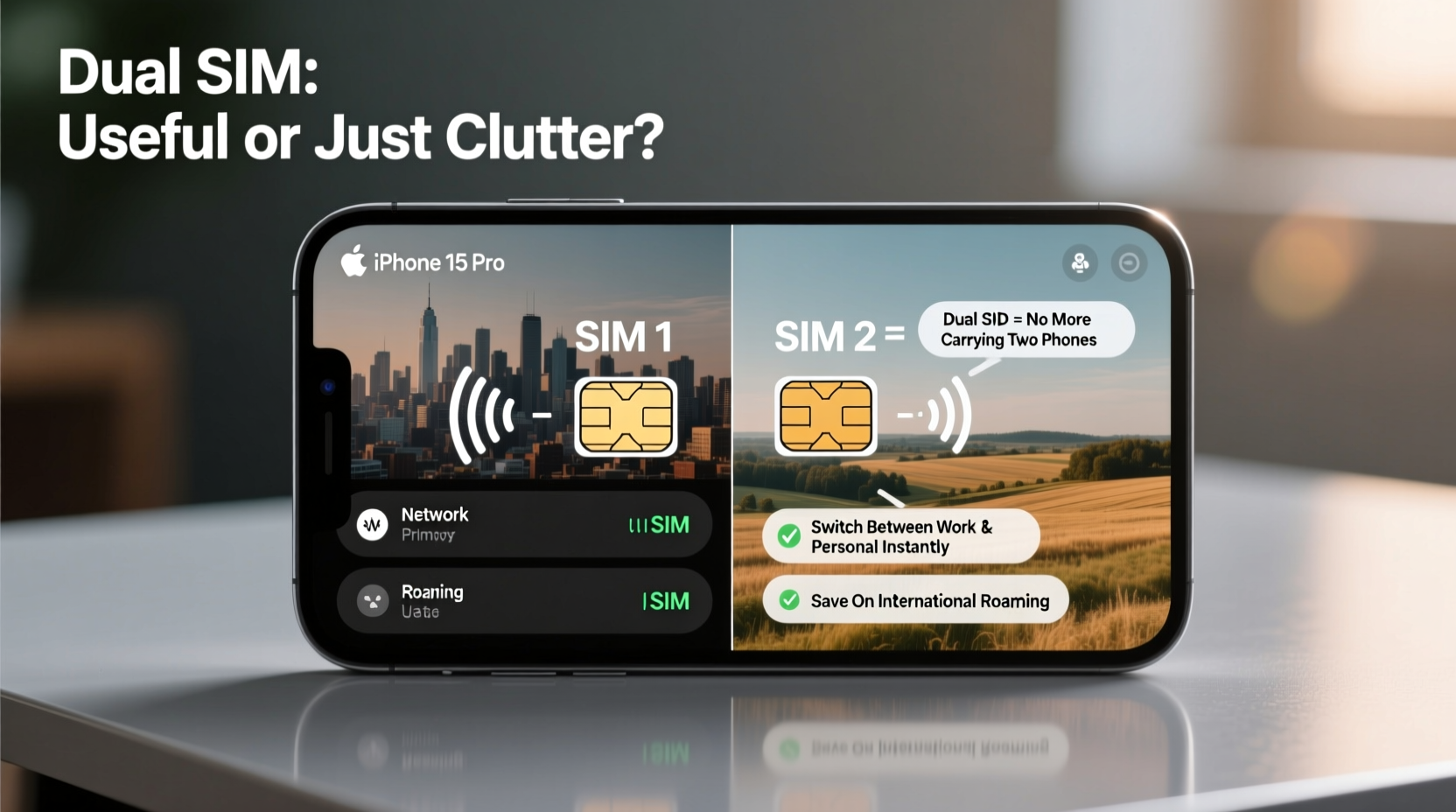
Dual SIM phones were once considered niche devices, primarily popular in emerging markets where carriers offered inconsistent coverage and competitive pricing. Consumers would switch between SIMs to save on calls or access better data rates. Over time, the technology evolved from “dual SIM, single standby” (only one SIM active at a time) to “dual SIM, dual standby” (both SIMs active simultaneously), and now even “dual 5G” support in premium models.
Today, brands like Samsung, Google, Apple, and OnePlus include dual SIM functionality in most new releases — often using a hybrid slot (SIM + microSD) or eSIM + physical SIM combo. This widespread adoption reflects growing demand, but also raises questions about utility. Just because a feature is available doesn’t mean it’s valuable to every user.
According to Statista, over 60% of smartphones shipped globally in 2023 supported dual SIM, with Asia-Pacific leading adoption. However, in North America and Western Europe, usage remains lower, suggesting regional differences in necessity.
Who Actually Benefits From Dual SIM?
Not all users need two phone numbers. But for specific groups, dual SIM isn't just convenient — it's essential.
- Business professionals: Separating work and personal communications avoids mixing contacts, messages, and call logs. With dual SIM, you can assign one number exclusively for clients while keeping your private life off the radar.
- Frequent travelers: Instead of paying high roaming fees, travelers can insert a local prepaid SIM while abroad while keeping their home number active for incoming calls or verification purposes.
- Digital nomads and remote workers: Many rely on local data plans for speed and affordability but still need a stable international number for banking, messaging apps, or VoIP services.
- Users in regions with spotty carrier coverage: In countries like India, Indonesia, or Nigeria, network reliability varies by provider. Having two SIMs allows seamless switching between carriers depending on signal strength.
- Parents sharing a device with teens: Some families use dual SIM to manage separate lines on a single phone, especially when budget constraints limit device ownership.
When Dual SIM Adds Clutter, Not Value
For many average users, dual SIM introduces more confusion than benefit. Consider these common pain points:
- Settings overload: Modern Android and iOS interfaces require navigating multiple menus to configure default SIMs for calls, texts, mobile data, and even app-specific connections.
- Accidental usage: Without careful setup, your phone might route a personal call through your business line — potentially exposing sensitive information or inflating costs.
- Limited hardware space: On phones with hybrid slots, enabling dual SIM means sacrificing expandable storage. Losing microSD support can be a dealbreaker for media-heavy users.
- eSIM complications: While eSIMs eliminate the need for a second physical card, not all carriers support them, and transferring eSIM profiles during device swaps can be tricky.
- Battery drain concerns: Though minimal, maintaining two active connections can slightly reduce standby battery life, particularly on older models.
A 2022 survey by Consumer Reports found that nearly 45% of dual SIM phone owners used only one SIM regularly. Among them, 30% weren’t even aware their phone had dual SIM capability until prompted. This suggests a significant gap between feature availability and actual utility.
“Dual SIM is a powerful tool for the right user, but for most people, it’s like having a spare tire they never check.” — Rajiv Mehta, Mobile Analyst at TechInsight Group
Real-World Example: Maria’s Travel Workflow
Maria, a freelance photographer based in Canada, spends four months each year working in Southeast Asia. Before switching to a dual SIM phone, she relied on roaming — which cost her over $200 monthly in data and call fees. Her solution? A Pixel 7 with eSIM support.
She keeps her Canadian number on her primary SIM for banking, WhatsApp, and family calls. When she arrives in Thailand, she activates a local AIS prepaid eSIM with unlimited 5G data for $15/month. Her phone automatically routes data through the Thai plan while allowing her to receive calls on her home number.
“It’s seamless,” she says. “I get fast internet without burning through my Canadian data cap, and I don’t have to carry two phones. The only learning curve was setting up the defaults correctly.”
Maria’s case illustrates ideal dual SIM usage: clear purpose, geographic mobility, and cost efficiency. For someone like her, the feature isn’t clutter — it’s critical infrastructure.
Comparison Table: Single vs. Dual SIM Use Cases
| Use Case | Single SIM Suitability | Dual SIM Advantage |
|---|---|---|
| Daily personal use | ✔️ Ideal | ❌ Unnecessary complexity |
| Work-life separation | ❌ Risk of mixing contacts | ✔️ Clean division of roles |
| International travel | ❌ High roaming costs | ✔️ Local data + home number |
| Multiple carriers for coverage | ❌ Limited flexibility | ✔️ Switch networks seamlessly |
| Shared device (e.g., parent/teen) | ❌ Privacy issues | ✔️ Separate billing and contacts |
Step-by-Step: Optimizing Your Dual SIM Setup
If you’ve decided to use dual SIM, proper configuration ensures smooth operation. Follow this sequence:
- Insert both SIMs or activate eSIM: Power off the device before inserting physical cards. For eSIM, scan the QR code provided by your carrier.
- Name your SIMs: Go to Settings > Network & Internet > SIMs (Android) or Settings > Cellular (iOS). Label them meaningfully (e.g., “Home,” “EU Data”).
- Set default for calls: Choose which SIM dials out by default. You can also select per-contact preferences if supported.
- Assign SMS defaults: Prevent accidental messaging from the wrong number by locking texts to one line unless manually changed.
- Select mobile data SIM: Only one SIM can provide data at a time. Pick the one with the best plan or strongest signal.
- Enable auto-switch (optional): Some phones allow automatic fallback to the secondary SIM if the primary loses signal.
- Test all functions: Make a test call, send a message, and browse online to confirm everything works as expected.
Checklist: Is Dual SIM Right for You?
Before deciding, answer these questions honestly:
- ✅ Do you regularly use two phone numbers (work/personal, home/abroad)?
- ✅ Have you experienced high roaming charges while traveling?
- ✅ Do you live or travel in areas with poor carrier coverage?
- ✅ Are you willing to manage additional settings and potential confusion?
- ✅ Does your phone’s hybrid slot compromise needed storage?
- ✅ Can your carrier support eSIM if you prefer not to use a second physical card?
If three or more apply, dual SIM likely offers meaningful value. If not, it may be digital overhead with little return.
FAQ: Common Questions About Dual SIM Phones
Can I use two different carriers at the same time?
Yes, dual SIM phones allow two carriers simultaneously. One handles voice/data at a time (depending on configuration), but both remain active for receiving calls and texts.
Does dual SIM drain the battery faster?
Slightly. Maintaining two network connections uses marginally more power, but modern chipsets minimize the impact. Expect no more than a 3–5% reduction in standby battery life.
Is eSIM better than a second physical SIM?
eSIM eliminates the need for a second card tray, freeing space for storage expansion. It also simplifies switching plans. However, not all carriers support eSIM, and recovery after device failure can be slower. Physical SIMs remain more universally compatible.
Conclusion: Utility vs. Complexity
Dual SIM phones aren’t inherently clutter or brilliance — they’re tools shaped by how we use them. For professionals, travelers, and those in multi-carrier environments, the functionality streamlines communication, reduces costs, and enhances privacy. The ability to segment identities on a single device is not just convenient; it’s empowering.
But for the majority of users who stick to one number and rarely leave their home network, dual SIM introduces subtle friction — extra prompts, misrouted calls, and decision fatigue over settings that could otherwise remain untouched. In such cases, the feature sits idle, contributing more to technical debt than daily utility.
The key isn’t whether dual SIM exists, but whether it serves your lifestyle. Technology should adapt to you, not the other way around. If you find yourself toggling between SIMs effortlessly and reaping real benefits, keep it enabled. If you’re ignoring it or frustrated by it, there’s no shame in simplifying.




 浙公网安备
33010002000092号
浙公网安备
33010002000092号 浙B2-20120091-4
Comments
No comments yet. Why don't you start the discussion?