
Folding fitted sheets has long been considered one of the most frustrating household tasks. Unlike flat sheets or pillowcases, their elastic edges and irregular shape seem designed to resist neat folding. But with the right technique, anyone can master this chore in under two minutes. The key isn’t brute force—it’s understanding geometry, using consistent hand placement, and practicing a method that turns chaos into order. Whether you're organizing a linen closet, prepping for laundry day, or simply tired of balling up your sheets, this guide delivers practical, repeatable strategies that work every time.
The Science Behind the Struggle
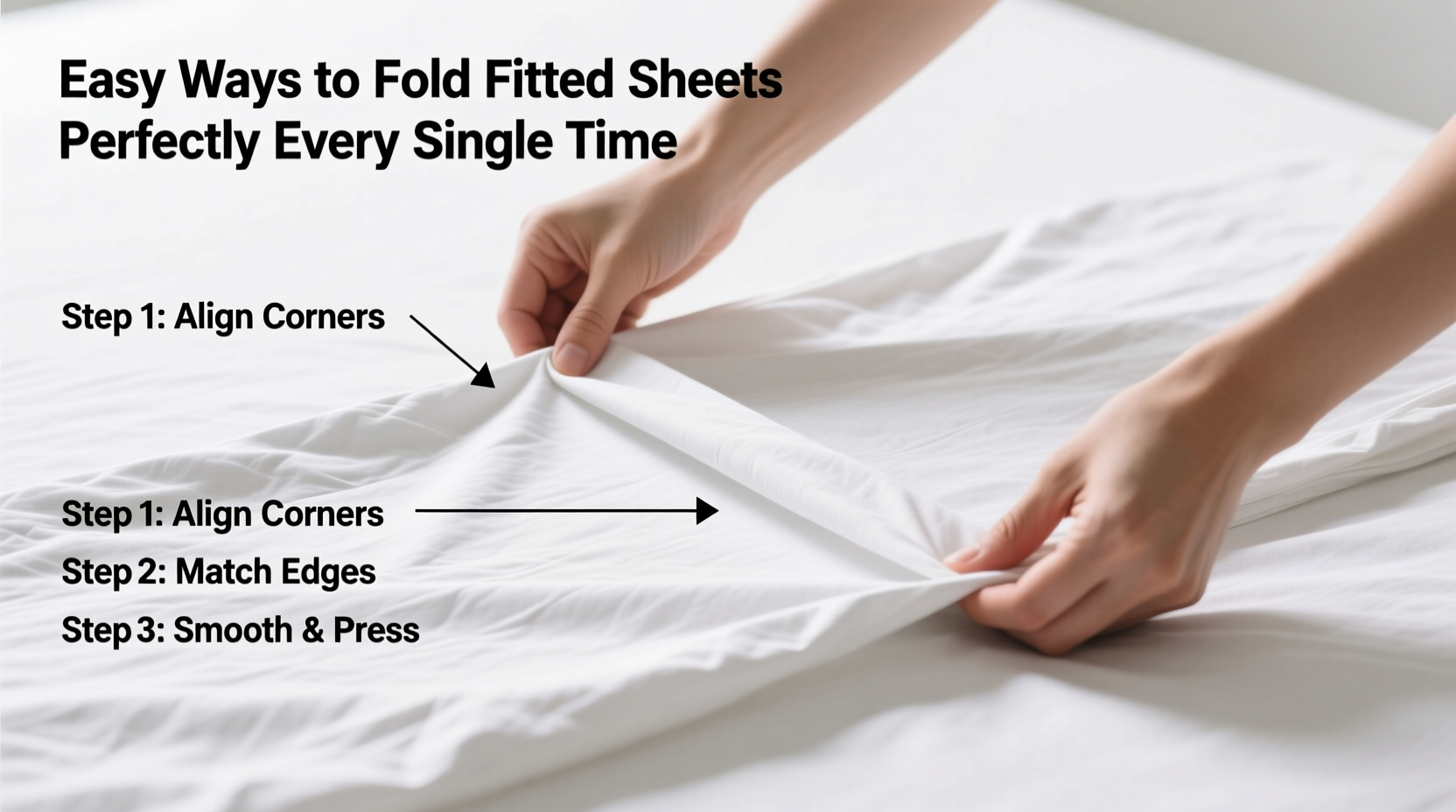
Fitted sheets are challenging because they’re three-dimensional. Their corners stretch outward, held in place by elastic, which naturally resists lying flat. When tossed into a pile or hastily folded, the fabric bunches, twists, and hides its structure. This leads many people to give up and stuff them into drawers haphazardly.
However, the solution lies in reversing the process: start by creating symmetry. By tucking the elasticized corners together, you effectively convert the sheet into a flat rectangle—a shape our brains and hands are wired to handle. Once flattened, standard folding techniques take over. This transformation is what makes all successful methods work.
“Folding a fitted sheet is less about strength and more about precision. It’s like origami for your linen closet.” — Clara Mendez, Home Organization Specialist
Step-by-Step Guide: The Inside-Out Method
This widely praised technique eliminates visual confusion by hiding the messy elastic edges early in the process. It's ideal for beginners and works consistently across twin, queen, and king sizes.
- Hold the sheet lengthwise: Grasp two adjacent corners of the short edge—one in each hand. Make sure the sheet is inside out so the elastic and seams face outward.
- Find the opposite corners: Without twisting the fabric, reach inside the sheet with both hands and grab the two remaining corners on the opposite short edge. Bring them toward the first pair.
- Clip the corners together: Pinch all four corners between corresponding fingers. You should now have a compact bundle with all elastic edges stacked neatly on one side.
- Flip it right-side out: Gently turn the sheet so the outer surface is visible again. Lay it flat on a bed or table if needed.
- Fold into a rectangle: Smooth out any wrinkles. Fold the left and right sides inward to create clean vertical edges.
- Accordion fold: Starting from one end, fold the sheet in thirds or quarters, depending on desired size. Each fold should be crisp but not forced.
Alternative Technique: The Corner-to-Corner Match
If the inside-out method feels awkward, try aligning corners while keeping the sheet right-side out. This approach relies on spatial awareness and careful hand positioning.
- Lay the sheet on a large surface with the top side facing up.
- Place your hands inside the two top corners (the ones at the head of the bed).
- Bring those corners down and over, draping them slightly past the bottom edge.
- Reach for the bottom two corners and lift them upward, tucking them inside the top corners.
- Smooth the entire sheet flat. The elastic will now be nested together.
- Fold vertically once or twice to create straight edges, then horizontally into a neat square.
This method preserves the aesthetic of the sheet during folding and is preferred by hotel staff who value presentation. It requires more space but offers greater control.
Do’s and Don’ts of Fitted Sheet Folding
| Do’s | Don’ts |
|---|---|
| Use a flat surface: Beds or tables provide stability and visibility. | Avoid folding in mid-air; it increases misalignment. |
| Match corners precisely: Ensures even tension and flat results. | Don’t rush corner pairing—this causes bulges later. |
| Fold immediately after drying: Warm fabric is more pliable and less prone to creasing. | Never store damp sheets—they develop mildew and stick together. |
| Pair with matching flat sheet: Store together for easy set retrieval. | Don’t mix sheet sets—colors fade differently over time. |
| Press folds gently: Use palms to smooth, not crush, the fabric. | Avoid aggressive creasing, especially with delicate materials like sateen or bamboo. |
Real Example: From Chaos to Closet Perfection
Sarah, a working mother of three in Portland, used to throw her fitted sheets into a linen cabinet unsorted. “I’d spend five minutes digging for a matching set every other week,” she says. After watching a quick tutorial based on the inside-out method, she practiced during her next laundry cycle. Within two tries, she had folded both a twin and queen-sized sheet neatly.
She now folds each set immediately after removing it from the dryer, pairs it with its matching flat sheet and pillowcases, and stores them together in labeled cotton bags. “My closet looks like a boutique display now,” Sarah shares. “And I haven’t lost a single corner since.”
Her success wasn’t due to special tools or extra time—just consistency and a reliable method. She estimates she saves at least ten minutes per month just by avoiding rummaging and re-folding crumpled bundles.
Expert Tips for Long-Term Success
Mastery doesn't stop at folding. How you maintain and store your sheets determines how easily they’ll stay organized.
“People underestimate how much stress improper folding places on fabric seams. Neat folding distributes tension evenly and extends sheet life by years.” — Dr. Lila Tran, Textile Preservation Researcher
Checklist: Perfect Fitted Sheet Folding Routine
Follow this checklist every time you fold a fitted sheet to build confidence and consistency:
- ✅ Remove sheet from dryer promptly
- ✅ Choose a spacious, flat surface (bed or dining table)
- ✅ Identify top and bottom corners clearly
- ✅ Pair all four corners together (inside-out or corner-to-corner)
- ✅ Smooth out wrinkles before final folds
- ✅ Fold vertically first to create clean edges
- ✅ Complete with horizontal accordion folds
- ✅ Pair with matching flat sheet and cases
- ✅ Store in a cool, dry place away from direct sunlight
- ✅ Label or color-code sets if managing multiple bedrooms
Frequently Asked Questions
Can I fold a fitted sheet without a flat surface?
Yes, but it’s significantly harder. The lack of visual feedback increases the chance of misaligned corners. If folding on the go, drape the sheet over your arms and use touch to match corners before compressing. However, for best results, always use a bed or table when possible.
What if my fitted sheet has deep pockets or extra elastic?
Deep-pocket sheets require extra attention to corner alignment. Hold the first two corners firmly, then insert your hands deeper into the sheet to locate the opposite pair. You may need to adjust grip width, but the folding principle remains unchanged. Some users find gripping the seam rather than the fabric helps maintain control.
Should I iron fitted sheets before folding?
Ironing isn’t necessary unless presentation is critical (e.g., guest rooms or hospitality). Most modern fabrics wrinkle minimally when folded promptly post-dry. If ironing, do so while the sheet is slightly damp and focus only on edges. Excessive heat can degrade elastic over time.
Conclusion: Transform a Chore Into a Habit
Folding fitted sheets perfectly isn’t a rare skill reserved for hotel housekeepers or obsessive organizers. It’s a learnable process grounded in simple mechanics and repetition. Once mastered, it takes less time than putting on socks. More importantly, it brings lasting order to one of the most overlooked corners of home management.
Start today. Pull out a fitted sheet from your drawer—no matter how crumpled—and apply the inside-out method. Do it again tomorrow. In a week, you’ll fold without thinking. In a month, your linen closet will reflect a new standard of care. These small acts of precision accumulate into a calmer, more functional home.




 浙公网安备
33010002000092号
浙公网安备
33010002000092号 浙B2-20120091-4
Comments
No comments yet. Why don't you start the discussion?