
Gifted students possess advanced cognitive abilities, intense curiosity, and a capacity for deep understanding that often sets them apart from their peers. However, traditional classroom structures may fail to challenge or engage them, leading to disengagement, underachievement, or frustration. Differentiated instruction offers a solution by tailoring teaching methods, content, process, and product to meet the unique needs of these learners. When implemented effectively, it empowers gifted students to thrive academically and emotionally.
The goal is not to give more work, but better work—complex, meaningful, and intellectually stimulating. Below are proven strategies and real-world applications of differentiation that educators can use to support gifted learners across grade levels and subjects.
1. Tiered Assignments Based on Readiness and Interest
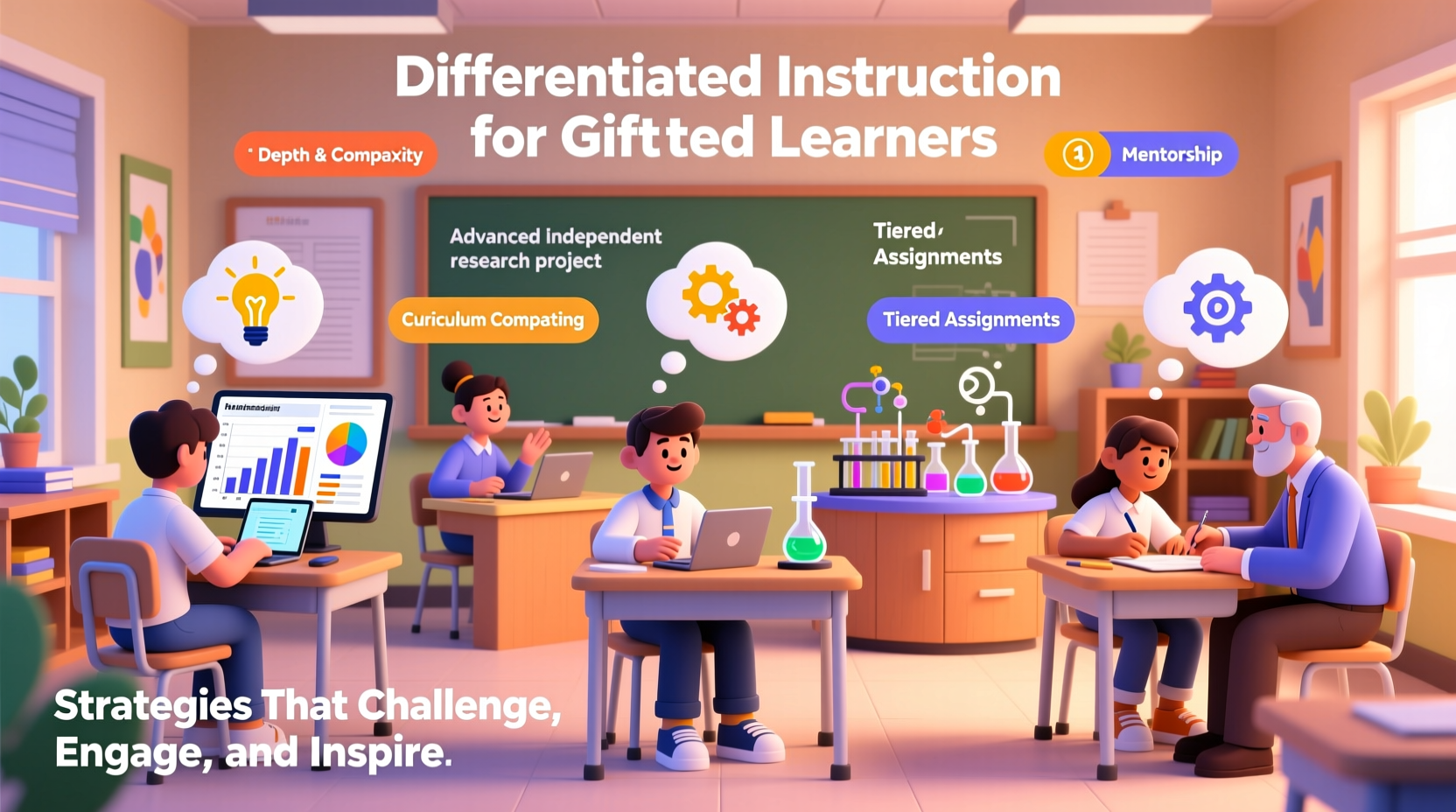
Tiered assignments allow students to explore the same essential concept at varying levels of complexity, depth, or abstraction. For gifted learners, this means engaging with higher-order thinking skills such as analysis, synthesis, and evaluation rather than mere recall.
In a 6th-grade science unit on ecosystems, for example, three tiers might be designed:
- Emerging Level: Identify components of an ecosystem and describe relationships between organisms.
- Proficient Level: Analyze energy flow in food webs and predict outcomes of disruptions.
- Advanced (Gifted) Level: Design a sustainable artificial ecosystem, justify species selection, and model long-term environmental impacts using scientific principles.
This approach ensures that all students access core standards while allowing gifted learners to pursue deeper inquiry without being isolated from their peers.
2. Curriculum Compacting and Acceleration
Curriculum compacting eliminates material that students already know, freeing up time for enrichment or acceleration. This is especially effective for gifted students who master content quickly.
“Curriculum compacting isn’t about doing less—it’s about doing more meaningful work once mastery is demonstrated.” — Dr. Susan Johnsen, Professor of Educational Leadership and Gifted Education
A step-by-step implementation looks like this:
- Pre-assess: Administer a diagnostic test on upcoming material (e.g., fractions in math).
- Exempt: Students scoring above 85–90% bypass redundant lessons.
- Enrich: Redirect time toward independent projects, problem-solving challenges, or advanced topics (e.g., algebraic reasoning).
In one middle school classroom, a student who mastered pre-algebra standards early was allowed to study geometry through an online platform while mentoring peers struggling with foundational concepts—a win-win for both challenge and social-emotional growth.
3. Independent Study Projects with Mentorship
Independent studies empower gifted students to dive deeply into self-selected topics under guided supervision. These projects foster autonomy, research skills, and passion-driven learning.
A 5th grader fascinated by space exploration conducted a six-week investigation on Mars colonization. With teacher guidance, she:
- Researched atmospheric conditions and life-support systems
- Designed a prototype habitat using CAD software
- Presented findings to the school board and local STEM club
The project aligned with science, technology, and communication standards while exceeding grade-level expectations.
4. Flexible Grouping Across Grade Levels and Subjects
Flexible grouping allows gifted students to work with intellectual peers regardless of age. It avoids permanent tracking while providing targeted challenge when needed.
For instance, a district implemented cross-grade math clusters. Fourth-grade students excelling in mathematics joined fifth graders for daily advanced instruction covering ratios, proportions, and early algebra. After two years, participants scored significantly higher on standardized assessments and reported increased motivation.
Effective flexible grouping includes:
- Short-term teams based on skill or interest (e.g., debate club, coding team)
- Subject-specific acceleration (math or language arts only)
- Cluster grouping within classrooms (3–5 gifted students placed together with a trained teacher)
5. Real-World Problem Solving and Socratic Seminars
Gifted learners benefit from open-ended, interdisciplinary challenges that mirror real-world complexity. Socratic seminars and project-based learning invite critical dialogue and deep thinking.
In a high school humanities class, students explored ethical dilemmas in artificial intelligence. They read philosophical texts, analyzed case studies, and participated in a Socratic seminar questioning whether AI should have rights. The discussion required evaluating moral frameworks, synthesizing diverse perspectives, and defending nuanced positions—all hallmarks of advanced cognitive engagement.
| Strategy | Benefits for Gifted Learners | Potential Pitfall |
|---|---|---|
| Tiered Assignments | Maintains peer interaction while increasing rigor | Requires careful planning and assessment alignment |
| Curriculum Compacting | Eliminates redundancy; creates time for enrichment | May be misused as “busy work” if not properly structured |
| Independent Projects | Fosters ownership, creativity, and expertise | Needs ongoing mentorship to stay on track |
| Flexible Grouping | Provides intellectual peer interaction | Can lead to stigma if not normalized across groups |
| Socratic Seminars | Develops analytical and communication skills | Requires strong facilitation to avoid domination by few voices |
Mini Case Study: The Poetry Think Tank
In a mixed-ability 7th-grade English class, four students consistently finished reading and writing tasks early, often expressing boredom. Instead of assigning extra worksheets, the teacher formed a “Poetry Think Tank” during independent work periods.
The group studied modernist poets like T.S. Eliot and Langston Hughes, analyzed literary devices in contemporary lyrics, and composed original poetry exploring identity and social justice. Their final project—a multimedia poetry slam—was shared at a school assembly and later published in the district newsletter.
Teachers observed increased focus during whole-class instruction, likely because students now had something compelling to look forward to. More importantly, the students reported feeling “seen” and challenged for the first time that year.
Checklist: Implementing Differentiation for Gifted Students
To ensure consistent and effective support, educators can follow this actionable checklist:
- ✅ Conduct regular pre-assessments to identify prior knowledge and misconceptions
- ✅ Offer choice in topics, products, and processes to increase engagement
- ✅ Provide opportunities for independent or small-group inquiry
- ✅ Use formative feedback focused on growth, not just correctness
- ✅ Collaborate with specialists (gifted coordinators, librarians, tech teachers) to expand resources
- ✅ Document student progress in portfolios or learning journals
- ✅ Rotate flexible groups regularly to prevent labeling and encourage collaboration
FAQ
Isn’t differentiation just giving gifted students more homework?
No. Effective differentiation emphasizes quality over quantity. It involves modifying the depth, complexity, and pace of learning—not simply adding extra pages or problems. The focus is on meaningful, challenging work that promotes higher-order thinking.
How can I differentiate in a large, mixed-ability classroom?
Start small. Use anchor activities for early finishers, offer tiered exit tickets, or create learning stations with varied task complexity. Technology tools like adaptive learning platforms (e.g., Khan Academy, Newsela) can also help personalize instruction efficiently.
Do gifted students need social-emotional support alongside academic challenge?
Yes. Many gifted students experience perfectionism, anxiety, or feelings of isolation. Differentiation should include opportunities for collaboration, reflection, and emotional check-ins. Pairing academic rigor with a supportive environment leads to holistic development.
Conclusion: Empowering Potential Through Purposeful Teaching
Supporting gifted students isn’t about creating separate tracks or privileging some over others—it’s about equity in action. Every learner deserves instruction that meets them where they are and pushes them forward. Differentiated instruction makes this possible by honoring individual strengths, interests, and readiness levels.
When teachers implement strategies like tiered tasks, curriculum compacting, and independent inquiry, they send a powerful message: your mind matters, your curiosity is valued, and your potential is limitless. Start integrating even one of these approaches today. Observe how engagement shifts, how questions deepen, and how students begin to see themselves not just as learners, but as thinkers, creators, and changemakers.




 浙公网安备
33010002000092号
浙公网安备
33010002000092号 浙B2-20120091-4
Comments
No comments yet. Why don't you start the discussion?