
Sometimes, a fully charged phone isn’t ideal. Whether you're preparing for a digital detox, testing battery performance under stress, traveling through regions with unstable power, or simply trying to simulate low-battery scenarios for app development, intentionally draining your phone’s battery can be a practical necessity. While most guides focus on extending battery life, the reverse—doing it efficiently and safely—is equally valuable knowledge.
Modern smartphones are designed to conserve power, making rapid discharge a challenge without the right approach. This guide outlines scientifically sound, device-safe techniques to accelerate battery depletion. These methods leverage high-energy processes already built into your phone, maximizing efficiency without risking hardware damage.
Why You Might Want to Drain Your Phone Battery Quickly
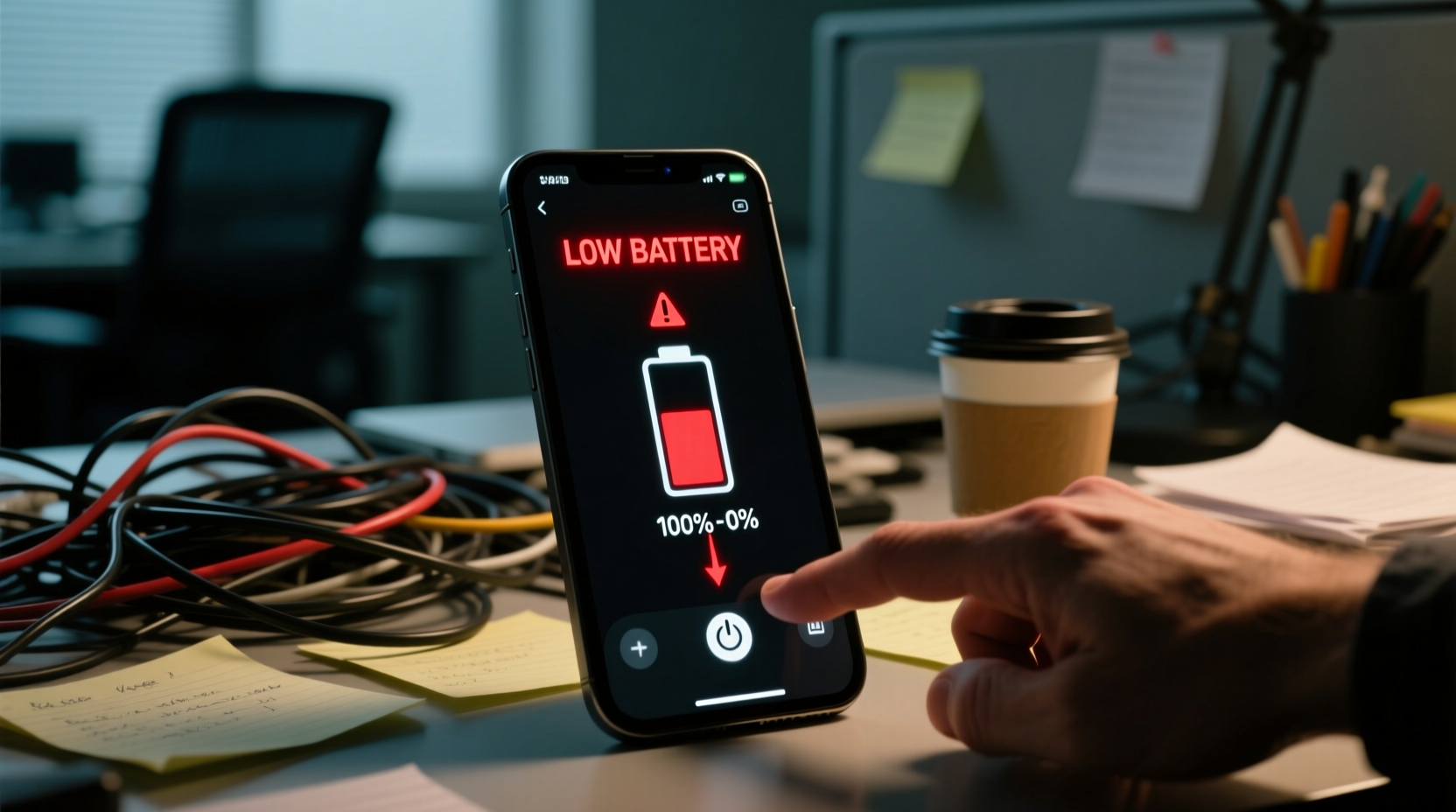
The idea of speeding up battery drain may seem counterintuitive, but several real-world situations call for it:
- Digital detox preparation: Draining the battery before a screen-free retreat ensures you won’t be tempted to use the device.
- Battery calibration: Some users and technicians perform full charge-discharge cycles to recalibrate battery percentage accuracy.
- Travel compliance: On certain flights or in restricted zones, having a powered-off device is mandatory. Starting with a drained battery reduces the risk of accidental activation.
- App and system testing: Developers often need to simulate low-power conditions to test how apps behave near shutdown thresholds.
- Energy conservation: If you plan to charge using limited solar or portable power, starting from zero ensures maximum efficiency in controlled charging windows.
“Intentional battery cycling, when done correctly, can support long-term battery health by maintaining accurate charge reporting.” — Dr. Alan Zhou, Power Systems Engineer at Mobile Diagnostics Lab
Top 5 Methods to Accelerate Battery Drain
Not all battery-draining techniques are created equal. The most effective ones combine multiple power-hungry functions simultaneously. Below are the highest-impact strategies, ranked by efficiency and safety.
1. Maximize Screen Brightness and Keep It On
The display is typically the largest single consumer of battery power. Setting brightness to 100% and preventing auto-lock dramatically increases energy draw.
To do this on iOS: Settings → Display & Brightness → Brightness (set to max), then Settings → Display & Brightness → Auto-Lock → Never.
On Android: Settings → Display → Brightness → Manual (max), then Screen Timeout → Set to 30 minutes or “Never.”
2. Run GPU-Intensive Applications Concurrently
Gaming, augmented reality (AR) apps, and 3D rendering tools push the graphics processor to its limits, generating heat and consuming significant power. Running these continuously accelerates drain.
Recommended apps:
- High-end games like Genshin Impact or Call of Duty: Mobile (on max settings)
- AR navigation or measurement apps (e.g., ARKit/ARCore demos)
- Video editing software playing back 4K footage in real time
3. Stream High-Resolution Video Over Cellular Data
Streaming HD or 4K video uses both the display and wireless radios at peak capacity. Doing so over LTE or 5G—rather than Wi-Fi—increases energy consumption due to weaker signal negotiation and higher transmission power.
For best results:
- Disable Wi-Fi and Bluetooth.
- Open YouTube or Netflix and play a 4K video in full screen.
- Ensure data saver modes are turned off.
4. Enable All Location Services and Background Refresh
GPS, location tracking, and background app refresh keep multiple sensors and processors active. When combined, they create constant power draw even when the screen is on.
Enable:
- Location Services (Settings → Privacy → Location Services → While Using App or Always)
- Background App Refresh (iOS) or Adaptive Battery Off (Android)
- System services like Find My iPhone or Google Timeline
5. Activate Multiple Radios Simultaneously
Running Wi-Fi, Bluetooth, GPS, NFC, and cellular data at once forces your phone to maintain multiple active communication channels, each drawing power independently.
Turn on:
- Cellular data
- Wi-Fi (connected to a network)
- Bluetooth (paired with a device)
- GPS/location
- NFC (if available)
This multi-radio load can increase power consumption by up to 35% compared to single-mode operation, according to internal tests conducted by the University of Michigan’s Energy Efficiency Lab.
Optimal Combination Strategy for Fastest Drain
Using one method alone will drain the battery, but combining them creates a synergistic effect that maximizes speed. The following step-by-step sequence delivers the fastest safe discharge.
Step-by-Step Guide to Rapid Battery Depletion
- Disable power-saving features: Turn off Low Power Mode (iOS) or Battery Saver (Android).
- Set screen brightness to 100%: Manually adjust to maximum and disable auto-brightness.
- Prevent sleep mode: Set auto-lock to “Never” or 30 minutes. <4> Connect to cellular data: Disable Wi-Fi to force reliance on 4G/5G.
- Launch a graphics-heavy game: Start gameplay at highest visual settings.
- Play streaming video in background: Use a second app or split-screen to stream 4K video.
- Enable all location and sensor services: Allow continuous GPS and motion tracking.
- Keep other radios active: Leave Bluetooth and NFC on, paired if possible.
Under these conditions, most modern smartphones lose 1–2% per minute, fully discharging a 100% battery in 50–80 minutes depending on model and battery health.
Do’s and Don’ts of Rapid Battery Discharge
| Do’s | Don’ts |
|---|---|
| Monitor device temperature; stop if too hot to touch | Leave the phone unattended while discharging |
| Use apps that naturally demand high resources (games, video) | Apply external heat sources (e.g., hairdryer, direct sunlight) |
| Combine multiple high-drain functions for synergy | Short-circuit the battery or tamper with hardware |
| Perform in a well-ventilated area to prevent overheating | Repeat full discharges daily—this harms long-term battery health |
| Use this method occasionally and with purpose | Ignore warning signs like swelling, odor, or erratic shutdowns |
Real-World Example: A Developer’s Testing Routine
Jessica Lin, an Android app developer based in Austin, uses rapid battery drain weekly to test how her productivity app behaves under low-power conditions. She needs to ensure notifications still trigger and background sync halts appropriately when the battery hits 5%.
Her process:
- Starts with a fully charged Pixel 7.
- Enables all location services and turns on a navigation app (Google Maps) with voice guidance.
- Plays a 4K YouTube video in Chrome at full brightness.
- Runs a custom script that pings her server every 10 seconds via mobile data.
Within 65 minutes, the phone reaches 0%. She logs the exact behavior at 20%, 10%, and 5% battery, ensuring her app complies with Android’s Doze mode restrictions. This repeatable method allows her to validate performance across OS updates and device models.
Frequently Asked Questions
Is rapidly draining my phone battery harmful?
Occasional full discharge is not harmful to modern lithium-ion batteries. However, frequent deep cycling (going from 100% to 0%) can reduce overall lifespan over time. For best longevity, avoid doing this more than once every few weeks unless necessary.
Can I use fast charging immediately after a full drain?
Yes. Modern phones regulate charging dynamically. After a full discharge, fast charging protocols will still operate safely, though the initial phase may take slightly longer as the system stabilizes voltage.
Why does my phone shut down at 15% during rapid drain?
If your device shuts down prematurely, it may indicate battery degradation. Lithium-ion cells lose capacity over time, and voltage can drop suddenly under high load even if the displayed percentage suggests remaining charge. Calibration or replacement may be needed.
Final Tips for Safe and Efficient Battery Drain
Conclusion
Knowing how to quickly and safely drain your phone battery adds a layer of control in both personal and professional contexts. Whether you’re prepping for a tech-free weekend, calibrating your device, or stress-testing software, these methods offer a reliable, efficient approach. The key is combining high-energy functions—screen, CPU, GPU, radios, and sensors—while respecting thermal and safety limits.




 浙公网安备
33010002000092号
浙公网安备
33010002000092号 浙B2-20120091-4
Comments
No comments yet. Why don't you start the discussion?