
Reading is more than just decoding words on a page—it's about understanding, analyzing, and retaining information. Whether you're a student preparing for exams, a professional absorbing industry reports, or an avid reader seeking deeper engagement with literature, improving your reading skills can transform how you learn and think. Strong comprehension doesn’t come from speed alone; it comes from deliberate practice, active engagement, and strategic techniques. The good news? These skills can be developed by anyone willing to apply consistent, evidence-based methods.
1. Practice Active Reading Techniques
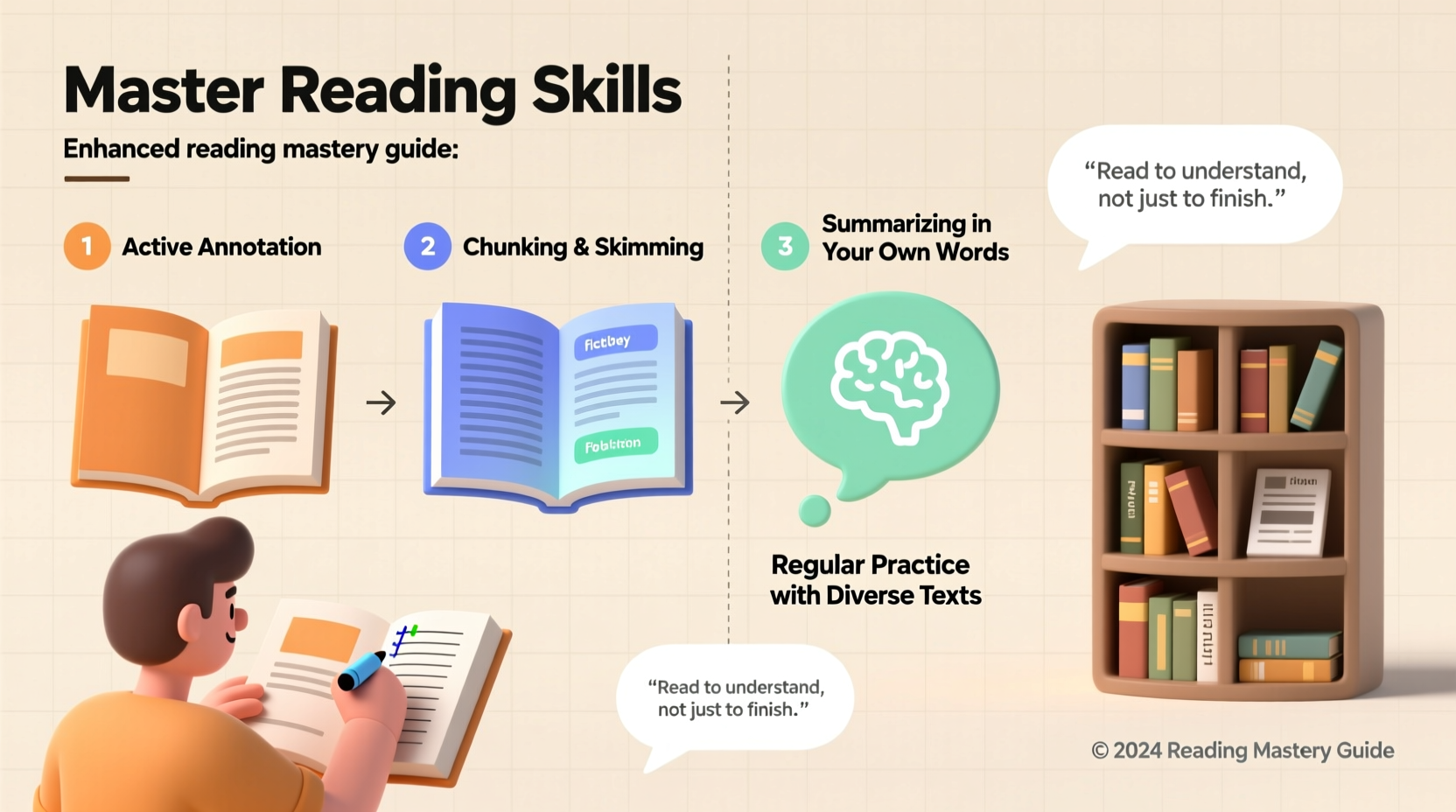
Passive reading—where you simply move your eyes across lines without mental engagement—leads to poor retention and shallow understanding. Active reading, on the other hand, involves interacting with the text through questioning, summarizing, and reflecting.
To become an active reader:
- Annotate as you read: Underline key points, write margin notes, or use sticky tabs to mark important sections.
- Ask questions: Before and during reading, ask: What is the author’s main point? How does this connect to what I already know?
- Summarize paragraphs: After each section, pause and restate the core idea in your own words.
“Active readers don’t just consume text—they interrogate it.” — Dr. Rebecca Thompson, Cognitive Psychologist
2. Expand Vocabulary and Contextual Understanding
A limited vocabulary is one of the biggest barriers to comprehension. When you encounter unfamiliar words, your brain stalls, disrupting flow and meaning. Building a robust vocabulary allows you to grasp nuances, follow complex arguments, and infer meanings from context.
Strategies to grow your vocabulary:
- Read widely across genres: Exposure to diverse writing styles introduces new words naturally.
- Keep a word journal: Record unfamiliar words, their definitions, and example sentences.
- Use context clues: Before reaching for a dictionary, try to deduce the meaning from surrounding sentences.
- Practice daily: Use apps or flashcards to review 5–10 new words per day.
Over time, repeated exposure strengthens retention. You’ll begin recognizing patterns in prefixes, roots, and suffixes, making it easier to decode unfamiliar terms.
3. Adjust Your Reading Speed Based on Purpose
Not all reading should be done at the same pace. Trying to speed-read a dense philosophical text or a technical manual often leads to missed details. Conversely, reading a news article slowly may waste time. Skilled readers modulate their speed based on content type and purpose.
| Reading Purpose | Recommended Speed | Strategy |
|---|---|---|
| Studying (textbooks, research) | Slow to moderate | Read carefully, take notes, summarize |
| Skimming (news, emails) | Fast | Focus on headlines, first/last sentences |
| Pleasure reading (novels, memoirs) | Moderate | Balance enjoyment with reflection |
| Research scanning | Very fast | Look for keywords, subheadings, citations |
Understanding when to slow down or speed up enhances both efficiency and depth of comprehension.
4. Strengthen Focus and Reduce Distractions
In today’s digital world, distractions are constant. Notifications, multitasking, and fragmented attention severely impair reading comprehension. Research shows that even brief interruptions can reduce understanding by up to 30%.
Create an environment conducive to deep reading:
- Choose a quiet space free from noise and visual clutter.
- Turn off phone notifications or use “Do Not Disturb” mode.
- Use tools like website blockers if reading online.
- Set a timer for focused 25-minute sessions (Pomodoro Technique).
Mini Case Study: From Struggling Student to Top Performer
Jamal, a sophomore in college, struggled with dense academic texts. He’d spend hours reading but retain little. After consulting his professor, he began applying active reading strategies: annotating lectures, summarizing each chapter, and using vocabulary flashcards. He also scheduled distraction-free reading blocks in the library.
Within two months, Jamal noticed significant improvements. His essay grades rose from C+ to A-, and he felt more confident participating in discussions. Most importantly, he enjoyed reading again—not as a chore, but as a tool for discovery.
5. Develop Critical Thinking While Reading
True comprehension goes beyond surface-level understanding. It requires evaluating arguments, identifying bias, and connecting ideas across texts. Critical reading transforms passive consumption into intellectual engagement.
Ask yourself these questions while reading:
- What evidence does the author provide?
- Are there logical fallacies or unsupported claims?
- How does this compare to other perspectives on the topic?
- What assumptions underlie the argument?
This habit not only improves comprehension but also sharpens analytical thinking—a skill valuable in academics, careers, and everyday decision-making.
Step-by-Step Guide to Improving Daily Reading Habits
Improvement comes from consistency. Follow this seven-day plan to build stronger reading skills:
- Day 1: Choose a short article or chapter. Read it once silently, then aloud to engage multiple senses.
- Day 2: Highlight only three key sentences. Write a 3-sentence summary.
- Day 3: Identify five unfamiliar words. Define them and use each in a sentence.
- Day 4: Practice skimming: scan a 5-page document and list the main topics covered.
- Day 5: Re-read a previous selection and annotate with questions or reactions in the margins.
- Day 6: Compare two articles on the same topic. Note similarities and differences in argument.
- Day 7: Reflect: What did you learn? How has your understanding improved?
Repeat and expand this routine weekly, gradually increasing complexity and duration.
FAQ
Can reading comprehension be improved at any age?
Yes. Neuroplasticity allows the brain to adapt and improve cognitive skills throughout life. Adults who practice structured reading strategies often see rapid gains in comprehension and retention.
Is speed reading effective for comprehension?
Only in specific contexts. While speed reading works well for scanning or reviewing familiar material, it often sacrifices deep understanding. For complex texts, slower, attentive reading yields better results.
How much should I read daily to see improvement?
Consistency matters more than volume. Aim for 20–30 minutes of focused reading per day. Quality engagement trumps quantity.
Essential Checklist for Better Reading Skills
- ✅ Set a clear purpose before reading (e.g., to learn, critique, enjoy)
- ✅ Eliminate distractions and choose a dedicated reading space
- ✅ Annotate or highlight key ideas
- ✅ Summarize each section in your own words
- ✅ Look up unfamiliar words and record them
- ✅ Ask critical questions about the author’s intent and evidence
- ✅ Review notes within 24 hours to boost retention
Conclusion
Improving your reading skills isn't about quick fixes or magic tricks—it's about adopting disciplined, thoughtful habits that compound over time. From active annotation to vocabulary building, from managing distractions to thinking critically, each strategy adds a layer of depth to your comprehension. The result? Faster learning, sharper thinking, and greater confidence in any field that demands understanding.




 浙公网安备
33010002000092号
浙公网安备
33010002000092号 浙B2-20120091-4
Comments
No comments yet. Why don't you start the discussion?