
Down and synthetic insulated jackets are designed to keep you warm in the harshest conditions, but their ability to pack down into small stuff sacks often leads to long-term compression. When stored compressed for weeks or months—especially after travel or seasonal storage—the insulation loses loft, resulting in reduced warmth and a flat, lifeless appearance. Fortunately, restoring puffiness doesn’t require professional equipment. With careful handling and household tools, you can revive your jacket’s original volume and performance right at home.
Why Compression Affects Insulation Performance
Insulated jackets rely on trapped air within down clusters or synthetic fibers to retain heat. When compressed, these structures collapse. Down feathers lose their three-dimensional structure, clumping together and reducing air pockets. Synthetic insulation, while more resilient, also degrades over time when under constant pressure. The longer a jacket stays compressed, the harder it becomes for fibers to rebound naturally.
According to Dr. Lena Torres, a textile engineer specializing in outdoor gear:
“Prolonged compression causes micro-damage to down barbules and synthetic filaments. While not immediately visible, this reduces thermal efficiency and longevity. Regular restoration helps maintain structural integrity.”
The good news is that most damage from short- to medium-term compression is reversible with proper care.
Step-by-Step Guide to Restore Loft at Home
Reviving your jacket’s puffiness involves mechanical agitation, moisture, and time. Follow this detailed process to maximize results:
- Remove from storage: Take the jacket out of its stuff sack or vacuum-sealed bag. Let it sit uncompressed for 24–48 hours to begin natural recovery.
- Dry on low heat (optional): If the jacket is slightly damp or musty, place it in the dryer on no heat or low heat (<30°C/85°F) with 2–3 clean tennis balls or dryer balls.
- Add motion: The balls bounce inside the drum, breaking up clumps and helping separate compressed fibers.
- Dry thoroughly: Run the cycle for 30–60 minutes. Check every 15 minutes to ensure even fluffing and prevent overheating.
- Manual intervention: Pause the dryer occasionally to shake and massage stubborn clumps by hand.
- Air dry fully: After drying, hang the jacket in a well-ventilated area away from direct sunlight for another 12–24 hours.
- Final shake test: Vigorously shake the jacket upside down and side to side to redistribute filling evenly.
Alternative Methods Without a Dryer
Not everyone has access to a dryer, or their jacket care label may advise against machine drying. Here are effective non-mechanical techniques:
- Shake and fluff daily: For 5–10 minutes each day, vigorously shake the jacket while rotating it. Focus on areas like the shoulders and hem where compression is worst.
- Sun-assisted airing: Hang the jacket outside on a dry, breezy day. Sunlight helps evaporate residual moisture, and airflow encourages fiber separation. Avoid UV overexposure—limit to 2–3 hours.
- Pillow method: Place soft pillows or rolled towels inside the jacket to gently push insulation outward while it rests on a hanger.
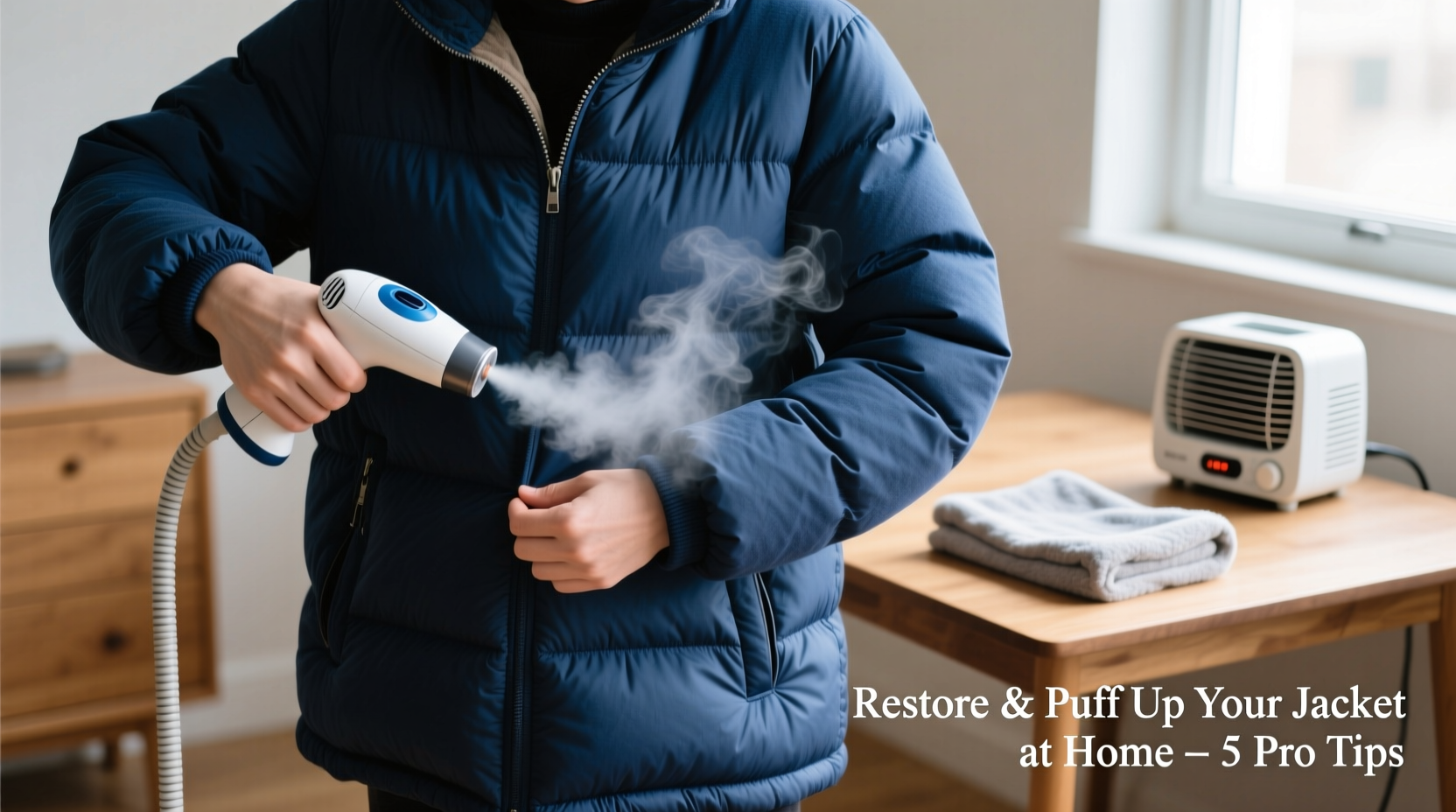
- Steam refresh (for synthetics only): Use a garment steamer on low setting to lightly pass over the fabric. Heat and moisture help relax compressed fibers. Do not saturate the material.
Do’s and Don’ts of Jacket Restoration
| Action | Do | Don't |
|---|---|---|
| Cleaning before restoration | Wash if visibly soiled or musty using a technical cleaner. | Use regular detergent—it strips natural oils in down. |
| Drying method | Low heat with dryer balls for 30+ minutes. | High heat or extended cycles that risk melting fibers. |
| Storage post-restoration | Hang loosely or store in a large cotton sack. | Fold tightly or leave in a compression bag. |
| Handling clumps | Gently massage with fingers to break them apart. | Use sharp objects or excessive force that could tear fabric. |
| Frequency of fluffing | After every extended compression period. | Ignore signs of permanent clumping—act early. |
Real Example: Restoring a Seasonally Stored Down Parka
Mark, an avid hiker from Colorado, stored his premium down parka in a vacuum bag over summer. By winter, the jacket emerged flat and cold to the touch. He followed the dryer method with two wool dryer balls on low heat for 45 minutes, pausing twice to shake and reposition the jacket. After air-drying overnight, he noticed 90% loft recovery. “It didn’t look brand new,” he said, “but the warmth was back, and the shoulders finally puffed up again. I won’t be using vacuum bags anymore.”
This case illustrates that even severely compressed insulation can recover significantly with patience and correct technique.
Preventative Care Checklist
To avoid future compression issues, follow this maintenance checklist:
- ✅ Remove jacket from stuff sack within 24 hours of unpacking.
- ✅ Air out the jacket for at least 12 hours after use or storage.
- ✅ Store in a breathable cotton storage sack—not plastic or vacuum sealed.
- ✅ Hang on a wide, padded hanger to preserve shoulder shape.
- ✅ Wash every 1–2 seasons using down-specific detergent if needed.
- ✅ Perform a quick shake-and-fluff routine monthly during active use.
FAQ: Common Questions About Jacket Loft Recovery
Can a completely flat down jacket regain its puff?
Yes, in most cases. Even after months of compression, down has excellent resilience. With repeated fluffing, drying, and airing, it can recover 80–95% of its original loft—provided the feathers aren’t damaged or degraded by moisture or oil buildup.
How long does it take to restore a compressed jacket?
Initial expansion happens within hours of decompression. Full recovery typically takes 1–7 days depending on method. Using a dryer with balls speeds up the process to under 2 hours. Passive methods may require several days of consistent shaking and airing.
Is it safe to wash my jacket just to restore loft?
Only if necessary. Washing can help reset matted insulation, but frequent washing wears out DWR (durable water repellent) coatings and stresses stitching. If the jacket isn’t dirty, skip washing and focus on mechanical fluffing instead.
Conclusion: Reclaim Warmth and Function with Simple Habits
Your insulated jacket is an investment in comfort and performance. Compression is inevitable, especially with modern lightweight designs built for portability. But neglecting post-compression care undermines both warmth and lifespan. By understanding how insulation responds to pressure—and applying straightforward restoration techniques—you can extend the functional life of your jacket for years.
Start today: pull that compressed coat from the closet, give it a good shake, and commit to better storage habits. Small actions yield big returns in warmth, comfort, and value.




 浙公网安备
33010002000092号
浙公网安备
33010002000092号 浙B2-20120091-4
Comments
No comments yet. Why don't you start the discussion?