
Choosing between a newer mid-range phone and an older flagship can be tricky. The Google Pixel 7a and Samsung Galaxy S22 represent two distinct philosophies in smartphone design: one emphasizes value and software excellence, the other delivers premium performance at a higher initial cost. Now that both devices are available on the open market—often at discounted prices—the real question isn’t just about specs, but long-term satisfaction. Is the Galaxy S22 still a smart purchase in 2024, or has the Pixel 7a rendered it obsolete for most buyers?
Design and Build Quality: Premium Feel vs Practical Durability
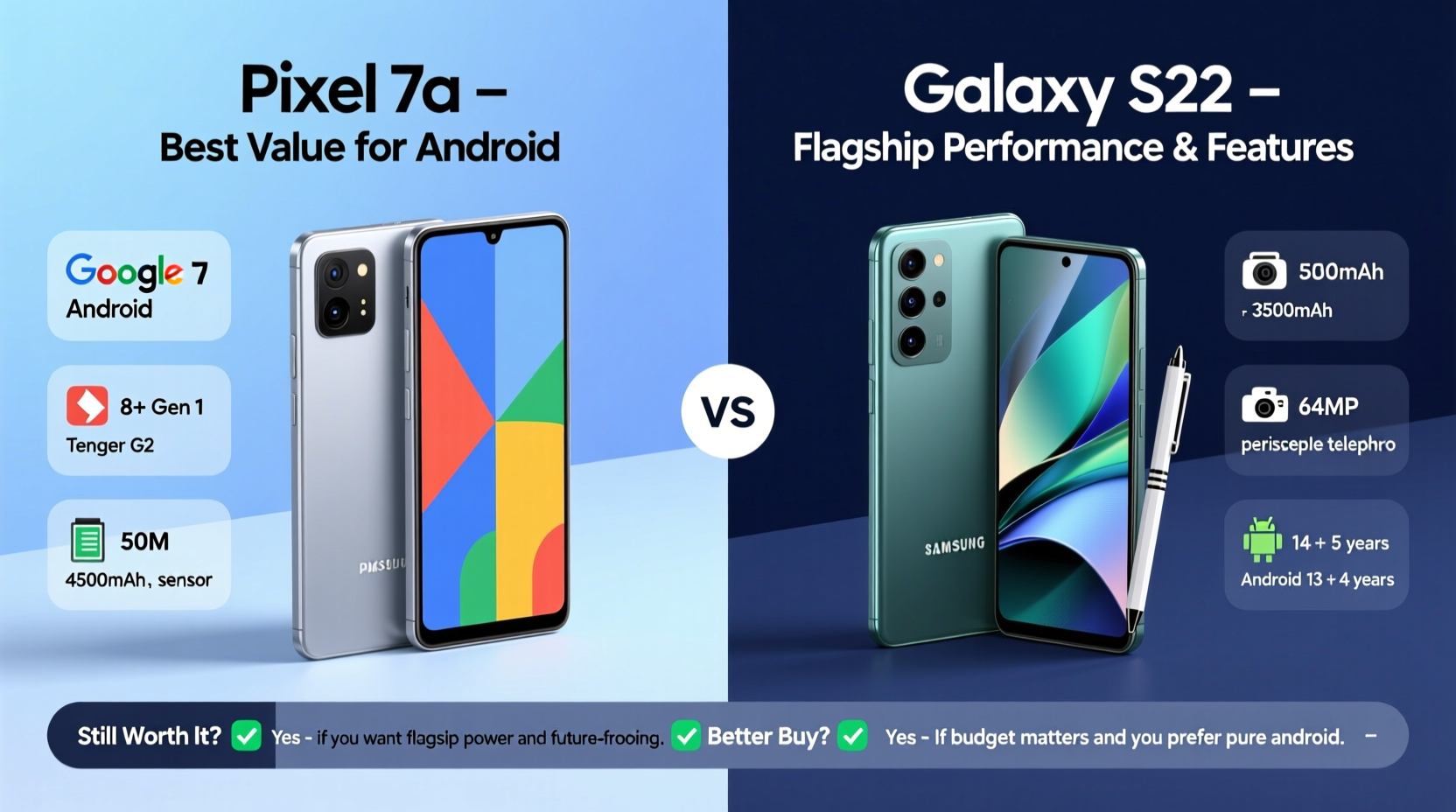
The Galaxy S22 was launched as a compact flagship with a sleek aluminum frame, Gorilla Glass Victus protection, and an IP68 water resistance rating. Its 6.1-inch display fits comfortably in one hand, making it ideal for users who prioritize portability without sacrificing screen quality. The flat display also reduces accidental touches and makes screen protector application easier.
In contrast, the Pixel 7a opts for a polycarbonate (plastic) frame instead of metal, though it retains the same IP67 dust and water resistance. It’s slightly larger at 6.1 inches too, but uses a curved OLED panel that gives it a more modern aesthetic. While some may miss the all-glass back of the S22, the textured matte finish on the 7a resists fingerprints and provides a more secure grip.
Display and Performance: Brightness vs Efficiency
The S22 shines in its display technology. With a peak brightness of up to 1,300 nits and a dynamic 120Hz refresh rate, it handles outdoor visibility and smooth scrolling exceptionally well. The AMOLED panel supports HDR10+ and delivers vibrant colors, making it excellent for media consumption.
The Pixel 7a, while using a high-quality OLED panel from LG, maxes out at around 1,000 nits and sticks with a standard 60Hz–120Hz adaptive refresh rate via LTPO. In direct sunlight, it performs well but not quite at S22 levels. However, Google’s Natural Light and Smooth Display features help optimize viewing comfort over extended use.
Under the hood, the differences widen. The S22 runs on Samsung’s Exynos 2200 (in most regions) or Snapdragon 8 Gen 1 (in the U.S.), both powerful chips capable of handling intensive tasks like gaming and multitasking. The Pixel 7a uses Google’s Tensor G2, which isn’t built for raw speed but excels in AI-driven tasks like speech recognition, photo processing, and voice transcription.
“Flagship processors age differently—Exynos struggled with thermals early on, but after software updates, the S22 remains surprisingly capable.” — David Lin, Mobile Hardware Analyst at TechPulse Weekly
Camera Comparison: Consistency vs Innovation
Camera quality is where preferences diverge sharply. The Galaxy S22 features a dual-camera setup: a 50MP main sensor and a 12MP ultra-wide. Samsung’s processing favors saturation and contrast, producing punchy photos that stand out on social media. Its zoom capabilities, thanks to a dedicated telephoto lens in the S22+, aren't present here, but digital zoom up to 30x is usable in good light.
The Pixel 7a counters with computational photography mastery. Despite having lower megapixel counts—a 64MP main and 13MP ultra-wide—it often produces more natural-looking images, especially in low light. Features like Magic Eraser, Photo Unblur, and Real Tone have become benchmarks in mobile imaging. Video stabilization is also superior, particularly when walking or filming in motion.
For videographers, the S22 supports 4K recording at 60fps with advanced stabilization modes, while the 7a matches this but adds cinematic pans and improved wind noise reduction—thanks again to Tensor’s AI processing.
| Feature | Galaxy S22 | Pixel 7a |
|---|---|---|
| Main Camera | 50MP (f/1.8) | 64MP (f/1.9) |
| Ultra-Wide | 12MP (f/2.2) | 13MP (f/2.2) |
| Front Camera | 10MP (f/2.2) | 13MP (f/2.0) |
| Video Recording | 4K @ 60fps | 4K @ 60fps |
| Night Mode | Solid | Excellent |
| AI Enhancements | Moderate | Extensive (Magic Eraser, etc.) |
Battery Life and Software Support: Longevity Matters
The Pixel 7a packs a 4,385mAh battery compared to the S22’s 3,700mAh. This translates into noticeably longer endurance—often lasting a full day and a half with moderate use. Fast charging is limited to 18W (charger sold separately), but wireless and reverse charging are included.
The S22, despite its smaller battery, benefits from more aggressive power management in One UI. Still, heavy users will likely need to charge by late afternoon. It supports faster 25W charging (adapter not included) and 10W wireless charging.
Software support tilts heavily in favor of the Pixel. Both phones receive four years of OS and security updates, but Google’s updates arrive faster and include exclusive AI features. The Pixel 7a ships with Android 13 and will be eligible for Android 17. The S22, launched with Android 12, will top out at Android 16—assuming Samsung maintains its update promise.
Real-World Example: Choosing Based on Lifestyle
Consider Sarah, a freelance photographer who travels frequently. She initially leaned toward the S22 for its compact size and brand familiarity. But after testing both, she chose the Pixel 7a. “I shoot hundreds of photos a week,” she says, “and the ability to remove photobombers with Magic Eraser saves me hours in post-processing. Plus, the battery lasts through long shoots.”
On the other hand, Mark, a finance professional who values quick app switching and smooth performance during video calls, stuck with the S22. “Even two years later, my apps load instantly. The screen looks incredible during presentations, and I don’t take many photos anyway.”
Their choices highlight a key truth: the “better” phone depends on how you use it.
Step-by-Step Guide: How to Decide Which Phone Suits You
- Evaluate your primary use case: Are you a content creator, casual user, or power multitasker?
- Assess battery needs: Do you regularly run out of charge before bedtime?
- Check camera priorities: Do you prefer automatic excellence (Pixel) or manual control (Samsung Pro mode)?
- Consider long-term ownership: Will you upgrade in 18 months or hold onto it for 3+ years?
- Test in person: Visit a store to compare weight, screen feel, and interface responsiveness.
- Compare current prices: As of 2024, unlocked S22s sell for $350–$400; Pixel 7a starts at $499 new.
Frequently Asked Questions
Is the Galaxy S22 still getting updates?
Yes. The S22 series is guaranteed to receive Android OS upgrades until Android 16 and monthly security patches through 2027, provided Samsung honors its four-year commitment.
Does the Pixel 7a have a headphone jack?
No, neither phone includes a 3.5mm jack. However, the Pixel 7a supports USB-C audio and Bluetooth 5.3 with improved codec compatibility, including LDAC for high-res audio streaming.
Which phone has better speakers?
The S22 edges ahead with louder, more balanced stereo speakers. The 7a’s sound is clear but slightly muffled at maximum volume, particularly in outdoor environments.
Final Verdict: Value vs Prestige
The Galaxy S22 remains a technically impressive device. Its compact form factor, brilliant display, and strong build make it appealing for users who want a no-compromise flagship experience. However, thermal throttling issues with the Exynos chip in early firmware—and ongoing concerns about its longevity under heavy loads—can’t be ignored.
The Pixel 7a, meanwhile, redefines what a $500 phone can do. It doesn’t match the S22 in raw performance or screen brilliance, but it offers longer battery life, superior computational photography, cleaner software, and future-proof update support. For most users, especially those who value AI features, clean Android, and long-term reliability, the 7a is the smarter investment.
If you find the S22 significantly cheaper—under $350—and prioritize screen quality and compactness, it’s still a viable option. But at similar price points, the Pixel 7a delivers more relevant innovation and sustained usability.




 浙公网安备
33010002000092号
浙公网安备
33010002000092号 浙B2-20120091-4
Comments
No comments yet. Why don't you start the discussion?