
In modern product development, speed and alignment are inseparable. The product trio—comprising the product manager, designer, and lead engineer—forms the core decision-making unit in agile teams. When this group operates with shared context and mutual understanding, outcomes improve dramatically. Yet, one of the most persistent challenges is ensuring that insights from research, testing, or iteration are not siloed but actively shared and internalized. Without deliberate practices, critical learnings can remain trapped in individual notes, Slack threads, or meeting summaries, leading to misalignment and repeated mistakes.
Effective knowledge sharing isn’t about broadcasting information—it’s about creating shared understanding. This article explores practical, battle-tested methods to ensure that every learning captured by one member of the product trio becomes a collective asset.
1. Embed Learning Sharing into Your Workflow Rhythm
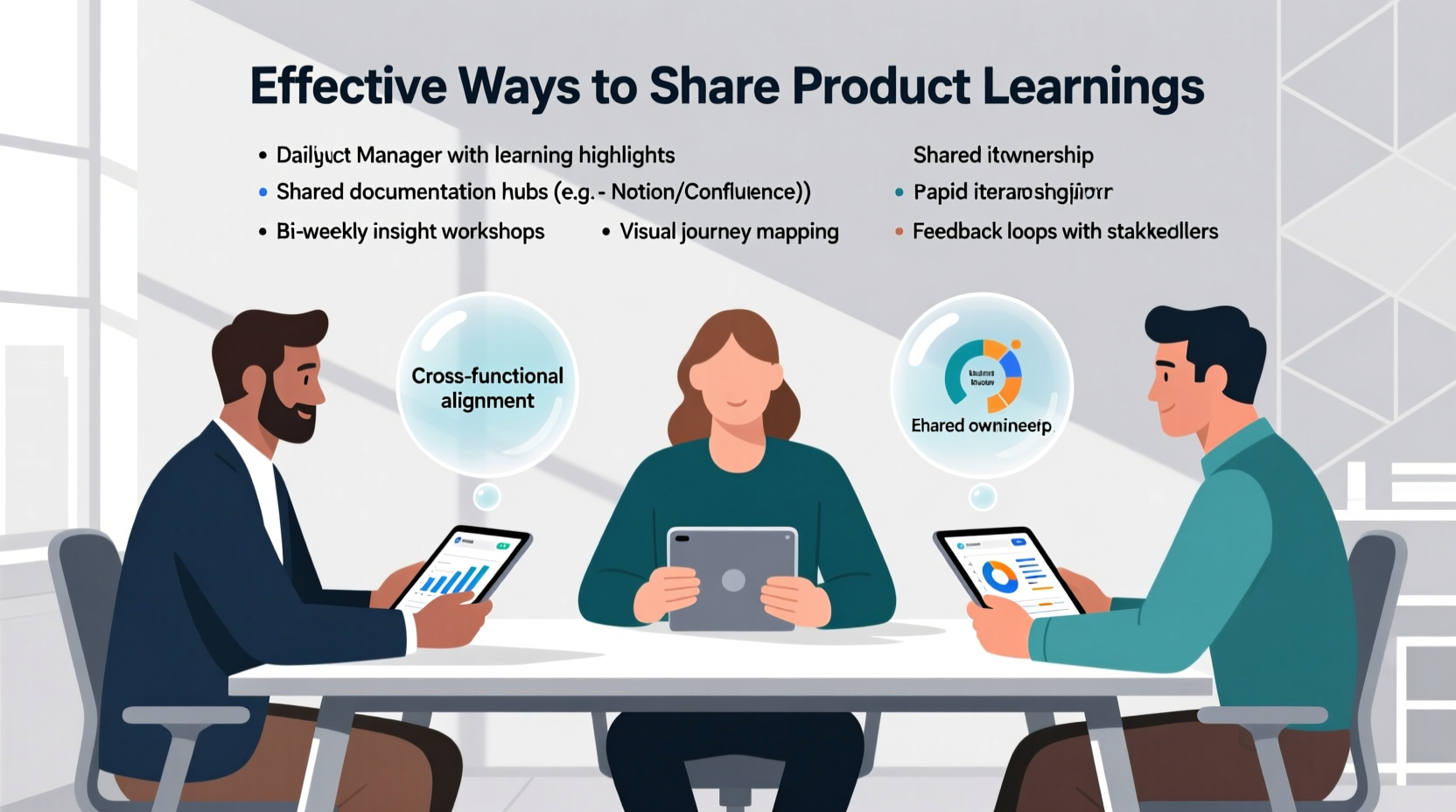
Ad hoc sharing leads to inconsistent retention. Instead, integrate learning dissemination into existing rituals such as sprint planning, backlog refinement, and retrospectives. These recurring events provide natural touchpoints where new insights can be surfaced, discussed, and acted upon.
For example, begin each sprint review with a “Learning Snapshot” segment—two to three minutes where one team member shares a key insight from user interviews, analytics, or technical exploration. Rotate ownership weekly so all voices contribute. Over time, this builds a culture where discovery is treated as equally important as delivery.
2. Create a Centralized, Living Knowledge Hub
Relying on memory or scattered documents undermines alignment. Establish a single source of truth—a shared digital space (like Notion, Confluence, or Google Drive) where all product learnings are documented consistently and made searchable.
This hub should include:
- User research summaries with direct quotes
- Usability test observations
- A/B test results and interpretation
- Technical constraints discovered during implementation
- Competitive analysis updates
The goal is not comprehensive documentation, but just enough structure to make knowledge accessible and actionable. Use tags like #usability-issue, #technical-limitation, or #user-motivation to help team members filter relevant insights quickly.
“We stopped having ‘surprise discoveries’ in design critiques once we started logging every usability observation in our shared Notion page. It changed how we collaborate.” — Lena Torres, Senior Product Designer at SaaSFlow Inc.
3. Run Structured Insight Workshops
Raw data doesn’t become insight without synthesis. Schedule biweekly insight workshops where the trio comes together to analyze recent findings—not just to report them, but to interpret and align on implications.
A typical 60-minute session might follow this timeline:
- Preparation (before): Each member contributes 1–2 key observations via a shared template.
- Individual Reflection (5 min): Read inputs silently and note reactions.
- Group Sense-Making (30 min): Discuss patterns, contradictions, and surprises. Ask: “What does this mean for our next steps?”
- Action Alignment (20 min): Decide on immediate changes to roadmap, design, or architecture.
- Capture (5 min): Update the knowledge hub with decisions and rationale.
These sessions prevent assumptions from hardening into beliefs and ensure that decisions are grounded in shared evidence.
4. Use Visual Mapping to Align Perspectives
Different roles interpret learnings through different lenses. A designer may focus on emotional friction, an engineer on system complexity, and a PM on business impact. To bridge these perspectives, use collaborative visual tools like journey maps, problem trees, or opportunity solution trees.
For instance, after conducting five user interviews, the trio can co-create a journey map highlighting pain points, emotional highs and lows, and moments of confusion. This exercise surfaces divergent interpretations early and fosters empathy across disciplines.
| Tool | Purpose | Best For |
|---|---|---|
| Journey Map | Visualize user experience over time | Identifying friction points across flows |
| Opportunity Solution Tree | Link problems to potential solutions | Aligning on root causes vs symptoms |
| Impact-Effort Matrix | Prioritize actions based on learning | Deciding what to act on immediately |
These visuals become living artifacts—updated as new learnings emerge—and serve as reference points during planning discussions.
5. Foster Psychological Safety for Honest Sharing
No process works if team members fear judgment for sharing incomplete or negative findings. One engineer might hesitate to admit a performance bottleneck; a designer may downplay poor usability test results. Without psychological safety, learnings get filtered or softened, distorting reality.
To build trust:
- Normalize “failure debriefs” where technical or design setbacks are reviewed without blame.
- Publicly acknowledge when assumptions were wrong—leadership sets the tone.
- Use neutral language: say “our hypothesis was incorrect” instead of “you were wrong.”
Mini Case Study: How a Fintech Trio Improved Decision Speed by 40%
A fintech startup struggled with repeated rework. The PM launched a feature based on market data, the designer created a seamless flow, and the engineer implemented it—only to discover in beta testing that users didn’t understand the core value proposition.
The trio introduced two changes:
- They began hosting weekly 30-minute “Learning Syncs” where each member shared one user or technical insight.
- They built a simple Notion dashboard tracking key hypotheses and their validation status.
Within six weeks, they caught a critical misunderstanding about user financial literacy before writing any code. By aligning early on behavioral insights, they reduced pivot cycles and accelerated feature validation. Stakeholders noted a marked improvement in team cohesion and clarity.
Checklist: Building a Learning-Sharing Practice
Use this checklist to assess and strengthen your trio’s knowledge-sharing habits:
- ✅ Hold regular, dedicated time for sharing new learnings (e.g., weekly sync)
- ✅ Maintain a centralized, searchable knowledge repository
- ✅ Document not just findings, but their implications for decisions
- ✅ Use visual models to align cross-functional interpretations
- ✅ Rotate responsibility for synthesizing and presenting insights
- ✅ Normalize discussing invalidated assumptions without blame
- ✅ Link learnings directly to backlog items or OKRs
FAQ
How do we avoid turning learning sharing into another meeting burden?
Keep sessions short and outcome-focused. Replace low-value status updates with insight exchanges. For example, cut a 15-minute progress report from your standup and use it for a “learning highlight” instead. Focus on quality, not quantity—share only what changes decisions.
What if one member resists participating in knowledge sharing?
Start small. Invite them to share just one insight per week. Highlight how past learnings prevented rework or improved outcomes. Connect the practice to their goals—e.g., fewer last-minute design changes benefit engineers too. Lead with curiosity, not compliance.
Should stakeholders outside the trio have access to our learning logs?
Yes—but with curation. Share a distilled version of key insights with broader stakeholders to maintain transparency. Keep raw notes internal to encourage candid documentation. Consider a monthly “Insights Digest” email summarizing validated assumptions, invalidated bets, and strategic shifts.
Conclusion: Turn Learning Into Leverage
The product trio’s strength lies not in individual brilliance, but in collective intelligence. Every user interview, prototype test, or deployment teaches something valuable—if that knowledge is shared and acted upon. By institutionalizing simple, human-centered practices, teams transform isolated insights into shared wisdom.
Alignment doesn’t happen by accident. It’s built through consistent, intentional communication. Start today: pick one method from this article—be it a learning snapshot, a shared doc, or a visual map—and run it with your trio. Observe how conversations shift, how decisions gain confidence, and how trust deepens. Small habits compound into powerful advantages.




 浙公网安备
33010002000092号
浙公网安备
33010002000092号 浙B2-20120091-4
Comments
No comments yet. Why don't you start the discussion?